seamus dubhghaill

Promoting Irish Culture and History from Little Rock, Arkansas, USA


1 Comment

John Philip Nolan Wins Co. Galway By-Election

john-philip-nolan

Captain John Philip Nolan, an Irish nationalist landowner and a supporter of home rule and tenant rights, defeats Conservative William Le Poer Trench on February 8, 1872, in a County Galway by-election. He serves in the House of Commons of the United Kingdom of Great Britain and Ireland and as member of the Irish Parliamentary Party representing Galway County (1872–1885) and Galway North (1885–1895, 1900–1906).

Nolan is the eldest son of John Nolan, Justice of the Peace, of Ballinderry, Tuam, and Mary Anne, Walter Nolan, of Loughboy. He receives his education at Clongowes Wood College, Stonyhurst, Trinity College, Dublin, the Staff College, Camberley and Woolwich. He enters the British Royal Artillery in 1857 and serves throughout the 1868 Expedition to Abyssinia. As adjutant to Colonel Milward, he is present at the capture of Amba Mariam (then known as Magdala) and is mentioned in dispatches. He is awarded the Abyssinian War Medal and retires from the Army with the rank of lieutenant-colonel in 1881.

Nolan becomes involved in the nascent home rule campaign of the Home Rule League. On February 8, 1872, he is elected MP for Galway County in a by-election, defeating by a large majority the Conservative William Le Poer Trench. Of the 4,686 available electors, who are chiefly Catholic, 2,823 vote for Nolan and 658 for Trench.

Trench appeals the result, claiming on petition that there is widespread intimidation during the election campaign. The local Catholic bishops and clergy had strongly supported Nolan, chiefly because the family of his opponent, a Captain Trench, was active in proselytism. The trial of the Galway County Election Petition begins, before Judge William Keogh, on April 1 and ends on May 21, 1872.

Judge Keogh finds that Nolan had been elected by the undue influence and intimidation and in his report states that he found 36 persons guilty of undue influence and intimidation, including John MacHale, the Archbishop of Tuam, the Bishop of Clonfert, Patrick Duggan, and the Bishop of Galway, John McEvilly, and twenty-nine named priests, such intimidation being in some cases exercised in the very churches. As a result, Nolan is unseated on June 13, with the seat going to Trench. The judgement causes an uproar. The judge is threatened with removal from the bench and his reputation never recovers.

Nolan retakes the seat at the 1874 election. He remains MP after the 1885 constituency reforms as MP for Galway North until 1895.

When the Irish Parliamentary Party splits over Charles Stewart Parnell‘s long-term family relationship with Katharine O’Shea, the separated wife of a fellow MP, Nolan sides with his deposed leader and seconds the motion to retain Parnell as chairman at the ill-fated party meeting in Committee Room 15 of the House of Commons. He goes on to become whip of the pro-Parnellite rump of the split party, the Irish National League. He loses the Galway North seat to an Anti-Parnellite, Denis Kilbride, in 1895 and stands unsuccessfully as a Parnellite for South Louth in 1896. He is re-elected unopposed at Galway North after the reunification of the Parliamentary Party in 1900 but loses the seat again for the final time in 1906 when he stands as an Independent Nationalist.

Leave a comment

The Brighton Hotel Bombing

The Brighton hotel bombing, a Provisional Irish Republican Army (IRA) assassination attempt against the top tier of the British government, takes place on October 12, 1984, at the Grand Brighton Hotel in Brighton, England. A long-delay time bomb is planted in the hotel by IRA member Patrick Magee, with the intent of killing Prime Minister Margaret Thatcher and her cabinet, who are staying at the hotel for the Conservative Party conference. Although Thatcher narrowly escapes injury, five people are killed including a sitting Conservative MP, and 31 are injured.

Patrick Magee stays in the hotel under the pseudonym Roy Walsh during the weekend of September 14-17, 1984. During his stay, he plants the bomb under the bath in his room, number 629. The device, described as a “small bomb by IRA standards,” is fitted with a long-delay timer made from videocassette recorder components and a Memo Park Timer safety device. The device may have avoided detection by sniffer dogs due to it being wrapped in cling film to mask the smell of the explosive.

The bomb detonates at approximately 2:54 AM (BST) on October 12. The midsection of the building collapses into the basement, leaving a gaping hole in the hotel’s facade. Firemen say that many lives are likely saved because the well-built Victorian hotel remained standing. Margaret Thatcher is still awake at the time, working on her conference speech for the next day in her suite. The blast badly damages her bathroom but leaves her sitting room and bedroom unscathed. Both she and her husband escape injury. She changes her clothes and is led out through the wreckage along with her husband and her friend and aide Cynthia Crawford and driven to Brighton police station.

At about 4:00 AM, as Thatcher leaves the police station, she gives an impromptu interview to the BBC‘s John Cole, saying that the conference would go on as scheduled. Alistair McAlpine persuades Marks & Spencer to open early at 8:00 AM so those who have lost their clothes in the bombing can purchase replacements. Thatcher goes from the conference to visit the injured at the Royal Sussex County Hospital.

Five people are killed, none of whom are government ministers. But a Conservative MP, Sir Anthony Berry, is killed, along with Eric Taylor, North-West Area Chairman of the Conservative Party, Lady Jeanne Shattock, wife of Sir Gordon Shattock, Western Area Chairman of the Conservative Party, Lady Muriel Maclean, wife of Sir Donald Maclean, President of the Scottish Conservatives, and Roberta Wakeham, wife of Parliamentary Treasury Secretary John Wakeham. Donald and Muriel Maclean are in the room in which the bomb explodes, but Mr. Maclean survives.

Several more, including Walter Clegg, whose bedroom is directly above the blast, and Margaret Tebbit, the wife of Norman Tebbit, who is then President of the Board of Trade, are left permanently disabled. Thirty-four people are taken to the hospital and recover from their injuries. When hospital staff asks Norman Tebbit, who is less seriously injured than his wife, whether he is allergic to anything, he is said to answer “bombs.”


Leave a comment

William Smith O’Brien Pardoned from Deportation

william-smith-obrien

William Smith O’Brien, leader of the Young Ireland Rebellion of 1848, is pardoned from his deportation to Van Diemen’s Land on February 26, 1854, on the condition of exile from Ireland.

From April 1828 to 1831 O’Brien serves as Conservative MP for Ennis. He becomes MP for Limerick County in 1835, holding his seat in the House of Commons until 1849.

Although a Protestant country-gentleman, O’Brien supports Catholic Emancipation while remaining a supporter of British-Irish union. In 1843, in protest against the imprisonment of Daniel O’Connell, he joins O’Connell’s anti-union Repeal Association.

Three years later, O’Brien withdraws the Young Irelanders from the association. In January 1847, along with Thomas Francis Meagher, he founds the Irish Confederation, although he continues to preach reconciliation until O’Connell’s death in May 1847. He is active in seeking relief from the hardships of the famine. In March 1848, he speaks out in favour of a National Guard and tries to incite a national rebellion. He is tried for sedition on May 15, 1848, but is not convicted.

On July 29, 1848, O’Brien and other Young Irelanders lead landlords and tenants in a rising in three counties, with an almost bloodless battle against police at Ballingarry, County Tipperary. In O’Brien’s subsequent trial, the jury finds him guilty of high treason. He is sentenced to be hanged, drawn, and quartered. Petitions for clemency are signed by 70,000 people in Ireland and 10,000 people in England.

In Dublin on June 5, 1849, the sentences of O’Brien and other members of the Irish Confederation are commuted to transportation for life to Van Diemen’s Land, which is Tasmania in present-day Australia.

O’Brien attempts to escape from Maria Island off Tasmania but is betrayed by Captain Ellis of the schooner hired for the escape. He is sent to Port Arthur where he meets up with John Mitchel, who had been transported prior to the rebellion. The cottages which O’Brien lives in on Maria Island and Port Arthur have been preserved in their 19th century state as memorials.

Having emigrated to the United States, Ellis is tried by another Young Irelanders leader, Terence MacManus, at a lynch court in San Francisco for the betrayal of O’Brien. He is freed for lack of evidence.

In 1854, after five years in Tasmania, O’Brien is released on the condition he never return to Ireland. He settles in Brussels. In May 1856, he is granted an unconditional pardon and returns to Ireland that July. He contributes to The Nation newspaper but plays no further part in politics.

In 1864 he visits England and Wales, with the view of rallying his failing health, but no improvement takes place, and he dies at Bangor, Wales on June 16, 1864.


Leave a comment

Birth of Richard Southwell Bourke, 6th Earl of Mayo

richard-southwell-bourke

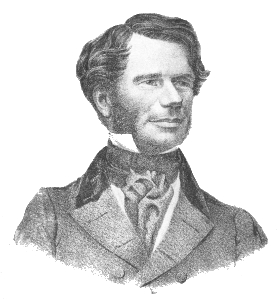
Richard Southwell Bourke, 6th Earl of Mayo, statesman, Viceroy of India, and prominent member of the British Conservative Party from Dublin, is born in Dublin on February 21, 1822.

Mayo is the eldest son of Robert Bourke, 5th Earl of Mayo, and his wife, Anne Charlotte, daughter of the Hon. John Jocelyn. His younger brother, the Hon. Robert Bourke, is also a successful politician. He is educated at Trinity College, Dublin.

After travelling in Russia, Mayo enters parliament for Kildare in 1847, a seat he holds until 1852, and then represents Coleraine from 1852 to 1857 and Cockermouth from 1857 to 1868. He is thrice appointed Chief Secretary for Ireland – in 1852, 1858, and 1866. In 1869 he becomes the fourth Viceroy of India where he is locally often referred to as “Lord Mayo.” He consolidates the frontiers of India and reorganises the country’s finances. He also does much to promote irrigation, railways, forests, and other useful public works. He establishes local boards to solve local problems. During his tenure, the first census takes place in 1872. The European-oriented Mayo College at Ajmer is founded by him for the education of young Indian chiefs, with £70,000 being subscribed by the chiefs themselves.

While visiting the convict settlement at Port Blair in the Andaman Islands in 1872 for the purpose of inspection, he is assassinated by Sher Ali Afridi, an Afridi Pathan convict who uses a knife. His murderer appears to be motivated only by a sense of injustice at his own imprisonment and has resolved to kill a high-ranking colonial official. Mayo’s body is brought home to Ireland and buried at the medieval ruined church in Johnstown, County Kildare, near his home at Palmerstown House. Afridi is hanged.

In 1873, the newly discovered swallowtail butterfly Papilio mayo from the Andaman Islands is named in his honour. The traditional Irish march Lord Mayo (Tiagharna Mhaighe-eo) is named after him. According to tradition, it is composed by his harper David Murphy to appease Mayo after Murphy angered him.

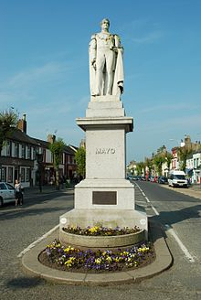
lord-mayo-statue

On August 19, 1875, a statue of Lord Mayo is unveiled in the town of Cockermouth in the centre of the main street. The 800-guinea cost of the statue is raised by public subscription. The statue, carved in Sicilian marble, depicts Lord Mayo in his viceregal garb, and still stands today.

In 2007, a statue of Lord Mayo is unearthed in Jaipur, India, after being buried for six decades. The statue had previously been installed in the premises of Mayo Hospital, currently known as the Mahilya Chikatsalya, Jaipur. The 9-foot-tall cast-iron statue, weighing around 3 tons, was ordered sculpted by the Maharaja Ram Singh ji of Jaipur, as a tribute to Lord Mayo after his assassination. To prevent it from vandalism, the statue is buried in the premises of the Albert Hall Museum of Jaipur at the time of the independence of India. After six decades, the statue is unearthed by the Jaipur Mayo Alumni Chapter on May 29, 2007, and sent to Mayo College, in Ajmer, India, where it is installed. Mayo College in Ajmer already has a full life-size statue of Lord Mayo sculpted in white marble installed in front of its famous Main Building since inception and a marble sculpted bust of him in its School Museum.