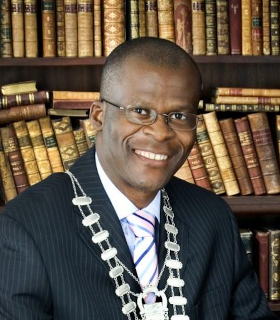
Adebari arrives in Dublin with his wife and two children in 2000. After he converts from Islam to Christianity, he flees Nigeria in 2000, and makes a claim for asylum on the grounds of religious persecution. His application is rejected because of a lack of evidence that he had personally suffered persecution. He does however gain automatic residency when his wife gives birth to a son in Ireland shortly after their arrival.
Adebari and his family settle in County Laois. He completes his master’s degree in intercultural studies at Dublin City University (DCU) and sets up a firm called Optimum Point Consultancy.
In 2004, Adebari is elected as a town councilor in local elections. On June 27, 2007, at the age of 43, he is elected mayor of the 9-member Portlaoise Town Council, by a vote of six to three and with support from Fine Gael, Sinn Féin and an Independent councilor. At a meeting attended by officials from the Nigerian, South African, and the United States embassies, the new mayor is quoted as saying his election is proof that “Ireland is not just a country of a thousand welcomes, but it is a country of equal opportunity.” In the 2009 local elections he is re-elected to the town council and also to Laois County Council for the Portlaoise electoral area.
In 2007, Adebari denies claims that he was a train operator in London who worked out of the Queen’s Park station on the Bakerloo line. Multiple London Underground employees, including Paddy Clarke, a retired tube driver from County Louth, state that Adebari worked as a train driver in London during the late 1990s before moving to Ireland. Clarke states, “at the very least fifty drivers and six or more managers will remember him. His photograph and signature are on file with London Underground’s personnel office which were used in the issue of his free travel-pass and identity card.” Adebari asserts he traveled to Ireland directly from Nigeria via Paris, and never worked or lived in London at any time.
McKenna is born Kathleen Maria Kenna on September 9, 1897, in Oldcastle, County Meath. Her parents are William, a draper and hardware merchant, and Mary Kenna (née Hanley). She is the eldest child of seven, with three sisters and three brothers. She and her siblings add “Mc” to their surname as teenagers. Her maternal grandfather, a Fenian, miller and land agitator, is a strong influence on her. Agnes O’Farrelly is her paternal great aunt. She attends the Oldcastle Endowed School and goes on to pass the National University of Ireland (NUI) matriculation examination. She attends University College Dublin (UCD) briefly, but the family’s circumstances prevent her from completing her course.
McKenna’s father had been an active member of the Irish National Land League and the Meath Labour Union. He is one of the organisers of a short-lived local newspaper, Sinn Féin – Oldcastle Monthly Review, in 1902. Both her parents are members of Conradh na Gaielge. Arthur Griffith and Brian O’Higgins frequently visit the family home. Denounced by the local parish priest, Fr. Robert Barry, her father’s business goes into decline. The family leaves Oldcastle and moves to Dundalk in August 1915, and to Rugby, Warwickshire, England, in March 1916. In Rugby, her father teaches typing and shorthand, and her mother works in an ammunition factory. She works as a secretary for an engineering firm. Members of the family return to Ireland from 1919 to 1922, and by the time of her father’s death in 1939, he is living back in Oldcastle.
McKenna spends some holidays in Ireland and, during a visit to Dublin in the summer of 1919, she presents herself to the Sinn Féin offices in Harcourt Street. She has a letter of introduction from her father to Griffith, which emphasises her willingness to work for Irish independence. For her holidays, she works in the Sinn Féin press bureau and is employed as one of the first “Dáil girls” of the clandestine government. She is informed that if a planned news bulletin comes through, she will be summoned back to Dublin. In October 1919, she receives that summons and, after a typing test on November 11, she joins the Irish Bulletin under Minister for Publicity, Desmond FitzGerald, and director of publicity, Robert Brennan. She also becomes a member of the Conradh na Gaielge Parnell branch.
The Irish Bulletin is published five times a week, circulating the misdeeds of the British government in Ireland. McKenna edits and mimeographs a summary of “acts of aggression” from British forces in Ireland weekly, compiled by Anna Kelly. Frank Gallagher does most of the writing, edited by FitzGerald, and later Erskine Childers. Though she is sometimes described as the Bulletin‘s editor, she is more akin to an editorial assistant. R. M. Smyllie later recalls that she was in regular contact with the media. She types out each issue on a wax stencil in a typewriter which is used to create mimeograph copies, and then circulated to England. In the beginning, about 30 recipients, mostly London journalists, receive the Bulletin but by October 1920 it has grown to 600, and by July 1921 over 1,200. She also keeps the accounts, takes dictation of statements, and at times works up articles from notes given to her by Griffith or others. She also acts as a confidential messenger, couriering between Dáil departments and Irish Republican Army (IRA) leaders such as Michael Collins. Through this, she meets Moya Llewelyn Davies.
The Bulletin becomes a symbol of the underground government and a target for British forces. This necessitates the frequent moving of the operation from one Dublin hideout to another. She fears that if she were captured, she would break under interrogation. When FitzGerald is arrested, he is asked about “the girl wearing a green tam” in reference to McKenna’s tam-o’-shanter hat which prompts her to change her choice of hat. Despite the capture of a number of the Bulletin staff, as well as the capture of the office files and equipment on March 26, 1921, it never misses an issue.
McKenna’s sister Winifred also works as a secretary to the clandestine government. Her brother, Tadhg (Timothy), is a member of Sinn Féin and in Greenore, County Louth, is involved in trade union affairs. He is detained, beaten, and interned in March 1921. He is later an activist with the Irish Labour Party. Her brother William is a messenger for the Irish government during this period and during the Irish Civil War serves in the Free State Army.
After the truce in 1921, McKenna is assigned to the Dáil cabinet secretarial staff at the Mansion House, where she continues to work in the publicity department. She travels as Griffith’s private secretary to London as part of the Irish delegation to the treaty negotiations in October 1921. She is an admirer of both Griffith and Collins and is a firm supporter of the Anglo-Irish Treaty. She works as Griffith’s secretary until just before his death and also does some secretarial work for Collins during the negotiations. One of her sisters is anti-Treaty, and she later recalls that she lost friends due to her support of the treaty.
McKenna marries Vittorio Napoli in 1931. He is a captain, and later a general, in the Italian royal grenadier guards. They meet when she is on holiday in Italy in 1927. For the first five years of their marriage, they live in the port of Derna in Cyrenaica, Libya, while her husband is stationed there. A son and daughter are born there. From September 1939 to June 1940, the family lives in Albania, but after Italy enters World War II, she and the children move to Viterbo. Her husband is taken prisoner in Greece in September 1943, and is detained in Germany and Poland. He returns to Italy in September 1945. Viterbo had been heavily bombed, and after Allied troops arrive, McKenna works as a translator and gives English language lessons to support her family. Her husband remains in the army, and they remain in Viterbo until 1956, later moving to Rome.
After the war, McKenna writes articles for the Irish Independent and other publications from Ireland, the United States and New Zealand, including The Irish Press, Irish Travel, Standard, Word, and Writer’s Digest. Sometimes she writes under her own name, as well as her pen name Kayn or Kayen MacKay. As the wives of Italian officers do not traditionally work, the money she earns from this is kept for travel and other leisure activities. This money allows her to visit her family in Ireland in 1947 for the first time since 1932. After their retirement, she and her husband visit Ireland regularly, and travel around Italy.
McKenna applies for an Irish military pension in 1950/51 and 1970, receiving references in support of her claim from Gallagher. As she had not served in a military organisation, her claims are rejected. As an Irish War of Independence veteran, she is awarded free travel in 1972, which is later extended to her husband. In her later years, she becomes concerned about the inaccuracies in the history around the Irish War of Independence and the Irish Civil War. She gives two talks to Radio Éireann in 1951, speaking about her time with the Irish Bulletin. Copies of these recordings are now held by the Bureau of Military History. During her lifetime, extracts of her memoir are published in the Capuchin Annual and The Irish Times. She drafted and redrafted these memoirs from the late 1940s to the early 1980s. A version edited by her daughter and niece is published in 2014 as A Dáil girl’s revolutionary recollections.
McKenna dies on March 22, 1988, in Rome. She is buried with an Irish flag which she had kept with her. A large collection of her papers is held in the National Library of Ireland (NLI). In 2010, 2011 and 2016, some of her memorabilia is sold in Dublin.
McGlinchey is one of eleven siblings born into a staunchly republican home in Ballyscullion Road, Bellaghy, in rural south County Londonderry, Northern Ireland. His father owns a garage and some of his father’s police customers later die at McGlinchey’s hands. His mother Monica is a devout Catholic. He is educated at the local school. When he was sixteen, he begins an apprenticeship in his father’s garage. About this time, he is joining the numerous civil rights marches that are taking place in the county. His precise reasons for doing so are unclear, but speculation is that he is reacting to events around him and the idea of participating in marches offers glamour and a close identification with his own community.
In 1971, McGlinchey is interned without charge for ten months in Long Kesh Detention Centre. Not long after his release the following year, he is imprisoned again on arms charges. On July 5, 1975, during his imprisonment, he marries Mary O’Neil, daughter of Patrick O’Neil from Toomebridge. Together they have three children.
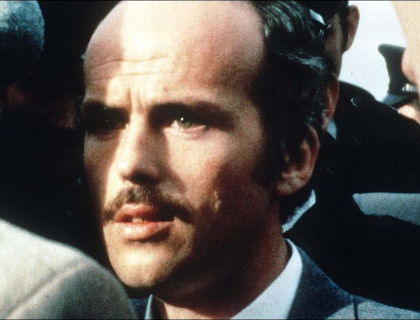
Following his release, McGlinchey joins Ian Milne and future Provisional IRA hunger strikersFrancis Hughes and Thomas McElwee and wages a campaign of shooting and bombing throughout the county and beyond. Together, they later join the Provisional IRA. The gang spends the late 1970s on the run, carrying out operations and evading both the British Army and the Garda Síochána. Following a mailvan robbery, the latter force arrests McGlinchey in County Monaghan in 1977 for carjacking a Garda patrol vehicle and threatening the officer with a pistol, although he claims that the gun is actually a wheel brace. He fails to make bail at Dublin‘s Special Criminal Court after a Garda Superintendent argues that McGlinchey would fail to attend court if bailed. He is convicted and sent to the maximum-security Portlaoise Prison. In 1982, while serving his prison sentence, he clashes with the prison’s IRA leadership and is either expelled by them for indiscipline or leaves the organisation due to strategic differences.
Following his departure from the IRA and his release from prison, McGlinchey joins the INLA. Due to his experience, he rises through the ranks, becoming chief of staff by 1982. Under his leadership, the INLA, which had previously had a reputation for disorganisation, becomes extremely active in cross-borderassassinations and bombings. These include many individual assassinations and woundings, but also massacres such as the Droppin Well bombing of 1982 in which both civilians and soldiers die. There are some failed operations, and McGlinchey, who believes this is the result of an informer within the ranks, devotes much time and energy to finding the cause. Those suspected of betraying the organisation are treated brutally, often by McGlinchey personally. As a result of this resurgence of activity and his high profile, the press nicknames him “Mad Dog.” Under his tenure the Darkley massacre is carried out, ostensibly by another group but using a weapon supplied by McGlinchey. In late 1983, while still on the run, he gives an interview with the Sunday Tribune newspaper in which he condemns the Darkley killings but also lays out his political philosophy and plans for the future.
By 1984, McGlinchey has fallen out with members of a powerful Republican family from South Armagh over what he considers missing funds. Men loyal to this family are subsequently killed by McGlinchey’s unit, which includes his wife. In March of the same year, he is captured in Newmarket-on-Fergus, County Clare, following a gunfight with the Gardaí. At this time, he is wanted in Northern Ireland for the shooting of an elderly woman, but republicans have traditionally been able to avoid extradition by claiming their offences were political. The bloody war in the north is leading the Republic of Ireland to re-evaluate its position, however, and he becomes the first republican to be extradited to Northern Ireland. Although convicted and sentenced there to life imprisonment, this is overturned in 1985. As a result, he is returned to the Republic, where he is sentenced to ten years’ imprisonment on firearms charges. While he is incarcerated, his wife is shot dead at her Dundalk home.
McGlinchey is released in March 1993 and claiming to have no further involvement with the INLA, moves to Drogheda. He survives an assassination attempt soon after his release from prison, but in February 1994, his enemies catch up with him. At around 9:30 on the evening of Thursday, February 10, 1994, he visits and dines with friends of his in Duleek Road, near his home. He leaves about forty minutes later, intending to take a video back to a shop in Brookville, on the north side of town. At around 11:00 p.m. he and his 16-year-old son Dominic are returning home, when he pulls up to make a phone call from a public kiosk on Hardman’s Gardens, near Our Lady of Lourdes Hospital. Almost immediately and despite the presence of four witnesses, a red Mazda pulls up alongside him. While his son watches from the car, three men get out and beat McGlinchey. Once he is on the ground the men, who are armed with three pump action shotguns and a pistol, fire into him fourteen times. The attack finishes with a coup de grâce to the head, although he is already dead. His last words are reputed to be “Jesus, Mary help me.” His son yells for an ambulance.
The following day, an autopsy is carried out in Our Lady of Lourdes Hospital, which indicates McGlinchey had been hit in the neck, skull, the left upper chest, the left arm, and both legs. His inquest is held in Drogheda two weeks later, suspended and then reopened in November 1996. Gardaí forensic officers tell the coroner that they had compared the shell casings they had found with the database, but no matches have been made to other known weapons. The officer notes that no such information has been received from the Royal Ulster Constabulary (RUC). The shotguns used are impossible to trace ballistically, but it is ascertained that the Mazda was registered in the north. His and his wife’s killers have never been found.
McGlinchey’s funeral is held on February 13, 1994, in Bellaghy, with no republican accoutrements. There is no INLA colour guard, and only an Irish tricolor draped over the coffin. Over 1,500 people attend and are watched closely by 200 RUC. Police armoured vans are held on the perimeter. He is buried alongside his wife and their young daughter Máire. His coffin is carried from the McGlinchey family home to St. Mary’s Church by pallbearers who are swapped out from the crowd every 40-yards or so. Martin McGuinness is among them, as is Bernadette McAliskey and her daughter Róisín. His sons carry the coffin for the final yards.
McGlinchey’s posthumous reputation ranges from being a “psycho” to his enemies to being an inspiration to those who followed him. Commentators have speculated on what he would have contributed to Irish politics had he lived. Some have suggested that he would have contributed to the Northern Ireland peace process, while others have argued that dissident republicans, opposed to that process, would have found him a willing rallying point. He remains an influence on Irish fiction and music, with both Edna O’Brien and Martin McDonagh producing acclaimed pieces based on his life and career. He is also featured in popular songs.
A notable aspect of McGahon’s political career is his stand against the Provisional IRA when that organisation’s campaign of violence is at its height. At great personal risk, he refuses to close his newsagents shop in Dundalk during the funerals of the hunger strikers in 1981. He takes another huge risk a few years later when he gives evidence in the High Court in support of The Sunday Times, which is being sued for libel by Thomas Murphy for accusing him of directing an IRA bombing campaign in Britain. Local Gardaí are ordered not to get involved in the case, but McGahon is not deterred from giving evidence that helps the newspaper to defend the claims being made against it by Murphy.
A maverick and outspoken TD, McGahon is known to speak his mind on many issues including divorce, crime, and single mothers. He once advocates that pedophiles should be castrated as part of their prison sentence and is the only TD to oppose the referendum to abolish the death penalty from the Constitution. He also argues that those under 21 years of age should not be able to drive or drink. He is a member of the World Anti-Communist League and opposes the decriminalisation of homosexuality. In 1993, he is the only TD to oppose the decriminalisation of homosexuality and says in the Dáil that:
“I regard homosexuals as being in a sad category, but I believe homosexuality to be an abnormality, some type of psycho-sexual problem that has defied explanation over the years. I do not believe that the Irish people desire this normalisation of what is clearly an abnormality. Homosexuality is a departure from normality and while homosexuals deserve our compassion, they do not deserve our tolerance. That is how the man in the street thinks. I know of no homosexual who has been discriminated against. Such people have a persecution complex because they know they are different from the masses or normal society. They endure inner torment, and it is not a question of the way others view them. The lord provided us with sexual organs for a specific purpose. Homosexuals are like left-hand drivers driving on the right-hand side of the road.”
On the other hand, McGahon speaks out strongly against the influence of the drink industry and defies his own party whip to vote with his left-wing friend Tony Gregory in favour of banning of hare coursing. He is also on good personal terms with members of the Oireachtas such as Michael D. Higgins and David Norris despite holding fundamentally opposed views to them.
McGahon does not contest the 2002 Irish general election and retires from politics.
McGahon lives in Ravensdale, County Louth. His son Conor is a Louth County Councillor from 1991 to 1999 and his brother Johnny is a Louth County Councillor from 1995 to 2004. Johnny’s nephew, John McGahon, is elected to Louth County Council at the 2014 Irish local elections and to Seanad Éireann in 2020.
McGahon dies at the age of 80 on February 8, 2017, following a short illness. Following a Mass at St. Patrick’s Cathedral on February 11, he is buried afterwards in St. Patrick’s Cemetery.
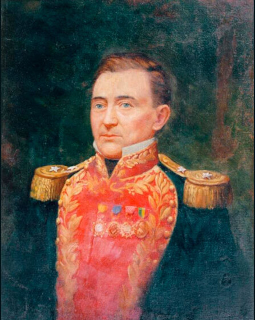
Wright is born to Joseph Wright and Mary Montgomery. At the age of eleven, he is sent to the Royal Naval College at Portsmouth, regarded at the time as the finest in the world, where he is educated to become an officer.
At the age of fourteen, following his junior officer training, Wright embarks on a sea voyage on board HMS Newcastle under the captaincy of Lord George Stuart. On this vessel he sails to the east coast of the United States where he is engaged in blockading activities in the squadron of Admiral John Borlase Warren. In 1817 he returns to England, having attained the junior officer’s rank of midshipman.
Although Wright passes the lieutenant‘s examination, promotional opportunities are diminishing in the Royal Navy, and he is not given a commission like many young junior officers in Britain. Collectively, he and others decide to enlist in Simón Bolívar’s revolutionary army and sail for South America in support of the uprisings against Spanish colonial rule. In November 1817, he enlists as an officer in the British Legions of Simón Bolívar, under the patronage of Luis Lopez Mendez, Bolivar’s agent in London. Originally setting off from the River Thames in November 1817, several snags delay the departure until January 2, 1818. They depart from Fowey harbor and sail on a brigantine named Dowson, under naval commander Captain Dormer, with 200 other volunteers armed with valuable weapons and ammunition. They land in the Saint Thomas Island after several weeks. Admiral Luis Brión arrives with his squadron on the Island of St Thomas and Pigott and the Rifle Corps are shipped on Patriot vessels to Margarita Island off the coast of Venezuela, arriving on April 21, 1818.
They are sent to Guayana and then to Angostura, beginning the campaign in the Apure. At Angostura (present-day Ciudad Bolívar), Wright first meets Simón Bolívar, for whom he develops a deep admiration. Bolívar opens the liberating campaign in Apure. During 1818–1819, one of the earliest battles with Wright partaking as an officer is at Trapiche de Gamarra on March 27, 1819. These encounters inspire Bolívar to begin his New Granada campaign and the march 1,500 miles over the Andes Mountains. Wright accompanies Bolívar on the legendary crossing on which 25% of the British/Irish troops die.
Wright takes part in the entire land campaign to liberate the northern countries of South America, and fights in numerous land battles with Bolívar’s army. He plays leading roles in the Battle of Vargas Swamp, and later in the victory at the Battle of Boyacá in August 1819, after which he is promoted to captain. In 1820, he returns with his Rifles regiment to the coastal plains to campaign in the jungles east of the Magdalena against the Spanish based on Santa Marta. The Rifles Corp are then transported by sea to Maracaibo, and on June 21, 1821, take part in Simon Bolívar’s decisive victory in the Battle of Carabobo. Cartagena is also seized, and the Rifles are brought in boats up the Magdalena River en route to Popayán. They form part of the forces led by Bolívar in the second of his famed Andean campaigns. After the successful battle at Bomboná on 7 April 7, 1822, Wright is twice mentioned in Bolívar’s order of the day for his exceptional skill and courage. Again, he is promoted and from February 1822 he is an acting lieutenant colonel.
In early 1824, Bolívar realizes that, despite the Patriot Army success on land, unless the South American revolutionary armies can control the seas off their coasts, they will forever be under sea blockade from imperial Spain. He appoints Wright to the newly fledged United Pacific Naval Squadron.
After Guayaquil seizes independence, John Illingworth Hunt is appointed as Commanding General of the Maritime Department. Immediately he takes care of organizing everything concerning the Navy. Thus, in 1823, the first Ecuadorian naval force is formed.
Wright, who in February 1824 is promoted to captain, becomes Commodore of the South Squadron, and embarks on the brig Chimborazo, and conducts patrols along the Peruvian coast with seven transports properly equipped and ready to assist in the transfer of troops, when Bolívar’s army would require it. Following Bolivar’s defeat of the royalist forces at the Battle of Junín on August 6, 1824, Wright is instructed to proceed to Callao with a squadron of five ships and is placed under the orders of Admiral Martin Guisse, head of the United Squadron. The Gran Colombian units, forming this squadron, participate in some naval actions against the royalists and also in the blockade of Callao, the last Spanish stronghold in South America.
Bolívar installs Wright as a Commodore of the Pacific Southern Squadron. He is appointed to command a small fleet of ships in support of Admiral Martin Guisse and joins the Patriotic naval force blockading off Callao. Along with Admiral Guisse and a handful of other former Royal Navy officers, they spearhead the blockade of Callao that successfully fights the Spanish naval squadron sent to lift the blockade of the besieged city. The blockade holds and Callao capitulates in early 1826, ending Spanish rule in South America.
The revolutionary independence struggles end with the unfolding liberation of South America countries, and Wright settles in Ecuador where he helps establish the Ecuadorian Navy and helps create the Ecuadorian naval school that is named in his honor.
The downfall and expulsion of the Spanish colonial power leads to land disputes and new wars among the South American home nations that once were united against Spain. In 1827, Peruvian PresidentJosé de la Mar invades Bolivia and then invades Ecuador. Wright takes up the cause of defending his new adopted homeland. His navy fights two battles with the Peruvians in the Gulf of Guayaquil.
Ecuador declares itself a republic in 1830, though the region is completely unsettled with Peru and Colombia both claiming parts of Ecuador as part of their territory. At this time Wright goes back in the Navy with his own flag officer’s pendant. He is also appointed to the army with the rank of General of Brigade in 1830. Two unconstitutional presidents, Vincente Rocafuerte and Valdivieso, declare themselves in office. Wright and Flores lead Rocafuerte’s army into a decisive battle that takes place at Minarica in 1835. This action is decisive, and they defeat General Barriga, who is Valdivieso’s appointed General. The victory guarantees the stability and future of Ecuador, with Rocafuerte becoming Ecuador’s president.
In 1835, Wright is Comandante del Apostadero, later changed to Comandancia General de la Marina (Commander-in-Chief of the Navy) for many years. He does not found the Ecuadorian Naval School, as often incorrectly cited. The college is named in his honor. He is the commanding officer of the Ecuadorian Naval Squadron before Ecuador becomes a Republic, as such he is considered a founding father of the Ecuadorian Navy. In this year he is also promoted to Army General of Division.
In 1843, Wright becomes the Governor of Guayaquil. This is the premier military position in the city.
In 1845, a military coup plot overthrows the liberal government supported by Wright and he goes into exile for fifteen years in Chile and Peru. In Chorrillos, Peru, he befriends the Ecuadorian exile Eloy Alfaro and exerts a massive influence on him as a mentor. Alfaro later becomes President of Ecuador from 1897 to 1913. Wright returns from exile in 1860 and opposes Gabriel García Moreno until his death in 1868.
MacEntee is born as John McEntee at 47 King Street, Belfast, on August 23, 1889, the son of James McEntee, a publican, and his wife, Mary Owens, both of whom are from Monaghan. James McEntee is a prominent Nationalist member of Belfast Corporation and a close friend of Joseph DevlinMP.
MacEntee is educated at St. Mary’s Christian Brothers’ Grammar School, St. Malachy’s College and the Belfast Municipal College of Technology where he qualifies as an electrical engineer. His early political involvement is with the Irish Socialist Republican Party in Belfast. He quickly rises through the ranks of the trade union movement becoming junior representative in the city’s shipyards. Following his education, he works as an engineer in Dundalk, County Louth, and is involved in the establishment of a local corps of the Irish Volunteers in the town. He mobilises in Dundalk and fights in the General Post Office garrison in the Easter Rising in 1916. He is sentenced to death for his part in the rising. This sentence is later commuted to life imprisonment. He is released in the general amnesty in 1917 and is later elected a member of the National Executives of both Sinn Féin and the Irish Volunteers in October 1917. He is later elected Sinn Féin Member of Parliament (MP) for South Monaghan at the 1918 Irish general election.
An attempt to develop MacEntee’s career as a consulting engineer in Belfast is interrupted by the Irish War of Independence in 1919. He serves as Vice-Commandant of the Belfast Brigade of the Irish Republican Army (IRA). He is also a member of the Volunteer Executive, a sort of Cabinet and Directory for the Minister for Defence and the HQ Staff, however, he remains one of the few Sinn Féiners from the north. On August 6, 1920, he presents ‘a Memorial’ lecture to the Dáil from the Belfast Corporation. He tells the Dáil it is the only custodian of public order, that a Nationalist pogrom is taking place, and he advises them to fight Belfast. The Dáil government’s policy is dubbed Hibernia Irredenta or “Greening Ireland.” He is asked to resign his South Monaghan seat after voting against a bunting celebration in Lurgan to mark the signing of the Anglo-Irish Treaty.
In April 1921 MacEntee is transferred to Dublin to direct a special anti-partition campaign in connection with the May general election. It remains Michael Collins‘s policy, he declares, that the largely Protestant shipyard workers of Belfast are being directed by the British, urging all Irishmen to rejoin the Republic. Correspondingly the Ulster Unionist Council rejects the call for a review of the boundary commission decision made on Northern Ireland. But when Ulstermen choose James Craig as Premier, Collins denounces democracy in the north as a sham. It is on the partition of Ireland issue that MacEntee votes against the Anglo-Irish Treaty of 1921. During the subsequent Irish Civil War, he commands the IRA unit in Marlboro Street Post Office in Dublin. He later fights with Cathal Brugha in the Hamman Hotel and is subsequently interned in Kilmainham and Gormanstown until December 1923.
After his release from prison, MacEntee devotes himself more fully to his engineering practice, although he unsuccessfully contests the Dublin Countyby-election of 1924. He becomes a founder-member of Fianna Fáil in 1926 and is eventually elected a TD for Dublin County at the June 1927 Irish general election.
MacEntee founds the Association of Patent Agents in 1929, having gained his interest in Patents when he worked as an assistant engineer in Dundalk Urban District Council. He values his status as a Patent Agent as he maintains his name on the Register for over 30 years while he holds Ministerial rank in the Irish Government, although he is not believed to have taken any active part in the patent business, which is carried on by his business partners.
In 1932, Fianna Fáil comes to power for the very first time, with MacEntee becoming Minister for Finance. In keeping with the party’s protectionist economic policies his first budget in March of that year sees the introduction of new duties on 43 imports, many of them coming from Britain. This sees retaliation from the British government, which in turn provokes a response from the Irish government. This is the beginning of the Anglo-Irish Trade War between the two nations, however, a treaty in 1938, signed by MacEntee and other senior members brings an end to the issue.
In 1939, World War II breaks out and a cabinet reshuffle results in MacEntee being appointed as Minister for Industry and Commerce, taking over from his rival Seán Lemass. During his tenure at this department, he introduces the important Trade Union Act (1941). In 1941, another reshuffle of ministers takes place, with him becoming Minister for Local Government and Public Health. The Health portfolio is transferred to a new Department of Health in 1947. Following the 1948 Irish general election, Fianna Fáil returns to the opposition benches for the first time in sixteen years.
In 1951, Fianna Fáil are back in government, although in minority status, depending on independent deputies for survival. MacEntee once again returns to the position of Minister for Finance where he feels it is vital to deal with the balance of payments deficit. He brings in a harsh budget in 1951 which raises income tax and tariffs on imports. His chief aim is to cut spending and reduce imports, however, this comes at a cost as unemployment increases sharply. The increases are retained in his next two budgets in 1952 and 1953. It is often said that it is his performance during this period that costs Fianna Fáil the general election in 1954. The poor grasp on economics also does his political career tremendous damage as up to that point he is seen as a likely successor as Taoiseach. Seán Lemass, however, is now firmly seen as the “heir apparent.”
In 1957, Fianna Fáil returns to power with an overall majority with MacEntee being appointed Minister for Health. The financial and economic portfolios are dominated by Lemass and other like-minded ministers who want to move away from protection to free trade. He is credited during this period with the reorganisation of the health services, the establishment of separate departments of health and social welfare, and the fluoridation of water supplies in Ireland. In 1959, he becomes Tánaiste when Seán Lemass is elected Taoiseach.
Following the 1965 Irish general election, MacEntee is 76 years old and retires from the government. He re-emerges in 1966 to launch a verbal attack on Seán Lemass for deciding to step down as party leader and Taoiseach. The two men, however, patch up their differences shortly afterwards. MacEntee retires from Dáil Éireann in 1969 at the age of 80, making him the oldest TD in Irish history.
MacEntee dies in Dublin on January 9, 1984, at the age of 94. He is buried in Glasnevin Cemetery, Dublin.
A rally of twelve to fifteen thousand Peace People from both north and south takes place at the new bridge over the River Boyne at Drogheda, County Louth, on December 5, 1976. In general, the Peace People’s goals are the dissolution of the Irish Republican Army (IRA) and an end to violence in Northern Ireland. The implicit goals of the Peace People rallies are delegitimization of violence, increasing solidarity, and gaining momentum for peace.
In the 1960s, Northern Ireland begins a period of ethno-political conflict called the Troubles. Through a series of social and political injustices, Northern Ireland has become a religiously divided society between historically mainland Protestants and Irish Catholics. Furthermore, the Irish people have become a fragmented body over a range of issues, identities, circumstances and loyalties. The conflict between Protestants and Catholics spills over into violence, marked by riots and targeted killings between the groups beginning in 1968. In addition, paramilitary groups, including the prominent IRA, launch attacks to advance their political agendas.
The violence continues to escalate. On August 10, 1976, Anne Maguire and her children are walking along Finaghy Road North in Belfast. Suddenly, a Ford Cortina slams into them. The car is being driven by Danny Lennon, who moments before had been shot dead by pursuing soldiers. The mother is the only survivor. The collision kills three of her four children, Joanne (8), John (2), and Andrew (6 months). Joanne and Andrew die instantly while John is injured critically.
The next day, immediately following John’s death, fifty women from the Republican neighborhoods of Andersonstown and Stewartstown protest Republican violence by marching with baby carriages. That evening, Mairead Corrigan, Anne Maguire’s sister, appears on television pleading for an end to the violence. She becomes the first leader of the Peace People to speak publicly.
However, she was not the only one to initiate action. As soon as she hears Mairead speak on the television, Betty Williams begins petitioning door-to-door for an end to sectarian violence. She garners 6,000 signatures of support within a few days. This support leads directly into the first unofficial action of the Peace People. On 14 August, only four days after the incident, 10,000 women, both Protestant and Catholic, march with banners along Finaghy Road North, the place of the children’s death, to Milltown Cemetery, their burial site. This march mostly includes women along with a few public figures and men. The marchers proceed in almost utter silence, only broken by short bouts of singing from the nuns in the crowd and verbal and physical attacks by Republican opposition.
The following day, the three who become leaders of the Peace People – Mairead Corrigan, Betty Williams, and journalist Ciaran McKeown – come together for their first official meeting. During these initial meetings they establish the ideological basis of nonviolence and goals for the campaign. The essential goals for the movement are the dissolution of the IRA and an end to the violence in Northern Ireland. The goals of the campaign implicit in their declaration are awareness, solidarity, and momentum. Peace People’s declaration:
“We have a simple message to the world from this movement for Peace. We want to live and love and build a just and peaceful society. We want for our children, as we want for ourselves, our lives at home, at work, and at play to be lives of joy and peace. We recognise that to build such a society demands dedication, hard work, and courage. We recognise that there are many problems in our society which are a source of conflict and violence. We recognise that every bullet fired, and every exploding bomb make that work more difficult. We reject the use of the bomb and the bullet and all the techniques of violence. We dedicate ourselves to working with our neighbours, near and far, day in and day out, to build that peaceful society in which the tragedies we have known are a bad memory and a continuing warning.”
During the four-month campaign, Peace People and partners organize and participate in 26 marches in Northern Ireland, Britain, and the Republic of Ireland. In order to organize these marches effectively they establish their main headquarters in Belfast.
After the initial Finaghy Road March, the Peace People, both Protestants and Catholics, rally in Ormeau Park on August 21. The official Declaration of the Peace People is first read at this rally, the largest rally of the entire campaign. The group numbers over 50,000. The rally even includes some activists from the Republic of Ireland, most notably Judy Hayes from the Glencree Centre of Reconciliation near Dublin. After the rally, she and her colleagues return to the south to organize solidarity demonstrations.
In the few days before the next march, the organization “Women Together” request Peace People to call off the march, disapproving of Catholics and Protestants participating in a joint march. The Peace People are not dissuaded. The next Saturday, 27,000 people march along Shankill Road, the loyalist/Protestant neighborhood.
In the next three months, Peace People organize and participate in a rally every Saturday; some weeks even have two. Some of the most notable marches include the Derry/Londonderry double-march, the Falls march, the London march, and the Boyne march.
The Saturday following the Shankill march marks the Derry/Londonderry double-march. At this march, Catholics march on one side of the River Foyle and Protestants on the other. The groups meet on the Craigavon Bridge. Simultaneously, 50,000 people march in solidarity in Dublin.
On October 23, marchers meet in the Falls, Belfast, in the pouring rain on the same Northumberland street corner where the Shankill March had started. The Falls Road rally is memorable for the fear and violence that ensues. During this rally Sinn Féin supporters throw stones and bottles at the marchers. The attackers escalate the violence as the marchers near Falls Park. The marchers are informed by others that more attackers await them at the entrance to the park, inciting fear within the body of the rally. The leaders decide that this is an important moment of conflict in the rally and that they must push on. They continue verbally encouraging the marchers through the cloud of bottles, bricks, and stones.
The leaders plan to escalate the campaign momentum for the last two major symbolic rallies in London and Boyne, Drogheda. A week before the rallies, on November 20-21, they plan a membership drive. Over 105,000 people sign within two days.
The symbolic week of the culminating rallies begins on November 27 at the glamorous London Rally. They begin to march at Hyde Park, cut through Westminster Abbey, and end at Trafalgar Square. Some groups sing “Troops Out,” and others resound with civil rights songs.
On December 5, Peace People holds its final march of the campaign, along the River Boyne. The Northern and Southern Ireland contingents met at the Peace Bridge. This is an important point in the legacy of the Peace People movement. Now that the enthusiastic rallies are over, the people are responsible for the tedious local work and continuing the momentum and solidarity that the rallies have inspired. The shape of the Peace People is changing.
After the planned marches are over, the rally portion of the campaign fades and the Peace People take a new shape. Corrigan, Williams, and McKeown stop planning marches, but continue to be involved in action that takes the form of conferences and traveling overseas. However, the leaders begin doing more separated work. Ciaran McKeown increases his focus on radical political restructuring.
In 1977, Betty Williams and Mairead Corrigan receive the Nobel Peace Prize. Issues regarding the use of the monetary award impact the two leaders’ relationships in an irreconcilable manner.
Due to the fact that many people, unlike McKeown, are less interested in the political side of the equation, the People continue actions along the lines of rallies and social work. Actions continue through the People’s initiative in the form of Peace Committees that each does separate work in local areas.
The Peace People makes a substantial impact. They help to de-legitimize violence, increase solidarity across sectarian lines, and develop momentum for peace. Although the violence does not fully subside until 1998 with the negotiation of political change, Ireland sees in 1976 one of its most dramatic decreases in political violence, accompanying the Peace People’s marches and rallies. The campaign dramatizes how tired the people are of bloodshed, their desperate desire for peace, and the clear possibility of alternatives.
(From: “Peace People march against violence in Northern Ireland, 1976” by Hannah Lehmann, Global Nonviolent Action Database, https://nvdatabase.swarthmore.edu/, 2011 | Pictured: The Peace People organisation rally in Drogheda, County Louth, December 5, 1976)
Carroll marries clothing designer Helena Reilly in Glasgow in 1923. They have four children, actress Helena Carroll, musician and producer Theresa Perez, journalist Kathleen Carroll and son Brian Carroll who resides in London. He is grandfather to Helena Perez Reilly and great grandfather to Paul Vincent Reilly. His brother, Niall Carroll, is a film critic.
Carroll founds two theater groups in Glasgow: the Curtain Theatre company, with Grace Ballantine and Molly Urquhart, in 1933 and the Glasgow Citizens Theatre in 1943. He remains the director and playwright in residence of the Citizens Theatre until his death.
The Wayward Saint is made into an opera in Germany in the 1960’s and his daughter Theresa commissions and produces an opera of his Beauty is Fled from the collection Plays for My Children which opens at Phoenix Symphony Hall in the 1970s as part of Theresa’s “Children’s Opera Series.”
Carroll dies at the age of 68 from undisclosed causes in Bromley, Kent, England on October 20, 1968.
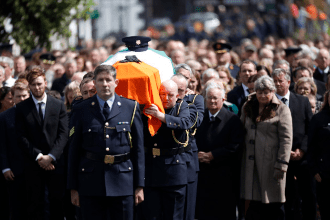
Among the thousands paying their respects are 4,000 serving and retired gardaí, over 2,000 in uniform. Garda Golden is remembered as a happy man, proud to serve, a role model for the community – and by his brother Patrick as a “big gentle giant.”
In his homily, chief celebrant parish priest Father Pádraig Keenan tells the congregation that the killing of Garda Golden was “cold-blooded murder.” He reminds the mourners that Garda Golden is the 88th garda to die in the line of duty. He says, “It is 88 members too many. He like all the others is mourned by the entire nation.”
“His murder brings to mind once again all the families and communities that have been affected on our island.”
Fr. Keenan says, “Garda Tony’s death once again reflects how north Louth and the Cooley Peninsula have been affected by the tragic history of the Troubles on the island of Ireland, and especially the murder of Detective Garda Adrian Donohoe, three years ago at Lordship Credit Union in Bellurgan.”
He says that too many hearts have been broken, and too many lives shattered. There is no place for violence in our society, violence is wrong, always wrong. He refers to Garda Golden as one of life’s gentlemen.
Fr. Keenan begins the funeral mass by saying that Garda Golden quietly let “his light shine in so many ways through his life in a very humble way. Amidst our sadness may we be thankful for the charisma of his beautiful but too short life.”
The stillness of the water across from the churchyard in Dundalk Bay mirrors the silence and sadness that has unfolded on everyone since the weekend, he tells the congregation.
“Tony was so proud to serve the community of Omeath,” he says. “As one person from Omeath put it to me in recent days, he was ‘our garda’, and to a person amongst his family and colleagues, all are immensely proud of Garda Tony and his selfless nature. Proud of everything he lived for, worked for and stood for. Tony Golden was a much-loved role model in our community.”
Symbols including a family photograph are taken to the altar in memory of Garda Golden. A club jersey and hurley from the Stephenites GAA club in his native Ballina, County Mayo, represent his roots and love of sport. A television remote control, a soft drink, a bar of chocolate and packet of crisps were offered to recall his cherished “time out.”
Garda Golden’s final journey begins at the home in the village of Blackrock he shared with his wife Nicola and their three young children, Lucy, Alex and Andrew. The funeral cortège is led by the Garda Commissioner, while thousands of gardaí escort their colleague into his parish church, St. Oliver Plunkett’s, for the funeral mass at noon.
Fr. Keenan is joined on the altar by the vicar general of the Armagh diocese Dean Colum Curry, who represents the Primate of All Ireland, Bishop Eamon Martin. As well as the chaplains to the Garda and the Defence Forces, Bishop John Fleming and Father Gerard O Hora travel to the funeral from Golden’s home county of Mayo.
Screens are erected in the grounds and the village to relay the service to those outside.
Businesses shut down along the route as a mark of respect during the funeral. Roads around the village are sealed off for several hours. Garda Golden is laid to rest at St. Paul’s Cemetery Heynestown.
Golden is killed as he is bringing Siobhan Phillips to her home to retrieve her personal possessions. Phillips is also shot in the incident and is in a critical condition in hospital with her family at her bedside at the time of Garda Golden’s funeral.
President of the Garda Representative Association, Dermot O’Brien, says members of the gardaí from all corners of Ireland traveled to County Louth to pay their respects to their colleague. He says they are grief-stricken and numb.
O’Brien says everyone will reflect in their own way and that the realisation has struck that Garda Golden was murdered doing “a bread-and-butter type call.”
“They are going to ask themselves, those that attended the same type of call on Sunday that it could have been them. These are very similar calls that a lot of members did on Sunday, and they will sit back and reflect on what happened to Tony as they responded to a similar call.”
O’Brien says he had spoken to Garda Golden’s unit in the days leading to the funeral and, while they are coping, they are not well. “They are angry, grieving and disillusioned because today they have to bury a second friend, a murdered friend, a second murdered colleague.”
Father Michael Cusack also speaks of the pain and anger expressed by members of the garda force he met following Garda Golden’s death. Speaking on RTÉ‘s Today with Sean O’Rourke, Fr. Cusack says it is a very difficult day and week for gardaí. He says a lot of care needs to be offered to the members of the force and that there needs to be appropriate follow-up care given.
(From: “Garda Tony Golden ‘mourned by entire nation’,” RTÉ News, http://www.rte.ie, October 15, 2015)
Accused by The Sunday Times of directing an IRA bombing campaign in Britain, in 1987 Murphy unsuccessfully sues the paper for libel in Dublin. The original verdict is overturned by the court of appeal because of omissions in the judge’s summing up and there is a retrial, which he also loses. At the retrial, both Sean O’Callaghan and Eamon Collins, former members of the Provisional Irish Republican Army, testify against Murphy, as do members of the Gardaí, Irish customs officials, British Army and local TDBrendan McGahon. Collins, who had also written a book about his experiences, Killing Rage, is beaten and killed by having a spike driven through his face near his home in Newry eight months later. In 1998, a Dublin court dismisses Murphy’s case after a high-profile trial, during which Murphy states that he has “never been a member of the IRA, no way” and claims not to know where the Maze prison is located. The jury rules, however, that he is an IRA commander and a smuggler.
The Sunday Times subsequently publishes statements given by Adrian Hopkins, the skipper who ferries weapons from Libya to the IRA, to the French authorities who intercept the fifth and final Eksund shipment. Hopkins details how Murphy met a named Libyan agent in Greece, paid for the weapons to be imported, and helped unload them when they arrived in Ireland. According to A Secret History of the IRA by Ed Moloney, Murphy has been the IRA Army Council’s chief of staff since 1997. Toby Harnden’s Bandit Country: The IRA & South Armagh also details Murphy’s IRA involvement.
On September 20, 2016, the BBC‘s Spotlight airs a programme in which an alleged British spy who had infiltrated the IRA claims that in 2006, Murphy had demanded the killing of Denis Donaldson, an IRA member and British informer, in order to maintain discipline. The BBC says it had tried to contact Murphy but had received no reply. He has yet to respond to the allegation. On September 23, 2016, the Donaldson family’s solicitor says that the allegation is “absolute nonsense.”
In October 2005, officers of the British Assets Recovery Agency and the Irish Criminal Assets Bureau carry out raids on a number of businesses in Manchester and Dundalk. It is extensively reported in the media that the investigation is aimed at damaging the suspected multi-million-pound empire of Murphy, who according to the BBC’s Underworld Rich List, has accumulated up to £40 million through smuggling oil, cigarettes, grain and pigs, as well as through silent or partial ownership in legitimate businesses and in property.
A large, purpose-built underground chamber that Gardaí believes the IRA used for interrogation is discovered close to Murphy’s home.
In his first-ever press release, issued on October 12, 2005, Murphy denies he owned any property and denies that he had any links with co-accused Cheshire businessman Dermot Craven. Furthermore, he claims that he had to sell property to cover his legal fees after his failed libel case against The Sunday Times, and that he made a living from farming.
On March 9, 2006, police, soldiers and customs officials from both sides of the Irish border launch a large dawn raid on Murphy’s house and several other buildings in the border region. Three persons are arrested by the Gardaí but are released three days later. A fleet of tankers, computers, documents, two shotguns, more than 30,000 cigarettes and the equivalent of 800,000 euros in sterling bank notes, euro bank notes and cheques are seized. Four diesel laundering facilities attached to a major network of storage tanks, some of which are underground, are also found. The Irish Criminal Assets Bureau later obtains seizure orders to take possession of euro cash and cheques and sterling cash and cheques, together worth around one million Euros.
Sinn Féin President Gerry Adams makes a public statement in support of Murphy following the March 2006 raids. Under political and media pressure over allegations of the IRA’s continued presence in South Armagh, Adams says, “Tom Murphy is not a criminal. He’s a good republican and I read his statement after the Manchester raids, and I believe what he says and also and very importantly he is a key supporter of Sinn Féin’s peace strategy and has been for a very long time.” He adds, “I want to deal with what is an effort to portray Tom Murphy as a criminal, as a bandit, as a gang boss, as someone who is exploiting the republican struggle for his own ends, as a multimillionaire. There is no evidence to support any of that.”
Murphy is arrested in Dundalk, County Louth, on November 7, 2007, by detectives from the Criminal Assets Bureau, on charges relating to alleged revenue offences. The following day, he is charged with tax evasion under the Tax Consolidation Act. He is later released on his own bail of €20,000 with an independent surety of €50,000.
On October 17, 2008, in an agreed legal settlement, Murphy and his brothers pay over £1 million in assets and cash to the authorities in Britain and the Republic in settlement of a global crime and fraud investigation relating to proceeds of crime associated with smuggling and money laundering. After an investigation involving the Irish Criminal Assets Bureau and the UK’s Serious Organised Crime Agency, more than 625,000 euros (£487, 000) in cash and cheques is confiscated by the Republic’s courts, while nine properties in North West England worth £445,000 are confiscated by British courts. Murphy is still fighting a claim in the Republic’s courts for tax evasion, relating to non-completion of tax returns for eight years from 1996. On April 26, 2010, he is further remanded on bail.
In 2011, there are claims that Murphy had become disillusioned with the Northern Ireland peace process and that he had fallen out with Sinn Féin. However, there is no evidence to support he is sympathetic to any dissident republican groups. In March 2013, the Garda and the Police Service of Northern Ireland (PSNI), along with members of the Irish Customs Authority and HM Revenue and Customs (HMRC), raid his farm on the Louth-Armagh border. The Sunday World reports that two hours prior to the raid, at approximately 4:00 a.m., fire is seen coming from Murphy’s yard. There are serious concerns within the Garda and PSNI that a mole may have tipped off Murphy about the raid hours earlier as laptops, computer disks and a large amount of documentation is destroyed in the fires. As a result, an internal Garda investigation takes place.
On December 17, 2015, Murphy is found guilty on nine charges of tax evasion by a three-judge, non-jury Special Criminal Court trial sitting in Dublin, lasting nine weeks. He is tried under anti-terrorist legislation due to the belief by the Director of Public Prosecutions (DPP) that there would not be a fair trial because of the potential of the intimidation of prosecution witnesses and jurors, and the security surrounding the trial.
Murphy is found guilty on all charges of failing to furnish tax returns on his income as a “cattle farmer” between 1996 and 2004. He is prosecuted following a 14-year-long Criminal Assets Bureau investigation, which during a raid of his property uncovers bags with more than €250,000 and more than £111,000 sterling in cash, along with documents, diaries and ledgers. He is remanded on bail until early 2016 for sentencing.
On February 26, 2016, Murphy is sentenced to 18 months in prison. None of the jail term is suspended. Following sentencing, he is immediately transferred from court to Ireland’s highest-security prison, Portlaoise Prison, reserved for terrorists, dissident republicans and serious gangland criminals, under a heavily armed Garda and Irish Army escort due to security concerns.
Murphy appeals the conviction in November 2016. His lawyer, John Kearney, claims that the tax Murphy had not paid had in fact been paid by his brother, Patrick. The Court of Appeal dismisses the appeal on all grounds in January 2017.





 seamus dubhghaill