seamus dubhghaill

Promoting Irish Culture and History from Little Rock, Arkansas, USA


Leave a comment

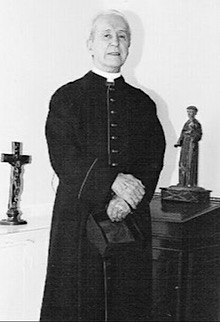
Death of Malachi Martin, Irish American Catholic Priest

Malachi Brendan Martin, also known under the pseudonym of Michael Serafian, Irish-born American Traditionalist Catholic priestbiblical archaeologistexorcistpalaeographerprofessor, and writer on the Catholic Church, dies in New York City on July 27, 1999.

Martin is born on July 23, 1921, in BallylongfordCounty Kerry, to a middle-class family in which the children are raised speaking Irish at the dinner table. His parents, Conor and Katherine Fitzmaurice Martin, have five sons and five daughters. Four of the five sons become priests, including his younger brother, Francis Xavier Martin.

Martin attends Belvedere College in Dublin, then studies philosophy for three years at University College Dublin (UCD). On September 6, 1939, he becomes a novice with the Society of Jesus. He teaches for three years, spending four years at Milltown Park, Dublin, and is ordained in August 1954.

Upon completion of his degree course in Dublin, Martin is sent to the Catholic University of Leuven in Belgium, where he takes a doctorate in archaeologyOriental history, and Semitic languages. He starts postgraduate studies at both the Hebrew University of Jerusalem and at the University of Oxford. He specializes in intertestamentary studiesJesus in Jewish and Islamic sources, Ancient Hebrew and Arabic manuscripts. He undertakes additional study in rational psychologyexperimental psychologyphysics, and anthropology.

Martin participates in the research on the Dead Sea Scrolls and publishes 24 articles on Semitic palaeography. He does archaeological research and works extensively on the Byblos syllabary in Byblos, in Tyre, and in the Sinai Peninsula. He assists in his first exorcism while working in Egypt for archaeological research. In 1958, he publishes a work in two volumes, The Scribal Character of the Dead Sea Scrolls.

Martin’s years in Rome coincide with the beginning of the Second Vatican Council (1962–65), which is to transform the Catholic Church in a way that the initially liberal Martin begins to find distressing. He becomes friends with Monsignor George Gilmary Higgins and Father John Courtney Murray.

In Rome, Martin becomes a professor at the Pontifical Biblical Institute, where he teaches Aramaic, Hebrew, palaeography, and Sacred Scripture. He also teaches theology, part-time, at Loyola University Chicago‘s John Felice Rome Center. He works as a translator for the Eastern Orthodox Churches and Ancient Oriental Churches Division of the Secretariat for Promoting Christian Unity under Bea. He becomes acquainted with Jewish leaders, such as Rabbi Abraham Joshua Heschel, in 1961 and 1962. He accompanies Pope Paul VI on a trip to Jordan in January 1964. He resigned his position at the Pontifical Institute in June 1964.

In 1964, Martin requests a release from his vows and from the Jesuit Order. He receives a provisional release in May 1965 and a dispensation from his vows of poverty and obedience on June 30, 1965. Even if dispensed from his religious vow of chastity, he remains under the obligation of chastity if still an ordained secular priest. He maintains that he remains a priest, saying that he had received a dispensation from Paul VI to that effect.

Martin moves to New York City in 1966, working as a dishwasher, a waiter, and taxi driver, while continuing to write. He co-founds an antiques firm and is active in communications and media for the rest of his life.

In 1967, Martin receives his first Guggenheim Fellowship. In 1970, he publishes the book The Encounter: Religion in Crisis, winning the Choice Book Award of the American Library Association. He then publishes Three Popes and the Cardinal: The Church of Pius, John and Paul in its Encounter with Human History (1972) and Jesus Now (1973). In 1970, he becomes a naturalized U.S. citizen.

In 1969, Martin receives a second Guggenheim Fellowship, allowing him to write his first of four bestsellersHostage to the Devil: The Possession and Exorcism of Five Living Americans (1976). In the book, he calls himself an exorcist, claiming he assisted in several exorcisms. According to McManus Darraugh, William Peter Blatty “wrote a tirade against Malachi, saying his 1976 book was a fantasy, and he was just trying to cash in.” Darraugh also says that Martin became “an iconic person in the paranormal world.”

Martin serves as religious editor for the National Review from 1972 to 1978. He is interviewed twice by William F. Buckley, Jr. for Firing Line on PBS. He is an editor for the Encyclopædia Britannica.

Martin is a periodic guest on Art Bell‘s radio program, Coast to Coast AM, between 1996 and 1998. The show continues to play tapes of his interviews on Halloween.

Martin’s The Keys of This Blood: The Struggle for World Dominion between Pope John Paul II, Mikhail Gorbachev, and the Capitalist West is published in 1990. It is followed in 1996 by Windswept House: A Vatican Novel.

The Vatican restores Martin’s faculty to celebrate Mass in 1989, at his request. He is strongly supported by some Traditionalist Catholic sources and severely criticized by other sources, such as the National Catholic Reporter. He serves as a guest commentator for CNN during the live coverage of the visit of Pope John Paul II to the United States in October 1995.

On July 27, 1999, Martin dies in Manhattan of an intracerebral haemorrhage, four days after his 78th birthday. It is caused by a fall in his Manhattan apartment. The documentary Hostage to the Devil claims that Martin says he was pushed from a stool by a demonic force.

Martin’s funeral takes place in St. Anthony of Padua Catholic Church in West Orange, New Jersey, before burial at Gate of Heaven Cemetery, in Hawthorne, New York.


Leave a comment

Death of Francis Browne, Irish Jesuit & Photographer

Francis Patrick Mary Browne, distinguished Irish Jesuit and a prolific photographer, dies in Dublin on July 7, 1960. His best-known photographs are those of the RMS Titanic and its passengers and crew taken shortly before its sinking in 1912. He is decorated as a military chaplain during World War I.

Browne is born to a wealthy family in 1880 at Buxton House, Cork, County Cork, the youngest of the eight children of James and Brigid (née Hegarty) Browne. His mother is the niece of William Hegarty, Lord Mayor of Cork, and a cousin of Sir Daniel Hegarty, the first Lord Mayor of Cork. She dies of puerperal fever eight days after his birth. After the death of his father in a swimming accident at Crosshaven on September 2, 1889, he is raised and supported by his uncle, Robert Browne, Bishop of Cloyne, who buys him his first camera shortly before the younger man embarks on a tour of Europe in 1897.

Browne spends his formative years at Bower Convent, Athlone (1888–91), Belvedere College (1891–92), Christian Brothers College, Cork (1892–1893), St. Vincent’s Castleknock College (1893–97), graduating in 1897. He goes on the aforementioned tour of Europe, where he begins taking photographs.

Upon his return to Ireland, Browne joins the Jesuits and spends two years in the novitiate at St. Stanislaus College, Tullabeg, County Offaly. He attends the Royal University of Ireland, Dublin, where he is a classmate of James Joyce, who features him as Mr. Browne the Jesuit in Finnegans Wake. In 1909, he visits Rome with his uncle and brother, a bishop and priest respectively, during which they have a private audience with Pope Pius X with the Pope allowing Browne to take his photograph. He studies theology at the Milltown Institute of Theology and Philosophy in Dublin from 1911 to 1916.

In April 1912 Browne receives a present from his uncle: a ticket for the maiden voyage of RMS Titanic from Southampton, England, to Queenstown, Ireland, via Cherbourg, France. He travels to Southampton via Liverpool and London, boarding the RMS Titanic on the afternoon of April 10, 1912. He is booked in cabin A-37 on the Promenade Deck. He takes dozens of photographs of life aboard RMS Titanic on that day and the next morning. He captures the last known images of many crew and passengers, including captain Edward J. Smith, gymnasium manager T. W. McCawley, engineer William Parr, Major Archibald Butt, writer Jacques Futrelle and numerous third-class passengers whose names are unknown.

During his voyage on the RMS Titanic, Browne is befriended by an American millionaire couple who are seated at his table in the liner’s first-class dining saloon. They offer to pay his way to New York and back in return for him spending the voyage to New York in their company. He telegraphs his superior, requesting permission, but the reply is an unambiguous “GET OFF THAT SHIP – PROVINCIAL.”

Browne leaves the RMS Titanic when she docks in Queenstown and returns to Dublin to continue his theological studies. When the news of the ship’s sinking reaches him, he realises that his photos would be of great interest, and he negotiates their sale to various newspapers and news cartels. They appear in publications around the world. The Eastman Kodak Company subsequently gives him free film for life, and he often contributes to The Kodak Magazine. It is unknown what type of camera he used to shoot the famous photos aboard RMS Titanic.

After his ordination on July 31, 1915, Browne completes his theological studies. In 1916, he is sent to Europe to join the Irish Guards as a chaplain. He serves with the Guards until the spring of 1920, including service at the Battle of the Somme and at Locre, Wytschaete, Messines Ridge, Paschendaele, Ypres, Amiens and Arras in Flanders.

Browne is wounded five times during the war, once severely in a gas attack. He is awarded the Military Cross (MC) on June 4, 1917 “for distinguished service in the field”. He is awarded a bar to his MC on February 18, 1918. He is also awarded the Croix de Guerre by France.

Browne takes many photographs during his time in Europe. One, which he calls “Watch on the Rhine,” is considered a classic image of World War I. He assembles a collection of his war photographs in an album named after his most famous photograph and distributes copies to his colleagues in the Guards.

After the war, Browne returns to Dublin, where, in 1922, he is appointed superior of Gardiner Street Church in Dublin. Ill health dogs him, however, and in 1924 it is thought that he would recover more quickly in warmer climes. He is sent on an extended visit to Australia. He takes his camera along, photographing life aboard ship and in Cape Town, South Africa, where he breaks his voyage.

On his way back to Ireland, Browne visits Ceylon, Aden, Suez, Saloniki, Naples, Toulon, Gibraltar, Algeciras, and Lisbon, taking photographs of local life and events at every stop. It is estimated that he takes more than 42,000 photographs during his life.

Browne resumes office as the Superior of Saint Francis Xavier Church, Dublin, upon his return. In 1929 he is appointed to the Retreats and Mission staff of the Irish Jesuits. His work entails preaching at missions and religious retreats all over Ireland. As most of this work is necessarily performed on evenings and Sundays, he has considerable time to indulge in his hobby during the daytime. He takes photographs of many parishes and towns in Ireland, and also photographs in London and East Anglia during his ecclesiastical travels to England.

Browne dies in Dublin on July 7, 1960, and is buried in the Jesuit plot in Glasnevin Cemetery in Dublin. His negatives lay forgotten for 25 years after his death. They are found by chance in 1985 when Father Edward E. O’Donnell discovers them in a large metal trunk, once belonging to Browne, in the Irish Jesuit archives. “When the trunk was opened in 1985, people compared him to the greats like Henri Cartier-Bresson and Robert Doisneau, but his work predated theirs by decades,” archivist David Davison later recalls.

O’Donnell brings the negatives to the attention of several publishers. The RMS Titanic photographs are published in 1997 as Father Browne’s Titanic Album with text by E. E. O’Donnell (Fr. Eddie O’Donnell). In all, at least 25 volumes of Browne’s photographs have now been published. The features editor of The Sunday Times of London calls this “the photographic equivalent to the discovery of the Dead Sea Scrolls.” Many of these books have become best-sellers, the latest being the Centenary Edition of Father Browne’s Titanic Album in 2012 by Messenger Publications, Dublin.

The Irish province of the Jesuits, the owner of the negatives pursuant to Browne’s will, engage photographic restoration specialists David and Edwin Davison to preserve and catalogue the fragile and unstable negatives. The Davisons make copies of every negative and are in the process of transferring every usable image to a digital format for future generations. The Davisons later acquire the rights to the photographs and still own the rights as Davison & Associates.