The province’s institutions are suspended on October 14 following a row over allegations of Irish Republican Army (IRA) activity, including alleged spying within the Northern Ireland Office (NIO).
Speaking after a 40-minute meeting with Trimble, Adams says they had had a “useful exchange of views.” But he adds, as expected, “there were very few conclusions in terms of the big picture….I asked Mr. Trimble how he thought things could be sorted out and Mr. Trimble had no particular suggestion to offer. But it was a good meeting.”
The Sinn Féin president says he had suggested to Trimble that each leader could address the executive of the opposite’s party. “He declined. But I hope he will think about the suggestion.”
Trimble says no significant developments came out of the meeting. He adds that the onus is on the republican movement to move the process forward. He dismisses Adams’s suggestion that they should address each other’s parties as a “stunt.”
Mitchel is the son of a Presbyterian minister. At the age of four, he is sent to a classical school, run by an old minister named Moor, nicknamed “Gospel Moor” by the students. He reads books from a very early age. When a little over five years old, he is introduced to Latin grammar by his teacher and makes quick progress. In 1830, not yet 15 years old, he enters Trinity College, Dublin and obtains a law degree in 1834.
In the spring of 1836 Mitchel meets Jane Verner, the only daughter of Captain James Verner. Though both families are opposed to the relationship, they become engaged in the autumn and are married on February 3, 1837, by the Rev. David Babington in Drumcree Church, the parish church of Drumcree.
Mitchel works in a law office in Banbridge, County Down, where he eventually comes into conflict with the local Orange Order. He meets Thomas Davis and Charles Gavan Duffy during visits to Dublin. He joins the Young Ireland movement and begins to write for The Nation. Deeply affected by the misery and death caused by the Great Famine, he becomes convinced that nothing will ever come of the constitutional efforts to gain Irish freedom. He then forms his own paper, United Irishmen, to advocate passive resistance by Ireland’s starving masses.
In May 1848, the British tire of Mitchel’s open defiance. Ever the legal innovators in Ireland, they invent a crime especially for the Young Irelanders – felony-treason. They arrest him for violating this new law and close down his paper. A rigged jury convicts him, and he is deported first to Bermuda and then to Australia. However, in June 1853, he escapes to the United States.
Mitchel works as a journalist in New York City and then moves to the South. When the American Civil War erupts, he is a strong supporter of the Southern cause, seeing parallels with the position of the Irish. His family fully backs his commitment to the Southern cause. He loses two sons in the war, one at the Battle of Gettysburg in 1863 and another at the Battle of Fort Sumter in 1864, and another son loses an arm. His outspoken support of the Confederacy causes him to be jailed for a time at Fort Monroe, where one of his fellow prisoners is Confederate PresidentJefferson Davis.
In 1874, the British allow Mitchel to return to Ireland and in 1875 he is elected in a by-election to be a member of the Parliament of the United Kingdom representing the Tipperary constituency. However, his election is invalidated on the grounds that he is a convicted felon. He contests the seat again in the resulting by-election and is again elected, this time with an increased vote.
Unfortunately, Mitchel, one of the staunchest enemies to English rule of Ireland in history, dies in Newry on March 20, 1875, and is buried there. Thirty-eight years later, his grandson, John Purroy Mitchel, is elected Mayor of New York City.
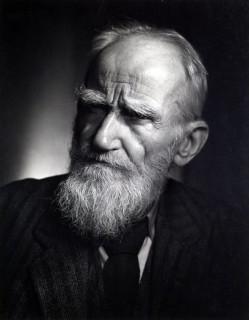
Shaw is born on July 26, 1856, at 3 Upper Synge Street in Portobello, a lower-middle-class area of Dublin. The Shaw family is of English descent and belong to the dominant Protestant Ascendancy in Ireland. Between 1865 and 1871, Shaw attends four schools, all of which he hates. His experiences as a schoolboy leave him disillusioned with formal education. In October 1871 he leaves school to become a junior clerk in a Dublin firm of land agents, where he works hard and quickly rises to become head cashier. During this period, he is known as “George Shaw”; after 1876, he drops the “George” and styles himself “Bernard Shaw.”
Shaw moves to London in 1876, where he struggles to establish himself as a writer and novelist and embarks on a rigorous process of self-education. By the mid-1880s he has become a respected theatre and music critic. Following a political awakening, he joins the gradualistFabian Society and becomes its most prominent pamphleteer. He has been writing plays for years before his first public success, Arms and the Man in 1894. Influenced by Henrik Ibsen, he seeks to introduce a new realism into English-language drama, using his plays as vehicles to disseminate his political, social, and religious ideas. By the early twentieth century his reputation as a dramatist is secured with a series of critical and popular successes that include Major Barbara, The Doctor’s Dilemma, and Caesar and Cleopatra.
Shaw’s expressed views are often contentious. He promotes eugenics and alphabet reform and opposes vaccination and organised religion. He courts unpopularity by denouncing both sides in World War I as equally culpable, and although not a republican, castigates British policy on Ireland in the postwar period. These stances have no lasting effect on his standing or productivity as a dramatist.
The inter-war years see a series of often ambitious plays, which achieve varying degrees of popular success. In 1938 Shaw provides the screenplay for a filmed version of Pygmalion for which he receives an Academy Award. His appetite for politics and controversy remains undiminished. By the late 1920s he has largely renounced Fabian gradualism and often writes and speaks favourably of dictatorships of the right and left — he expresses admiration for both Mussolini and Stalin. In the final decade of his life, he makes fewer public statements, but continues to write prolifically until shortly before his death, refusing all state honours including the Order of Merit in 1946.
During his later years, Shaw enjoys tending the gardens at Shaw’s Corner. He dies on November 2, 1950, at the age of 94 of renal failure precipitated by injuries incurred when falling while pruning a tree. His body is cremated at Golders Green Crematorium on November 6, 1950. His ashes, mixed with those of his wife Charlotte, are scattered along footpaths and around the statue of Saint Joan in their garden.
Since Shaw’s death scholarly and critical opinion has varied about his works, but he has regularly been rated as second only to Shakespeare among English-language dramatists. Analysts recognise his extensive influence on generations of playwrights. The word “Shavian” has entered the language as encapsulating Shaw’s ideas and his means of expressing them.
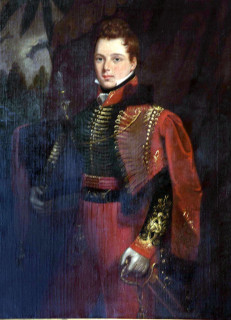
Morgan O’Connell, soldier, politician and son of the Irish Nationalist leader Daniel O’Connell, the Liberator of Ireland, is born in Dublin on October 31, 1804. He serves in the Irish South American legion and the Imperial Austrian Army. He is MP for Meath from 1832 until 1840 and afterwards assistant registrar of deeds for Ireland from 1840 until 1868.
O’Connell, one of seven children (and the second of four sons) of Daniel and Mary O’Connell, is born at 30 Merrion Square, Dublin. His brothers Maurice, John and Daniel are also MPs.
In 1819, self-styled General John Devereux comes to Dublin to enlist military aid for Simón Bolívar‘s army to liberate Venezuela from Spanish rule. He succeeds in forming an Irish Legion, to be part of Bolivar’s British Legions. O’Connell, encouraged by his father, is one of the officers who purchases a commission in it even though he is only 15 years old. The enterprise is mismanaged; there is no commissariat organisation on board the ships, and a part of the force die on the voyage. The remainder are disembarked on the Spanish Main at Margarita Island, where many deaths take place from starvation eight days after the Irish mutineers leave for Jamaica.
Bolivar, who had noted his pleasure at the departure of “these vile mercenaries,” is too astute a diplomat to offend the son of his Irish counterpart. O’Connell is accorded the appropriate privileges of his rank, and toasts are drunk to the health of his father, the “most enlightened man in all Europe.” A portion of the expedition, under Francis O’ Connor, effects an alliance with Bolivar, and to the energy of these allies the republican successes are chiefly due.
Bolivar makes sure that the untrained Irish lad stays out of danger. “I have numberless hardships to go through,” said Bolivar, “which I would not bring him into, for the character of his father is well known to me.” But ceremonial duties soon bore the restless young Irishman. After a year at Bolivar’s headquarters Morgan leaves for Ireland.
If South America did not satisfy O’Connell’s taste for adventure, he has more than his fill on the return journey. He survives a bout of tropical fever and is shipwrecked twice in succession, ending up stranded in Cuba. A schooner captain, who turns out to be a long-lost Irish cousin, rescues him. After the captain is killed in a fight with his boatswain, he hitches a ride to Jamaica on a Danish ship commanded by a skipper from Cork. From Jamaica, another Irish officer offers Morgan passage home.
Arriving in January 1822, O’Connell is greeted by his proud father as a prodigal son returned. His South American adventure, declares Daniel O’Connell, has made a man of Morgan. Otherwise, said O’Connell, “it would have been difficult to tame him down to the sobriety of business.” After his return to Ireland, he again seeks foreign service in the Austrian army.
On December 19, 1832, O’Connell enters parliament in the Liberal interest, as one of the members for Meath, and continues to represent that constituency until January 1840, when he is appointed first assistant-registrar of deeds for Ireland, at a salary of £1,200 a year, a position he holds until 1868. In politics he is never in perfect accord with his father, and his retirement from parliament is probably caused by his inability to accept the Repeal movement.
During his parliamentary career O’Connell fights a duel with Lord William Arden, 2nd Baron Alvanley, a captain in the British Army, at Chalk Farm, on May 4, 1835. A challenge had been sent by Alvanley to O’Connell’s father, who, in accordance with a vow he had made after shooting John D’Esterre, declines the meeting. The younger O’Connell thereupon takes up the challenge on his father’s account. Two shots each are exchanged, but no one is hurt. Afterwards, in December 1835, he receives a challenge from Benjamin Disraeli, in consequence of an attack made on Disraeli by O’Connell’s father. He declines to meet Disraeli.
On July 23, 1840, O’Connell marries Kate Mary, youngest daughter of Michael Balfe of South Park, County Roscommon.
Morgan O’Connell dies at 12 St. Stephen’s Green, Dublin, on January 20, 1885. He is buried in Glasnevin Cemetery in Dublin on January 23.
(Pictured: Morgan O’Connell, oil on canvas, artist unknown, c. 1819/20)
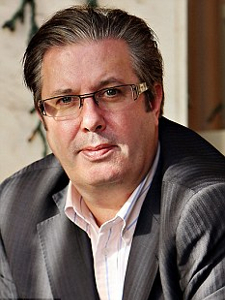
Gerard “Gerry” Ryan, presenter of radio and television employed by Raidió Teilifís Éireann (RTÉ), becomes the latest homegrown celebrity to feature in the Irish version of Madame Tussauds collection when he unveils a life-size model of himself at the Dublin museum on October 29, 2002.
Ryan is born in Clontarf, County Dublin on June 4, 1956. He describes his father, Vinnie, as a “slightly eccentric” dentist from a Presbyterian background and his mother, Maureen, as “a flamboyant woman” who comes from a theatrical background and works in the theatre. His godfather is broadcaster Eamonn Andrews. He is educated at St. Paul’s College, Raheny.
Ryan presents The Gerry Ryan Show on radio station RTÉ 2fm each weekday morning from 1988 until hours before his sudden death. He is presented with a Jacob’s Award for the show in 1990.
Ryan marries Morah Brennan in 1988 and they have five children: Lottie, Rex, Bonnie, Elliott and Babette. In 1997, Morah famously telephones her husband’s show and, under the name Norah, tells half a million listeners intimate details concerning his personal household habits. Gerry and Morah announce their separation in March 2008, which Ryan calls “a very painful experience.” He soon begins a relationship with the former South African Ambassador to Ireland and the then UNICEF Ireland executive director, Melanie Verwoerd.
Ryan is noted for his love of fine food and wine. He battles a weight problem for several years and takes Reductil (Sibutramine), a “slimming pill,” which he says is effective and safe. Ryan concedes in his autobiography Would the Real Gerry Ryan Please Stand Up, released in October 2008, that he drinks too much for his own good.
Ryan is found dead in the bedroom of his home on Leeson Street, Dublin on April 30, 2010.
Among the dignitaries to send tributes following Ryan’s death are Bono, Bill and Hillary Clinton, TaoiseachBrian Cowen, and PresidentMary McAleese. His funeral takes place on May 6, 2010, and is broadcast on 2fm, the home of Ryan’s radio show and a first for the predominantly youthpop-oriented station. His death also comes sixteen years to the day after he hosted Eurovision 1994.
An inquest shows that the cause of Ryan’s death is cardiac arrhythmia and that traces of cocaine found in Ryan’s system are the “likely trigger” of Ryan’s death. A considerable public controversy erupts when Ryan’s long-term use of cocaine comes to light. RTÉ eventually admits to having given insufficient coverage of Ryan’s cocaine habit in the aftermath of the inquest.
Moore is born in 1701, the second son of Charles Moore, Lord Moore, son of Henry Hamilton-Moore, 3rd Earl of Drogheda, and Jane Loftus, daughter of Lord Loftus. He serves in the Irish House of Commons as the Member of Parliament for Dunleer between 1725 and 1727 when he succeeds to his elder brother’s titles and takes his seat in the Irish House of Lords. In 1748 he is invested as a member of the Privy Council of Ireland and made a Governor of Meath.
Moore marries, firstly, Lady Sarah Ponsonby, daughter of Brabazon Ponsonby, 1st Earl of Bessborough, and Sarah Margetson, in 1727, with whom he has six sons and two daughters. Following her death on January 19, 1736, he married, secondly, Bridget Southwell, daughter of William Southwell and Lucy Bowen, on October 13, 1737.
Moore and his son Edward are lost in a storm at sea while travelling between Holyhead and Dublin on October 28, 1758. He is succeeded by his eldest son, Charles, who is created Marquess of Drogheda in 1791.
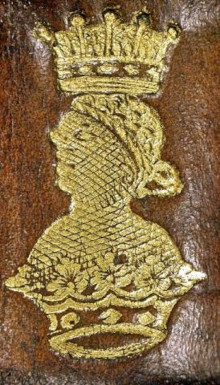
(Pictured: Stamp of Edward Moore, 5th Earl of Drogheda)
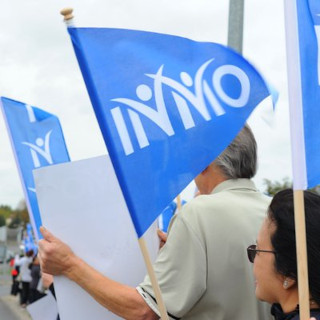
The more difficult task is to modify the pay demands made by the State’s 2,500 ward sisters. The INO executive calls for senior ward sisters to receive salaries of £31,000 a year, or £6,400 more than the current maximum. However, one of the INO branch amendments calls for a new maximum of £35,000, the same salary as directors of nursing in major hospitals.
The conference is called to report on progress to date in talks, spell out objectives and obtain a mandate for strike action if negotiations break down. There is little progress to report. Talks at the Labour Relations Commission the previous week failed to resolve claims on extra-long-service increments for staff nurses, or better rates of pay for ward sisters. Both issues are now referred to the Labour Court, which is already dealing with allowances for extra professional qualifications held by nurses.
The Labour Court is due to hear submissions from the INO, other nursing unions and health service managers on the qualifications issue the following day. About half of the State’s staff nurses have such qualifications, worth £347 a year. The union wants them re-rated at 10% of basic salary, worth up to £2,200 a year for staff nurses at the top of the scale. Despite the negotiating gap, this issue is less difficult to resolve than the others, because it is less likely to lead to follow-on claims from other public service unions.
The union is looking for new long-service increments at the top of the current 15-year scale, which will add 18% to basic salary. As 80% of nurses never graduate to ward sister level, the INO argues that a nurse with 22 years’ service should be earning £25,000.
It is also seeking a minimum 10% pay differential between the maximum amount staff nurses can earn and the pay for the new Clinical Nurse Managers I, recommended by the Nursing Commission. The differential for Clinical Nurse Managers II should be 15% and that for Clinical Nurse Managers III should be 25%.
The union argues that any smaller differentials will make it unattractive for staff nurses to accept promotion and forgo the opportunity for unsocial hours premiums. Recent offers from the management on overtime pay could make promotion even less attractive.
A week earlier the nursing unions defer a nationwide overtime ban only after management agrees to introduce a national framework for overtime payments. Ominously, the concession comes after an overtime ban was introduced in Cork. For the first time nurses nationwide will be paid time-and-a-half, or double time for overtime.
But the unions also demand permanent part-time nursing posts be introduced, as a means of combating the increasing nursing shortage. That there is a shortage of staff nurses is the one issue unions, health service managers and the Department of Health are agreed on. It is severest in Dublin hospitals, where over 300 beds have closed.
MacSwiney is born at 23 North Main Street, Cork, County Cork, one of eight children of John and Mary MacSwiney. Following the failure of this business, John MacSwiney emigrates to Australia in 1885 leaving the children in the care of their mother and his eldest daughter.
MacSwiney is educated by the Christian Brothers at the North Monastery school in Cork but leaves at fifteen to help support the family. He becomes an accountancy clerk but continues his studies and matriculates successfully. He continues in full-time employment while he studies at the Royal University (now University College Cork), graduating with a degree in Mental and Moral Science in 1907.
In 1901 MacSwiney helps to found the Celtic Literary Society, and in 1908 he founds the Cork Dramatic Society with Daniel Corkery and writes a number of plays for them. His first play, The Last Warriors of Coole, is produced in 1910. His fifth play, The Revolutionist (1915), takes the political stand made by a single man as its theme.
Described as a sensitive poet-intellectual, MacSwiney’s writings in the newspaper Irish Freedom bring him to the attention of the Irish Republican Brotherhood. He is one of the founders of the Cork Brigade of the Irish Volunteers in 1913 and is President of the Cork branch of Sinn Féin. He founds a newspaper, Fianna Fáil, in 1914, but it is suppressed after only 11 issues. In April 1916, he is intended to be second in command of the Easter Rising in Cork and Kerry but stands down his forces on the order of Eoin MacNeill.
Following the rising, MacSwiney is imprisoned by the British Government under the Defence of the Realm Act 1914 in Reading and Wakefield Gaols until December 1916. In February 1917 he is deported from Ireland and imprisoned in Shrewsbury and Bromyardinternment camps until his release in June 1917. It is during his exile in Bromyard that he marries Muriel Murphy of the Cork distillery-owning family. In November 1917, he is arrested in Cork for wearing an Irish Republican Army (IRA) uniform, and inspired by the example of Thomas Ashe, goes on a hunger strike for three days prior to his release.
In the 1918 Irish general election, MacSwiney is returned unopposed to the first Dáil Éireann as Sinn Féin representative for Mid Cork, succeeding the Nationalist MP D. D. Sheehan. After the murder of his friend Tomás Mac Curtain, the Lord Mayor of Cork on March 20, 1920, he is elected as Lord Mayor. On August 12, 1920, he is arrested in Cork for possession of “seditous articles and documents,” and also possession of a cipher key. He is summarily tried by a court on August 16 and sentenced to two years’ imprisonment at Brixton Prison in England.
In prison MacSwiney immediately starts a hunger strike in protest of his internment and the fact that he was tried by a military court. Eleven other Irish Republican prisoners in Cork Jail go on hunger strike at the same time. On August 26, the British Government states that “the release of the Lord Mayor would have disastrous results in Ireland and would probably lead to a mutiny of both military and police in south of Ireland.”
MacSwiney’s hunger strike gains world attention. The British Government is threatened with a boycott of British goods by Americans, while four countries in South America appeal to Pope Benedict XV to intervene. Protests are held in Germany and France as well. An Australian member of Parliament, Hugh Mahon, is expelled from the Parliament of Australia for “seditious and disloyal utterances at a public meeting,” after protesting against the actions of the British Government. Two weeks later, the Spanish Catalan organization Autonomous Center of Employees of Commerce and Industry (CADCI) sends a petition to British Prime MinisterDavid Lloyd George calling for his release and the newspaper of the organization, Acció (Acción in Spanish), begins a campaign for MacSwiney.
Food is often placed near MacSwiney to persuade him to give up the hunger strike. Attempts at force-feeding are undertaken in the final days of his strike. On October 20, 1920, he slips into a coma and dies five days later after 73 days on hunger strike. His body lay in St. George’s Cathedral, Southwark in London where 30,000 people file past it. Fearing large-scale demonstrations in Dublin, the authorities divert his coffin directly to Cork, and his funeral in the Cathedral of St. Mary and St. Anne on October 31 attracts huge crowds. He is buried in the Republican plot in St. Finbarr’s Cemetery in Cork. Arthur Griffith delivers the graveside oration.
Jack Lynch, in full John Mary Lynch, is born on August 15, 1917, in Cork, County Cork. He serves as Taoiseach of Ireland from 1966 to 1973 and from 1977 to 1979.
Lynch studies law and enters the civil service with the Department of Justice in 1936. He eventually decides on a legal career, is called to the bar in 1945, resigns from the civil service, and practices on the Cork circuit. He already enjoys a national reputation as a sports hero as he had won five All-Ireland medals as a Cork hurler and another as a footballer.
Lemass’s retirement in 1966 causes an internal party conflict over the succession that leads to Lynch’s selection as a compromise candidate, a position he reluctantly accepts. In November 1966 he becomes leader of Fianna Fáil and Taoiseach. In June 1969 he becomes the only Fianna Fáil leader other than de Valera to win an overall majority in a general election.
In 1969–1973 Lynch plays an important role when civil unrest leads to the collapse of the government of Northern Ireland and poses a threat to the stability of the Irish state. He fires two cabinet ministers who are suspected of involvement in smuggling arms to the Provisional Irish Republican Army (IRA). He also creates a consensus in Irish party politics on a policy of conciliation and cooperation with the British government in seeking a solution to the Northern Ireland problem based on establishing power-sharing between the unionist majority and the Roman Catholic minority.
In 1972 Lynch wins an 83% majority in a referendum on Ireland’s entry into the European Economic Community and, on January 1, 1973, Ireland becomes a member. Although he is defeated in the 1973 Irish general election, he again demonstrates his remarkable popularity at the polls in 1977 when Fianna Fáil wins their largest and their last overall majority. In December 1979, however, discouraged by challenges to his authority from party colleagues, he resigns his leadership and soon after retires from politics. He serves on a number of corporate boards after his retirement.
Lynch dies in the Royal Hospital, Donnybrook, Dublin on October 20, 1999, at the age of 82. He is honoured with a state funeral which is attended by the President Mary McAleese, Taoiseach Bertie Ahern, former Taoisigh John Bruton, Albert Reynolds and Charles Haughey, and various political persons from all parties. The coffin is then flown from Dublin to Cork where a procession through the streets of the city draws some of the biggest crowds in the city’s history. Following the Requiem Mass celebrated in his home parish of the Cathedral of St. Mary and St. Anne, his friend and political ally, Desmond O’Malley, delivers the graveside oration, paying tribute to Lynch’s sense of decency. He is buried in St. Finbarr’s Cemetery, Cork.
Butlers’s attempts to conclude a peace are blocked by a Catholic faction that advocates complete independence for Ireland. The situation deteriorates further, and, in July 1647, he departs from Ireland, leaving the Protestant cause in the hands of the parliamentarians, who had defeated King Charles I in the first English Civil War (1642–1646).
Returning to Ireland in September 1648, Butler concludes a peace with the confederacy in January 1649. He then rallies Protestant royalists and Catholic confederates in support of Charles II, son and successor of Charles I. For several months most of Ireland is under his control. But the parliamentarian general Oliver Cromwell lands at Dublin in August 1649 and swiftly conquers the country for Parliament. Butler flees to France and becomes one of Charles II’s closest advisers at his court-in-exile in Paris.
When Charles II returns to England in the Restoration of 1660, Butler, who had urged constitutional rather than military rule, is made commissioner for the treasury and the navy. Appointed Lord Lieutenant of Ireland in 1662, he makes vigorous attempts to encourage Irish commerce and industry. Nevertheless, his enemies at court persuade Charles to dismiss him in 1669. He is restored to royal favour in 1677 and is again appointed Lord Lieutenant of Ireland. Although he is created a duke in the English peerage in 1682, he is recalled from Ireland in 1684 as a result of new intrigues at Charles’s court and because of the determination of James, Duke of York, to strengthen his supporters in Ireland.