seamus dubhghaill

Promoting Irish Culture and History from Little Rock, Arkansas, USA


Leave a comment

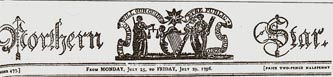
Publication of the First Issue of the “Northern Star”

northern-star

The first issue of the Northern Star, the newspaper of the Society of United Irishmen, is published in Belfast on January 4, 1792. It is published from 1792 until its suppression by the British army in May 1797.

The publication of an Irish newspaper that reflects and disseminates liberal views is an early goal of Irish republicans in the late 18th century. By the founding of the Society of United Irishmen in October 1791, the project is well underway, and the first edition of the Northern Star appears in Belfast in January 1792. Like the United Irishmen, the first financial backers of the Northern Star are Presbyterian and one of the United Irish leadership, Samuel Neilson, is made editor.

Political content dominates the Northern Star but its publication of local news, as opposed to the focus on British and international affairs of other Irish newspapers of the time, brings it wide popularity. Leading members of the United Irishmen are regular contributors and mixed direct political analyses with cutting political satire. William Orr is among those who contributed to its content and his letters lead to his eventual arrest and execution under the Insurrection Act of 1797. The newspaper also enjoys an excellent voluntary distribution network as its penetration follows rapidly wherever the United Irishmen set up new branches. It was estimated that for each copy of the Northern Star sold there are at least five readers, as the reading aloud of articles from the paper is a regular feature of United Irish meetings.

The newspaper is initially protected from the authorities due to the support of well-connected liberals but following the outbreak of war between Great Britain and Revolutionary France in 1793 and the subsequent banning of the United Irishmen as a seditious body it begins to draw increasing attention. The massive popularity of the newspaper protects it from serious harassment until January 1797 when the establishment goes into a state of panic following the French invasion scare at Bantry Bay. The paper is alleged to be behind the Dublin-based Union Star, a militant, low-circulation newssheet, often posted in public places, which specializes in naming informers, “notorious Orangemen,” and other enemies of the United Irishmen, being regarded by Dublin Castle as a republican hitlist.

The extensive distribution network and potency of the Northern Star in spreading United Irish opinion alarms the authorities and possession of a copy comes to be regarded as an admission of seditious intent. The end finally comes with the uncovering of supposed United Irish infiltration of the Monaghan militia in Belfast, which results in the execution of four soldiers. General Gerard Lake, 1st Viscount Lake, already engaged in a brutal counter-insurgency campaign, is quick to put much of the blame on the Northern Star and requests permission to suppress the paper.

As it turns out, official suppression is not necessary as on May 19, 1797, three days after the execution of their ex-comrades, a mob of Monaghan militiamen anxious to prove their loyalty attack the offices of the Northern Star and destroy not only the printing presses but the building itself. The attack results in the demise of the Northern Star to the undoubted satisfaction of the authorities as no action is taken against those involved in the destruction. The Chartist movement later pays tribute to the Northern Star by using the same name for their newspaper that is founded in 1837 by Feargus O’Connor.


Leave a comment

Death of Samuel Nielson, Society of United Irishmen Founder Member

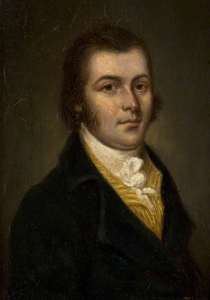
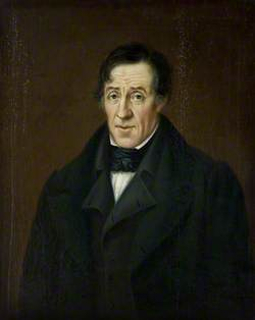
Samuel Neilson, one of the founder members of the Society of United Irishmen and the founder of its newspaper the Northern Star, dies in Poughkeepsie, New York on August 29, 1803.

Neilson is born in Ballyroney, County Down, the son of Presbyterian minister Alexander, and Agnes Neilson. He is educated locally. He is the second son in a family of eight sons and five daughters. At the age of 16, he is apprenticed to his elder brother, John, in the business of woolen drapery in Belfast. Eight years later he establishes his own business.

Despite his commercial success, Neilson is naturally drawn to politics and is early on a member of the reformist Irish Volunteers movement. In 1791, inspired by the French Revolution, he suggests to Henry Joy McCracken the idea of a political society of Irishmen of every religious persuasion. He establishes the Society of United Irishmen in Belfast. The following year he launches the newspaper of the United Irishmen, the Northern Star, which effectively throws away his fortune. As its editor he is a high-profile target for the authorities and is prosecuted for libel several times, being twice imprisoned between 1796 and 1798.

Along with several other state prisoners, Neilson is released in February 1798 following several petitions by influential friends, on grounds of bad health. Upon release he immediately involves himself in the United Irishmen aligning with the radicals among the leadership who are pressing for immediate rebellion and oppose the moderates who wish to wait for French assistance before acting.

The United Irishmen are however, severely penetrated by informants who keep Dublin Castle abreast of their plans and discussions. In March 1798, information of a meeting of the United Irish executive at the house of Oliver Bond leads to the arrest of most of the leadership, leaving Neilson and Lord Edward FitzGerald as the only figures of national importance still at liberty. They decide to press ahead as soon as possible and settled on May 23 as the date for the rebellion to begin.

As the date looms closer, the authorities go into overdrive to sweep up the rump leadership and on May 18 Lord Edward is betrayed in his hiding place and critically wounded while resisting capture. Neilson, now with responsibility for finalising plans for the looming rebellion, decides that Fitzgerald is too valuable to do without, and decides to try and rescue him from Newgate Prison in Dublin. Wary of confiding his plans too early for fear of betrayal, Neilson goes on a reconnaissance of the prison but is spotted by chance by one of his former jailers and after a fierce struggle, he is overpowered and dragged into the prison.

Neilson is indicted for high treason and held in Kilmainham Gaol with other state prisoners for the duration of the doomed rebellion outside. After the execution of Oliver Bond, and the brothers John and Henry Sheares, Neilson and the remaining prisoners agree to provide the authorities with details of the organisation of the United Irishmen, plans for the rebellion, etc. in return for exile.

Following the suppression of the rebellion, Neilson is transferred to Fort George in Inverness-shire, Scotland, and in 1802 he is deported to the Netherlands. From there he makes his way to the United States, arriving in December 1802, and settling in Poughkeepsie, New York.  He has little time to enjoy his liberty before his sudden death on August 29, 1803, of yellow fever, or possibly a stroke.

Nielson is not idle during his short life in America as he completes plans to start a new evening newspaper in Poughkeepsie and also has plans in the works to establish a version of the Society of United Irishmen in the United States. Since his death, his remains have been moved to three different cemeteries before coming to rest in the Poughkeepsie Rural Cemetery in 1880.

(Photograph: (c) National Museums Northern Ireland; Supplied by The Public Catalogue Foundation)


1 Comment

Death of James Napper Tandy, Irish Revolutionary

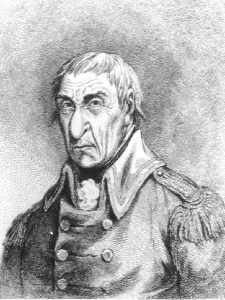
James Napper Tandy, Irish revolutionary and member of the Society of United Irishmen, dies in Bordeaux, France on August 24, 1803.

A Dublin Protestant and the son of an ironmonger, Tandy is baptised in St. Audoen’s Church on February 16, 1739. He attends the Quaker boarding school in Ballitore, County Kildare. He starts life as a small tradesman. Turning to politics, he becomes a member of Dublin Corporation and is popular for his denunciation of municipal corruption and his proposal of a boycott of English goods in Ireland in retaliation for the restrictions imposed by the government on Irish commerce.

Tandy and John Binns persuade Dublin Corporation to condemn by resolution William Pitt the Younger‘s amended commercial resolutions in 1785. He becomes a member of the Whig club founded by Henry Grattan, and he actively co-operates with Theobald Wolfe Tone in founding the Society of United Irishmen in 1791, of which he becomes the first secretary.

Sympathy with the French Revolution is rapidly spreading in Ireland. A meeting of some 6,000 people in Belfast votes a congratulatory address to the French nation in July 1791. In the following year, Tandy takes a leading part in organising a new military association in Ireland modelled after the French National Guard. Tandy also, with the purpose of bringing about a fusion between the Defenders and the United Irishmen, took the oath of the Defenders, a Roman Catholic society whose agrarian and political violence had been increasing for several years.

Tandy is about to be tried in 1793 for distributing a seditious pamphlet in County Louth when the government discovers he has taken the oath of the Defenders. Being threatened with prosecution for this step, and also for libel, he takes refuge by changing his Dublin address often until he flees to the United States in 1795, where he remains until 1798. In February 1798 he goes to Paris, where a number of Irish refugees are assembled and planning rebellion in Ireland to be supported by a French invasion but quarrelling among themselves over tactics.

Tandy accepts the offer of a corvette, the HMS Anacreon, from the French government and sails from Dunkirk accompanied by a few United Irishmen, a small force of men and a considerable quantity of arms and ammunition for distribution in Ireland. He arrives at the isle of Arranmore, off the coast of County Donegal, on September 16, 1798.

Tandy takes possession of the village of Rutland, where he hoists an Irish flag and issues a proclamation. He soon discovers that the French expedition of General Jean Joseph Amable Humbert to aid the Irish rebellion has failed. He sails his vessel around the north of Scotland to avoid the British fleet. He reaches Bergen in safety having brought with him a British ship captured along the way. Tandy then made his way with three or four companions to the free port of Hamburg but a peremptory demand from the British government to detain the fugitives was acceded to despite a counter-threat from the French Directory. In 1799 HMS Xenophon, under Commander George Sayer, brings Tandy and some of his associates back to England as state prisoners.

On February 12, 1800, Tandy is put on trial at Dublin and is acquitted. He remains in prison in Lifford Gaol in County Donegal until April 1801, when he is tried for the treasonable landing on Rutland Island. He pleads guilty and is sentenced to death although he is reprieved and allowed to go to France.

In France, where his release is regarded as a French diplomatic victory, he is received, in March 1802, as a person of distinction. When he dies on August 24, 1803, in Bordeaux, his funeral is attended by the military and an immense number of civilians. James Napper Tandy is buried in his family’s burial crypt, St. Mary’s churchyard, Julianstown, County Meath. His fame is perpetuated in the Irish ballad The Wearing of the Green.


Leave a comment

Execution of the Sheares Brothers

Brothers John and Henry Sheares, both Irish lawyers and members of the Society of United Irishmen, are executed in Dublin on July 14, 1798 during the Irish Rebellion of 1798.

The Sheares brothers are the sons of Henry Sheares, a liberal banker from County Cork who also sits in the Irish Parliament for the Borough of Clonakilty. Henry attends Trinity College, Dublin, buys an officer’s commission and then studies as a lawyer, being called to the bar as a barrister in 1790. John qualifies as a barrister in 1788.

In 1792 the brothers go to Paris and are swept away by the popular enthusiasms of the French Revolution. They meet leaders such as Jacques Pierre Brissot and Jean-Marie Roland, both of whom are to be executed in 1793. In particular they witness the introduction of the guillotine, on which 1,400 are to die in 1792. On the boat from France to England they meet Daniel O’Connell, then a student, who is disgusted by the increasingly bloodthirsty nature of the revolution. O’Connell remains an advocate of non-violence thereafter.

The brothers join the United Irish movement upon their return to Dublin in January 1793, when it is still legal, and John begins to write articles for the Press, a nationalist paper. However, France declares war on Britain, and by extension on Ireland, in February 1793. The Society’s initial aims of securing Catholic emancipation and universal suffrage are unsuccessful, amounting to the administration’s 1793 Relief Act. Its stance becomes more radical, and in turn the Irish administration fears a group inspired by France, banning it in 1794.

The Sheares brothers principally organise the movement in Cork, while continuing with their legal careers. A Mr. Conway, one of their keenest members in Cork, informs the administration of their activities. During 1793 the brothers also join the Dublin Society of the United Irishmen, where another spy, Thomas Collins, passes on their names. Their other two less famous brothers enlist in the British army and are killed in action. On the arrest of most of the United Irish “Directory” members in March 1798, John is chosen as a replacement on the approach to the outbreak of rebellion. His main act at this point is to decide on the date – May 23.

The Directory fatally stays in Dublin, where the United Irish have less support. Already quietly betrayed by Conway and Collins, John also befriends Captain Warnesford Armstrong from County Down, who claims to be a busy member of the party there. John never verifies this, and Armstrong informs the authorities of the brothers’ whereabouts, also appearing as a witness in the ensuing trial. They are arrested on May 21 and indicted on June 26.

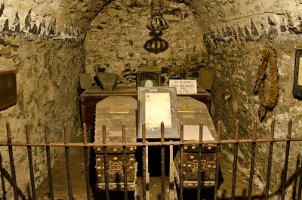
Inevitably the brothers are tried on July 12, as the rebellion is at its height, and are hanged, drawn and quartered two days later outside Newgate Prison. Their lawyer is John Philpot Curran who, with Sir Jonah Barrington, obtain a stay of execution in the hope that Henry will recant, but the brothers are already dead. They are buried at Dublin’s St. Michan’s Church. Visitors are brought to their coffins on a tour of St. Michan’s vaults.

(Pictured: The coffins of the Sheares brothers in the crypt of St. Michan’s Church)


Leave a comment

Death of Statesman Edmund Burke

Edmund Burke, statesman born in Dublin, dies on July 9, 1797, in Beaconsfield, Buckinghamshire, England. He is also known as an author, orator, political theorist, and philosopher who, after moving to London, served as a member of parliament (MP) for many years in the House of Commons with the Whig Party.

Burke receives his early education at a Quaker school in Ballitore, County Kildare. In 1744, he enters Trinity College, Dublin, a Protestant establishment, which up until 1793, did not permit Catholics to take degrees. He graduates from Trinity in 1748. Burke’s father wants him to read Law, and with this in mind he goes to London in 1750, where he enters the Middle Temple, before soon giving up legal study to travel in Continental Europe. After eschewing the Law, he pursues a livelihood through writing.

Burke criticizes British treatment of the American colonies, including through its taxation policies. He also supports the American Revolution, believing both that it could not affect British or European stability and would be an innovative experiment in political development since the Americas are so far away from Europe and thus could have little impact on England.

Burke is remembered for his support for Catholic emancipation, the impeachment of Warren Hastings from the East India Company, and for his later opposition to the French Revolution. In his Reflections on the Revolution in France, he claims that the revolution is destroying the fabric of good society and condemned the persecution of the Catholic Church that results from it. This leads to his becoming the leading figure within the conservative faction of the Whig Party, which he dubs the “Old Whigs,” as opposed to the pro–French Revolution “New Whigs” led by Charles James Fox.

For more than a year prior to his death, Burke realizes that his “stomach” is “irrecoverably ruind.” Edmund Burke dies in Beaconsfield, Buckinghamshire, on July 9, 1797, and is buried there alongside his son and brother. His wife, Mary Jane Nugent, survives him by nearly fifteen years.

In the nineteenth century Burke is praised by both conservatives and liberals. Subsequently, in the twentieth century, he becomes widely regarded as the philosophical founder of modern conservatism.


Leave a comment

First Priests Ordained at St. Patrick’s College, Maynooth

The ordination of the first priests at St. Patrick’s College, Maynooth takes place on June 6, 1800. The college is the “National Seminary for Ireland” and a Pontifical university located in the village of Maynooth, fifteen miles from Dublin.

The college is established on June 5, 1795, as The Royal College of St. Patrick, by act of the Parliament of Ireland, to provide “for the better education of persons professing the popish or Roman Catholic religion.” The College in Maynooth is originally established to provide a university education for Catholic lay and ecclesiastical students and is based in Riverstown House on the south campus from 1802. With the opening of Clongowes Wood College in 1814, the lay college is closed and the college functions solely as a Catholic seminary for almost 150 years.

The college is particularly intended to provide for the education of Catholic priests in Ireland, who until this Act have to go to the continent for training. The added value in this is the reduction of the number of priests returning from training in revolutionary France, with whom Great Britain is at war, thus hindering potential revolution. The value to the government is proved by the condemnation by the Catholic Church hierarchy of the Irish Rebellion of 1798 and later support for the Act of Union.

In 1800, John Butler, 12th Baron Dunboyne, dies and leaves a substantial fortune to the College. Butler had been a Roman Catholic, and Bishop of Cork, who had embraced Protestantism in order to marry and guarantee the succession to his hereditary title. However, there are no children to his marriage, and it is alleged that he had been reconciled to the Catholic Church at his death. Were this the case, a Penal law demands that the will is invalid, and his wealth will pass to his family. Much litigation follows before a negotiated settlement in 1808 that leads to the establishment of a Dunboyne scholarship fund.

The land is donated by William FitzGerald, 2nd Duke of Leinster, who has argued in favour of Catholic emancipation in the Irish House of Lords. He lives nearby at Carton House and also at Leinster House. The building work is paid for by the British Government and parliament continues to give it an annual grant until the Irish Church Act 1869. When this law is passed the College receives a capital sum of £369,000. The trustees invest 75% of this in mortgages to Irish landowners at a yield of 4.25% or 4.75% per annum. This is considered a secure investment at the time but agitation for land reform and the depression of the 1870s erodes this security. The largest single mortgage is granted to the Earl of Granard. Accumulated losses on these transactions reached £35,000 by 1906.

The first building to go up on the site is designed by, and named after, John Stoyte. Stoyte House, which can still be seen from the entrance to the old campus, is a well-known building to Maynooth students and stands very close to the very historic Maynooth Castle. Over the next 15 years, the site at Maynooth undergoes rapid construction so as to cater to the influx of new students, and the buildings which now border St. Joseph’s Square are completed by 1824.

The Rev. Laurence F. Renehan (1797–1857), a noted antiquarian, church historian, and cleric, serves as president of St. Patrick’s from 1845 until 1857. Under Renehan, many of the college’s most important buildings are constructed by Augustus Pugin.

In 2015–16 there are approximately 80 men studying for the priesthood at Maynooth, 60 resident seminarians and approximately 20 non-residents.


4 Comments

Birth of Major General Thomas Conway

thomas-conway

Thomas Conway, a major general in the American Continental Army during the American Revolutionary War, is born in Cloghane, County Kerry, on February 27, 1735. He becomes involved with the alleged Conway Cabal with Horatio Gates and later serves with Émigré forces during the French Revolutionary War.

Conway is born to James Conway and his wife Julieanne Conway. As a child, he immigrates to France with his parents. At 14, he enrolls in the Irish Brigade of the French Army and rises rapidly to the rank of colonel by 1772.

Following the outbreak of the American Revolutionary War he volunteers to the Continental Congress for service with the American rebels in 1777. Based on an introduction from Silas Deane, the Congress appoints him a brigadier general on May 13, and sends him on to George Washington.

Conway commands the leading brigade on the American right flank at the Battle of Germantown and is justly praised for his actions. However, Washington opposes his promotion to major general, believing that many American-born officers with longer and valuable service deserve the rank. This, and Conway’s condescending attitude, lead to continued friction between the men. Congress appoints Conway a major general anyway in December 1777 and makes him inspector general of the army.

When his name is used politically, it is used to describe the infighting known as the Conway Cabal. During the affair, he has written a letter to General Horatio Gates in which he refers to Washington as a “weak general.” The letter is intercepted by Washington and his backers after its delivery is botched by Brigadier General James Wilkinson and is brought before the Congress for inquiry. When the contents of the letter are made public, Conway loses his command as a result. He tries a ploy that had worked before his promotion and submits his resignation to Congress in March 1778. This time, however, it is accepted, so he is forced to leave the Continental Army. John Cadwalader shoots him in a duel on July 4, 1778. When he recovers, he writes an apology to Washington and returns to France.

Conway later returns to the French Army. In 1787 he receives promotion to Maréchal-de-camp (Major General) and an appointment as Governor of French colonies in India.

In 1793 he fights with royalist forces in opposition to French Revolution in southern France. Their loss forces him to become an exile from his adopted country.

During the French Revolution he is condemned to death. He is saved only by an appeal to Great Britain, against which he had fought in the American Revolution, but is compelled to flee from France for his life. He supposedly returns to Ireland and remains there until his death.

After that Conway disappears from history. He is believed to have died about 1800 in poverty and exile.


Leave a comment

Founding of the Society of United Irishmen

society-of-united-irishmen

The Society of United Irishmen, a liberal political organisation that initially seeks Parliamentary reform, is founded in Belfast on October 14, 1791. It evolves into a revolutionary republican organisation, inspired by the American Revolution and allied with Revolutionary France. It launches the Irish Rebellion of 1798 with the objective of ending British monarchical rule over Ireland and founding a sovereign, independent Irish republic.

The enthusiasm for the French Revolution sees great Irish interest in Thomas Paine‘s The Rights of Man released in May 1791. A couple of months later the Belfast Volunteer company gathers to celebrate the second anniversary of the fall of the Bastille. It is intended that a new radical society is to be announced during the celebrations which William Drennan, who is to give a declaration, asks to add in resolutions. Drennan refuses due to the short notice of the request and suggests that Theobald Wolfe Tone be asked.

Tone’s reformist radicalism has advanced beyond that of the Whigs, and he proposes three resolutions for the new society, which he names the Society of United Irishmen. The first resolution is for the denouncing of the continuing interference of the British establishment in Irish affairs. The second is for the full reform of the Irish parliament and its representation. The last resolution calls for a union of religious faiths in Ireland to “abolish the differences that had long divided Irishmen” and seeks to give Catholics political rights. This last proposal, however, is quietly dropped by the Belfast Volunteers to ensure unanimity for the proposals amongst the people.

This seems to delay the launch of the new society and by August 1791 Tone, in response to the rebuff of his third resolution, publishes the popular and robust An Argument on Behalf of the Catholics of Ireland, which argues why they should be included in attempts at reform. That October, Tone is invited to a debate on the creation of a new society by a group of people including Samuel Neilson. Here he finds that his resolutions are now found a few months later to be “too tame.” A new set of resolutions is drafted and agreed upon on October 14, which the Belfast branch of the Society of United Irishmen adopts on October 18, and the Dublin branch on November 9. The main problem they identify for Ireland is the issue of national sovereignty.

All attendees at the first meeting of the Belfast branch are Protestant. Two, Theobald Wolfe Tone and Thomas Russell, are Anglicans and the remainder are Presbyterian, most of whom are involved in the linen trade in Belfast. Along with Tone and Russell, the men involved are William Sinclair, Henry Joy McCracken, Samuel Neilson, Henry Haslett, Gilbert McIlveen, William Simms, Robert Simms, Thomas McCabe, and Thomas Pearce. After forming, the Society names chandler Samuel McTier as its first President.


Leave a comment

Birth of Irish Politician Henry Grattan

henry-grattan

Henry Grattan, Irish politician and member of the Irish House of Commons, who campaigns for legislative freedom for the Irish Parliament in the late 18th century, is born at Fishamble Street in Dublin on July 3, 1746.

Grattan is baptised at the church of St. John the Evangelist in Dublin. He attends Drogheda Grammar School and then goes on to become a distinguished student at Trinity College, Dublin, where he begins a lifelong study of classical literature, and is especially interested in the great orators of antiquity.

After studying at the King’s Inns, Dublin, and being called to the Irish bar in 1772, he never seriously practises law but is drawn to politics, influenced by his friend Henry Flood. He enters the Irish Parliament for Charlemont in 1775, sponsored by Lord Charlemont, just as Flood has damaged his credibility by accepting office. Grattan quickly supersedes Flood in the leadership of the national party, not least because his oratorical powers are unsurpassed among his contemporaries.

Grattan’s movement gains momentum as more and more Irish people come to sympathize with the North American colonists in their war for independence from Great Britain. By 1779, he is powerful enough to persuade the British government to remove most of its restraints on Irish trade, and in April 1780 he formally demands the repeal of Poynings’ Law, which has made all legislation passed by the Irish Parliament subject to approval by the British Parliament. Two years later the British relinquish their right to legislate for Ireland and frees the Irish Parliament from subservience to the English Privy Council. Despite these successes, Grattan soon faces rivalry from Flood, who bitterly criticizes Grattan for failing to demand that the British Parliament completely renounce all claims to control of Irish legislation. Flood succeeds in undermining Grattan’s popularity, but by 1784 Flood himself has lost much of his following.

From 1782 to 1797 Grattan makes limited progress in his struggle to reform the composition of the Irish Parliament and to win voting rights for Ireland’s Roman Catholics. The outbreak of the French Revolution in 1789 bolsters his cause by infusing democratic ideas into Ireland, but the subsequent growth of a radical Irish movement for Catholic emancipation provokes repressive measures by the British. Grattan is caught between the two sides. Ill and discouraged, he retires from Parliament in May 1797 and is in England when the Irish radicals stage an unsuccessful rebellion in 1798.

Grattan returns to Parliament for five months in 1800 and wages a vigorous but fruitless campaign against Prime Minister William Pitt’s plans for the legislative union of the Irish and British parliaments. In 1805, Grattan is elected to the British House of Commons, where for the last 15 years of his life he fights for Catholic emancipation.

In 1920, after crossing from Ireland to London while in poor health to bring forward the Irish question once more, he becomes seriously ill. On his deathbed he speaks generously of Castlereagh, and with warm eulogy of his former rival, Flood. Henry Grattan dies on June 4, 1820, and is buried in Westminster Abbey. His statue is in the Outer Lobby of the Palace of Westminster.

The building housing the faculty of Law and Government at Dublin City University has been named in his honour. Grattan Bridge crossing the River Liffey between Parliament Street on the south side of Dublin and Capel Street on the north side is also named in his honour.


Leave a comment

Birth of Theobald Wolfe Tone

theobald-wolfe-tone

Theobald Wolfe Tone, posthumously known as Wolfe Tone, a leading Irish revolutionary figure and one of the founding members of the United Irishmen, is born on June 20, 1763, in Dublin. He is regarded as the father of Irish republicanism and leader of the Irish Rebellion of 1798.

The son of a coach maker, Tone studies law and is called to the Irish bar in 1789 but soon gives up his practice. In October 1791 he helps found the Society of United Irishmen, initially a predominantly Protestant organization that works for parliamentary reforms, such as universal suffrage and Roman Catholic emancipation. In Dublin in 1792 he organizes a Roman Catholic convention of elected delegates that force Parliament to pass the Catholic Relief Act of 1793. Tone himself, however, is anticlerical and hopes for a general revolt against religious creeds in Ireland as a sequel to the attainment of Irish political freedom.

By 1794, he and his United Irishmen friends begin to seek armed aid from Revolutionary France to help overthrow English rule. After an initial effort fails, Tone goes to the United States and obtains letters of introduction from the French minister at Philadelphia to the Committee of Public Safety in Paris. In February 1796 Tone arrives in the French capital, presents his plan for a French invasion of Ireland, and is favourably received. The Directory then appoints one of the most brilliant young French generals, Lazare Hoche, to command the expedition and makes Tone an adjutant in the French army.

On December 16, 1796, Tone sails from Brest with 43 ships and nearly 14,000 men. The ships are badly handled and, after reaching the coast of west Cork and Kerry, are dispersed by a storm. Tone again brings an Irish invasion plan to Paris in October 1797, but the principal French military leader, Napoleon Bonaparte, takes little interest. When insurrection breaks out in Ireland in May 1798, Tone can only obtain enough French forces to make small raids on different parts of the Irish coast. In September he enters Lough Swilly, County Donegal, with 3,000 men and is captured there.

At his trial in Dublin on November 10, 1798, he defiantly proclaims his undying hostility to England and his desire “in fair and open war to produce the separation of the two countries.” He is found guilty and is sentenced to be hanged on November 12. Early in the morning of the day he is to be hanged, Tone cuts his throat with a penknife.

Theobald Wolfe Tone dies of his self-inflicted wound on November 19, 1798, at the age of 35 in Provost’s Prison, Dublin, not far from where he was born. He is buried in Bodenstown, County Kildare, near his birthplace at Sallins, and his grave is in the care of the National Graves Association.