seamus dubhghaill

Promoting Irish Culture and History from Little Rock, Arkansas, USA


Leave a comment

Birth of Mary Leadbeater, Irish Quaker Author & Diarist

Mary Leadbeater (née Shackleton), Irish Quaker author and diarist, is born in the planned Quaker settlement of BallitoreCounty Kildare, on December 1, 1758. She writes and publishes extensively on both secular and religious topics ranging from translation, poetry, letters, children’s literature and biography. Her accounts of the Irish Rebellion of 1798 provide an insight into the effects of the Rebellion on the community in Ballitore.

Shackleton is the daughter of Richard Shackleton (1726–92) by his second wife, Elizabeth Carleton (1726–66), and granddaughter of Abraham Shackleton, schoolmaster of Edmund Burke. Her parents are Quakers. She keeps a personal diary for most of her life, beginning at the age of eleven and writing in it almost daily. There 55 extant volumes of her diaries in the National Library of Ireland.

Shackleton is educated, and her literary studies are aided by Aldborough Wrightson, a man who had been educated at Ballitore school and had returned to die there. In 1784, she travels to London with her father and pays several visits to Burke’s town house, where she meets Sir Joshua Reynolds and George Crabbe. She also goes to Beaconsfield, and on her return writes a poem in praise of the place and its owner, which is acknowledged by Burke on December 13, 1784, in a long letter. On her way home she visits, at Selby, North Yorkshire, some primitive Quakers whom she describes in her journal.

On January 6, 1791, Shackleton marries William Leadbeater, a former pupil of her father and a descendent of the Huguenot Le Batre and Gilliard families. He becomes a prosperous farmer and landowner in Ballitore. She spends many years working in the village post office and also works as a bonnet-maker and a herbal healer for the village. The couple lives in Ballitore and have six children. Their daughter Jane dies at a young age from injuries sustained after an accident with a wax taper. Another daughter, Lydia, is a friend and possible patron of the poet and novelist Gerald Griffin.

On her father’s death in 1792, Leadbeater receives a letter of consolation from Burke. Besides receiving letters from Burke, she corresponds with, among others, Maria Edgeworth, George Crabbe, and Melesina Trench. On May 28, 1797, Burke writes one of his last letters to her.

Leadbeater describes in detail the effects of the Irish Rebellion of 1798 on the lives of her family and neighbours in Ballitore. She is in Carlow on Christmas Day 1796 attending a Quaker meeting when the news arrives that the French fleet has been seen off Bantry. She describes the troops marching out of the town and the ensuing confusion in Carlow and Ballitore.

Leadbeater’s first literary work, Extracts and Original Anecdotes for the Improvement of Youth, is published anonymously in 1794 in Dublin. It contains an account of the history of Quakerism and several poems on secular and religious subjects.

In 1808, Leadbeater publishes Poems with a metrical version of her husband’s prose translation of Maffeo Vegio‘s Thirteenth Book of the Æneid. She next publishes in 1811 Cottage Dialogues among the Irish Peasantry, of which four editions, with some alterations and additions, appear by 1813. In 1813, she tries to instruct the rich on a similar plan in The Landlord’s Friend. Intended as a sequel to Cottage Dialogues, in which persons of quality are made to discourse on such topics as beggars, spinning-wheels, and Sunday in the village, Tales for Cottagers, which she brings out in 1814 in conjunction with Elizabeth Shackleton, is a return to the original design. The tales illustrate perseverance, temper, economy, and are followed by a moral play, Honesty is the Best Policy.

In 1822, Leadbeater concludes this series with Cottage Biography, being a Collection of Lives of the Irish Peasantry. The lives are those of real persons, and contain some interesting passages, especially in the life of James Dunn, a pilgrim to Lough Derg. Many traits of Irish country life appear in these books, and they preserve several of the idioms of the English-speaking inhabitants of the PaleMemoirs and Letters of Richard and Elizabeth Shackleton … compiled by their Daughter is also issued in 1822. Her Biographical Notices of Members of the Society of Friends who were resident in Ireland appears in 1823, and is a summary of their spiritual lives, with a scanty narrative of events. Her last work is The Pedlars, a Tale, published in 1824.

Leadbeater’s best known work, the Annals of Ballitore, is not printed until 1862, when it is brought out with the general title of The Leadbeater Papers (2 vols.) by Richard Davis Webb, a printer who wants to preserve a description on rural Irish life. It tells of the inhabitants and events of Ballitore from 1766 to 1823, and few books give a better idea of the character and feelings of Irish cottagers, of the premonitory signs of the rebellion of 1798, and the Rebellion itself. The second volume includes unpublished letters of Burke and the correspondence with Mrs. Richard Trench and with Crabbe.

Leadbeater dies at Ballitore on June 27, 1826, and is buried in the Quaker burial-ground there.

Leave a comment

Death of Gerald Griffin, Novelist, Poet & Playwright

Gerald Griffin (Irish: Gearóid Ó Gríofa), Irish novelist, poet and playwright, dies of typhus fever on June 12, 1840. His novel The Collegians is the basis of Dion Boucicault‘s play The Colleen Bawn, or The Brides of Garryowen. Feeling he is “wasting his time” writing fiction, he joins the Congregation of Christian Brothers, a Catholic religious congregation founded by Edmund Ignatius Rice, to teach the children of the poor.

Griffin is born in Limerick, County Limerick, on December 12, 1803, the youngest son of thirteen children of a substantial Catholic farming family. Patrick Griffin, his father, also makes a living through brewing, and he participates as one of Henry Grattan‘s Irish Volunteers (18th century). His mother comes from the ancient O’Brien dynasty and first introduces him to English literature. When he is aged seven, the family moves to Fairy Lawn, a house near Loghill, County Clare, which sits on a hill above the bank of the Shannon Estuary, about twenty-seven miles from Limerick. Here he has an idyllic childhood and receives a classical education.

In 1820 the family at Fairy Lawn is broken up. The parents with several of the children emigrate to the United States and settle in Pennsylvania. Griffin, with one brother and two sisters, is left behind under the care of his elder brother William, a practicing physician in Adare, County Limerick. He meets John Banim in Limerick. Inspired by the successful production of Banim’s play Damon and Pythias (1821), Griffin, at nineteen years of age, moves to London in 1823. After an unsuccessful attempt at becoming a playwright, he endures years of poverty in London, managing only to scrape by through writing reviews for periodicals and newspapers. At the end of two years, he obtains steady employment in the publishing house as reader and reviser of manuscripts, and in a short time becomes frequent contributor to some of the leading periodicals and magazines. His early pieces in The Literary Gazette vividly describe the rural setting of his childhood, recount Irish folklore, translate the Celtic Irish language for the English readers, and, as Robert Lee Wolff observes, “waxed richly sardonic about Irishmen who tried to be more English than the English.”

Griffin’s Holland-Tide or Munster Popular Tales is published by Simpkin & Marshall in 1827. Holland-Tide is a collection of seven short stories, all of which are told in the house of a hospitable Munster farmer during All Hallows’ Eve in Munster. Holland-Tide establishes his reputation, and he returns to Ireland, where he writes Tales of the Munster Festivals in Pallaskenry to which his brother William has moved.

Experience leads Griffin to modify his expectations in relation to literary work, and, with a view to the legal profession, he enters the University of London as a law student, but in a short time removes to Dublin for the study of ancient Irish history, preparatory to his work The Invasion, which is published in 1832. This work has a good sale and is highly praised by scholars but never becomes popular.

With the exception of a tour through Scotland and a short trip on the European continent, Griffin lives with his brother, keeping up to some extent his literary labours. By 1833, he is increasingly concerned that he is wasting his time and begins to devote himself to teaching the poor children of the neighborhood. In 1838, hes all of his unpublished manuscripts and joins the Congregation of Christian Brothers, a Catholic religious order which has as its special aim the education of children of the poor. Writing to an old friend he says he feels a great deal happier in the practice of this daily routine than he ever did while roving about the great city, absorbed in the modest project of rivaling Shakespeare and throwing Scott in the shade. In June 1839, he is transferred from Dublin to Cork, where he dies of typhus fever at the age of thirty-six on June 12, 1840.

Griffin’s play Gisippus is produced posthumously at Theatre Royal, Drury Lane on February 23, 1842, by William Macready, and it runs to a second edition in print.

One of Griffin’s most famous works is The Collegians, a novel based on a trial that he had reported on, involving the murder of a young Irish Catholic girl (Ellen Hanley) by a Protestant Anglo-Irish man (John Scanlon). The novel is later adapted for the stage as The Colleen Bawn by Dion Boucicault.

Griffin has a street named after him in Limerick and another in Cork. Loughill/Ballyhahill GAA club in west Limerick plays under the name of Gerald Griffins.

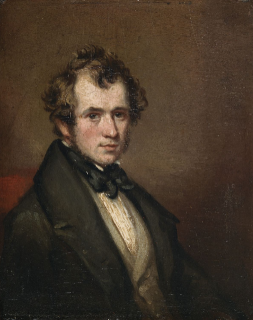
(Pictured: “Portrait of Gerald Griffin (1803-1840), Poet and Novelist,” painting by Richard Rothwell (1800-1868), National Gallery of Ireland)


Leave a comment

Birth of Painter Richard Rothwell

Richard Rothwell, nineteenth-century Irish portrait and genre painter, is born on November 20, 1800, in Athlone, County Westmeath.

Rothwell is born to James and Elizabeth and is the oldest of their seven children. He trains to become a painter at the Dublin Society‘s school from 1814 until 1820 and wins a silver medal for his work. At the age of 24, he is made a member of the newly established Royal Hibernian Academy and exhibits portraits there from 1826 to 1829. He subsequently moves to London and works as a studio assistant to Thomas Lawrence. When Lawrence dies in 1830, Rothwell completes many of his unfinished works and is poised to become the next foremost portrait painter in Britain and Ireland.

According to Leoneé Ormond’s biographical article in the Grove Dictionary of Art, Rothwell “was at the height of his powers from 1829 to 1831” and he “was much influenced by Lawrence, but he lacked the incisiveness and flair of his master.” According to Fintan Cullen‘s biographical entry in the Oxford Dictionary of National Biography, Rothwell’s “portraits are highly accomplished” and “fine examples” including those of novelist Gerald Griffin and Mary Shelley.

From 1831 to 1834, Rothwell tours Italy to study Italian art so that he can paint history paintings. In the 1830s, he starts painting genre pictures, such as The Poor Mendicants (1837). He usually paints Italian-inspired pieces, such as his semi-nude study Calisto, a work he considers to be his masterpiece. He is furious when the painting is poorly hung at the 1862 International Exhibition in London and publishes a pamphlet on the topic.

When Rothwell returns to London, his popularity has evaporated. He lives and exhibits works in Ireland, the United States, London, and Italy, but he never again achieves the same level of popularity he had reached in the late 1820s.

In 1842 Rothwell marries Rosa Marshall. The couple has several children.  Rothwell contracts a fever while working in Rome and dies on September 13, 1868. Joseph Severn, who painted a portrait of the Romantic poet John Keats, arranges for Rothwell’s funeral and tomb in the Protestant Cemetery, Rome.


Leave a comment

Birth of Irish Novelist Anna Maria Hall

anna-maria-hall

Anna Maria Hall (nee Fielding), Irish novelist who often publishes as “Mrs. S. C. Hall,” is born in Dublin on January 6, 1800. She lives with her mother, a widow named Sarah Elizabeth Fielding, and stepfather, George Carr of Graigie, Wexford, until 1815. She goes to England with her mother in 1815, and on September 20, 1824, marries Samuel Carter Hall. Her mother lives with her in London until she dies.

Hall’s first recorded contribution to literature is an Irish sketch called “Master Ben,” which appears in The Spirit and Manners of the Age, January 1829. Other tales follow. Eventually they are collected into a volume entitled Sketches of Irish Character (1829), and henceforth she becomes “an author by profession.” The following year she issues a little volume for children, Chronicles of a School-Room, consisting of a series of simple tales.

In 1831, she publishes a second series of Sketches of Irish Character fully equal to the first, which is well received. The first of her nine novels, The Buccaneer (1832), is a story of the time of The Protectorate, and Oliver Cromwell is among the characters. To The New Monthly Magazine, which her husband is editing, she contributes Lights and Shadows of Irish Life, articles which are republished in three volumes in 1838. The principal tale in this collection, “The Groves of Blarney,” is dramatised with considerable success by the author with the object of supplying a character for Tyrone Power and runs for a whole season at the Adelphi Theatre in 1838. Hall also writes “The French Refugee,” produced at the St. James’s Theatre in 1836, where it runs ninety nights, and for the same theatre Mabel’s Curse, in which John Pritt Harley sustains the leading part.

Another of her dramas, of which she has neglected to keep a copy, is Who’s Who? which is in the possession of Tyrone Power when he is lost in the President in April 1841. In 1840, she issues what has been called the best of her novels, Marian, or a Young Maid’s Fortunes, in which her knowledge of Irish character is again displayed in a style equal to anything written by Maria Edgeworth. Her next work is a series of “Stories of the Irish Peasantry,” contributed to Chambers’s Edinburgh Journal, and afterwards published in a collected form. In 1840 she aids her husband in a book chiefly composed by him, “Ireland, its Scenery, Characters, &c.” She edits the St. James’s Magazine from 1862 to 1863.

In the Art Journal, edited by her husband, she brings out Pilgrimages to English Shrines in 1849, and here the most beautiful of all her books, Midsummer Eve, a Fairy Tale of Love, first appears. One of her last works, Boons and Blessings (1875), dedicated to the Earl of Shaftesbury, is a collection of temperance tales, illustrated by the best artists.

Hall’s sketches of her native land bear a closer resemblance to the tales of Miss Mitford than to the Irish stories of John Banim or Gerald Griffin. They contain fine rural descriptions and are animated by a healthy tone of moral feeling and a vein of delicate humour. Her books are never popular in Ireland, as she sees in each party much to praise and much to blame, so that she fails to please either the Orange Order or the Roman Catholics.

On December 10, 1868, she is granted a civil list pension of £100 a year. She is instrumental in founding the Hospital for Consumption at Brompton, the Governesses’ Institute, the Home for Decayed Gentlewomen, and the Nightingale Fund. Her benevolence is of the most practical nature. She works for the temperance cause, for women’s rights, and for the friendless and fallen. She is a friend to street musicians, and a thorough believer in spiritualism, but this belief does not prevent her from remaining, as she ever was, a devout Christian. She dies at Devon Lodge, East Moulsey, January 30, 1881, and is buried in Addlestone churchyard on February 5.


Leave a comment

Birth of Gerald Griffin, Novelist & Playwright

gerald-griffin

Gerald Griffin, Irish novelist, poet, and playwright, born in Limerick on December 12, 1803.

Griffin is the twelfth of the fifteen surviving children in his family. His father, Patrick Griffin, is a brewery farmer, and his mother, Ellen Griffin, of the ancient Gaelic family of the O’Briens, is very cultivated and much interested in literature.

Griffin goes to London in 1823 and becomes a reporter for one of the daily papers. He later turns to writing fiction. One of his most famous works is The Collegians, a novel based on a trial he has reported on, that of John Scanlan, a Protestant Anglo-Irish man who murdered Ellen Hanley, a young Irish Catholic girl. The novel is adapted to the stage as The Colleen Bawn, by Dion Boucicault.

In September 1838, Griffin informs his family of his intention of joining the Congregation of Christian Brothers. He enters the novitiate at North Richmond Street, Dublin, on September 8. He embarks on his new career with intense dedication, abandoning his literary work entirely. He is then admitted to the religious habit on the feast of St. Theresa and embarks on a two-year novitiate. His distaste for his earlier vocation is allayed to the extent that he is willing to undertake the composition of a few tales of a pious nature, but he is also desperately determined to avoid as much as possible the renewal of old contacts and the reopening of painful associations. Griffin burns most all of his unpublished manuscripts, preserving only a few poems and the tragedy, Gisippus.

Griffin dies at the North Monastery, Cork, from typhus fever on June 12, 1840. He is buried in the community’s graveyard on June 15.

Gerald Griffin has a street named after him in Limerick City and another in Cork City. Loughill/Ballyhahill GAA club in west Limerick plays under the name of Gerald Griffins.