seamus dubhghaill

Promoting Irish Culture and History from Little Rock, Arkansas, USA


Leave a comment

Death of Francis McCloskey, First Fatality of “The Troubles”

the-troubles

Francis McCloskey, a 67-year-old Catholic civilian, dies on July 14, 1969, one day after being hit on the head with a baton by an officer of the Royal Ulster Constabulary (RUC) during street disturbances in Dungiven, County Derry. McCloskey is sometimes considered to be the first fatality of The Troubles.

McCloskey is found unconscious on July 13 near the Dungiven Orange Hall following a police baton charge against a crowd who had been throwing stones at the hall. Witnesses later say they had seen police beating a figure with batons in the doorway where McCloskey is found, although police claim he had been unconscious before the baton charge and may have been hit with a stone.

The Troubles is the common name for the ethno-nationalist conflict in Northern Ireland that begins in the late 1960s and is deemed by most to end with the Good Friday Agreement of 1998. Although the Troubles mainly take place in Northern Ireland, violence spills over at times into parts of the Republic of Ireland, England, and mainland Europe.

The conflict is primarily political, but it also has an ethnic or sectarian dimension, although it is not a religious conflict. A key issue is the constitutional status of Northern Ireland. Unionists and loyalists, who are mostly Protestants and consider themselves British, generally want Northern Ireland to remain within the United Kingdom. Irish nationalists and republicans, who are mostly Catholic and consider themselves Irish, generally want it to leave the United Kingdom and join a united Ireland. The conflict begins amid a campaign to end discrimination against the Catholic/nationalist minority by the Protestant/unionist government and police force in 1968. The campaign is met with violence, eventually leading to the deployment of British troops and subsequent warfare.

The main participants in the Troubles are republican paramilitaries such as the Provisional Irish Republican Army (IRA) and Irish National Liberation Army (INLA), loyalist paramilitaries such as the Ulster Volunteer Force (UVF) and Ulster Defence Association (UDA), the British Army and Royal Ulster Constabulary (RUC), and political activists and politicians. The security forces of the Republic of Ireland play a smaller role. More than 3,500 people are killed in the conflict, of whom 52% were civilians, 32% are members of the British security forces, and 16% are members of paramilitary groups. There has been sporadic violence since the signing of the Good Friday Agreement, including a campaign by anti-ceasefire republicans.


Leave a comment

Patrick Magee Found Guilty of Grand Brighton Hotel Bombing

patrick-joseph-magee

Patrick Joseph Magee of Belfast is found guilty on June 10, 1986, of planting a bomb at the Grand Brighton Hotel in 1984 which kills five people but misses its primary target, British Prime Minister Margaret Thatcher. The bombing is testament to the ingenuity of the Irish Republican Army (IRA) and its bomb makers.

The 30-pound bomb is planted behind a bath in a room on the sixth floor more than three weeks prior to the Prime Minister’s visit. Timed to go off on the final day of the conference, it explodes in the early morning hours of October 12, 1984 and nearly wipes out most of Thatcher’s cabinet, killing five prominent Conservatives and injuring thirty-four.

The bomb destroys a bathroom that Mrs. Thatcher had been in just a few minutes earlier.

Magee stays in the hotel four weeks previously under the false name of Roy Walsh, during the weekend of September 14-17, 1984. He plants the bomb, which includes a long-delay timer, in the bathroom wall of his room, number 629. Magee becomes the primary suspect when forensic officers find his palm print on a hotel registration card following the blast.

Magee is arrested in the Queen’s Park area of Glasgow on June 22, 1985 with other members of an active service unit, including Martina Anderson, while planning other bombings.

Sentenced to a minimum 35 years in jail, he is released from prison in 1999 as part of the Good Friday Agreement early release program. Magee is one of many on both sides of the conflict whose release raises differing emotions.

In one of the more compelling twists associated with the Northern Ireland troubles, Magee works diligently since his release to ease tensions in Northern Ireland and develops a strong working relationship with Jo Berry, daughter of Sir Anthony Berry MP who was killed in the Grand Brighton Hotel blast. They first meet publicly in November 2000 in an effort at achieving reconciliation. They have met publicly on more than one hundred occasions since that date.


Leave a comment

Signing of the Good Friday Agreement

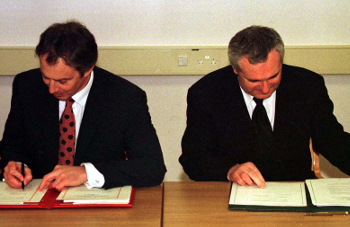
After nearly two years of talks, the Good Friday Agreement, a major political development in the Northern Ireland peace process of the 1990s, is signed by Irish Taoiseach Bertie Ahern and British Prime Minister Tony Blair on Good Friday, April 10, 1998 in Belfast, Northern Ireland.

The Good Friday Agreement brings to an end the 30 years of sectarian conflict in Northern Ireland known as “The Troubles.”  Northern Ireland’s present devolved system of government is based on the Agreement.

The Agreement is made up of two inter-related documents: (1) a multi-party agreement by most of Northern Ireland’s political parties and (2) an international agreement between the British and Irish governments called the British-Irish Agreement.

The Agreement sets out a complex series of provisions relating to a number of areas including the status and system of government of Northern Ireland within the United Kingdom (Strand 1), the relationship between Northern Ireland and the Republic of Ireland (Strand 2), and the relationship between the Republic of Ireland and the United Kingdom (Strand 3).

Issues relating to civil and cultural rights, decommissioning of weapons, justice and policing are central to the Agreement.

The Agreement is approved by voters across the island of Ireland in two referendums held on May 22, 1998. The people of both Northern Ireland and the Republic of Ireland need to approve the Agreement in order for it to come into effect. In Northern Ireland, voters are asked whether they support the multi-party agreement. In the Republic of Ireland, voters are asked whether they will allow the state to sign the agreement and allow necessary constitutional changes to facilitate it.

The British-Irish Agreement comes into force on December 2, 1999. The Democratic Unionist Party (DUP) is the only major political group in Northern Ireland to oppose the Good Friday Agreement.


Leave a comment

Birth in Belfast of Ian Paisley

ian-paisley

Ian Richard Kyle Paisley, loyalist politician and Protestant religious leader from Northern Ireland is born on April 6, 1926, in Armagh, County Armagh.

Paisley becomes a Protestant evangelical minister in 1946 and remains one for the rest of his life. In 1951, he co-founds the fundamentalist Free Presbyterian Church of Ulster and is its leader until 2008. Paisley becomes known for his fiery speeches and regularly preaches and protests against Catholicism, ecumenism and homosexuality. He gains a large group of followers who are referred to as “Paisleyites.”

Paisley becomes involved in Ulster unionist/loyalist politics in the late 1950s. In the mid-late 1960s he leads and instigates loyalist opposition to the Catholic civil rights movement in Northern Ireland. This leads to the outbreak of The Troubles in the late 1960s, a conflict that engulfs Northern Ireland for the next thirty years. In 1970, he becomes Member of Parliament for North Antrim and the following year he founds the Democratic Unionist Party (DUP), which he leads for almost forty years. In 1979, he becomes a Member of the European Parliament.

Throughout the Troubles, Paisley is seen as a firebrand and the face of hard-line unionism. He opposes all attempts to resolve the conflict through power-sharing between unionists and Irish nationalists/republicans, and all attempts to involve the Republic of Ireland in Northern affairs. His efforts help bring down the Sunningdale Agreement of 1974. He also opposes the Anglo-Irish Agreement of 1985, with less success. His attempts to create a paramilitary movement culminate in Ulster Resistance. Paisley and his party also oppose the Northern Ireland peace process and Good Friday Agreement of 1998.

In 2005, Paisley’s DUP becomes the largest unionist party in Northern Ireland, displacing the Ulster Unionist Party (UUP), which has dominated unionist politics since 1905. In 2007, following the St. Andrews Agreement, the DUP finally agrees to share power with republican party Sinn Féin and consent to all-Ireland governance in certain matters. Paisley and Sinn Féin’s Martin McGuinness become First Minister and deputy First Minister respectively in May 2007. Paisley steps down as First Minister and DUP leader in May 2008 and leaves politics in 2011. Paisley is made a life peer in 2010 as Baron Bannside.

In November 2011, Paisley announces to his congregation that he is retiring as a minister. He delivers his final sermon to a packed attendance at the Martyrs’ Memorial Hall on December 18, 2011, and finally retires from his religious ministry on January 27, 2012.

Paisley dies in Belfast on September 12, 2014. He is buried in Ballygowan, County Down on September 15 following a private funeral and a public memorial for 800 invited guests is held in the Ulster Hall on October 19. An obituary in The New York Times reports that late in life Paisley had moderated and softened his stances against Roman Catholics but that “the legacies of fighting and religious hatreds remained.”


1 Comment

The 1996 Docklands Bombing

docklands-bombing

The Docklands bombing, also known as the Canary Wharf bombing or the South Quay bombing, occurs on February 9, 1996, marking the end of the Irish Republican Army‘s (IRA) seventeen-month ceasefire.

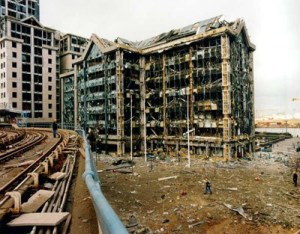
At about 7:01 PM on February 9, the Provisional Irish Republican Army detonates a large bomb in a small lorry about 80 yards from South Quay Station on the Docklands Light Railway in the Canary Wharf financial district of London. The bomb, containing 500 kg of ammonium nitrate fertilizer and sugar and a detonating cord made of semtex, PETN, and RDX high explosives, is placed directly under the point where the tracks cross Marsh Wall.

The IRA sends telephone warnings 90 minutes prior to the detonation and the area is evacuated. However, two men working in the newsagents shop directly opposite the explosion, Inam Bashir and John Jeffries, are not evacuated in time and are killed in the explosion. Thirty-nine people require hospital treatment as a result of the blast and falling glass. A portion of the South Quay Plaza is destroyed, and the explosion leaves a crater ten metres wide and three metres deep. The shockwave from the blast causes windows to rattle five miles away.

Approximately £100 million worth of damage is done by the blast. The Midland Bank building is damaged beyond economic repair and is demolished. South Quay Plaza I and II are severely damaged and require complete rebuilding. The station itself is extensively damaged, but both it and the bridge under which the bomb is exploded are reopened within weeks.

The bombing marks the end of a 17-month IRA ceasefire during which Irish, British, and American leaders work for a political solution to the troubles in Northern Ireland. IRA member James McArdle is convicted of conspiracy to cause explosions and sentenced to 25 years in prison, but murder charges are dropped. McArdle is released under the terms of the Good Friday Agreement in June 2000 with a royal prerogative of mercy from Queen Elizabeth II.

dockland-bombing-damage

The IRA describes the deaths and injuries as a result of the bomb as “regrettable,” but says that they could have been avoided if police had responded promptly to “clear and specific warnings.” Commissioner of the Metropolitan Police Sir Paul Condon says, “It would be unfair to describe this as a failure of security. It was a failure of humanity.”

Gerry Adams, the leader of Sinn Féin, the political wing of the IRA, speaks of the need to continue the peace process. British Prime Minister John Major says there is now “a dark shadow of doubt” where optimism has existed.

On February 28, Prime Minister Major and Taoiseach of the Republic of Ireland John Bruton, announce that all-party talks will be resumed in June. Major’s decision to drop the demand for IRA decommissioning of weapons before Sinn Fein is allowed into talks leads to criticism from the press, which accuse him of being “bombed to the table.”


Leave a comment

Hillary Clinton Announced for Induction into Irish America Hall of Fame

hillary-clintonOn February 2, 2015, Irish America magazine announces that Hillary Rodham Clinton will be inducted into the Irish America Hall of Fame in March, in recognition of her work on the Irish peace process.

Clinton travels frequently to Ireland as First Lady and as U.S. Secretary of State, and often talks about the end of the civil strife, known as The Troubles, as a crowning foreign policy achievement of her husband’s administration. On her visit to Belfast in 2012, she pledges to continue to support peace in Ireland in whatever way possible.

“Hillary Rodham Clinton is one of the unsung heroes of the success of the Irish peace process,” says Niall O’Dowd, publisher of Irish America magazine. “As First Lady, U.S. Senator, and Secretary of State she always gave the issue top priority to help ensure it remained at the top of the U.S. foreign policy agenda. During that historic first trip to Northern Ireland with Bill Clinton in 1995, which I was privileged to be on, she galvanized women’s groups on both sides by meeting with them, shaping their agenda, and making sure they always had a friend in the U.S. administration. More than that, she constantly stayed involved, never giving up her focus on bringing an end to Europe’s longest conflict at the time.”

On the eve of St. Patrick’s Day, Clinton delivers the keynote address at the luncheon in Manhattan of high profile Irish-Americans who each year honor elected officials and others. She describes sitting at a table in Belfast, over cups of tea, with women from both sides of the conflict and watching as they discover how much they share.

She does not portray herself as instrumental to the Good Friday Agreement that President Clinton brokered in 1998, but says her outreach to women in Belfast on multiple visits during that period had played a critical role.

“You cannot bring peace and security to people just by signing an agreement,” she says. “In fact, most peace agreements don’t last.” She says that when “the work of peace permeates down to the kitchen table, to the backyard, to the neighborhood, around cups of tea, there’s a much greater chance the agreement will hold.”

Previous inductees into the Irish America Hall of Fame include former President John F. Kennedy, former President Bill Clinton, Vice President Joseph R. Biden, Jr., and former Maryland Governor Martin O’Malley, who addressed the luncheon in 2014 in a mix of English and Irish.