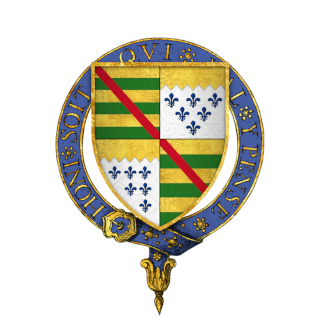
Robert Poynings is implicated in Jack Cade’s rebellion, and Edward is himself concerned in a Kentish rising against Richard III, which compels him to escape to Continental Europe. He attaches himself to Henry, Earl of Richmond, afterwards King Henry VII, with whom he returns to England in 1485.
Poynings is employed in the wars on the continent, and in 1493 he is made governor of Calais. In the following year he goes to Ireland as Lord Deputy under the viceroyalty of Prince Henry, afterwards King Henry VIII. He immediately sets about anglicizing the government of Ireland, which he thoroughly accomplishes, after inflicting punishment on the powerful Irish clans who support the imposture of Perkin Warbeck.
Poynings then summons the celebrated parliament of Drogheda, which meets in December 1494 and enacts the “Statutes of Drogheda,” famous in Irish history as “Poynings’s law,” which make the Irish legislature subordinate to, and completely dependent on, that of England, until its repeal in 1782.
After defeating Perkin Warbeck at Waterford and driving him out of Ireland, he returns to England in 1496, and is appointed warden of the Cinque Ports. He is employed both in military commands and in diplomatic missions abroad by Henry VII, and later by Henry VIII, his most important achievement being the successful negotiation of the “holy league” between England, Spain, the emperor, and the pope, in 1513. In 1520 Poynings is present at the Field of the Cloth of Gold, in the arrangement of which he has taken an active part. He is also present at Henry’s meeting with Emperor Charles V at Gravelines on July 10.
Poynings dies at Westenhanger in October 1521. By his wife, Elizabeth Scot, he leaves no surviving issue, and his estates pass through a collateral female line to the Earl of Northumberland. He has several illegitimate children, one of whom, Thomas Poynings, is created Baron Poynings in 1545, but dies in the same year without heirs.
By this time access to institutional power in Ireland was restricted to a small minority, the Anglo-Irish of the Protestant Ascendancy, and frustration at the lack of reform among the Catholic majority eventually led, along with other reasons, to the Irish Rebellion in 1798, involving a French invasion of Ireland and the seeking of complete independence from Great Britain. This rebellion was crushed with much bloodshed, and the subsequent drive for union between Great Britain and Ireland that passes in 1800 is motivated at least in part by the belief that the rebellion was caused as much by reactionary loyalist brutality as by the Society of United Irishmen.
Furthermore, Catholic emancipation is being discussed in Great Britain, and fears that a newly enfranchised Catholic majority will drastically change the character of the Irish government and parliament also contributes to a desire from London to merge the Parliaments.
Complementary acts have to be passed in the Parliament of Great Britain and in the Parliament of Ireland. The Parliament of Ireland had recently gained a large measure of legislative independence under the Constitution of 1782. Many members of the Irish Parliament jealously guard this autonomy and a motion for union is legally rejected in 1799.
Only Anglicans are permitted to become members of the Parliament of Ireland, though the great majority of the Irish population are Roman Catholic, with many Presbyterians in Ulster. In 1793 Roman Catholics regain the right to vote if they own or rent property worth £2 per acre. The Catholic hierarchy is strongly in favour of union, hoping for rapid emancipation and the right to sit as MPs, which is delayed after the passage of the acts until the passage of the Roman Catholic Relief Act 1829.
From the perspective of Great Britain, the union is desirable because of the uncertainty that followed the Irish Rebellion of 1798 and the French Revolution of 1789. If Ireland adopted Catholic Emancipation, willingly or not, a Roman Catholic Parliament could break away from Britain and ally with the French. Also the Irish and British Parliaments, when creating a regency during King George III‘s “madness”, gave the Prince Regent different powers. These considerations lead Great Britain to decide to attempt merger of the two kingdoms and their Parliaments.
The final passage of the Act in the Irish Parliament is achieved with substantial majorities, in part according to contemporary documents through bribery, namely the awarding of peerages and honours to critics to get their votes. Whereas the first attempt had been defeated in the Irish House of Commons by 109 votes against to 104 for, the second vote in 1800 produces a result of 158 to 115.
In the first Parliament of the United Kingdom of Great Britain and Ireland, the members of the House of Commons are not elected afresh. By royal proclamation authorised by the Act, all the members of the last House of Commons from Great Britain take seats in the new House, and from Ireland 100 members are chosen from the last Irish House of Commons: two members from each of the 32 counties and from the two largest boroughs, and one from each of the next 31 boroughs (chosen by lot) and from the University of Dublin. The other 84 Irish parliamentary boroughs are disfranchised, all being pocket boroughs, whose patrons receive £15,000 compensation for the loss of what is considered their property.
(Pictured: Coat of Arms of the United Kingdom from 1837 to 1952 used by Queen Victoria, King Edward VII, George V, Edward VIII and George VI)
Rhys Meyers is born to Geraldine (née Meyers) and folk musician John O’Keeffe. The family moves to County Cork when he is almost a year old. At the age of three, his father leaves the family, leaving his mother alone to care for him and his three younger brothers.
Rhys Meyers grows up with a tumultuous childhood and attends North MonasteryChristian Brothers school, from which he is permanently expelled at age sixteen. Happy to be out of school, he begins spending time in a local pool hall where he is discovered by Hubbard Casting. The casting agents are talent-spotting for the David Puttnam production of War of the Buttons (1994) and ask him to appear for an audition. After three days of auditions, however, he does not get the role and gives up on his acting aspirations. Soon after the failed audition, he receives a call to audition for a national ad campaign for Knorr soup, and though embarrassed by the attention from the ad, he soon finds himself considered for a major film.
Rhys Meyers movie acting debut is a very small role in the film A Man of No Importance (1994), where his simple cast credit is as “First Young Man.” His first lead role is in the film The Disappearance of Finbar (1996). During a 6-month postponement in production, he returns home to Cork and there receives a call about the film Michael Collins (1996). He travels to Dublin to meet with director Neil Jordan and successfully wins the role of Collins’s assassin. Jordan writes about his meeting with the actor, “I have found someone to play Collins’s killer. Jonathan Rhys Meyers, from County Cork, apparently, who looks like a young Tom Cruise. He comes into the casting session with alarming certainty. Obviously gifted.”
Rhys Meyers has been the face of several Hugo Boss advertising campaigns. He has also been involved in several charitable causes, including the Hope Foundation, and the children’s charity, Barretstown. He is married to Mara Lane, and they have one son together. He still resides in County Cork.
In 2020, Rhys Meyers is listed as number 44 on The Irish Times list of Ireland’s greatest film actors.
Simnel is born around 1477. His real name is not known, and contemporary records call him John, not Lambert, and even his surname is suspect. Different sources have different claims of his parentage, but he is most definitely of humble origin. At the age of about ten, he is taken as a pupil by an Oxford-trained priest named Richard Simon who apparently decides to become a kingmaker. He tutors the boy in courtly manners and contemporaries describe the boy as handsome. He is taught the necessary etiquette and is well educated by Simon.
Simon notices a striking resemblance between Lambert and the sons of Edward IV, so he initially intends to present Simnel as Richard, Duke of York, son of King Edward IV, the younger of the vanished Princes in the Tower. However, when he hears rumours (at the time false) that the Edward Plantagenet, 17th Earl of Warwick has died during his imprisonment in the Tower of London, he changes his mind. The real Warwick is a boy of about the same age, having been born in 1475, and has a claim to the throne as the son of George Plantagenet, 1st Duke of Clarence, King Edward IV’s executed brother.
Simon spreads a rumour that Warwick has actually escaped from the Tower and is under his guardianship. He gains some support from Yorkists. He takes Simnel to Ireland where there is still support for the Yorkist cause and presents him to the head of the Irish government, Gerald FitzGerald, 8th Earl of Kildare, Lord Deputy of Ireland. Kildare is willing to support the story and invade England to overthrow King Henry. Simnel is paraded through the streets, carried on the shoulders of “the tallest man of the time,” an individual called D’Arcy of Platten.
On May 24, 1487, Simnel is crowned in Christ Church Cathedral in Dublin as King Edward VI. He is about 10 years old. Lord Kildare collects an army of Irish soldiers under the command of his younger brother, Thomas FitzGerald of Laccagh.
Simnel’s army, mainly Flemish and Irish troops, lands on Piel Island in the Furness area of Lancashire on June 5, 1487, and are joined by some English supporters. However, most local nobles, with the exception of Sir Thomas Broughton, do not join them. They clash with the King’s army on June 16 at the Battle of Stoke Field in Nottinghamshire and are defeated. Lincoln and Thomas FitzGerald are killed. Lovell goes missing and there are rumours that he has escaped to Scotland with Sir Thomas Broughton and hidden to avoid retribution. Simons avoids execution due to his priestly status but is imprisoned for life. Kildare, who had remained in Ireland, is pardoned.
King Henry pardons young Simnel, probably because he recognises that Simnel had merely been a puppet in the hands of adults and puts him to work in the royal kitchen as a spit-turner. When he grows older, he becomes a falconer. Almost no information about his later life is known. He dies sometime between 1525 and 1535. He seems to have married, as he is probably the father of Richard Simnel, a canon of St. Osyth’s Priory in Essex during the reign of Henry VIII.
In the 17th century, parliament settles at Chichester House, a town house in Hoggen Green (later College Green) formerly owned by Sir George Carew, Lord President of Munster and Lord High Treasurer of Ireland, which had been built on the site of a nunnery disbanded by King Henry VIII at the time of the dissolution of the monasteries. Carew’s house, named Chichester House after its later owner Sir Arthur Chichester, is a building of sufficient importance to have become the temporary home of the Kingdom of Ireland’s law courts during the Michaelmas law term in 1605. Most famously, the legal documentation facilitating the Plantation of Ulster is signed there on November 16, 1612.
Chichester House is in a dilapidated state, allegedly haunted and unfit for official use. In 1727 parliament votes to spend £6,000 on a new building on the site. It is to be the world’s first purpose-built two-chamber parliament building.
The then ancient Palace of Westminster, the seat of the English before 1707 and, later, British Parliament, is a converted building. The House of Commons‘s odd seating arrangements is due to the chamber’s previous existence as a chapel. Hence MPs face each other from former pews.
The original, domed House of Commons chamber is destroyed by fire in the 1790s, and a less elaborate new chamber, without a dome, is rebuilt in the same location and opened in 1796, four years before the Parliament’s ultimate abolition.
Pearce’s designs come to be studied and copied both at home and abroad. The Viceregal Apartments in Dublin Castle imitate his top-lit corridors. The British Museum in Bloomsbury in London copies his colonnaded main entrance. His impact reaches Washington, D.C., where his building, and in particular his octagonal House of Commons chamber, is studied as plans are made for the United States Capitol building. While the shape of the chamber is not replicated, some of its decorative motifs are, with the ceiling structure in the Old Senate Chamber and old House of Representatives chamber (now the National Statuary Hall) bearing a striking resemblance to Pearce’s ceiling in the House of Commons.
(Pictured: Architectural drawing of the front of Parliament House by Peter Mazell based on the drawing by Rowland Omer, 1767)
About 1520 Butler joins the household of CardinalThomas Wolsey, who praises him as a young gentleman “both wise and discreet.” In early 1522, it is proposed by King Henry VIII that he marry his cousin Anne Boleyn, who is the great-granddaughter of Thomas Butler, 7th Earl of Ormond. This is to resolve a dispute her father Thomas Boleyn, 1st Earl of Wiltshire has with James’ father over the Ormond inheritance and title. Wolsey himself supports the proposal. The marriage negotiation, comes to a halt for unknown reasons. Butler subsequently marries Lady Joan Fitzgerald in December 1532. Lady Joan is the daughter and heiress of the other great Munster landholder, the James FitzGerald, 10th Earl of Desmond and his wife Amy O’Brien. Their marriage produces seven sons.
During the early 1540s Butler gradually restores the Butler dynasty to their former position of influence, leading to antagonism from the quarrelsome Lord Deputy of Ireland, Sir Anthony St. Leger. St. Leger gives Butler command of the Irish forces in the Anglo-Scottish War of 1544. On the face of it this is an honour, but allies of Butler accuse St. Leger of deliberately sending him into danger. Butler himself demands an inquiry into claims that St. Leger had planned his murder, and the matter is thought to merit a Privy Council investigation. The Council finds in favour of St. Leger and he and Butler are ordered to work together amicably. Key Government allies of Butler like John Alan and Walter Cowley are removed from office, and Butler is struggling to maintain his standing when he is poisoned.
On October 17, 1546, James goes to London with many of his household. They are invited to dine at Ely Place in Holborn. He is poisoned along with his steward, James Whyte, and sixteen of his household. He dies nine days later, on October 28, leaving Joan a widow in her thirties.
It is surprising, in view of Butler’s high social standing, that no proper investigation into his death is carried out. Who is behind the poisoning remains a mystery. His host at the dinner, John Dudley, 1st Duke of Northumberland, though he could be notably ruthless, seems to have no motive for the crime, as he is not known to have had any quarrel with Butler. A recent historian remarks that it would be an extraordinary coincidence if St. Leger had no part in the sudden and convenient removal of his main Irish opponent.
England’s King Henry VIII, Lord of Ireland and self-declared King of Ireland, marries Anne Boleyn on January 25, 1533, after a secret marriage November 14, 1532. On May 23, 1533, Thomas Cranmer, Archbishop of Canterbury, declares Henry’s first marriage to Catherine of Aragon to be null and void. Five days later, he declares Henry and Anne’s marriage to be valid.
Soon thereafter, Pope Clement VII, who had refused to annul the marriage of Henry and Anne, decrees sentences of excommunication against Henry and Cranmer. As a result of this marriage and these excommunications, the first break between the Church of England and Rome takes place and the Church of England is brought under the King’s control.
Anne is crowned Queen of England on June 1, 1533, and on September 7, she gives birth to a daughter who is christened Elizabeth, in honour of Henry’s mother, Elizabeth of York, and who becomes the future Queen Elizabeth I. Henry is disappointed to have a daughter rather than a son but hopes a son will follow and professes to love Elizabeth.
The king and queen are not pleased with married life. The royal couple enjoys periods of calm and affection but Anne refuses to play the submissive role expected of her. Henry dislikes Anne’s constant irritability and violent temper. After a miscarriage in 1534, Henry sees her failure to give him a son as a betrayal. As early as Christmas 1534, Henry is discussing with Archbishop Cranmer and Thomas Cromwell, his chief minister, the chances of leaving Anne without having to return to Catherine.
In January 1536, the Henry is thrown from his horse in a tournament and is badly injured. It seems for a time that the king’s life was in danger. When news of this accident reaches the queen, who is again pregnant and aware of the consequences if she fails to give birth to a son, she is sent into shock and miscarries a male child that is about 15 weeks old. This is seen by most historians as the beginning of the end of the royal marriage.
Anne’s downfall comes shortly after she has recovered from her miscarriage. Henry has Anne investigated for high treason in April 1536. On May 2, she is arrested and sent to the Tower of London where she is tried before a jury of peers, which includes Henry Percy, her first husband, and her own uncle, Thomas Howard. Anne is found guilty on May 15 and is beheaded on Tower Green at 8:00 AM on May 19, 1536, at the age of 36.
In the century that followed the union of England and Scotland, Ireland gained effective legislative independence from Great Britain through the Constitution of 1782. However, access to institutional power in Ireland was restricted to a small minority, the so-called Anglo-Irish of the Protestant Ascendancy. Frustration at the lack of reform eventually led to a rebellion in 1798, involving a French invasion of Ireland and seeking complete independence from Great Britain. The rebellion was crushed with much bloodshed and the subsequent drive for union between Great Britain and Ireland that passed in 1800 was motivated at least in part by the belief that the rebellion was caused as much by loyalist brutality as by the United Irishmen.
Each Act had to be passed in the Parliament of Great Britain and the Parliament of Ireland. The final passage of the Act in the Irish Parliament was achieved with substantial majorities, achieved in part according to contemporary documents through bribery, namely the awarding of peerages and honours to critics to get their votes.



 seamus dubhghaill