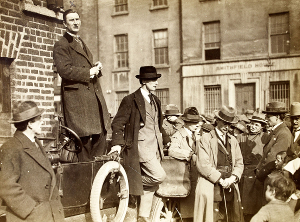
The London-born son of a British scholar and an Irish mother, Childers is a lifelong Protestant, itself an anomaly since Irish nationalism maps strongly to Catholicism. In his early years his loyalty was with the British Empire. In his twenties, Childers volunteers for the Second Boer War, and he later says the rank savagery and underlying injustice of England’s war “changed the whole current of my life and made me a Liberal and a Nationalist.”
Laying down the sword, Childers takes up the pen and writes several books of military history. He also writes a novel, The Riddle of the Sands, that has a claim of being the first spy novel. The Riddle of the Sands has never gone out of print since it was published in 1903.
Both in fiction and nonfiction, Childers’ warnings against the German challenge to British hegemony are prophetic, but he is himself becoming a man divided. In 1914 he runs German guns to Irish nationalists aboard his yacht Asgard and then signs up for the royal navy when World War I erupts. The British crackdown on the Easter Rising during the war completes his radicalization. He moves to Dublin and turns his eloquence against the British.
After Collins’s assassination, emergency laws promulgate the death sentence for anyone caught armed without authorization. Childers is a writer, not a partisan, but he is arrested in early November with a small sidearm, a gift Collins had given him back when they were on the same side. It is a time of bloody justice, and they throw the book at him.
Childers knows as well as Collins had that the internecine conflict would have to end. He faces his execution with awe-inspiring forgiveness. Summoning his 16-year-old son to prison the night before his execution, Childers extracts a promise from the boy that he will find everyone who signed his death warrant and shake their hands. This son, young Erskine Hamilton Childers, eventually becomes President of Ireland.
Childers himself likewise shakes the hands of his own firing squad, one by one. His last words, reported in a number of slightly different variations, are lightheartedly addressed to them: “Take a step or two forwards, lads. It will be easier that way.”
In 1910, at the age of 17, he starts an apprenticeship in O’Neill’s hardware trade in Mitchelstown, where he joins the Gaelic League and the Ancient Order of Hibernians. Later he works at Barry’s Timber Merchants in Fermoy. In the aftermath of the 1916 Easter Rising, he witnesses the shooting and arrest of David, Thomas and Richard Kent of Bawnard House by the Royal Irish Constabulary. After this, he determines to dedicate his life to Irish republicanism. In 1917 he is elected First Lieutenant of the Irish Volunteer Company, which resides in Fermoy.
In Cork in 1919, Lynch re-organises the Irish Volunteers, the paramilitary organisation that becomes the Irish Republican Army (IRA), becoming commandant of the Cork No. 2 Brigade of the IRA during the guerrilla Irish War of Independence. He is captured, along with the other officers of the Cork No. 2 Brigade, in a British raid on Cork City Hall in August 1920. He provides a false name and is released three days later. In September 1920, he and Ernie O’Malley command a force that takes the British Army barracks at Mallow. The arms in the barracks are seized and the building is partially burned. In April 1921, the IRA is re-organised into divisions based on regions. Lynch’s reputation is such that he is made commander of the 1st Southern Division.
The war formally ends with the signing of the Anglo-Irish Treaty between the Irish negotiating team and the British government in December 1921. Lynch is opposed to the Treaty, on the ground that it disestablishes the Irish Republic proclaimed in 1916 in favour of Dominion status for Ireland within the British Empire. He becomes Chief of Staff of the IRA in March 1922, much of which is also against the Treaty.
Although Lynch opposes the seizure of the Four Courts in Dublin by a group of hardline republicans, he joins its garrison in June 1922 when it is attacked by the newly formed National Army. This marks the beginning of the Irish Civil War. The ‘Munster Republic’ falls in August 1922, when Free State troops land by sea in Cork and Kerry. The Anti-Treaty forces then disperse and pursue guerrilla tactics.
Lynch contributes to the growing bitterness of the war by issuing what are known as the “orders of frightfulness” against the Provisional government on November 30, 1922. This General Order sanctions the killing of Free State Teachta Dála (TDs) and Senators, as well as certain judges and newspaper editors in reprisal for the Free State’s killing of captured republicans. Lynch is heavily criticised by some republicans for his failure to co-ordinate their war effort and for letting the conflict peter out into inconclusive guerrilla warfare. Lynch makes unsuccessful efforts to import mountain artillery from Germany to turn the tide of the war.
In March 1923, the Anti-Treaty IRA Army Executive meets in a remote location in the Nire Valley. Several members of the executive propose ending the civil war. However, Lynch opposes them and narrowly carries a vote to continue the war.
On April 10, 1923, a National Army unit is seen approaching Lynch’s secret headquarters in the Knockmealdown Mountains. Lynch is carrying important papers that could not fall into enemy hands, so he and his six comrades begin a strategic retreat. To their surprise, they run into another unit of 50 soldiers approaching from the opposite side. Lynch is hit by rifle fire from the road at the foot of the hill. Knowing the value of the papers they carry, he orders his men to leave him behind.
When the soldiers finally reach Lynch, they initially believe him to be Éamon de Valera, but he informs them, “I am Liam Lynch, Chief-of-Staff of the Irish Republican Army. Get me a priest and doctor, I’m dying.” He is carried on an improvised stretcher manufactured from guns to “Nugents” pub in Newcastle, at the foot of the mountains. He is later brought to the hospital in Clonmel and dies that evening. He is laid to rest two days later at Kilcrumper Cemetery, near Fermoy, County Cork.
O’Duffy does an apprenticeship as an engineer in Wexford before working as an engineer and architect in Monaghan. In 1919 he becomes an auctioneer. He is a leading member of the Gaelic Athletic Association in Ulster in the 1910s. In 1912 he is appointed secretary of the Ulster provincial council. He is also a member of Harps’ Gaelic Football Club.
Professionally, O’Duffy becomes the second Commissioner of the Garda Síochána, the police force of the new Irish Free State, after the Civic Guard Mutiny and the subsequent resignation of Michael Staines. He holds this post until 1933, when he is dismissed by Éamon de Valera. In his political life O’Duffy is an early member of Sinn Féin, founded by Arthur Griffith. He is elected as a Teachta Dála (TD) for his home county of Monaghan during the 1921 election.
After a split in 1923 he becomes associated with Cumann na nGaedheal and becomes head of a veteran’s group then known as the Army Comrades Association. O’Duffy changes its name to “National Guard” and begins to stage fascist-style rallies and adopts a fascist salute. Its members begin to wear blue uniform shirts and become known as the Blueshirts. When government opposition groups form Fine Gael in September 1933, he becomes its first president, reaching the apex of his political power.
Subsequently, the government bans O’Duffy’s National Guard, as well as the group he creates to replace it, the Young Ireland Association, which he in turn replaces with the League of Youth, but their blue shirts indicate its continued fascist ideology. Fine Gael’s other leaders soon tire of his inflammatory rhetoric and the frequent violent behavior of the Blueshirts but are still surprised when their opposition causes him to resign his party leadership in September 1934. He is then ousted as leader of the Blueshirts as well but does retain a small loyal following.
Eoin O’Duffy takes no further part in Irish politics and dies in Dublin on November 30, 1944. In spite of his later politics, he is given a state funeral for his earlier contributions to the Irish government. He is buried in Dublin’s Glasnevin Cemetery.
Raised in Cork, the only child of Minnie (née O’Connor) and Michael O’Donovan, O’Connor attends Saint Patrick’s School on Gardiner’s Hill and North Monastery CBS. His early life is marked by his father’s alcoholism, debt, and ill-treatment of his mother. His childhood is shaped in part by his mother, who supplies much of the family’s income by cleaning houses, because his father is unable to keep steady employment due to his drunkenness. He adores his mother and is bitterly resentful of his father. In his memoirs, he recalls his childhood as “those terrible years,” and admits that he has never been able to forgive his father for his abuse of himself and his mother. When his mother is seventy, O’Connor is horrified to learn from his own doctor that she has suffered for years from chronic appendicitis, which she has endured with great stoicism, as she has never had the time nor the money to see a doctor.
Following his release, O’Connor takes various positions including that of teacher of Irish, theatre director, and librarian. He begins to move in literary circles and is befriended by George William Russell (Æ), through whom he comes to know most of the well-known Irish writers of the day, including William Butler Yeats, Lennox Robinson, F. R. Higgins and Lady Gregory. In his memoirs, he pays tribute to both Yeats and Russell for the help and encouragement they gave him.
In 1935, O’Connor becomes a member of the board of directors of the Abbey Theatre in Dublin, founded by Yeats and other members of the Irish National Theatre Society. In 1937, he becomes managing director of the Abbey. Following Yeats’s death in 1939, O’Connor’s long-standing conflict with other board members comes to a head and he leaves the Abbey later that year. In 1950, he accepts invitations to teach in the United States, where many of his short stories have been published in The New Yorker and have won great acclaim. He spends much of the 1950s in the United States, although it is always his intention to return eventually to Ireland.
From the 1930s to the 1960s O’Connor is a prolific writer of short stories, poems, plays, and novellas. His work as an Irish teacher complements his plethora of translations into English of Irish poetry, including his initially banned translation of Brian Merriman‘s Cúirt an Mheán Oíche (The Midnight Court). Many of O’Connor’s writings are based on his own life experiences – notably his well-known The Man of the House in which he reveals childhood details concerning his early life in County Cork. The Sullivan family in this short story, like his own boyhood family, is lacking a proper father figure.
O’Connor’s early years are recounted in An Only Child, a memoir published in 1961 which has the immediacy of a precocious diary. He continues his autobiography through his time with the Abbey Theatre in Dublin in his book My Father’s Son, which is published posthumously in 1968. It contains valuable character sketches of many of the leading Irish literary figures of the 1930s, in particular Yeats and Æ.
Frank O’Connor has a stroke while teaching at Stanford University in 1961, and he later dies from a heart attack in Dublin on March 10, 1966. He is buried in Deans Grange Cemetery two days later.
Originally from Cork, Buckley joins Inghinidhe na hÉireann, which was founded in 1900, taking an active role in the women’s movement. She is involved in anti-British royal visit protests in 1903 and 1907 and is among the group that founds An Dún in Cork in 1910. In 1906, she marries Patrick Buckley, described as “a typical rugby-playing British civil servant.” After his death she moves into a house in Marguerite Road, Glasnevin, Dublin. Later, she returns to Cork to care for her elderly father.
Arrested in the aftermath of 1916 Easter Rising, she is released in the amnesty of June 1917 and plays a prominent role in the reorganisation of Sinn Féin. She is involved in the Irish War of Independence in Cork.
At the October 1934 Sinn Féin ardfheis, Buckley is elected one of the party’s vice-presidents. Three years later, in 1937, she succeeds Cathal Ó Murchadha, who is a former Teachta Dála (TD) of the second Dáil Éireann, as President of Sinn Féin at an ardfheis attended by only forty delegates.
When she assumes the leadership of Sinn Féin, the party is not supported by the IRA, which had severed its links with the party in the 1920s. When she leaves the office in 1950, relations with the IRA have been resolved. As President she begins the lawsuit Buckley v. Attorney-General, the Sinn Féin Funds case, in which the party seeks unsuccessfully to be recognised as owners of money raised by Sinn Féin before 1922 and held in trust in the High Court since 1924.
In 1938, her book, The Jangle of the Keys, about the experiences of Irish Republican women prisoners interned by the Irish Free State forces is published. In 1956, her Short History of Sinn Féin is published.
Buckley serves as honorary vice-president of Sinn Féin from 1950 until her death in 1962. She is the only member of the Ard Chomhairle of the party not to be arrested during a police raid in July 1957.
Margaret Buckley dies on July 24, 1962, and is buried in St. Finbarr’s Cemetery in Cork.
Born Charles William St. John Burgess, Brugha is the tenth of fourteen children and is educated at the JesuitBelvedere College but is forced to leave at the age of sixteen because of the failure of his father’s business.
In 1899 Brugha join the Gaelic League, and he subsequently changes his name from Charles Burgess to Cathal Brugha. He meets his future wife, Kathleen Kingston, at an Irish class in Birr, County Offaly and they marry in 1912. They have six children, five girls and one boy. Brugha becomes actively involved in the Irish Republican Brotherhood (IRB) and in 1913 he becomes a lieutenant in the Irish Volunteers. He leads a group of twenty Volunteers to receive the arms smuggled into Ireland in the Howth gun-running of 1914.
He is second-in-command at the South Dublin Union under Commandant Éamonn Ceannt in the Easter Rising of 1916. On the Thursday of Easter Week, being badly wounded, he is unable to leave when the retreat is ordered. Brugha, weak from loss of blood, continues to fire upon the enemy and is found by Eamonn Ceannt singing “God Save Ireland” with his pistol still in his hands. He is initially not considered likely to survive. He recovers over the next year but is left with a permanent limp.
Brugha is elected speaker of Dáil Éireann at its first meeting on January 21, 1919, and he reads out the Declaration of Independence in Irish, which ratifies “the establishment of the Irish Republic.” On the following day, he is appointed president of the ministry pro tempore. He retains this position until April 1, 1919, when Éamon de Valera takes his place.
Brugha has differences with Michael Collins, who, although nominally only the IRA’s Director of Intelligence, has far more influence in the organisation as a result of his position as a high-ranking member of the Irish Republican Brotherhood, an organisation that Brugha sees as undermining the power of the Dáil and especially the Ministry for Defence. Brugha opposes the oath of allegiance required for membership of the IRB and, in 1919, his proposition that all Volunteers should swear allegiance to the Irish Republic and the Dáil is adopted.
At a top-level IRA meeting in August 1920, Brugha argues against ambushes of Crown forces unless there is first a call to surrender, but it is dismissed as unrealistic by the brigade commanders present. Brugha also has the idea of moving the front line of the war to England but is opposed by Collins.
In the months between the Treaty debates and the outbreak of Civil War, Brugha attempts to dissuade his fellow anti-treaty army leaders including Rory O’Connor, Liam Mellows and Joe McKelvey from taking up arms against the Free State. When the IRA occupies the Four Courts, he and Oscar Traynor call on them to abandon their position. When they refuse, Traynor orders the occupation of the area around O’Connell Street in the hope of easing the pressure on the Four Courts and of forcing the Free State to negotiate.
On June 28, 1922, Brugha is appointed commandant of the forces in O’Connell Street. The outbreak of the Irish Civil War ensues in the first week of July when Free State forces commence shelling of the anti-treaty positions.
Most of the anti-Treaty fighters under Oscar Traynor escape from O’Connell Street when the buildings they are holding catch fire, leaving Brugha in command of a small rearguard. On July 5, he orders his men to surrender but refuses to do so himself. He then approaches the Free State troops, brandishing a revolver. He sustains a bullet wound to the leg which severs a major artery.
Cathal Brugha dies on July 7, 1922, eleven days before his 48th birthday. He has been re-elected as an anti-Treaty Teachta Dála (TD) at the 1922 Irish general election but dies before the Dáil assembles. He is buried in Glasnevin Cemetery.
Belfast sees almost 500 people die in political violence between 1920 and 1922. Violence in the city breaks out in the summer of 1920 in response to the Irish Republican Army (IRA) killing of Royal Irish Constabulary Detective Oswald Swanzy after Sunday services outside a Protestant church in nearby Lisburn. Seven thousand Catholics and some Protestant trade unionists are driven from their jobs in the Belfast shipyards and over 50 people are killed in rioting between Catholics and Protestants.
Violence in Belfast wanes until the following summer of 1921. At the time, Irish republican and British authorities are negotiating a truce to end the war but fighting flares up in Belfast. On June 10, an IRA gunman, Jack Donaghy, ambushes three RIC constables on the Falls Road, fatally wounding one, Thomas Conlon, a Roman Catholic from County Roscommon, who, ironically, is viewed as “sympathetic” to the local nationalists. Over the following three days, at least 14 people lose their lives and 14 are wounded in fighting in the city, including three Catholics who are taken from their homes and killed by uniformed police.
Low-level attacks continue in the city over the next month until another major outbreak of violence that leads to “Bloody Sunday.” On July 8, the RIC attempt to carry out searches in the mainly Catholic and republican enclave around Union Street and Stanhope Street. However, they are confronted by about fifteen IRA volunteers in an hour-long firefight.
On July 9, a truce to suspend the war is agreed in Dublin between representatives of the Irish Republic and the British government, to come into effect at noon on July 11. Many Protestants/unionists condemn the truce as a “sell-out” to republicans.
On the night of July 9/10, hours after the truce is announced, the RIC attempt to launch a raid in the Lower Falls district of west Belfast. Scouts alert the IRA of the raid by blowing whistles, banging dustbin lids and flashing a red light. On Raglan Street, a unit of about fourteen IRA volunteers ambush an armoured police truck, killing one officer and wounding at least two others.
This sparks an outbreak of ferocious fighting between Catholics and Protestants in west Belfast the following day, Sunday July 10, in which 16 civilians lose their lives and up to 200 houses are destroyed. Of the houses destroyed, 150 are owned by Catholics. Most of the dead are civilians and at least four of the Catholic victims are ex-World War I servicemen.
Protestants, fearful of absorption into a Catholic Ireland and blindly angered by the presence of heresy and treason in their midst, strike at the Catholic community while vengeful Catholics strike back with counter-terror. Gun battles rage all day along the sectarian “boundary” between the Catholic Falls and Protestant Shankill districts and rival gunmen use rifles, machine guns and grenades in the clashes. Gunmen are seen firing from windows, rooftops and street corners. A loyalist mob, several thousand strong, attempt to storm the Falls district, carrying petrol and other flammable materials.
A tram travelling from the Falls into the city centre is struck by snipers’ bullets, and the service has to be suspended. Catholics and republicans claim that police, mostly from the Ulster Special Constabulary (USC), drive through Catholic enclaves in armoured cars firing indiscriminately at houses and bystanders. The police return to their barracks late on Sunday night, allegedly after a ceasefire has been agreed by telephone between a senior RIC officer and the commander of the IRA’s Belfast Brigade, Roger McCorley.
The truce is due to come into effect at midday on Monday, July 11, but violence resumes that morning. Three people are shot dead that day, including an IRA volunteer who is shot minutes before midday. In the north the official truce does not end the fighting. While the IRA is involved in the violence, it does not control the actions of the Catholic community. Tuesday July 12 sees the Orange Order‘s annual Twelfth marches pass off peacefully and there are no serious disturbances in the city. However, sporadic violence resumes on Wednesday, and by the end of the week 28 people in all have been killed or fatally wounded in Belfast.
The violence of the period in Belfast is cyclical, and the events of July 1921 are followed by a lull until a three-day period beginning on August 29, when another 20 lives are lost in the west and north of the city. The conflict in Belfast between the IRA and Crown forces and between Catholics and Protestants continues until the following summer, when the northern IRA is left isolated by the outbreak of the Irish Civil War in the south and weakened by the rigorous enforcement of internment in Northern Ireland.
At the time the day is referred to as “Belfast’s Bloody Sunday.” However, the title of “Bloody Sunday” is now more commonly given in Ireland to events in Dublin in November 1920 or Derry in January 1972.
In June 1921 the Kinnitty Company of the South Offaly No. 2 Brigade Irish Republican Army (IRA) is ordered to construct a roadblock in the rural area of Coolacrease near Cadamstown as part of county-wide military manoeuvres. The roadblock is located at the boundary of land owned by loyalist farmer William Pearson. At around midnight some of the Pearsons are said to have come to the roadblock and fire a shot or shots as a warning to rebels who are damaging their property. A brief gun battle ensues and a man is injured on each side.
Following official investigation into the identity of the men who attacked the roadblock, Thomas Burke, the IRA Officer Commanding South Offaly No. 2 Brigade, orders that the three brothers Richard, Abraham, and Sidney Pearson are to be executed and their houses destroyed.
On June 30, 1921, about a week after the roadblock shootings, a party of about thirty IRA men arrest Richard and Abraham Pearson. They are taken to their house and held under guard there with their mother, three sisters, younger brother, and two female cousins while the house is prepared to be burned. Their father, William Pearson, and brother Sidney are away from home at the time. The brothers Richard and Abraham Pearson are shot by a firing squad of about ten men, and the house is burned. Richard and Abraham Pearson die after six hours and fourteen hours, respectively.
The medical reports declare that the death of Richard Pearson is due to haemorrhage and shock caused by gunshot wounds to the left shoulder, right groin, right buttock, left lower leg and to the back with the most serious being the wound to the right groin. In the case of Abraham Pearson, death is declared to be the result of shock from gunshot wounds to the left cheek, left shoulder, left thigh, lower third of left leg and through the abdomen.
Traynor is an Irish politician and republican born into a strongly nationalist family in Dublin on March 21, 1886. He serves in a number of cabinet positions, most notably as the country’s longest-serving Minister for Defence. He is educated by the Christian Brothers in Dublin. In 1899 he is apprenticed to John Long, a famous woodcarver. As a young man he is a noted footballer and tours Europe as a goalkeeper with Belfast Celtic F.C. whom he plays with from 1910 to 1912.
Traynor joins the Irish Volunteers and takes part in the Easter Rising in 1916, following which he is interned in Wales. During the Irish War of Independence, he is brigadier of the Dublin Brigade of the Irish Republican Army. He leads the attack on The Custom House in 1921 and an ambush on the West Kent Regiment at Claude Road, Drumcondra on June 16, 1921, when the Thompson submachine gun is fired for the first time in action. When the Irish Civil War breaks out in June 1922, Traynor takes the republican side.
The Dublin Brigade is split however, with many of its members following Michael Collins in taking the pro-Treaty side. On June 29, 1922, Traynor and his supporters occupy O’Connell Street in an attempt to help the republicans who have occupied the Four Courts but are under attack by Free State forces. Traynor and his men hold out for a week of street fighting before making their escape. He organises guerilla activity in south Dublin and County Wicklow, before being captured by Free State troops in September. He is then imprisoned for the remainder of the war.
On March 11, 1925, Traynor is elected to Dáil Éireann in a by-election as a Sinn FéinTeachta Dála (TD) for the Dublin North constituency, though he does not take his seat due to the abstentionist policy of Sinn Féin. He is re-elected as one of eight members for Dublin North in the June 1927 Irish general election but just one of six Sinn Féin TDs. Once again, he does not take his seat. He does not contest the second general election called that year but declares his support for Fianna Fáil. He stands again in the 1932 general election and is elected as a Fianna Fáil TD for Dublin North.
In 1936 Traynor is first appointed to the Cabinet as Minister for Posts and Telegraphs. In September 1939 he is appointed Minister for Defence and holds the portfolio until February 1948. In 1948 he becomes President of the Football Association of Ireland, a position he holds until his death. He serves as Minister for Defence in several Fianna Fáil governments and as Minister for Justice, where he is undermined by his junior minister, and later Taoiseach, Charles Haughey, before he retires in 1961.
Oscar Traynor dies on December 15, 1963, in Dublin at the age of seventy-seven. He has a road named in his memory on the Coolock to Santry stretch in North Dublin.
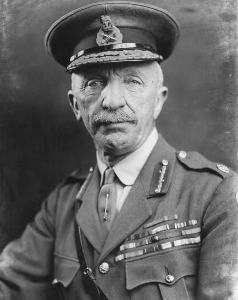
Wilson is born in County Longford and a long-time opponent of the Irish Home Rule movement. He joins the British army in 1884 and sees action during the Boer War. He is assigned to British army headquarters during the infamous Curragh incident and supports the near-mutiny of British officers who refuse to lead troops against Ulster opponents of home rule. He serves in France during the World War I and, when the war ends, continues his staunch support of the Unionist cause while serving as Chief of General Staff. He is a strong supporter of the coercion tactics of the British in Ireland during the Irish War of Independence, even suggesting that the leaders of Sinn Féin be executed. He leaves the army when David Lloyd George decides not to renew his term as chief of staff and is elected Member of Parliament (MP) for North Down as a Conservative in 1922. In Parliament, he urges even stronger coercion methods than those then being carried out by the Black and Tans.
On June 22, 1922, two London-based volunteers of the Irish Republican Army, Reginald Dunne and Joseph O’Sullivan, assassinate Wilson outside his house at 36 Eaton Place at approximately 2:20 PM. He is in full uniform as he is returning from unveiling the Great Eastern Railway War Memorial at Liverpool Street station at 1:00 PM. He has six wounds, two of them fatal wounds to the chest.
Stories later circulate that the first shot misses but rather than taking shelter in the house, he draws his sword and advances on his attackers, who are able to shoot and kill him. These stories often stress that he dies a martyr. His housemaid testifies that she found his drawn sword lying by his side. These details do not feature in the witness accounts by Reginald Dunne, which is smuggled out of prison, the inquest testimony of one of two road menders working nearby, and the taxi driver who had just dropped Wilson off. One of the road mender’s accounts, as published in the Daily Mail, mentions Wilson turning on his attackers with the words “you cowardly swine!” but this is believed to be a possible embellishment by the newspaper.
Two police officers and a chauffeur are also shot as the men attempt to avoid capture. They are then surrounded by a crowd and arrested by other policemen after a struggle. Dunne and O’Sullivan are convicted of murder and hanged on August 10, 1922. On the day Wilson’s killers were hanged, Currygrane, the family homesite in Ballinalee, County Longford is burned to the ground, possibly as a reprisal although possibly as an unrelated part of the unrest in that county.
Wilson’s widow blames the government for his death and is only persuaded to allow government representation at the funeral on the grounds that not to do so would be disrespectful to the King. Wilson’s funeral is a public affair attended by David Lloyd George and the cabinet, Ferdinand Foch, Robert Nivelle and Maxime Weygand from France as well as many of his former army colleagues including John French, Nevil Macready, Douglas Haig and William Robertson. He is buried in the crypt of St. Paul’s Cathedral in London.




 The
The