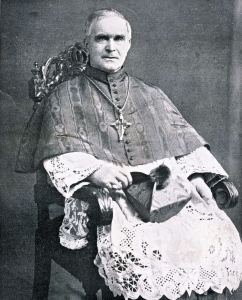
Mulvany is born in Moynalty, County Meath, 8 km (5 mi) north of Kells, on March 1, 1864, to James Mulvany and Mary Monaghan. He is ordained a priest of the Diocese of Meath on March 6, 1892.
Following his predecessors death, Pope Pius XI names him Bishop of Meath on April 12, 1929, and he is consecrated on June 30, with CardinalJoseph MacRory being the principal consecrator. He retains that position until his death.
At the time of his appointment, Mulvaney becomes involved with plans for a new cathedral for Mullingar and the Diocese of Meath to replace the aging Cathedral of the Immaculate Conception (1836–1936). He takes the plans to Pope Pius XI, who is supportive and requests that the new building be dedicated as the Cathedral of Christ the King. Construction begins in 1932 and the building is completed in 1936.
Mulvany dies at the age of 75 as a result of hypertension and cerebral hemorrhage, in the Bishops Palace, Mullingar, on June 16, 1943. His death is registered on June 24, 1943, by Margaret Walsh, a nurse who is present at his death. He is buried in the grounds of the Cathedral of Christ the King, Mullingar.
D’Alton is born to Joseph D’Alton and his wife Mary Brennan, at the height of the Land Wars in Ireland. He is baptised four days later, on October 15, 1882, with Michael and Mary Brennan acting as his godparents. His mother has a daughter, Mollie Brennan, from a previous marriage, she remarries again after the Cardinal’s father dies in 1883.
D’Alton occupies important roles at the National Seminary and is successively Professor of Ancient Classics (1912), Greek (1922), Vice-President (1934), and President (1936). He is raised to the rank of Monsignor on June 27, 1938.
D’Alton is named Archbishop of Armagh and thus Primate of All Ireland on June 13, 1946, and is created Cardinal Priest of Sant’ Agata de’ Goti in Rome by Pope Pius XII in the consistory of January 12, 1953. As a cardinal elector in the 1958 papal conclave, he gives a hint of the difficulties involved in that papal conclave and achieving unanimity in the voting.
One highlight of D’Alton’s time in Armagh is the Patrician Year Celebrations in 1961, marked by the Irish Catholic hierarchy as the 1,500th anniversary of the death of Saint Patrick and as such an opportunity to promote the “spiritual empire” created by the Irish Catholic church in the wider anglophone world. He writes a pastoral letter to mark the occasion.
Cardinal D’Alton is seen to be more ecumenical in outlook than other members of the Irish hierarchy. He tries to broker talks between the Irish Free State and the United Kingdom to ease the tensions between both countries, even going so far as to address the situation regarding the Irish ports, but to little avail.
In 1952, D’Alton becomes the first individual from the Republic of Ireland to receive an honorary degree from Queen’s University Belfast (QUB), when he is conferred with a Doctorate in Literature. He already possesses a Doctor of Divinity, so this degree is a recognition of his earlier works such as Horace and His Age: A Study in Historical Background (1917), Roman Literary Theory and Criticism: A Study in Tendencies (1931), and Selections from St. John Chrysostom (1940).
In D’Alton’s hometown of Claremorris, the Dalton Inn Hotel and Dalton Street (formerly Church Street) are named after him. A plaque commemorating him is unveiled at the Dalton Inn Hotel on September 28, 2023. Plans to canonise him have been discussed.
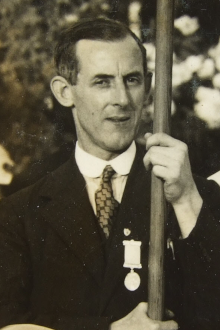
Duff is born in Dublin on June 7, 1889, at 97 Phibsboro Road, the eldest of seven children of John Duff and his wife, Susan Letitia (née Freehill). The wealthy family lives in the city at St. Patrick’s Road, Drumcondra. He attends Blackrock College.
In 1908, Duff enters the Civil Service and is assigned to the Irish Land Commission. In 1913, he joins the Society of Saint Vincent de Paul and is exposed to the real poverty of Dublin. Many who live in tenement squalor are forced to attend soup kitchens for sustenance, and abject poverty, alcoholism, and prostitution are rife in parts of Dublin. He joins and soon rises through the ranks to President of the St. Patrick’s Conference at St. Nicholas of Myra Parish. Having concern for people he sees as materially and spiritually deprived, he gets the idea to picket Protestant soup kitchens as he considers they are giving aid in the form of food and free accommodation at hostels in return for not attending Catholic services. He sets up rival Catholic soup kitchens and, with his friend, Sergeant Major Joe Gabbett, discourages Catholics from patronizing Protestant soup kitchens. They succeeded in closing down two of them over the years.
Duff publishes his first pamphlet, Can we be Saints?, in 1916. In it, he expresses the conviction that all, without exception, are called to be saints, and that through Christian faith, all have the means necessary.
Duff briefly acts as private secretary to Michael Collins, the chairman of the Provisional Government and the commander-in-chief of the National Army. In 1924, he is transferred to the Department of Finance.
On September 7, 1921, Duff is a part of a meeting alongside Fr. Michael Toher and fifteen women which becomes the nucleus of what would become the Legion of Mary. The Legion of Mary is created to organise lay Catholics to perform voluntary work. He models the organisation on Roman legions. Some of the first causes the Legion pursues is to become involved with homelessness and prostitution in Dublin. In 1922, he defies the wishes of the Archbishop of Dublin and the widespread Crypto-Calvinism, or Jansenism, within the Catholic Church in Ireland, which had created an intense hostility towards both prostitutes and other allegedly “fallen women.” Similarly, to St. Vitalis of Gaza before him, he begins an outreach to the prostitutes living in often brutal and inhuman conditions in the “kip houses” of “the Monto,” as Dublin’s red-light district, one of the largest in Europe at the time, is then called. Although middle-class Dubliners dismissively view these women as “whores,” the impoverished but devoutly Catholic residents of the Monto tenements refer to local prostitutes as “unfortunate girls,” and understand that they often turn to prostitution as a last resort. As part of his work, Duff establishes the Sancta Maria hostel, a safe house for former prostitutes who had run away from their “kip keepers.” Following the Irish War of Independence and Irish Civil War, he also persuades the first Catholic Commissioner of the Dublin Metropolitan Police, former Irish Army General W. R. E. Murphy, to launch a crackdown and, even though prostitution in the Republic of Ireland, rooted in human trafficking, still exists, the closure of the Monto’s last “Kip-Houses” is announced on March 12, 1925.
In 1927, Duff establishes the Morning Star hostel for homeless men, followed shortly by the Regina Coeli hostel for homeless women in 1930. Unlike the Magdalen Asylums, the Regina Coeli hostel reflects his view that unwed mothers should be taught how to be able to provide for and raise their children. This defies the norm of the era which holds that the children of unwed mothers should be saved from the stigma of their illegitimacy by being put up for adoption as quickly as possible.
While Duff enjoys the support of W. T. Cosgrave, Ireland’s head of government, and in May 1931 is granted an audience with Pope Pius XI, his efforts are opposed internally in the Dublin diocese. The Archbishop of Dublin Edward Joseph Byrne and his successor John Charles McQuaid seek to censor him because of his involvement with prostitutes. McQuaid also does not approve of his ecumenical efforts. In the 1930s and 1940s Duff creates the Mercier Society, a study group designed to bring together Catholics and Protestants, as well as the Pillar of Fire, a group designed to promote dialogue with Ireland’s Jewish community. In communication with Irish social dissidents Seán Ó Faoláin and Peadar O’Donnell, he suggests he is far more censored than even they are.
Duff does have some supporters amongst the Catholic hierarchy though. With the backing of Cardinal Joseph MacRory and Francis Bourne of Westminster, the Legion is able to expand rapidly and internationally. In 1928 the Legion establishes its first presidium in Scotland. In 1932 he is able to use the occasion of the Eucharistic Congress of Dublin to introduce the concept of the Legion of Mary to several visiting bishops, leading to further international growth.
Duff retires from the Civil Service in 1934 to devote all of his time to the Legion of Mary.
In July 1940, an overseas club for Afro-Asian students in Dublin is created. At that time Ireland is a popular destination for students from Asia and Africa because of its recent anti-imperial, anti-colonial history. Duff personally funds the purchase of a building for the club using funds from an inheritance. The club lasts until 1976 and facilitate many notable students, including Jaja Wachuku.
For the rest of his life, and with the help of many others, Duff guides the Legion’s worldwide extension. Today, the Legion of Mary has an estimated four million active members and 10 million auxiliary members in close to 200 countries in almost every diocese in the Catholic Church.
In 1965, Pope Paul VI invites Duff to attend the Second Vatican Council as a lay observer. When he is introduced to the assembly by the Archbishop of Liverpool, John Heenan, he receives a standing ovation.
Duff dies in Dublin at the age of 91 on November 7, 1980, and is interred at Glasnevin Cemetery. In July 1996, the cause of his beatification is introduced by Cardinal Desmond Connell.
Joseph MacRory, an Irish Cardinal of the Roman Catholic Church who serves as Archbishop of Armagh from 1928 until his death in 1945, is born in Ballygawley, County Tyrone, on March 19, 1861.
MacRory is one of ten children of Francis MacRory, a farmer, and his wife, Rose Montague. He studies at St. Patrick’s College, Armagh, and St. Patrick’s Pontifical University, Maynooth. He is ordained to the priesthood on September 13, 1885, and serves as the first president of St. Patrick’s Academy, Dungannon from 1886 to 1887. MacRory teaches Scripture and Modern Theology at St. Mary’s College, Oscott in England until 1889, when he is appointed Professor of Scripture and Oriental Languages at his alma mater of Maynooth College. In 1906, he co-founds the Irish Theological Quarterly. In 1912, he is made Vice-President of Maynooth.
On August 9, 1915, MacRory is appointed Bishop of Down and Connor by Pope Benedict XV and receives his episcopal consecration on November 14 from Cardinal Michael Logue. During his tenure, his life is threatened repeatedly due to the turbulent atmosphere in Belfast. He is a member of the Irish Convention from 1917 to 1918.
MacRory is the papal legate at the 1933 laying of the foundation stone of Liverpool Metropolitan Cathedral in England. He also serves as one of the cardinal electors who participate in the 1939 papal conclave which ultimately selects Pope Pius XII.
MacRory is a strenuous opponent of social injustice, National Socialism, Protestantism, and the Partition of Ireland. It is MacRory who suggests to Eoin O’Duffy that he raise an Irish Brigade to aid Generalissimo Francisco Franco during the Spanish Civil War. In 1940, he voices strong objections to conscription in the North.
MacRory is a supporter of the Gaelic League. Errigal Ciarán GAC, one of the most famous GAA clubs in Ireland, plays at Cardinal MacRory Park in Dunmoyle, County Tyrone, which is built in 1956 in his honour.
After a brief illness, Cardinal MacRory dies on October 13, 1945, at the age of 84 from a heart attack at Ara Coeli, the residence in Armagh. He is interred in St. Patrick’s Cathedral Cemetery, Armagh.


 seamus dubhghaill