seamus dubhghaill

Promoting Irish Culture and History from Little Rock, Arkansas, USA


Leave a comment

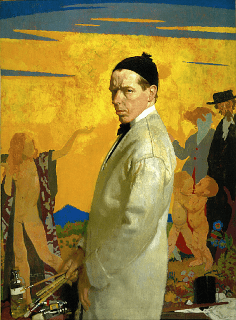
Birth of William Orpen, Irish-born Artist

Major Sir William Newenham Montague Orpen, KBE, RA, RHA, Irish artist who mainly works in London and is best known for his vigorously characterized portraits, is born on November 27, 1878, at Oriel, Grove Avenue, Stillorgan, County Dublin. He also works as an official war artist during World War I.

Orpen is the fourth and youngest son of Arthur Herbert Orpen (1830–1926), a solicitor, and his wife, Anne Caulfield (1834–1912), the eldest daughter of the Right Rev. Charles Caulfield (1804–1862), the Bishop of Nassau. Both his parents are amateur painters, and his eldest brother, Richard Caulfield Orpen, becomes a notable architect. His nieces are Bea Orpen and Kathleen Delap. The historian Goddard Henry Orpen is his second cousin. The family lives at “Oriel,” a large house with extensive grounds containing stables and a tennis court. He appears to have a happy childhood there.

Orpen is a naturally talented painter, and six weeks before his thirteenth birthday is enrolled at the Dublin Metropolitan School of Art. During his six years at the college, he wins every major prize there, plus the British Isles gold medal for life drawing, before leaving to study at the Slade School of Fine Art in London between 1897 and 1899. At the Slade he masters oil painting and begins to experiment with different painting techniques and effects.

While at the Slade, Orpen becomes engaged to Emily Scobel, a model and the subject of his painting The Mirror (1900). She ends their relationship in 1901, and he marries Grace Knewstub, the sister-in-law of Sir William Rothenstein. He and Knewstub have three daughters together, but the marriage is not a happy one. By 1908, he has begun a long-running affair with Evelyn Saint-George, a well-connected American millionairess based in London, with whom he also has a child.

Orpen first exhibits at the New English Art Club (NEAC) in 1899, becoming a member in 1900. In 1901, he holds a solo exhibition at the Carfax Gallery in central London. His portraits, which establish his reputation, show the influence of the Realist artist Édouard Manet. He also becomes known as a painter of group portraits such as Homage to Manet (1909), in which he portrays members of the contemporary English art world sitting in conversation beneath a famous portrait by that artist.

At the start of World War I, a number of Irish people living in England return to Ireland to avoid conscription. Among them is Orpen’s studio assistant and former pupil, Seán Keating. Keating encourages him to do likewise, but he refuses and commits himself to supporting the British war effort. In December 1915, he is commissioned into the Royal Army Service Corps and reports for clerical duty at London’s Kensington Barracks in March 1916. Throughout 1916 he continues painting portraits, most notably one of a despondent Winston Churchill, but soon starts using both his own contacts and those of Evelyn Saint-George, to secure a war artist posting.

He is the official painter of the Paris Peace Conference after World War I. Throughout 1919 he paints individual portraits of the delegates to the Conference and these form the basis of his two large paintings, A Peace Conference at the Quai d’Orsay and The Signing of Peace in the Hall of Mirrors. In both pictures, the architecture overwhelms the gathered politicians and statesmen who’s political wranglings and vainglory diminish them in Orpen’s eyes.

Orpen is appointed Knight Commander of the Order of the British Empire in 1918 and is elected an associate of the Royal Academy of Arts in 1919.

Orpen becomes seriously ill in May 1931, and, after suffering periods of memory loss, dies at the age of 52 on September 29, 1931, in South Kensington, London, of liver and heart failure. He is buried at Putney Vale Cemetery in southwest London. A stone tablet in the Island of Ireland Peace Park Memorial at Mesen, Belgium, commemorates him. He is posthumously regarded as a facile and prolific, but somewhat superficial, artist who nevertheless achieves great popularity in his day.

(Pictured: “Self-portrait” (1913), oil on canvas by William Orpen, Saint Louis Art Museum)

Leave a comment

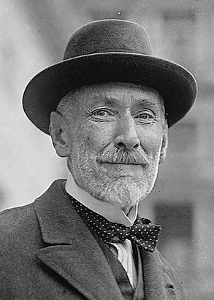
Death of Sir Horace Curzon Plunkett

Sir Horace Curzon Plunkett, Anglo-Irish agricultural reformer, pioneer of agricultural cooperatives, Unionist Member of Parliament (MP), supporter of Home Rule, Irish Senator and author, dies in Weybridge, Surrey, England on March 26, 1932.

Plunkett, the third son of Admiral the 16th Baron of Dunsany, of Dunsany Castle, Dunsany, near Dunshaughlin, County Meath, and the Honourable Anne Constance Dutton, daughter of John Dutton, 2nd Baron Sherborne, is born on October 24, 1854. He is educated at Eton College and University College, Oxford, of which he becomes an honorary fellow in 1909.

Threatened by lung trouble in 1879, Plunkett goes to the United States and spends ten years as a cattle rancher in the Bighorn Mountains of Wyoming. He returns to Ireland in 1889 and devotes himself to the agricultural cooperative movement, first organizing creameries and then, in 1894, the Irish Agricultural Organisation Society, a forerunner of similar societies in England, Wales, and Scotland. A moderate Unionist member of Parliament for South County Dublin from 1892 to 1900, he becomes vice president (1899–1907) of the new Department of Agriculture and Technical Instruction for Ireland, which he has been instrumental in creating.

Plunkett’s later experience convinces him of the need for the independence of an Ireland without partition inside the Commonwealth, and he fights strongly for this goal, as chairman of the Irish Convention (1917–18) and, in 1919, as founder of the Irish Dominion League and of the Plunkett Foundation for Cooperative Studies, an agricultural research and information centre. He is appointed to the first Senate of the Irish Free State (1922–23). His house in Dublin is bombed and burned during in the Irish Civil War and he lives in England thereafter. In 1924 the Plunkett Foundation also moves to England. In 1924 he presides over a conference in London on agricultural co-operation in the British Commonwealth and in 1925 he visits South Africa to help the movement there.

Plunkett is made a Fellow of the Royal Society in 1902 and Knight Commander of the Royal Victorian Order in 1903. His writings include Ireland in the New Century (1904) and The Rural Life Problem of the United States (1910).

Sir Horace Plunkett dies at Weybridge, Surrey, England on March 26, 1932.


Leave a comment

First Non-Stop Transatlantic Flight

alcock-and-brown

British aviators John Alcock and Arthur Brown complete the first non-stop transatlantic flight, landing at Clifden, County Galway on June 15, 1919. They fly a modified World War I Vickers Vimy bomber from St. John’s, Newfoundland, to Clifden. The Secretary of State for Air, Winston Churchill, presents them with the Daily Mail prize for the first crossing of the Atlantic Ocean by aeroplane in “less than 72 consecutive hours.” A small amount of mail is carried on the flight, making it the first transatlantic airmail flight.

Alcock and Brown take off from Lester’s Field at around 1:45 PM on June 14. They fly the modified Vickers Vimy, powered by two Rolls-Royce Eagle 360 hp engines which are supported by an on-site Rolls Royce team led by engineer Eric Platford.

It is not an easy flight. The overloaded aircraft has difficulty taking off from the rough field and only barely misses the tops of the trees. A short time later the wind-driven electrical generator fails, depriving them of radio contact, their intercom and heating. An exhaust pipe bursts shortly afterwards, causing a frightening noise which makes conversation impossible without the failed intercom.

At 5:00 PM they have to fly through thick fog. This is serious because it prevents Brown from being able to navigate using his sextant. Blind flying in fog or cloud should only be undertaken with gyroscopic instruments, which they do not have, and Alcock twice loses control of the aircraft and nearly hits the sea after a spiral dive. Alcock also has to deal with a broken trim control that makes the plane become very nose heavy as fuel is consumed.

At 12:15 AM on June 15 Brown gets a glimpse of the stars and is able to use his sextant and finds that they are still on course. By this point, their electric heating suits have failed, making them very cold in the open cockpit.

Then at 3:00 AM they fly into a large snowstorm. They are drenched by rain, their instruments ice up, and the plane is in danger of icing and becoming unflyable. The carburetors also ice up.

Alcock and Brown make landfall in County Galway at 8:40 AM on June 15, not far from their intended landing place, after less than sixteen hours of flying time. The aircraft is damaged upon arrival because of an attempt to land on what appears from the air to be a suitable green field, but which turns out to be a bog, near Clifden, but neither of the airmen is hurt. Brown says that if the weather had been good, they could have pressed on to London.

Alcock and Brown are treated as heroes on the completion of their flight. In addition to the Daily Mail award of £10,000, the crew receives 2,000 guineas (£2,100) from the Ardath Tobacco Company and £1,000 from Lawrence R. Phillips for being the first British subjects to fly the Atlantic Ocean. The two aviators are awarded the honour of Knight Commander of the Most Excellent Order of the British Empire (KBE) a week later by King George V at Windsor Castle.

Alcock and Brown fly to Manchester on July 17, where they are given a civic reception by the Lord Mayor and Corporation of Manchester, and awards to mark their achievement.

John Alcock is killed on December 18, 1919, when he crashes near Rouen while flying the new Vickers Viking amphibian to the Paris Air Show. Arthur Brown dies on October 4, 1948. Two memorials commemorating the flight are sited near the landing spot in County Galway. The first is an isolated cairn four kilometres south of Clifden, around 500 metres from the spot where they land, on the site of Guglielmo Marconi‘s first transatlantic wireless station from which the aviators transmit their success to London. In addition, there is a sculpture of an aircraft’s tailfin on Errislannan Hill two kilometres north of their landing spot, dedicated on June 15, 1959, the fortieth anniversary of their landing.


Leave a comment

Birth of Sir Horace Curzon Plunkett

Sir Horace Curzon Plunkett, Anglo-Irish agricultural reformer, pioneer of agricultural cooperatives, Unionist Member of Parliament (MP), supporter of Home Rule, Irish Senator and author, is born on October 24, 1854.

Plunkett is the third son of Admiral the 16th Baron of Dunsany, of Dunsany Castle, Dunsany, near Dunshaughlin, County Meath, and the Honourable Anne Constance Dutton, daughter of John Dutton, 2nd Baron Sherborne. He is educated at Eton College and University College, Oxford, of which he becomes an honorary fellow in 1909.

Threatened by lung trouble in 1879, Plunkett goes to the United States and spends ten years as a cattle rancher in the Bighorn Mountains of Wyoming. He returns to Ireland in 1889 and devotes himself to the agricultural cooperative movement, first organizing creameries and then, in 1894, the Irish Agricultural Organisation Society, a forerunner of similar societies in England, Wales, and Scotland. A moderate Unionist member of Parliament for South County Dublin from 1892 to 1900, he becomes vice president (1899–1907) of the new Department of Agriculture and Technical Instruction for Ireland, which he has been instrumental in creating.

Plunkett’s later experience convinces him of the need for the independence of an Ireland without partition inside the Commonwealth, and he fights strongly for this goal, as chairman of the Irish Convention (1917–18) and, in 1919, as founder of the Irish Dominion League and of the Plunkett Foundation for Cooperative Studies, an agricultural research and information centre. He is appointed to the first Senate of the Irish Free State (1922–23). His house in Dublin is bombed and burned during in the Irish Civil War and he lives in England thereafter. In 1924 the Plunkett Foundation also moves to England. In 1924 he presides over a conference in London on agricultural co-operation in the British Commonwealth and in 1925 he visits South Africa to help the movement there.

Plunkett is made a Fellow of the Royal Society in 1902 and Knight Commander of the Royal Victorian Order in 1903. His writings include Ireland in the New Century (1904) and The Rural Life Problem of the United States (1910).

Sir Horace Plunkett dies at Weybridge, Surrey, England on March 26, 1932.