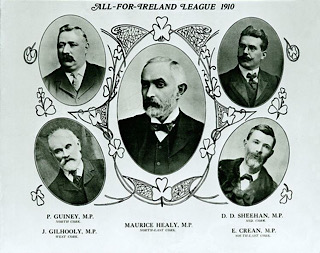
Guiney is the eldest son of Timothy Guiney, a shopkeeper and later clerk of Kanturkpoor law union, and Ellen Carver. He is educated at St. Patrick’s Monastery, Mountrath, County Laois. He serves three terms of imprisonment for activity in the Land War and later Plan of Campaign movement during the 1880s under the Coercion Act. He becomes a farmer and serves as councillor for Newmarket and on the Cork County Council (1908–11) as well as Chair of Newmarket Agricultural Society, Newmarket Gaelic League and Newmarket Old-Age Pensions Committee.
(Pictured: All-for-Ireland League group portrait of five of its Members of Parliament, in the “Cork Free Press”, 30 July 1910. These are: Patrick Guiney (North Cork), James Gilhooly (West Cork), Maurice Healy (North-east Cork), D. D. Sheehan (Mid Cork), and Eugene Crean (South-east Cork))
The Land Purchase (Ireland) Act 1903, also known as the Wyndham Land Act, is enacted on August 14, 1903, and allows for entire estates to be purchased by the occupying tenantry, subsidized by the state.
It differs from earlier legislation which initially advanced to tenants the sum necessary to purchase their holdings, repayable over a period of years on terms determined by an independent commission, while the Wyndham Act finishes off absentee landlords‘ control over tenants and makes it easier for tenants to purchase land, facilitating the transfer of about 9 million acres (36,000 km2) up to 1914. By then, 75% of occupiers are buying out their landlords under the 1903 Act and the later Irish Land Act 1909 of Augustine Birrell, which extends the 1903 act by allowing for the compulsory purchase of tenanted farmland by the Land Commission, but falls far short in its financial provisions. In all, under these pre-1921 Land Acts over 316,000 tenants purchase their holdings amounting to 11.5 million acres (47,000 km2) out of a total of 20 million acres (81,000 km2) in the country.
The Acts provide Irish tenant farmers with more rights than tenant farmers in the rest of the United Kingdom. Munster tenants avail of land purchase in exceptionally high numbers, encouraged by their Irish Land and Labour Association‘s leader D. D. Sheehan after he and O’Brien establish an Advisory Committee to mediate between landlords and tenants on purchase terms which produce a higher take-up of land purchase than in any other province.
Historian Robert K. Webb gives most of the credit for the Wyndham Act to Conservative leader Arthur Balfour. He says the Act is “a complete success. By the time the Irish Free State was created in 1922, the system of peasant proprietorship had become universal… A land problem more than a century old had been solved, though it had taken more than 30 years of educating Parliament and landlords to do it. The scheme was intended as well to ‘kill Home Rule by kindness.’”
As a member of the Irish Parliamentary Party (IPP), Harrington represents Westmeath from February 1883 to November 1885. In 1885 he is elected for the new constituency of Dublin Harbour, which he represents until his death. He serves as Lord Mayor of Dublin three times from 1901 to 1904.
Harrington owns two newspapers, United Ireland and the Kerry Sentinel, and is a member of the so-called Bantry band of prominent nationalist politicians from the Bantry vicinity. They are also more pejoratively known as the Pope’s brass band. Tim Healy is another prominent member of this unofficial group.
In 1884, Harrington publishes a pamphlet, “Maamtrasna Massacres – Impeachment of the Trials,” in which he dismantles the Crown Prosecution’s case against the eight men accused of the murders of the Joyce family on August 17, 1882. He provides evidence that Crown Prosecutor George Bolton had deliberately suppressed evidence that would have acquitted Maolra Seoighe (English: Myles Joyce), who was hanged, and four men who were sentenced to twenty years of penal servitude.
Thereafter Harrington becomes excluded from Redmond’s closed circle of confidants, retains sympathy with O’Brien, and represents the interests of the tenant farmers at the 1902 Land Conference negotiations which lead to the enactment of the unprecedented WyndhamLand Purchase (Ireland) Act 1903.
On September 7, 1901, as the Lord Mayor of Dublin, Harrington kicks off at the official ceremony to open Bohemian F.C.‘s new home, Dalymount Park.
Harrington retains the party nomination for the Dublin Harbour constituency in the January 1910 United Kingdom general election, largely because of local divisions about who should succeed him and because an O’Brienite offer to pay his election expenses deters rivals from going to the polls. He decides that the finely balanced result of the general election means that every nationalist vote would be required at Westminster. He therefore travels to London, but shortly after attending the parliamentary party meeting on February 23 he suffers a stroke. After some days’ recuperation he is brought home to Dublin, but his condition deteriorates and he dies on March 12, 1910, at his home, 70 Harcourt Street. He is buried near the Parnell circle at Glasnevin Cemetery.
Harrington is celebrated by a statue erected in 2001 at the east end of Castletownbere near the Millbrook bar.
The Plan of Campaign is a stratagem adopted in Ireland between 1886 and 1891, co-ordinated by Irish politicians for the benefit of tenant farmers, against mainly absentee and rack-rentlandlords and the tyrannical regime of enforced massive rents and evictions. It is launched to counter agricultural distress caused by the continual depression in prices of dairy products and cattle from the mid-1870s, which leaves many tenants in arrears with rent. Bad weather in 1885 and 1886 also cause crop failure, making it harder to pay rents. The Land War of the early 1880s is about to be renewed after evictions increase and outrages become widespread.
The Plan, conceived by Timothy Healy, is devised and organised by Timothy Harrington, secretary of the Irish National League, William O’Brien and John Dillon. It is outlined in an article headed Plan of Campaign by Harrington which is published on October 23, 1886, in the League’s newspaper, the United Ireland, of which O’Brien is editor.
Dillon is among those who organise a campaign whereby tenants pay their rents to the Land League instead of their landlords. If the tenants are evicted, they are to receive financial assistance from a general fund established for that purpose. As a result of his involvement in this campaign, Dillon spends a number of months in jail.
The measures are to be put into operation on 203 estates, mainly in the south and west of the country though including some scattered Ulster estates. Initially sixty landlords accept the reduced rents, twenty-four holding out but then agreeing to the tenant conditions. Tenants give in on fifteen estates. The chief trouble occurs on the remaining large estates.
The organisers of the Plan decide to test a number of their measures, expecting the remainder will then give in. Widespread attention is focused on it being implemented by Dillon and O’Brien on the estate of Hubert de Burgh-Canning, 2nd Marquess of Clanricarde, at Portumna, County Galway, on November 19, 1886, where the landlord is an absentee ascendancy landlord. The estate comprising 52,000 acres, or 21,000 hectare, yields 25,000 sterling annually in rents paid by 1,900 tenants. The hard-pressed tenants look for a reduction of twenty-five percent. The landlord refuses to give any abatement. The tenant’s reduced rents are then placed into an estate fund, and the landlord informed he will only receive the monies when he agrees to the reduction. Tenants on other estates then follow the example of the Clanricarde tenants, the Plan on each estate led by a member of the Irish Parliamentary Party (IPP) Campaign activists including Pat O’Brien, Alexander Blane or members of its constituency organisation, the National League. Some 20,000 tenants are involved.
In 1887, a rent strike takes place on the estate of Lady Kingston near Mitchelstown, County Cork. Another of the Land Leaguers, William O’Brien, is brought to court on charges of inciting non-payment of rent. Dillon organises an 8,000 strong crowd to demonstrate outside the courthouse. Three estate tenants are shot by police and others are injured. This incident becomes known as the “Mitchelstown Massacre.”
In December 1890, following the verdict in the O’Shea v O’Shea and Parnell divorce case, the IPP splits. This diverts attention from the Campaign which slowly peters out. The IPP also wants to disassociate itself from the more violent aspects on the approach to the Second Home Rule Bill that narrowly succeeds with a majority of 30 in the House of Commons but is then defeated by the House of Lords in 1893.
(Pictured: Eviction scene, Woodford Galway 1888, during the Plan of Campaign. The Woodford evictions become some of the most highly resisted with numerous pamphlets, during the period, referring to them)
Mathew is born on July 10, 1830, at Lehenagh House, County Cork, eldest son of Charles Mathew, gentleman, of Lehenagh House and Castlelake, County Tipperary, and his wife Mary, daughter of James Hackett of Cork. He is of a Roman Catholic family and his uncle is Fr. Theobald Mathew, the temperance movement campaigner. His initial education is at a private school in Cork. He enters Trinity College Dublin (TCD) in July 1845, graduating BA (1850) as a gold medalist and senior moderator. In Hilary term 1850 he is admitted to the King’s Inns in Dublin. He moves to London, entering Lincoln’s Inn on June 1, 1851, and is called to the English bar in Hilary term 1854.
Mathew is a founding member of the Hardwicke Society, a legal debating society, and builds up a substantial practice as a junior barrister, being much in demand as counsel for jury cases in the Guildhall sittings. Despite being highly regarded by his peers, a certain lack of confidence holds him back and even when vacancies arise, he does not apply to be made a Queen’s Counsel (QC). In 1873, however, he represents the treasury as a junior counsel in the prosecution of the Tichborne claimant, Arthur Orton, in one of the most celebrated legal cases of the day. He is the only counsel for the treasury who does not get into heated arguments in court with Orton’s leading council, Dr. Edward Vaughan Hyde Kenealy.
Mathew possesses an encyclopedic knowledge of legal procedure and in 1881 is made a bencher at Lincoln’s Inn and awarded an honorary doctorate by TCD. Although still only a junior counsel he is appointed a judge in the Queen’s Bench Division in March 1881 and knighted. After the return to office of the Liberal Party in August 1892 he becomes chairman of the commission established to investigate the state of evicted tenants in Ireland. His appointment is perhaps unfortunate, as he is a home ruler in politics and the home rule MPJohn Dillon is his son-in-law. When the commission begins its hearings on November 7, 1892, he announces that he will not allow witnesses to be cross-examined. This provokes protests from Edward Carson, who had recently been replaced as solicitor general for Ireland. Counsel is ordered to withdraw and eventually two members of the commission resign, while the landlords refuse to cooperate with the proceedings. Despite severe criticism, many of the commission’s recommendations are incorporated in the Wyndham Land Purchase Act of 1903.
Throughout his legal career, Mathew argues for the establishment of a separate commercial court and eventually succeeds in convincing the other members of the bench and also Lord Russell of Killowen, who is appointed Lord Chief Justice in 1894, that such a court be established. As a result of this, he is appointed as the first judge of the Commercial Court when it is set up in 1895. In 1901 he is made a privy councilor and appointed judge in the Court of Appeal.
On December 6, 1905, Mathew is seized with a paralytic stroke at the Athenaeum Club in London, and his resignation is announced on the following day. On November 9, 1908, he dies at his London home, 46 Queen’s Gate Gardens. His remains are returned to Ireland, where they are interred in St. Joseph’s Cemetery, Cork.
Mathew marries Elizabeth Blackmore, eldest daughter of the Rev. Edwin Biron, JP and vicar of Lympne near Hythe, Kent, in December 1861. They have two sons and three daughters. His eldest daughter, Elizabeth Mathew, marries John Dillon. A portrait of Sir James Charles Mathew, by Frank Holl, is in the possession of the family. In 1896 a cartoon portrait of him by ‘Spy’ appears in Vanity Fair.
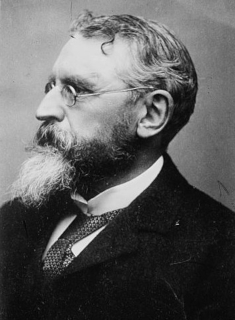
(From: “Mathew, Sir James Charles” by David Murphy, Dictionary of Irish Biography, http://www.dib.ie | Pictured: Sir James Charles Mathew by Alexander Bassano, half-plate glass negative, 1883, National Portrait Gallery, London)
O’Brien, who is for several years second only to Charles Stewart Parnell among Irish Nationalist leaders, is born on October 2, 1852, in Mallow, County Cork. He is perhaps most important for his Plan of Campaign (1886), by which Irish tenant farmers withhold all rent payments from landlords who refuse to lower their rents and instead pay the money into a mutual defense fund on which evicted tenants can draw.
O’Brien shares his primary education with a townsman with whom he is later to have a close political connection, CanonPatrick Augustine Sheehan of Doneraile. He enjoys his secondary education at the Cloyne diocesan college, which results in his being brought up in an environment noted for its religious tolerance. He greatly values having had this experience from an early age, which strongly influences his later views for the need of such tolerance in Irish national life.
A journalist from 1869, O’Brien is appointed editor of the Irish Land League’s weekly United Ireland by Parnell in 1881. In October of that year the British authorities suppress the paper and put O’Brien in Kilmainham Gaol in Dublin, along with Parnell and others. There he draws up a No Rent Manifesto, which, when read at a Land League meeting, results in the outlawing of the League. Released from prison in 1882, he resumes the editorship of United Ireland, and in 1883 he is elected to the British House of Commons, remaining there until 1895. His “plan of campaign” is disavowed by Parnell but nonetheless stirs up fierce agitation. To suppress the movement, the British government passes the Criminal Law and Procedure (Ireland) Act 1887, under which O’Brien is jailed again.
For some time following the Katherine O’Shea divorce case (1889–90), in which Parnell is correspondent, O’Brien attempts to mediate between the Parnellites and their opponents, although he sides with the majority in rejecting Parnell’s continued leadership of the Irish Home Rule struggle. In 1902 he supports the Land Conference, which secures agreement between landlords and tenants’ representatives and results in George Wyndham‘s Land Purchase Act (1903), which is designed to turn Irish tenant farmers into occupying owners.
Retiring from political life, O’Brien contents himself with writing and declines Éamon de Valera‘s offer to stand for Fianna Fáil in the 1927 general election. He dies suddenly at the age of 75 on February 25, 1928, while on a visit to London with his wife. His remains rest in Mallow, and one of the principal streets in the town bears his name to this day. His head-bust overlooks the town Council’s Chamber Room and one of his finest portraits hangs in University College Cork.
O’Brien shares his primary education with a townsman with whom he is later to have a close political connection, CanonPatrick Augustine Sheehan of Doneraile. He enjoys his secondary education at the Cloyne diocesan college, which results in his being brought up in an environment noted for its religious tolerance. He greatly values having had this experience from an early age, which strongly influences his later views for the need of such tolerance in Irish national life.
A journalist from 1869, O’Brien is appointed editor of the Irish Land League’s weekly United Ireland by Parnell in 1881. In October of that year the British authorities suppress the paper and put O’Brien in Kilmainham Gaol in Dublin, along with Parnell and others. There he draws up a No Rent Manifesto, which, when read at a Land League meeting, results in the outlawing of the League. Released from prison in 1882, he resumes the editorship of United Ireland, and in 1883 he is elected to the British House of Commons, remaining there until 1895. His “plan of campaign” is disavowed by Parnell but nonetheless stirs up fierce agitation. To suppress the movement, the British government passes the Criminal Law and Procedure (Ireland) Act 1887, under which O’Brien is jailed again.
For some time following the O’Shea divorce case (1889–90), in which Parnell is corespondent, O’Brien attempts to mediate between the Parnellites and their opponents, although he sides with the majority in rejecting Parnell’s continued leadership of the Irish Home Rule struggle. In 1902 he supports the Land Conference, which secures agreement between landlords and tenants’ representatives and results in George Wyndham‘s Land Purchase Act (1903), which is designed to turn Irish tenant farmers into occupying owners.
Retiring from political life, O’Brien contents himself with writing and declines Éamon de Valera‘s offer to stand for Fianna Fáil in the 1927 general election. He dies suddenly at the age of 75 on February 25, 1928, while on a visit to London with his wife. His remains rest in Mallow, and one of the principal streets in the town bears his name to this day. His head-bust overlooks the town Council’s Chamber Room and one of his finest portraits hangs in University College Cork.




 seamus dubhghaill