seamus dubhghaill

Promoting Irish Culture and History from Little Rock, Arkansas, USA


Leave a comment

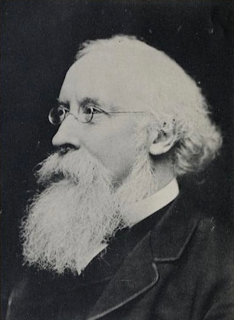
Birth of Whitley Stokes, Irish Lawyer & Celtic Scholar

Whitley StokesCSICIEFBA, Irish lawyer and Celtic scholar, is born at 5 Merrion Square, Dublin, on February 28, 1830.

Stokes is a son of William Stokes (1804–78), and a grandson of Whitley Stokes, a physician and anti-Malthusian (1763–1845), each of whom is Regius Professor of Physic at Trinity College Dublin (TCD). His sister, Margaret Stokes, is a writer and archaeologist.

Stokes is educated at St. Columba’s College where he is taught the Irish language by Denis Coffey, author of Primer of the Irish Language. Through his father he comes to know the Irish antiquaries Samuel FergusonEugene O’CurryJohn O’Donovan and George Petrie. He enters Trinity College Dublin in 1846 and graduates with a BA in 1851. His friend and contemporary Rudolf Thomas Siegfried (1830–63) becomes assistant librarian at TCD in 1855, and the college’s first professor of Sanskrit in 1858. Stokes likely learns both Sanskrit and comparative philology from Siegfried, thus acquiring a skill-set rare among Celtic scholars in Ireland at the time.

Stokes qualifies for the bar at Inner Temple. His instructors in the law are Arthur CayleyHugh McCalmont Cairns, and Thomas Chitty. He becomes an English barrister on November 17, 1855, practicing in London before going to India in 1862, where he fills several official positions. In 1865 he marries Mary Bazely by whom he has four sons and two daughters. One of his daughters, Maïve, compiles a book of Indian Fairy Tales in 1879 when she is 12 years old, based on stories told to her by her Indian ayahs and a man-servant. It also includes some notes by Mrs. Mary Stokes. Mary dies while the family is still living in India. In 1877, Stokes is appointed legal member of the viceroy’s council, and he drafts the codes of civil and criminal procedure and does much other valuable work of the same nature. In 1879 he becomes president of the commission on Indian law. Nine books he writes on Celtic studies are published in India. He returns to settle permanently in London in 1881 and marries Elizabeth Temple in 1884. In 1887 he is made a Companion of the Order of the Star of India (CSI), and two years later an Order of the Indian Empire (CIE). He is an original fellow of the British Academy, an honorary fellow of Jesus College, Oxford and foreign associate of the Institut de France.

Stokes is perhaps most famous as a Celtic scholar, and in this field he works both in India and in England. He studies Irish, Breton and Cornish texts. His chief interest in Irish is as a source of material for comparative philology. Despite his learning in Old Irish and Middle Irish, he never acquires Irish pronunciation and never masters Modern Irish. In the hundred years since his death he continues to be a central figure in Celtic scholarship. Many of his editions have not been superseded during this time and his total output in Celtic studies comes to over 15,000 pages. He is a correspondent and close friend of Kuno Meyer from 1881 onwards. With Meyer he establishes the journal Archiv für celtische Lexicographie and is the co-editor, with Ernst Windisch, of the Irische Texteseries. In 1876 his translation of Vita tripartita Sancti Patricii, along with a written introduction, is published.

In 1862 Stokes is awarded the Cunningham Medal by the Royal Irish Academy.

Stokes dies at his London home, 15 Grenville Place, Kensington, on April 13, 1909, and is buried in Paddington Old Cemetery, Willesden Lane, where his grave is marked by a Celtic cross. Another Celtic cross is erected as a memorial to him at St. Fintan’s Cemetery, Sutton, Dublin. The Gaelic League newspaper An Claidheamh Soluis calls him “the greatest of the Celtologists” and expresses pride that an Irishman has excelled in a field which is at that time dominated by continental scholars. In 1929 the Canadian scholar James F. Kenney describes him as “the greatest scholar in philology that Ireland has produced, and the only one that may be ranked with the most famous of continental savants.”

A conference entitled “Ireland, India, London: The Tripartite Life of Whitley Stokes” takes place at the University of Cambridge on September 18-19, 2009. The event is organised to mark the centenary of Stokes’s death. A volume of essays based on the papers delivered at this conference, The Tripartite Life of Whitley Stokes (1830–1909), is published by Four Courts Press in autumn 2011.

In 2010 Dáibhí Ó Cróinín publishes Whitley Stokes (1830–1909): The Lost Celtic Notebooks Rediscovered, a volume based on the scholarship in Stokes’s 150 notebooks which had been resting unnoticed at the Leipzig University LibraryLeipzig since 1919.


Leave a comment

Birth of Kuno Meyer, Scholar of Celtic Philology

kuno-meyer

Kuno Meyer, German scholar distinguished in the field of Celtic philology and literature, is born in Hamburg, Germany on December 20, 1858. He was considered first and foremost a lexicographer among Celtic scholars but is known by the general public in Ireland rather as the man who introduced them to Selections from Ancient Irish Poetry (1911). His brother was the distinguished classical scholar, Eduard Meyer.

Meyer studies in Hamburg at the Gelehrtenschule des Johanneums. He spends two years in Edinburgh, Scotland, as a teenager (1874–1876) learning English. From 1879, he attends Leipzig University, where he is taught Celtic scholarship by Ernst Windisch. He receives his doctorate for his thesis Eine irische Version der Alexandersage, an Irish version of the Romance of Alexander, in 1884.

Meyer then takes up the post of lecturer in Teutonic languages at the new University College, Liverpool, the precursor of the University of Liverpool, which is established three years earlier.

Meyer continues to publish on Old Irish and more general topics on the Celtic languages, as well as producing textbooks for German. In 1896, he founds and edits, jointly with Ludwig Christian Stern, the prestigious Zeitschrift für celtische Philologie. He also cofounds Archiv für celtische Lexicographie in 1898 with Whitley Stokes, producing three volumes from 1900 to 1907.

In 1903, Meyer founds the School of Irish Learning in Dublin, and the next year creates its journal Ériu of which he is the editor. Also in 1904, he becomes Todd Professor in the Celtic Languages at the Royal Irish Academy. In October 1911, he follows Heinrich Zimmer as Professor of Celtic Philology at Friedrich Wilhelm University in Berlin. The following year, a volume of Miscellany is presented to him by pupils and friends in honour of his election, and he is made a freeman of both Dublin and Cork.

At the outbreak of World War I, Meyer leaves Europe for the United States, where he lectures at Columbia University, University of Illinois at Urbana-Champaign, and elsewhere. A pro-German speech he gives in December 1914 to Clan na Gael on Long Island causes outrage in Britain and some factions among the Irish, and as a result, he is removed from the roll of freemen in Dublin and Cork and from his Honorary Professorship of Celtic at Liverpool. He also resigns as Director of the School of Irish Learning and editor of Ériu. Harvard University also had extended an invitation to Meyer to lecture on campus, but it subsequently cancels the invitation in the fall of 1914 on account of Meyer’s propagandist activity.

Meyer nevertheless accepts candidacy for the post of exchange professor at Harvard, at the recommendation of German professors there. However, when the April 1915 issue of The Harvard Advocate awards first prize to an anti-German satirical poem “Gott mit Uns” written by an undergraduate, Meyer sends the university and the press a letter of protest, rebuking the faculty members who served as judges for failure to exercise neutrality. Meyer also declines his candidacy from the exchange professorship in the letter. In a reply, President Abbott Lawrence Lowell says, in explaining Harvard’s policy, that freedom of speech includes pro-German and pro-Allied voices alike.

Meyer is injured in a railway collision in 1915 and meets 27-year-old Florence Lewis while he is recovering in a California hospital. They marry shortly afterwards. He returns to Germany in 1917 and dies in Leipzig on October 11, 1919.

Posthumously, in 1920, Meyer’s name is restored, both by Dublin and Cork, in their Rolls of Honorary Freemen. The restoration occurs on April 19, 1920, in Dublin, where Sinn Féin had won control of the City Council three months earlier, rescinding the decision taken in 1915 by the Irish Parliamentary Party. The restoration in Cork follows on May 14, 1920.


Leave a comment

Birth of Charles Villiers Stanford, Composer & Conductor

charles-villiers-stanford

Sir Charles Villiers Stanford, composer, music teacher, and conductor, is born in Dublin on September 30, 1852.

Stanford is born into a well-off and highly musical family, the only son of John James Stanford, a prominent Dublin lawyer, Examiner to the Court of Chancery in Ireland and Clerk of the Crown for County Meath, and his second wife, Mary, née Henn. He is educated at the University of Cambridge before studying music in Leipzig and Berlin. He is instrumental in raising the status of the Cambridge University Musical Society, attracting international stars to perform with it.

While still an undergraduate, Stanford is appointed organist of Trinity College, Cambridge. In 1882, at the age of 29, he is one of the founding professors at the Royal College of Music, where he teaches composition for the rest of his life. From 1887 he is also Professor of Music at Cambridge. As a teacher, he is skeptical about modernism and bases his instruction chiefly on classical principles as exemplified in the music of Johannes Brahms. Among his pupils are rising composers whose fame go on to surpass his own, such as Gustav Holst and Ralph Vaughan Williams. As a conductor, he holds posts with the Bach Choir and the Leeds Triennial Music Festival.

Stanford composes a substantial number of concert works, including seven symphonies, but his best-remembered pieces are his choral works for church performance, chiefly composed in the Anglican tradition. He is a dedicated composer of opera, but none of his nine completed operas has endured in the general repertory. Some critics regard him, together with Hubert Parry and Alexander Mackenzie, as responsible for a renaissance in music from the British Isles. However, after his conspicuous success as a composer in the last two decades of the 19th century, his music is eclipsed in the 20th century by that of Edward Elgar as well as former pupils.

In September 1922, Stanford completes the sixth Irish Rhapsody, his final work. Two weeks later he celebrates his 70th birthday and thereafter his health declines. On March 17, 1924, he suffers a stroke and dies on March 29 at his home in London, survived by his wife and children. He is cremated at Golders Green Crematorium on April 2 and his ashes are buried in Westminster Abbey the following day.

Stanford’s last opera, The Travelling Companion, composed during World War I, is premiered by amateur performers at the David Lewis Theatre, Liverpool in 1925 with a reduced orchestra. The work is given complete at Bristol in 1928 and at Sadler’s Wells Theatre, London, in 1935.

Stanford receives many honours, including honorary doctorates from University of Oxford (1883), University of Cambridge (1888), Durham University (1894), University of Leeds (1904), and Trinity College, Dublin (1921). He is knighted in 1902 and in 1904 is elected a member of the Prussian Academy of Arts, Berlin.