The pub is attacked by the Provisional Irish Republican Army on November 7, 1974, and two people are killed: Gunner Richard Dunne (aged 42), of the Royal Artillery (whose barracks are just 100 yards away), and Alan Horsley (aged 20), a sales clerk. A further 35 people, including the landlady, Margaret Nash, are injured. Echoing similar attacks in Guildford the previous month, a bomb, made of 6 lbs. of gelignite plus shrapnel, is thrown through a window into the pub.
Initially a left-wing extremist group called Red Flag 74 says it had placed the bomb, but responsibility is subsequently claimed by the Provisional Irish Republican Army and specifically by part of the Active Service Unit apprehended in December 1975 at the Balcombe Street siege. Two of the Guildford Four are wrongfully charged in December 1974 with involvement in the Woolwich pub bombing, and their convictions in October 1975 are eventually quashed in 1989 after a long campaign for justice.
The bombing is most likely the work of the Balcombe Street ASU, which claims sole responsibility during the 1977 trial of four members apprehended at the siege and include Joe O’Connell, who states from the dock:
“We have instructed our lawyers to draw the attention of the court to the fact that four totally innocent people – Carole Richardson, Gerry Conlon, Paul Hill and Paddy Armstrong – are serving massive sentences for three bombings, two in Guildford and one in Woolwich, which three of us and another man now imprisoned, have admitted that we did.”
Neither the Woolwich bombing nor the wrongful imprisonments result in further charges or convictions. Three British police officers—Thomas Style, John Donaldson and Vernon Attwell—are charged in 1993 with conspiracy to pervert the course of justice, but each is found not guilty.
In continuation of a “troubles” overseas offensive, the Royal Artillery Barracks in Woolwich are bombed by the IRA in December 1983.
On April 17, 2018, P2P Residential Limited obtains full planning permission to demolish the pub and redevelop it as 19 residential units, nine parking spaces and a replacement pub across the ground floor and basement.
Similar plans had been proposed in 2013. Permission was granted in 2015 for 12 residential units and a pub, but the then owner did not implement the consent. The pub is demolished for redevelopment in 2020. Following a 2022 planning application, a Tesco Express supermarket is opened on the ground floor of the building.
Ward, 25, from Stockport in Cheshire, receives a life term for each of those who died when the coach exploded on the M62 motorway. The sentences are to run concurrently with three other sentences of up to twenty years for causing explosions. She remains impassive as Justice Waller passes sentence.
During the trial the court hears that Ward had joined the army – from which she later deserts – on the instructions of the republican group, the IRA. Her detailed knowledge of bases helps to facilitate the coach bombing, prosecution barrister John Cobb QC alleges. She also gives information to the IRA which leads to two attacks on army targets in which six people die, Cobb adds.
Ward initially confesses her crimes in a statement to police which she later retracts. She denies being a member of the IRA but photographs of her in the outlawed organisation’s uniform are shown to the jury at Wakefield Crown Court.
It also emerges in court that Ward was arrested after the bombing of Euston railway station in September 1973 but is later released. Questions are raised as to why the police let her go even though traces of explosives were found on her hands.
As Ward is led from the courtroom to the cells, the only member of her family present, sister-in-law Jean Ward, sobs. Her father, Thomas, says earlier he does not believe his daughter is capable of such “brutal and callous acts.” Her brother, Tommy, says none of the family think Judith has ever been in the IRA. “We don’t think she was so heavily involved. There has been a lot of romancing,” he says.
That is a point echoed in court by Ward’s solicitor, Andrew Rankin QC, who highlights many improbabilities in her confessions. They include having been married to an IRA man and having borne a child by another.
Ward spends 18 years in jail before her conviction is quashed in 1992. Her lawyers argue that the trial jury should have been told of her history of mental illness.
Three Appeal Court judges conclude that Ward’s conviction had been “secured by ambush.” They say government forensic scientists had withheld information that could have changed the course of her trial. Her case is one of a spate of miscarriage of justices revealed in the early 1990s.
After her release, Ward writes an autobiography, Ambushed, published in 1992. She subsequently starts a course in criminology and becomes a campaigner for prisoners’ rights.
(From: “On This Day – 4 November,” BBC News, news.bbc.co.uk)
McCartney takes part in the civil rights march in Derry on January 30, 1972, an event widely known as Bloody Sunday. One of his cousins, James Wray, is one of fourteen men shot and killed by the 1st Battalion, Parachute Regiment of the British Army on that march. As a result of this incident, he joins the Provisional IRA several months later. In 1974, Martin McGuinness, who commands the IRA in Derry, instructs him to beat up an Irish National Liberation Army (INLA) man, Patsy O’Hara, who McGuinness calls a “scumbag” and a “hood.” On January 12, 1979, at Belfast‘s Crown Court, he and another man, Eamonn MacDermott, are convicted of the murder of Detective Constable Patrick McNulty of the Royal Ulster Constabulary (RUC), who was shot several times outside a garage in Derry on January 27, 1977. He is also convicted of IRA membership and the murder of businessman Jeffery Agate in February 1977 and is sentenced to life imprisonment. The murder convictions are overturned in 2007.
McCartney spends 53 days on hunger strike, from October 27 to December 18. From 1989–91 he is Officer Commanding of the IRA prisoners in the H-Blocks and is released in 1994.
Following his release, McCartney is active with ex-prisoners’ groups Tar Abhaile and Coiste na n-Íarchimí, and is the first member of Sinn Féin to hear his own voice heard on television after the lifting of the British broadcasting ban in 1994. He is arrested on April 4, 2002, following a breach of security at Belfast’s police headquarters, but is released without charge the following day. Later that year, on September 5, he is the first former IRA member to appear before the Bloody Sunday Inquiry, and encourages anyone with information, including paramilitaries, to come forward. He is a member of the Legislative Assembly (MLA) for Foyle from July 15, 2004, until February 3, 2020.
On February 15, 2007, McCartney and MacDermott have their murder convictions quashed by the Court of Appeal, following an investigation by the Criminal Cases Review Commission (CCRC) in 2002. The Secretary of State for Northern Ireland declines to compensate McCartney and MacDermott on the grounds that they have not proven themselves innocent. The decision is appealed to the Supreme Court of the United Kingdom which, in May 2011, finds in favour of the applicants, opening the way for a substantial compensation claim from both for their prison terms of 15 and 17 years.
The senior surviving leader of the 1916 Easter Rising, de Valera is jailed by the British after his death sentence for his participation in the Rising is reduced to life imprisonment. He likes to tell the story that his life was spared because of his American birth, a story he tells the visiting United States presidentJohn F. Kennedy at a State reception in 1963. However, it is most likely that his court-martial is scheduled too late after the public and popular pressure becomes too much on the British Government who call a stop to the executions. British prison authorities are surely glad to see him go. He had led Irish prisoners in acts of defiance in several different prisons.
At Dartmoor Prison, de Valera goes on hunger strike and gets a fellow prisoner off bread and water. When all the Irish prisoners are transferred to Lewes Jail, he organizes a work stoppage and gets another man off bread and water. The exasperated British then split up the Irish prisoners, sending de Valera to Maidstone Prison, whose governor has a reputation for breaking men. De Valera meets him head on, refusing to stand at attention or button his jacket as required in his presence, then piercing his pride by wondering aloud, to the delight of the British prison guards, why a military-age man such as he is not at the front. The governor avoids him after that.
Soon after this, de Valera is transferred to Pentonville Prison for early release. Most of the notable leaders of the 1916 Rising, including Dr. Kathleen Lynn, Thomas Ashe and others, had been released from various British prisons. Before his release, they congregate at Pentonville and say a prayer over the grave of Roger Casement, who had been hanged there.
As a free man, de Valera continues to plague Ireland’s foreign rulers. He is handed a telegram saying that he is going to stand as the Sinn Féin candidate in the East Clare by-election. This is the start of a political career that extends over fifty years.
Hughes is born in Bellaghy, County Londonderry, Northern Ireland, on February 28, 1956, into a republican family, the youngest of four brothers in a family of ten siblings. His father, Joseph, had been a member of the Irish Republican Army in the 1920s and one of his uncles had smuggled arms for the republican movement. This results in the Hughes family being targeted when internment is introduced in 1971, and his brother Oliver is interned for eight months without trial in Operation Demetrius. He leaves school at the age of 16 and starts work as an apprentice painter and decorator.
Hughes is returning from an evening out in Ardboe, County Tyrone, when he is stopped at an Ulster Defence Regiment (UDR) checkpoint. When the soldiers realise he comes from a republican family, he is badly beaten. His father encourages him to see a doctor and report the incident to the police, but he refuses, saying he “would get his own back on the people who did it, and their friends.”
Hughes initially joins the Official Irish Republican Army but leaves after the organisation declares a ceasefire in May 1972. He then joins up with Dominic McGlinchey, his cousin Thomas McElwee and Ian Milne, before the three decide to join the Provisional Irish Republican Army in 1973. He, Milne and McGlinchey take part in scores of IRA operations, including daylight attacks on Royal Ulster Constabulary (RUC) stations, bombings, and attacks on off-duty members of the RUC and UDR. Another IRA member describes the activities of Hughes:
“He led a life perpetually on the move, often moving on foot up to 20 miles for one night then sleeping during the day, either in fields and ditches or safe houses; a soldierly sight in his black beret and combat uniform and openly carrying a rifle, a handgun and several grenades as well as food rations.”
On April 18, 1977, Hughes, McGlinchey and Milne are travelling in a car near the town of Moneymore when an RUC patrol car carrying four officers signals them to stop. The IRA members attempt to escape by performing a U-turn but lose control of the car which ends up in a ditch. They abandon the car and open fire on the RUC patrol car, killing two officers and wounding another, before running off through the fields. A second RUC patrol comes under fire while attempting to prevent the men from fleeing, and despite a search operation by the RUC and British Army the IRA members escape. Following the Moneymore shootings, the RUC name Hughes as the most wanted man in Northern Ireland, and issue wanted posters with pictures of Hughes, Milne and McGlinchey. Milne is arrested in Lurgan, County Armagh, in August 1977, and McGlinchey later in the year in the Republic of Ireland.
Hughes is arrested on March 17, 1978, at Lisnamuck, near Maghera in County Londonderry, after an exchange of gunfire with the British Army the night before. British soldiers manning a covert observation post spot Hughes and another IRA volunteer approaching them wearing combat clothing with “Ireland” sewn on their jackets. Thinking they might be from the Ulster Defence Regiment, one of the soldiers stands up and calls to them. The IRA volunteers open fire on the British troops, who return fire. A soldier of the Special Air Service (SAS), Lance Corporal David Jones, is killed and another soldier wounded. Hughes is also wounded and is arrested nearby the next morning.
In February 1980, Hughes is sentenced to a total of 83 years in prison. He is tried for, and found guilty of, the murder of one British Army soldier (for which he receives a life sentence) and wounding of another (for which he receives 14 years) in the incident which leads to his arrest, as well as a series of gun and bomb attacks over a six-year period. Security sources describe him as “an absolute fanatic” and “a ruthless killer.” Fellow republicans describe him as “fearless and active.”
Hughes is involved in the mass hunger strike in 1980 and is the second prisoner to join the 1981 Irish Hunger Strike in the H-Blocks at the Long Kesh Detention Centre. His hunger strike begins on March 15, 1981, two weeks after Bobby Sands began his hunger strike. He is also the second striker to die, at 5:43 p.m. BST on May 12, after 59 days without food, refusing requests from the IRA leadership outside the prison to end the strike after the death of Sands. The journey of his body from the prison to the well-attended funeral near Bellaghy is marked by rioting as the hearse passes through loyalist areas. His death leads to an upsurge in rioting in nationalist areas of Northern Ireland.
Hughes’s cousin Thomas McElwee is the ninth hunger striker to die. Oliver Hughes, one of his brothers, is elected twice to Magherafelt District Council.
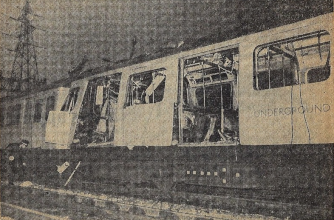
A 5-lb. (2.3 kg) bomb on a Metropolitan line train explodes prematurely in the front carriage of the train, injuring seven passengers. The bomb detonates prior to reaching the City of London, where it is thought the intended target to be Liverpool Street station at rush hour. Adrian Vincent Donnelly, a Provisional Irish Republican Army (IRA) volunteer, then shoots Post Office engineer Peter Chalk in the chest, and kills train driver Julius Stephen, who had attempted to catch him. Donelly exits the station to the street and threatens people with his revolver before Police Constable Raymond Kiff catches up with him. Shouting “You English bastards!” Donelly shoots himself in the chest but survives and is apprehended by Kiff.
Eleven days prior to the West Ham station attack, an IRA bomb explodes in a train at Cannon Street station. The day after the West Ham attack, a bomb on a train at Wood Green tube station explodes, injuring a man. On March 17, a 9-lb. (4.1 kg) bomb is discovered in a train at Neasden Depot. After these events, the London Transport Executive launches a security operation and assigns 1,000 plainclothed policemen on the London Underground system.
An appeal to raise money is launched for the family of the driver of the train, Julius Stephen, who left behind a widow and a family. As of August 1976, £17,000 had been raised.
(Pictured: The underground train damaged in the explosion, The Times, March 16, 1976)
McGlinchey is one of eleven siblings born into a staunchly republican home in Ballyscullion Road, Bellaghy, in rural south County Londonderry, Northern Ireland. His father owns a garage and some of his father’s police customers later die at McGlinchey’s hands. His mother Monica is a devout Catholic. He is educated at the local school. When he was sixteen, he begins an apprenticeship in his father’s garage. About this time, he is joining the numerous civil rights marches that are taking place in the county. His precise reasons for doing so are unclear, but speculation is that he is reacting to events around him and the idea of participating in marches offers glamour and a close identification with his own community.
In 1971, McGlinchey is interned without charge for ten months in Long Kesh Detention Centre. Not long after his release the following year, he is imprisoned again on arms charges. On July 5, 1975, during his imprisonment, he marries Mary O’Neil, daughter of Patrick O’Neil from Toomebridge. Together they have three children.
Following his release, McGlinchey joins Ian Milne and future Provisional IRA hunger strikersFrancis Hughes and Thomas McElwee and wages a campaign of shooting and bombing throughout the county and beyond. Together, they later join the Provisional IRA. The gang spends the late 1970s on the run, carrying out operations and evading both the British Army and the Garda Síochána. Following a mailvan robbery, the latter force arrests McGlinchey in County Monaghan in 1977 for carjacking a Garda patrol vehicle and threatening the officer with a pistol, although he claims that the gun is actually a wheel brace. He fails to make bail at Dublin‘s Special Criminal Court after a Garda Superintendent argues that McGlinchey would fail to attend court if bailed. He is convicted and sent to the maximum-security Portlaoise Prison. In 1982, while serving his prison sentence, he clashes with the prison’s IRA leadership and is either expelled by them for indiscipline or leaves the organisation due to strategic differences.
Following his departure from the IRA and his release from prison, McGlinchey joins the INLA. Due to his experience, he rises through the ranks, becoming chief of staff by 1982. Under his leadership, the INLA, which had previously had a reputation for disorganisation, becomes extremely active in cross-borderassassinations and bombings. These include many individual assassinations and woundings, but also massacres such as the Droppin Well bombing of 1982 in which both civilians and soldiers die. There are some failed operations, and McGlinchey, who believes this is the result of an informer within the ranks, devotes much time and energy to finding the cause. Those suspected of betraying the organisation are treated brutally, often by McGlinchey personally. As a result of this resurgence of activity and his high profile, the press nicknames him “Mad Dog.” Under his tenure the Darkley massacre is carried out, ostensibly by another group but using a weapon supplied by McGlinchey. In late 1983, while still on the run, he gives an interview with the Sunday Tribune newspaper in which he condemns the Darkley killings but also lays out his political philosophy and plans for the future.
By 1984, McGlinchey has fallen out with members of a powerful Republican family from South Armagh over what he considers missing funds. Men loyal to this family are subsequently killed by McGlinchey’s unit, which includes his wife. In March of the same year, he is captured in Newmarket-on-Fergus, County Clare, following a gunfight with the Gardaí. At this time, he is wanted in Northern Ireland for the shooting of an elderly woman, but republicans have traditionally been able to avoid extradition by claiming their offences were political. The bloody war in the north is leading the Republic of Ireland to re-evaluate its position, however, and he becomes the first republican to be extradited to Northern Ireland. Although convicted and sentenced there to life imprisonment, this is overturned in 1985. As a result, he is returned to the Republic, where he is sentenced to ten years’ imprisonment on firearms charges. While he is incarcerated, his wife is shot dead at her Dundalk home.
McGlinchey is released in March 1993 and claiming to have no further involvement with the INLA, moves to Drogheda. He survives an assassination attempt soon after his release from prison, but in February 1994, his enemies catch up with him. At around 9:30 on the evening of Thursday, February 10, 1994, he visits and dines with friends of his in Duleek Road, near his home. He leaves about forty minutes later, intending to take a video back to a shop in Brookville, on the north side of town. At around 11:00 p.m. he and his 16-year-old son Dominic are returning home, when he pulls up to make a phone call from a public kiosk on Hardman’s Gardens, near Our Lady of Lourdes Hospital. Almost immediately and despite the presence of four witnesses, a red Mazda pulls up alongside him. While his son watches from the car, three men get out and beat McGlinchey. Once he is on the ground the men, who are armed with three pump action shotguns and a pistol, fire into him fourteen times. The attack finishes with a coup de grâce to the head, although he is already dead. His last words are reputed to be “Jesus, Mary help me.” His son yells for an ambulance.
The following day, an autopsy is carried out in Our Lady of Lourdes Hospital, which indicates McGlinchey had been hit in the neck, skull, the left upper chest, the left arm, and both legs. His inquest is held in Drogheda two weeks later, suspended and then reopened in November 1996. Gardaí forensic officers tell the coroner that they had compared the shell casings they had found with the database, but no matches have been made to other known weapons. The officer notes that no such information has been received from the Royal Ulster Constabulary (RUC). The shotguns used are impossible to trace ballistically, but it is ascertained that the Mazda was registered in the north. His and his wife’s killers have never been found.
McGlinchey’s funeral is held on February 13, 1994, in Bellaghy, with no republican accoutrements. There is no INLA colour guard, and only an Irish tricolor draped over the coffin. Over 1,500 people attend and are watched closely by 200 RUC. Police armoured vans are held on the perimeter. He is buried alongside his wife and their young daughter Máire. His coffin is carried from the McGlinchey family home to St. Mary’s Church by pallbearers who are swapped out from the crowd every 40-yards or so. Martin McGuinness is among them, as is Bernadette McAliskey and her daughter Róisín. His sons carry the coffin for the final yards.
McGlinchey’s posthumous reputation ranges from being a “psycho” to his enemies to being an inspiration to those who followed him. Commentators have speculated on what he would have contributed to Irish politics had he lived. Some have suggested that he would have contributed to the Northern Ireland peace process, while others have argued that dissident republicans, opposed to that process, would have found him a willing rallying point. He remains an influence on Irish fiction and music, with both Edna O’Brien and Martin McDonagh producing acclaimed pieces based on his life and career. He is also featured in popular songs.
Price and her sister, Marian, also an IRA member, are the daughters of Albert Price, a prominent Irish republican and former IRA member from Belfast. Their aunt, Bridie Dolan, is blinded and loses both hands in an accident while handling IRA explosives.
Price becomes involved in Irish republicanism in the late 1960s and she and Marian participate in the Belfast to Derrycivil rights march in January 1969 and are attacked in the Burntollet Bridge incident.
In 1971 Price and her sister join the Provisional Irish Republican Army (IRA). In 1972 she joins an elite group within the IRA called “The Unknowns” commanded by Pat McClure. The Unknowns are tasked with various secretive activities and transport several accused traitors across the border into the Republic of Ireland where they are “disappeared.” She personally states that she had driven Joe Lynskey across the border to face trial. In addition, she states that she, Pat McClure and a third Unknown were tasked with killing Jean McConville, with the third Unknown actually shooting her.
Price leads the car bombing attacks in London on March 8, 1973, which injure over 200 people and is believed to have contributed to the death of one person who suffers a fatal heart attack. The two sisters are arrested, along with Gerry Kelly, Hugh Feeney and six others, on the day of the bombing as they are boarding a flight to Ireland. They are tried and convicted at the Great Hall in Winchester Castle on November 14, 1973. Although originally sentenced to life imprisonment, which is to run concurrently for each criminal charge, their sentence is eventually reduced to 20 years. She serves seven years for her part in the bombing. She immediately goes on a hunger strike demanding to be moved to a prison in Northern Ireland. The hunger strike lasts for 208 days because the hunger strikers are force-fed by prison authorities to keep them alive.
On the back of the hunger-striking campaign, Price’s father contests Belfast West at the February 1974 United Kingdom general election, receiving 5,662 votes (11.9%). The Price sisters, Hugh Feeney, and Gerry Kelly are moved to Northern Ireland prisons in 1975 as a result of an IRA truce. In 1980 she receives the royal prerogative of mercy and is freed on humanitarian grounds in 1981, purportedly suffering from anorexia nervosa due to the invasive trauma of daily force feedings.
After her release in 1980, Price marries Irish actor Stephen Rea, with whom she has two sons, Danny and Oscar. They divorce in 2003.
The Price sisters remain active politically. In the late 1990s, Price and her sister claim that they have been threatened by their former colleagues in the IRA and Sinn Féin for publicly opposing the Good Friday Agreement (i.e. the cessation of the IRA’s military campaign). she is a contributor to The Blanket, an online journal, edited by former Provisional IRA member Anthony McIntyre, until it ceases publication in 2008.
In 2001, Price is arrested in Dublin and charged with possession of stolen prescription pads and forged prescriptions. She pleads guilty and is fined £200 and ordered to attend Alcoholics Anonymous meetings.
In February 2010, it is reported by The Irish News that Price had offered help to the Independent Commission for the Location of Victims’ Remains in locating graves of three men, Joe Lynskey, Seamus Wright, and Kevin McKee. The bodies of Wright and McKee are recovered from a singular grave in County Meath in August 2015. It is unclear if Price played a role in their recovery. The remains of Joe Lynskey have not been recovered as of April 2021.
Price is the subject of the 2018 feature-length documentary I, Dolours in which she gives an extensive filmed interview.
In 2010, Price claims Gerry Adams had been her officer commanding (OC) when she was active in the IRA. Adams, who has always denied being a member of the IRA, denies her allegation. She admits taking part in the murder of Jean McConville, as part of an IRA action in 1972. She claims the murder of McConville, a mother of ten, was ordered by Adams when he was an IRA leader in West Belfast. Adams subsequently publicly further denies Price’s allegations, stating that the reason for them is that she is opposed to the Provisional Irish Republican Army’s abandonment of paramilitary warfare in favour of politics in 1994, in the facilitation of which Adams has been a key figure.
Oral historians at Boston College interview both Price and her fellow IRA paramilitary Brendan Hughes between 2001 and 2006. The two give detailed interviews for the historical record of the activities in the IRA, which are recorded on condition that the content of the interviews is not to be released during their lifetimes. Prior to her death in May 2011, the Police Service of Northern Ireland (PSNI) subpoena the material, possibly as part of an investigation into the disappearance of a number of people in Northern Ireland during the 1970s. In June 2011, the college files a motion to quash the subpoena. A spokesman for the college states that “our position is that the premature release of the tapes could threaten the safety of the participants, the enterprise of oral history, and the ongoing peace and reconciliation process in Northern Ireland.” In June 2011, U.S. federal prosecutors ask a judge to require the college to release the tapes to comply with treaty obligations with the United Kingdom. On July 6, 2012, the United States Court of Appeals for the First Circuit agrees with the government’s position that the subpoena should stand. On October 17, 2012, the Supreme Court of the United States temporarily blocks the college from handing over the interview tapes. In April 2013, after Price’s death, the Supreme Court turns away an appeal that seeks to keep the interviews from being supplied to the PSNI. The order leaves in place a lower court ruling that orders Boston College to give the Justice Department portions of recorded interviews with Price. Federal officials want to forward the recordings to police investigating the murder of Jean McConville.
Price dies in her Malahide, County Dublin, home on January 23, 2013, from a toxic effect of mixing prescribed sedative and anti-depressant medication. Her body is found the following day. The inquest returns a verdict of death by misadventure. She is buried at Milltown Cemetery in West Belfast.
In 1974 and 1975, London is subjected to a 14-month campaign of gun and bomb attacks by the Provisional IRA. Some 40 bombs explode in London, killing 35 people and injuring many more. The four members of what becomes known as the “Balcombe Street gang,” Joe O’Connell, Edward Butler, Harry Duggan and Hugh Doherty, are part of a six-man IRA Active Service Unit (ASU) that also includes Brendan Dowd and Liam Quinn.
The Balcombe Street siege starts after a chase through London, as the Metropolitan Police pursues Doherty, O’Connell, Butler and Duggan through the streets after they had fired gunshots through the window of Scott’s restaurant in Mount Street, Mayfair. The four IRA men ultimately run into a block of council flats in Balcombe Street, adjacent to Marylebone station, triggering the six-day standoff.
The four men go to 22b Balcombe Street in Marylebone, taking its two residents, middle-aged married couple John and Sheila Matthews, hostage in their front room. The men declare that they are members of the IRA and demand a plane to fly both them and their hostages to Ireland. Scotland Yard refuses, creating a six-day standoff between the men and the police. Peter Imbert, later Commissioner of the Metropolitan Police Service, is the chief police negotiator.
The siege ends peacefully on December 12, 1975, after the men free their two hostages and surrender following several days of intense negotiations between Metropolitan Police Bomb squad officers, Detective Superintendent Peter Imbert and Detective Chief Superintendent Jim Nevill, and the unit’s leader Joe O’Connell, who goes by the name of “Tom.” The other members of the gang are named “Mick” and “Paddy,” thereby avoiding revealing to the negotiators precisely how many of them are in the living room of the flat. The resolution of the siege is a result of the combined psychological pressure exerted on the gang by Imbert and the deprivation tactics used on the four men. The officers also use carefully crafted misinformation, through the BBC Radio news to further destabilise the gang into surrender. A news broadcast states that the British Special Air Service are going to be sent in to storm the building and release the hostages. This seems to deter the gang and they eventually give themselves up to the police.
The four are found guilty at their Old Bailey trial in 1977 of seven murders, conspiring to cause explosions, and falsely imprisoning John and Sheila Matthews during the siege. O’Connell, Butler and Duggan each receive 12 life sentences, and Doherty receives 11. Each of the men is later given a whole life tariff, the only IRA prisoners to receive this tariff. During the trial they instruct their lawyers to “draw attention to the fact that four totally innocent people were serving massive sentences” for three bombings in Woolwich and Guildford. Despite telling the police that they are responsible, they are never charged with these offences and the Guildford Four and Maguire Seven remain in prison for 15 more years, until it is ruled that their convictions are unsafe.
In 1973, the Provisional Irish Republican Army (IRA) extends its campaign to mainland Britain, attacking military and symbolically important targets to both increase pressure on the British government, via popular British opinion, to withdraw from Northern Ireland and to maintain morale amongst their supporters. By 1974, mainland Britain sees an average of one attack — successful or otherwise — every three days.
In the early evening hours of November 21, at least three bombs connected to timing devices are planted inside two separate public houses and outside a bank located in and around central Birmingham. It is unknown precisely when these bombs were planted. If official IRA protocol of preceding attacks upon non-military installations with a 30-minute advance warning to security services is followed, and subsequent eyewitness accounts are accurate, the bombs would have been planted at these locations after 7:30 p.m. and before 7:47 p.m.
According to testimony delivered at the 1975 trial of the six men wrongly convicted of the bombings, the bomb planted inside the Mulberry Bush pub is concealed inside either a duffel bag or briefcase, whereas the bomb planted inside the Tavern in the Town is concealed inside a briefcase or duffel bag (possibly concealed within a large, sealed plastic bag) and Christmas cracker boxes. The remnants of two alarm clocks recovered from the site of each explosion leaves the possibility that two bombs had been planted at each public house. The explosion crater at each location indicates that if two bombs had been planted at each public house, they would each have been placed in the same location and likely the same container.
Reportedly, those who plant the bombs then walk to a preselected phone box to telephone the advance warning to security services. However, the phone box has been vandalised, forcing the caller to find an alternative phone box and thus shortening the amount of time police have to clear the locations.
At 8:11 p.m., an unknown man with a distinct Irish accent telephones the Birmingham Post newspaper. The call is answered by operator Ian Cropper. The caller says, “There is a bomb planted in the Rotunda and there is a bomb in New Street at the tax office. This is Double X,” before terminating the call. (“Double X” is an IRA code word given to authenticate any warning call.) A similar warning is also sent to the Birmingham Evening Mail newspaper, with the anonymous caller again giving the code word, but again failing to name the public houses in which the bombs had been planted.
The Rotunda is a 25-story office block, built in the 1960s, that houses the Mulberry Bush pub on its lower two floors. Within minutes of the warning, police arrive and begin checking the upper floors of the Rotunda, but they do not have sufficient time to clear the crowded pub at street level. At 8:17 p.m., six minutes after the first telephone warning had been delivered to the Birmingham Post, the bomb, which had been concealed inside either a duffel bag or briefcase located ner the rear entrance to the premises, explodes, devastating the pub. The explosion blows a 40-inch crater in the concrete floor, collapsing part of the roof and trapping many casualties beneath girders and concrete blocks. Many buildings near the Rotunda are also damaged, and pedestrians in the street are struck by flying glass from shattered windows. Several of the victims die at the scene, including two youths who had been walking past the premises at the moment of the explosion.
Ten people are killed in this explosion and dozens are injured, including many who lose limbs. Several casualties are impaled by sections of wooden furniture while others have their clothes burned from their bodies. A paramedic called to the scene of this explosion later describes the carnage as being reminiscent of a slaughterhouse. One fireman says that, upon seeing a writhing, “screaming torso,” he begs police to allow a television crew inside the premises to film the dead and dying at the scene, in the hope the IRA would see the consequences of their actions. However, the police refuse this request, fearing the reprisals would be extreme.
The Tavern in the Town is a basement pub on New Street located a short distance from the Rotunda and directly beneath the New Street Tax Office. Patrons there hear the explosion at the Mulberry Bush, but do not believe that the sound, described by one survivor as a “muffled thump,” is an explosion.
Police have begun attempting to clear the Tavern in the Town when, at 8:27 p.m., a second bomb explodes there. The blast is so powerful that several victims are blown through a brick wall. Their remains are wedged between the rubble and live underground electric cables that supply the city centre. One of the first police officers on the scene, Brian Yates, later testifies that the scene which greeted his eyes was “absolutely dreadful,” with several of the dead stacked upon one another, others strewn about the ruined pub, and several screaming survivors staggering aimlessly amongst the debris, rubble, and severed limbs. A survivor says the sound of the explosion is replaced by a “deafening silence” and the smell of burned flesh.
Rescue efforts at the Tavern in the Town are initially hampered as the bomb had been placed at the base of a set of stairs descending from the street, the sole entrance to the premises, had been destroyed in the explosion. The victims whose bodies are blown through a brick wall and wedged between the rubble and underground electric cables take up to three hours to recover, as recovery operations are delayed until the power can be isolated. A passing West Midlands bus is also destroyed in the blast.
This bomb kills nine people outright, and injures everyone in the pub, many severely. Two later die of their injuries. After the second explosion, police evacuate all pubs and businesses in Birmingham city centre and commandeer all available rooms in the nearby City Centre Hotel as an impromptu first-aid post. All bus services into the city centre are halted, and taxi drivers are encouraged to transport those lightly injured in the explosions to hospital. Prior to the arrival of ambulances, rescue workers remove critically injured casualties from each scene upon makeshift stretchers constructed from devices such as tabletops and wooden planks. These severely injured casualties are placed on the pavement and given first aid prior to the arrival of ambulance services.
At 9:15 p.m., a third bomb, concealed inside two plastic bags, is found in the doorway of a Barclays Bank on Hagley Road, approximately two miles from the site of the first two explosions. This device consists of 13.5 pounds of Frangex connected to a timer and is set to detonate at 11:00 p.m. The detonator to the device activates when a policeman prods the bags with his truncheon, but the bomb does not explode. The device is destroyed in a controlled explosion early the following morning.
The bombings stoke considerable anti-Irish sentiment in Birmingham, which then has an Irish community of 100,000. Irish people are ostracised from public places and subjected to physical assaults, verbal abuse and death threats. Both in Birmingham and across England, Irish homes, pubs, businesses and community centres are attacked, in some cases with firebombs. Staff at thirty factories across the Midlands go on strike in protest of the bombings, while workers at airports across England refuse to handle flights bound for Ireland. Bridget Reilly, the mother of the two Irish brothers killed in the Tavern in the Town explosion, is herself refused service in local shops.
The bombings are immediately blamed on the IRA, despite the organisation not having claimed responsibility. Due to anger against Irish people in Birmingham after the bombings, the IRA Army Council places the city “strictly off-limits” to IRA active service units. In Northern Ireland, loyalist paramilitaries launch a wave of revenge attacks on Irish Catholics and within two days of the bombings, five Catholic civilians have been shot dead by loyalists. The Provisional IRA never officially admits responsibility for the Birmingham pub bombings.
Six Irishmen are arrested within hours of the blasts and in 1975 are sentenced to life imprisonment for the bombings. The men, who become known as the Birmingham Six, maintain their innocence and insist police had coerced them into signing false confessions through severe physical and psychological abuse. After 16 years in prison, and a lengthy campaign, their convictions are declared unsafe and unsatisfactory, and quashed by the Court of Appeal in 1991. The episode is seen as one of the worst miscarriages of justice in British legal history.
In 2001, each of the Birmingham Six is subsequently paid between £840,000 and £1.2 million in compensation.
(Pictured: The Mulberry Bush pub after the November 21, 1974, bombing)





 seamus dubhghaill