seamus dubhghaill

Promoting Irish Culture and History from Little Rock, Arkansas, USA


Leave a comment

The Gibbet Rath Executions

The Gibbet Rath executions, sometimes called the Gibbet Rath massacre, refers to the execution of several hundred surrendering rebels by government forces during the Irish Rebellion of 1798 at the Curragh of Kildare on May 29, 1798.

News of the outbreak of the rebellion prompts Major-General Sir James Duff, Military Commander in Limerick, to gather a force of about 600 men, mainly Dublin militia members, backed up by seven artillery pieces, and sets out on a forced march to Dublin on May 27. His twin objectives are to restore communications between the two cities and to crush any resistance encountered on the way. As the soldiers enter County Kildare, they discover the bodies of several rebel victims, among them Lieutenant William Giffard, the son of the commander of the Dublin militia, Captain John Giffard, which reportedly inflames the soldiers.

However, by the time Duff’s column arrives in Monasterevin in County Kildare, at 7:00 a.m. on May 29, the bulk of the rebel forces have already accepted a government amnesty from Generals Gerard Lake and Ralph Dundas, following their defeat at the Battle of Kilcullen and had surrendered at Knockaulin Hill, several kilometres to the east of the Curragh on May 27. Not aware that the rebels are gathering to surrender on the Curragh plain, Duff reinforces his column and marches to the nearby town of Kildare, and on to the adjacent southwest corner of the Curragh.

Duff’s force had by now grown to 700 militia, dragoons and yeomanry with four pieces of artillery, three having been presumably left at Monasterevin. The designated place of surrender, the ancient fort of Gibbet Rath, is a wide expanse of plain with little or no cover for several kilometres around but neither the rebels nor Duff’s force have seemingly any reason to fear treachery as a separate peaceful surrender to General Dundas at Knockaulin Hill, who is accompanied only by two dragoons, has been successfully accomplished without bloodshed.

By the time of Duff’s arrival at Gibbet Rath on the morning of May 29, an army of between 1,000 and 2,000 rebels is waiting to surrender in return for the promised amnesty. They are subjected to an angry tirade for their treason by Duff who orders them to kneel for pardon and then to stack their arms. Shortly after the weapons are stacked, an infantry and cavalry assault results in the death of about 350 men. Accounts of why the massacre began differ. Rebel claims that Duff orders his troops to attack the disarmed and surrounded men are denied by Duff himself who claims that the rebels fired on his men, while another source records “one man in the crowd, saying he would not hand over his fire-lock loaded, blazed it off in the air”.

However, Duff redrafts his own official report of the engagement before submission to Dublin Castle, his final draft is transmitted without references to his knowledge of the surrender preparations. The original report reads as follows with the items in brackets excised from his final report:

“My Dear Genl. (I have witnessed a melancholy scene) We found the Rebels retiring from this Town on our arrival armed. We followed them with Dragoons; I sent on some of the Yeomen to tell them, on laying down their arms, they should not be hurt. Unfortunately some of them Fired on the Troops; from that moment they were attacked on all sides, nothing could stop the Rage of the Troops. I believe from Two to Three hundred of the Rebels were killed. (They intended, we are told, to lay down their arms to General Dundas). We have 3 men killed & several wounded. I am too fatigued to enlarge. I have forwarded the mails to Dublin.”

The grieving Captain John Giffard expresses his own satisfaction as follows:

“My troops did not leave my hero unavenged – 500 rebels bleaching on the Curragh of Kildare—that Curragh over which my sweet innocent girls walked with me last Summer, that Curragh was strewed with the vile carcasses of popish rebels and the accursed town of Kildare has been reduced to a heap of ashes by our hands.”

General Duff receives no censure for the massacre and, upon his arrival in Dublin the following day, is feted as a hero by the population who honour him with a victory parade. General Dundas, by contrast, is denounced for having shown clemency toward the rebels. However, because of the massacre, wavering rebels are discouraged from surrendering and there are no further capitulations in County Kildare until the final surrender of William Aylmer in July. Dr. Chambers considers that Lake and Duff are not in communication about the surrenders, being on opposite sides of the Curragh. Duff and his 500 men arrive in Kildare after a forced march from Limerick and find it sacked by the rebels, along with the piked body of Duff’s nephew.

Duff is later involved in an unsuccessful campaign after the Battle of Vinegar Hill to trap and destroy a surviving rebel column in Wexford led by Anthony Perry who fights and eludes Duff’s forces at the battle of Ballygullen/Whiteheaps on 5 July.

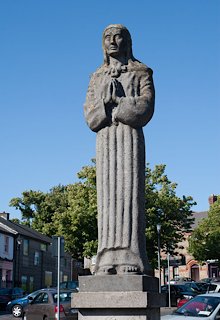
(Pictured: The statue of Saint Brigid at the Market Square of Kildare which is dedicated to the memory of the victims at Gibbet Rath)


Leave a comment

Birth of David Byrne, Former AG of Ireland and EU Commissioner

David Byrne, Fianna Fáil politician, Irish senior counsel, former Attorney General of Ireland and former European Commissioner for Health and Food Safety, is born in Monasterevin, County Kildare, on April 6, 1947.

Byrne is educated at Newbridge College, County Kildare, University College Dublin (UCD) and King’s Inns, Dublin. He is called to the Bar in 1970 and practises law in the Irish and European Courts. During his student days in Dublin, he founds the Free Legal Advice Centre, a student-run organisation providing legal aid to citizens in association with the legal profession. He campaigns in favour of Irish entry into the European Community (EC) in the 1970s and has been a keen supporter of European integration ever since.

Byrne becomes a Senior Counsel in 1985. He practises in both the Irish courts and the European Court of Justice and also serves as a member of the International Court of Commercial Arbitration from 1990–97.

In 1997 Byrne becomes Attorney General of Ireland in the Fianna Fáil-Progressive Democrats coalition government. As one of the negotiators of the Good Friday Agreement in April 1998, he drafts and oversees the major constitutional amendments required by that agreement, which are approved by Referendum in May 1998. He also advises on the constitutional amendments necessary for Ireland’s ratification of the Treaty of Amsterdam. During his tenure, he establishes the first independent Food Safety Agency in Europe responsible to the Minister for Health.

Byrne is nominated to the European Commission by Taoiseach Bertie Ahern in September 1999, serving as Ireland’s EU Commissioner and has responsibility for Health & Consumer Protection in the Prodi Commission. He continues in that role until replaced as Ireland’s Commissioner by Charlie McCreevy in 2004.

During his time in office, Byrne is a major driving force behind European tobacco control legislation, such as directives banning tobacco advertising and regulating tobacco products, in keeping with the World Health Organization Framework Convention on Tobacco Control (WHO FCTC). Under his leadership, the European Union also creates the European Centre for Disease Prevention and Control (ECDC) in 2004.

When he concludes his Brussels assignment, Byrne acts as World Health Organization (WHO) Special Envoy on the revision of the International Health Regulations (IHR) for a six-month period following a series of outbreaks of SARS and avian influenza.

Byrne is mooted as a potential candidate for the position of Director General of the World Health Organization following the death of the incumbent, Dr Lee Jong-wook in 2006. However, he is eventually not included in the list of thirteen candidates to head the agency.

In December 2006 Byrne is appointed as Chancellor of Dublin City University (DCU). He holds this position until 2011.

After leaving the European Commission, Byrne holds a variety of paid and unpaid positions, including Co-Chair of European Alliance for Personalised Medicine, member of the International Advisory Board of FleishmanHillard, Chairman of the Ethics Committee of the International Prevention Research Institute (IPRI), Chairman of the Advisory Committee of the National Treasury Management Agency (NTMA), of counsel of Wilmer Cutler Pickering Hale and Dorr, Honorary Co-Chair of the World Justice Project (WJP) and a member of the World Prevention Alliamce.


Leave a comment

Death of John McCormack, Renowned Irish Tenor

Papal Count John Francis McCormack, KSG, KSS, KHS, Irish tenor celebrated for his performances of the operatic and popular song repertoires, and renowned for his diction and breath control, dies in Booterstown, Dublin, on September 16, 1945.

McCormack is born on June 14, 1884, in Athlone, County Westmeath, the second son and fifth of the 11 children of Andrew McCormack and his wife Hannah Watson. His parents are both from Galashiels, Scotland, and work at the Athlone Woolen Mills, where his father is a foreman. He is baptised in St. Mary’s Church, Athlone, on June 23, 1884.

McCormack receives his early education from the Marist Brothers in Athlone and later attends Summerhill College, Sligo. He sings in the choir of the old St. Peter’s Church in Athlone under his choirmaster Michael Kilkelly. When the family moves to Dublin, he sings in the choir of St. Mary’s Pro-Cathedral where he is discovered by Vincent O’Brien. In 1903 he wins the coveted gold medal of the Dublin Feis Ceoil. He marries Lily Foley in 1906 and they have two children, Cyril and Gwen.

In March 1904, McCormack becomes associated with James Joyce, who at the time has singing ambitions himself. He persuades Joyce to enter the Feis Ceoil that year, where the not yet famous writer is awarded the Bronze Medal.

Fundraising activities on his behalf enable McCormack to travel to Italy in 1905 to receive voice training by Vincenzo Sabatini, father of the novelist Rafael Sabatini, in Milan. Sabatini finds McCormack’s voice naturally tuned and concentrates on perfecting his breath control, an element that becomes part of the basis of his renown as a vocalist.

In 1906, McCormack makes his operatic début at the Teatro Chiabrera, Savona. The next year, he begins his first important operatic performance at Covent Garden in Pietro Mascagni‘s Cavalleria rusticana, becoming the theatre’s youngest principal tenor. In 1909, he begins his career in the United States.

In February 1911, McCormack plays Lieutenant Paul Merrill in the world premiere of Victor Herbert‘s opera Natoma with Mary Garden in the title role. Later that year, he tours Australia after Dame Nellie Melba engages him, then at the height of his operatic career, aged 27, as a star tenor for the Melba Grand Opera Season. He returns for concert tours in subsequent years.

By 1912, McCormack is beginning to become involved increasingly with concert performances, where his voice quality and charisma ensures that he becomes the most celebrated lyric tenor of his time. He does not, however, retire from the operatic stage until after his performance of 1923 in Monte Carlo, although by then the top notes of his voice have contracted. Famous for his extraordinary breath control, he can sing 64 notes on one breath in Mozart‘s “Il mio tesoro” from Don Giovanni, and his Handelian singing is just as impressive in this regard.

McCormack makes hundreds of recordings, his best-known and most commercially successful series of records being those for the Victor Talking Machine Company during the 1910s and 1920s. He is Victor’s most popular Red Seal recording artist after tenor Enrico Caruso. In the 1920s, he sings regularly on radio and later appears in two sound films, Song o’ My Heart (1930), playing an Irish tenor, and as himself appearing in a party scene in Wings of the Morning (1937), the first British three-strip Technicolor feature.

McCormack is one of the first artists to record the popular ballad “I Hear You Calling Me” written in 1908 by Harold Harford and Charles Marshall. He records it twice for Odeon Records starting in 1908 and a further four times for Victor between 1910 and 1927, becoming his best seller. He is the first artist to record the famous World War I song “It’s a Long Way to Tipperary” in 1914. He also records a best-selling version of another popular World War I tune, “Keep the Home Fires Burning,” in 1917. He also sings songs expressive of Irish nationalism and endorses the Irish Nationalist estrangement from the United Kingdom. He is associated particularly with the songs of Thomas Moore, notably “The Harp That Once Through Tara’s Halls,” “The Minstrel Boy,” “Believe Me If All (Those Endearing Young Charms),” and “The Last Rose of Summer.” Between 1914 and 1922, he records almost two dozen songs with violin accompaniment provided by Fritz Kreisler, with whom he also tours. He records songs of Hugo Wolf for the Hugo Wolf Society in German. In 1918, he records the song “Calling Me Home to You.”

In 1917, McCormack becomes a naturalised citizen of the United States. In June 1918, he donates $11,458 toward the U.S. World War I effort. By then, his career is a huge financial success, earning millions in his lifetime from record sales and appearances.

By 1920, Edwin Schneider has become McCormack’s accompanist and the two are “inseparable.” When Schneider retires, Gerald Moore takes over as accompanist from 1939 to 1943.

In 1927, McCormack moves into Moore Abbey, Monasterevin, County Kildare, and adopts a very opulent lifestyle by Irish standards. He also owns apartments in London and New York. He hopes that one of his racehorses, such as Golden Lullaby, would win The Derby, but this never occurs.

McCormack also purchases Runyon Canyon in Hollywood in 1930 from Carman Runyon. He sees and likes the estate while there filming Song o’ My Heart (1930), an early all-talking, all-singing picture. He uses his salary for this movie to purchase the estate and builds a mansion he calls ‘San Patrizio,’ after Saint Patrick. He and his wife live in the mansion until they return to England in 1938.

McCormack tours often, and in his absence, the mansion is often let to celebrities such as Janet Gaynor and Charles Boyer. The McCormacks make many friends in Hollywood, among them Errol Flynn, Will Rogers, John Barrymore, Basil Rathbone, Ronald Colman, Charles E. Toberman and the Dohenys. After his farewell tour of America in 1937, the McCormacks deed the estate back to Carman Runyon expecting to return to the estate at a later date. World War II intervenes and he does not return.

McCormack originally ends his career at the Royal Albert Hall in London, during 1938. However, one year after that farewell concert, he is back singing for the Red Cross and in support of the war effort. He gives concerts, tours, broadcasts and records in this capacity until 1943 when poor health finally forces him to retire permanently.

Ill with emphysema, McCormack purchases a house near the sea, “Glena,” Booterstown, Dublin. After years of increasingly poor health, and a series of infectious illnesses, including influenza and pneumonia, he dies at his home in Booterstown on September 16, 1945. He is buried in Deans Grange Cemetery, St. Patrick’s section, plot reference E/120.


Leave a comment

Birth of Michael Kelly Lawler, United States Army Officer

Michael Kelly Lawler, a volunteer militia soldier in the Black Hawk War (1831–32), an officer in the United States Army in both the Mexican–American War and the American Civil War, is born on November 16, 1814, in Monasterevin, County Kildare. As a brigadier general in the American Civil War, he commands a brigade of infantry in the Western Theater and serves in several battles.

Born to John Lawler and Elizabeth Kelly, they move to the United States four years later and settle initially in Frederick County, Maryland. In 1819, they move to rural Gallatin County, Illinois. On December 20, 1837, Lawler marries Elizabeth Crenshaw. He receives an appointment as a captain in the Mexican-American War and commands two companies in separate deployments to Mexico. He first leads a company from Shawneetown, Illinois that guards the supply route from Veracruz to General Winfield Scott‘s army. After the fall of Veracruz his company is discharged. He makes a visit to Washington after which he is asked by Illinois Governor Thomas Ford to organize a company of riflemen. He serves in the campaign to take Matamoros, Tamaulipas.

Lawler then returns to his farm in Illinois, where he is residing at the outbreak of the American Civil War. He establishes a thriving mercantile business, dealing in hardware, dry goods, and shoes. He studies law, passes his bar exam, and uses his legal license to help the claims of Mexican War veterans.

In May 1861 Lawler recruits the 18th Illinois Volunteer Infantry Regiment and is appointed as its first colonel. His time in command of the regiment in Kentucky and Tennessee is controversial and an “ordeal.” He is wounded during the Battle of Fort Donelson. In November 1862 he is commissioned as a brigadier general, and commands a brigade in the Second Division of the XIII Corps. He fights with distinction in the Vicksburg campaign in 1863. He leads his men in the battles of Port Gibson, Champion Hill, Big Black River Bridge, and the May 22, 1863, general assault on Vicksburg, Mississippi, where troops under his command are the only Union forces to enter the Confederate works at the Railroad Redoubt where they plant the United States flag.

Following the surrender of Jackson, Mississippi, the XIII Corps is split up and divided among other operations in the Western Theater. For the rest of the war, Lawler serves as commander of the 1st Division, XIII Corps in Louisiana in the Department of the Gulf, taking command of the division during the disastrous Red River campaign and leading it on an expedition in June 1864 to secure a crossing of the Atchafalaya River used by Confederate forces.

In the omnibus promotions at the end of the American Civil War, Lawler receives a promotion for distinguished service to major general in the Union army backdated from March 13, 1865. After mustering out of the army in 1866, he returns home and resumes his legal practice and farming near Shawneetown, Illinois.

Lawler dies in Shawneetown on July 22, 1882, and is buried in the Lawler Family Cemetery near Equality, Illinois, at the rear of the Old Slave House property.

A memorial to Lawler stands in Equality, Illinois. He also is honored with a marble bust in Vicksburg National Military Park in Vicksburg, Mississippi. Chicago renames a street to Lawler Avenue in his memory.


Leave a comment

Kidnapping of Tiede Herrema by the IRA

File source: http://commons.wikimedia.org/wiki/File:Tiede_Herrema_(1975).jpg

Dr. Tiede Herrema, chief executive of the Dutch-owned Ferenka factory in Ballyvarra, County Limerick, is kidnapped by the Provisional Irish Republican Army (IRA) on October 3, 1975. He is a Dutch businessman, born in Zuilen on April 21, 1921.

On the morning of October 3, Herrema is driving from his home in Castletroy, County Limerick, to an early-morning meeting at the Ferenka steel plant when he is abducted by two republicans, Marion Coyle and Eddie Gallagher.

Herrema, invariably referred to thereafter as “the Dutch industrialist,” had been dispatched by the parent company in his native Netherlands to troubleshoot the strike-ridden factory, which employs 1,200 at a time when the Irish economy is reeling from the oil crisis and six years of Northern Ireland troubles.

The kidnappers, banking that Taoiseach Liam Cosgrave’s government will quietly cave in, so as not to scare off other foreign investors, threatens to execute Herrema in 48 hours unless it releases republican prisoners Rose Dugdale, Kevin Mallon (a friend of Coyle’s) and James Hyland. It is the start of a 36-day ordeal for Herrema and his family, sparking the biggest manhunt in the State’s history.

Two weeks later a tape of Herrema’s voice is released, accompanied by demands for a £2 million ransom and a flight to the Middle East. After 18 days the kidnappers are traced to a terraced house in Monasterevin, County Kildare.

When Gardaí smashes the front door down the kidnappers retreat to the house’s box room, where they hole up with the hostage in a stand-off that lasts 18 days, with the world’s media camped outside.

After several days without food or water the kidnappers begin to accept supplies, as well as underpants and a chamber pot, hoisted up in a shopping basket. On day 18, Gallagher claims to be getting severe headaches and neck cramps, which Herrema takes as a sign that he is seeking a way out. Soon afterwards the kidnappers throw their guns out of a window and surrender. Herrema leaves Ireland soon thereafter.

Coyle was sentenced to 15 years, of which she serves nine. Gallagher serves 14 years of his 20-year sentence. In 1978 Gallagher and Dugdale become the first convicted prisoners in the State’s history to be married behind bars.

Herrema eventually returns to Ireland to present an episode of Saturday Live. He and his wife Elizabeth are made honorary Irish citizens in 1975, and he is made a Freeman of the city of Limerick. In 2005, he donates his personal papers to the University of Limerick.

(Pictured: Tiede Herrema (1975) by Rob Bogaerts/Anefo, Nationaal Archief, copyright: http://proxy.handle.net/10648/ac768a7c-d0b4-102d-bcf8-003048976d84)


Leave a comment

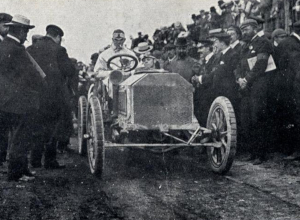
The 1903 Gordon Bennett Cup

gordon-bennett-cup-1903

The Gordon Bennett Cup takes place on July 2, 1903, becoming the first international motor race to be held in Ireland. The race is sponsored by James Gordon Bennett, Jr., owner of the New York Herald. Under the rules, the races are hosted in the country of the previous year’s winner. Selwyn Edge had won the 1902 event in the ParisVienna race driving a car manufactured by D. Napier & Son.

The Automobile Club of Great Britain and Ireland want the race to be hosted in the British Isles, and their secretary, Claude Johnson, suggests Ireland as the venue because racing is illegal on British public roads. The editor of the Dublin Motor News, Richard J. Mecredy, suggests an area in County Kildare, and letters are sent to 102 Irish MPs, 90 Irish peers, 300 newspapers, 34 chairmen of county and local councils, 34 County secretaries, 26 mayors, 41 railway companies, 460 hoteliers, 13 PPs, plus the Bishop of Kildare and Leighlin, Patrick Foley, who pronounces himself in favour.

Local laws have to be adjusted, ergo the ‘Light Locomotives (Ireland) Bill’ is passed on March 27, 1903. Kildare and other local councils draw attention to their areas, while Queen’s County (now County Laois) declares that every facility will be given and the roads placed at the disposal of motorists during the proposed race. Eventually Kildare is chosen, partly on the grounds that the straightness of the roads will be a safety benefit. As a compliment to Ireland the British team chooses to race in Shamrock green which thus becomes known as British racing green, although the winning Napier of 1902 had been painted Olive green.

There is considerable public concern about safety after the 1901 Paris-Bordeaux Rally, in which at least eight people had been killed, and severe crashes during the May 24, 1903 Paris-Madrid race where more than 200 cars competed over a distance of 800 miles but which had to be halted at Bordeaux because there had been so many fatalities. To allay these fears, the 1903 race is held over a closed course which is carefully prepared for the event, and is marshaled by 7,000 police officers assisted by troops and club stewards, with strict instructions to keep spectators off the roads and away from corners. The route consists of two loops that comprise a figure of eight, the first being a 52-mile loop that includes Kilcullen, the Curragh, Kildare, Monasterevin, Ballydavis (Port Laoise), Stradbally and Athy, followed by a 40-mile loop through Castledermot, Carlow, and Athy again. The race starts at the Ballyshannon cross-roads near Calverstown.

The official timekeeper of the race is T. H. Woolen of the Automobile Club of Great Britain and Ireland. Ninety one chronographs for timing the race are supplied by the Anglo-Swiss firm Stauffer Son & Co. of La Chaux-de-Fonds and London. Competitors are started at seven-minute intervals and have to follow bicycles through the “control zones” in each town. The 328-mile race is won by the famous Belgian Camille Jenatzy, driving a Mercedes in German colours.