Butch Moore, born James Augustine Moore, Irish singer and showband icon during the 1960s, dies in Massachusetts on April 3, 2001. He is born in Dublin on January 10, 1938.
Moore plays with a number of bands before securing his big break with the Capitol Showband in 1958. Its lineup includes band leader, Des Kelly, and Paddy Cole, who is still involved in the entertainment business, and an early songwriter for the band is Phil Coulter. The Capitol achieves a considerable degree of success in the early 1960s attracting huge crowds in the State’s many ballrooms. It tours the United States in 1961, and two years later becomes the first showband to appear on the new RTÉ Television service. The Capitol plays in the London Palladium in 1964 on a night when the lineup includes Roy Orbison.
Moore marries Norah Sheridan in 1962. They have three children – Karen, Grainne and Gary.
As the lead singer with the Capitol Showband, he rivals the Royal Showband’s Brendan Bowyer as Ireland’s most popular showband vocalist. His marriage to Norah breaks down in 1969 and his career begins to decline. He emigrates to the United States in 1970, where he spends the last 31 years of his life.
Moore marries Irish ballad singer Maeve Mulvany in 1972 in the United States. They form a very successful group known as “Butch N Maeve” with a mixture of ballads and pop. They also own a pub in Massachusetts named after one of their songs, The Parting Glass. They have three children, Rory, Tara and Thomas.
Although suffering from cancer of the esophagus, Butch Moore dies of a heart attack on April 3, 2001. His body is returned to Dublin and a funeral Mass is celebrated at St. Canice’s Church in Finglas. After his death, Maeve makes plans to move back to Ireland where she has bought a house in Cormeen, County Cavan, but she dies on February 14, 2004.
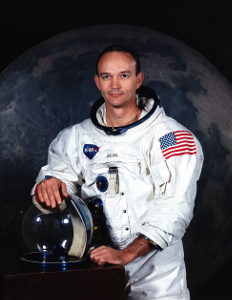
Collins makes the decision to become an astronaut after watching John Glenn‘s Mercury-Atlas 6 flight. He applies for the second group of astronauts that same year but is not accepted. Disappointed, but undaunted, Collins enters the USAF Aerospace Research Pilot School as the Air Force begins to research space. That year, NASA once again calls for astronaut applications, and Collins is more prepared than ever. In 1963 he is chosen by NASA to be part of the third group of astronauts.
Collins makes two spaceflights. The first, on July 18, 1966, is the Gemini 10 mission, where Collins performs a spacewalk. The second is the Apollo 11 mission on July 20, 1969, the first lunar landing in history. Collins, accompanied by Neil Armstrong and Edwin “Buzz” Aldrin, remains in the Command Module while his partners walk on the moon’s surface. Collins continues circling the moon until July 21, when Armstrong and Aldrin rejoin him. The next day, he and his fellow astronauts leave lunar orbit. They land in the Pacific Ocean on July 24. Collins, Armstrong and Aldrin are all awarded the Presidential Medal of Freedom by Richard Nixon. However, Aldrin and Armstrong end up receiving a majority of the public credit for the historic event, although Collins is also on the flight.
Collins leaves NASA in January 1970, and one year later, he joins the administrative staff of the Smithsonian Institution in Washington, D.C. In 1980, he enters the private sector, working as an aerospace consultant. In his spare time, Collins says he stays active and spends his days “worrying about the stock market” and “searching for a really good bottle of cabernet under ten dollars.”
Collins and his wife, Patricia Finnegan, have three children. The couple lived in both Marco Island, Florida, and Avon, North Carolina until her death in April 2014.
On April 28, 2021, Collins dies of cancer at his home in Naples, Florida, at the age of 90. Buzz Aldrin, who becomes the last survivor of Apollo 11, says that “wherever [Collins has] been or will be, you will always have the Fire to Carry us deftly to new heights and the future.”
Sheridan has her early vocal training while at school at the Dominican Convent in Eccles Street, Dublin, with additional lessons from Vincent O’Brien. In 1908, she wins a gold medal at the Feis Ceoil. From 1909 to 1911 she studies at the Royal Academy of Music in London, during which time she is introduced to the Italian inventor Guglielmo Marconi, who is instrumental in arranging further studies for her in opera in Rome.
Sheridan returns to Italy, where her career continues to grow, with performances at the Teatro Dal Verme in Milan and at the Teatro di San Carlo in Naples, primarily in Puccini roles. In 1922 she first sings at La Scala, Milan, in La Wally by Alfredo Catalani under the direction of Arturo Toscanini. For the next few years, she sings at La Scala with great success. Perhaps her greatest role is Madama Butterfly, which she sings extensively in Italy and at Covent Garden. When she plays the part of Madama Butterfly, Puccini is said to be spellbound.
Despite her successes, Sheridan’s career is short. Suffering vocal difficulties, she goes into retirement around 1930 except for a few concerts. Bríd Mahon, in her 1998 book While Green Grass Grows, states that “It was rumoured that an Italian whose overtures she had rejected had blown his brains out in a box in La Scala, Milan, while she was on stage and that after the tragedy, she never sang in public again.”
Margaret Sheridan dies in relative obscurity on April 16, 1958, having lived in Dublin for many years, and her remains are buried in Glasnevin Cemetery, Dublin.
Madden is born at Wormwood Gate, Dublin to Edward Madden, a silk manufacturer, and his wife Elizabeth (née Corey). His father has married twice and fathered twenty-one children. Luckily for young Richard his father is still affluent enough by the time he is reaching adolescence to afford him a top-quality education. This means private schools and a medical apprenticeship in Athboy, County Meath. He studies medicine in Paris, Italy, and St. George’s Hospital, London. While in Naples he becomes acquainted with Marguerite Gardiner, Countess of Blessington and her circle.
In 1828 Madden marries Harriet Elmslie, herself coincidentally the youngest of twenty-one children. Born in Marylebone in 1801 and baptised there into the Church of England, she is the last child of John Elmslie, a Scot who owns hundreds of slaves on his plantations in Jamaica, and his wife Jane Wallace. Both Harriet’s parents are of Quaker stock, but while living in Cuba she converts to Roman Catholicism. On marriage, Madden stops travelling and practises medicine for five years.
Eventually he realises that he needs to contribute to the abolitionist cause. The slave trade has been illegal in the empire since 1807, but slaves still exist. Abolishing slavery is a popular cause, and it is obvious that the trading of slaves is still in progress, and many are not actively involved but they are complicit with the activity.
Madden is employed in the British civil service from 1833, first as a justice of the peace in Jamaica, where he is one of six Special Magistrates sent to oversee the eventual liberation of Jamaica’s slave population, according to the terms of the Slavery Abolition Act 1833. From 1835 he is Superintendent of the freed Africans in Havana. His son, Thomas More Madden, who later becomes a surgeon and writer, is born there. In 1839 he becomes the investigating officer into the slave trade on the west coast of Africa and, in 1847, the secretary for the West Australian colonies. He returns to Dublin and in 1850 is named secretary of the Office for Loan Funds in Dublin.
Richard Madden dies at his home in Booterstown, just south of Dublin, on February 5, 1886, and is interred in Donnybrook Cemetery.
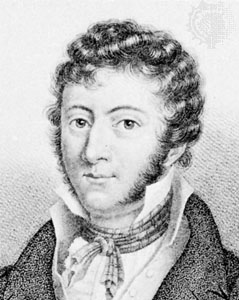
John Field, pianist, composer, and teacher, is born in Dublin into a musical family on July 26, 1782. He is the eldest son of Irish parents who are members of the Church of Ireland. His father, Robert Field, earns his living by playing the violin in Dublin theatres.
Field first studies the piano under his grandfather, who is a professional organist, and later under Tommaso Giordani. He makes his debut at the age of nine, a performance that is well-received, on March 24, 1792 in Dublin. By late 1793, the Fields have settled in London, where the young pianist starts studying with Muzio Clementi.
Field continues giving public performances and soon becomes famous in London, attracting favourable comments from the press and the local musicians. Around 1795 his performance of a Jan Ladislav Dussek piano concerto is praised by Joseph Haydn. Field continues his studies with Clementi, also helping the Italian with the making and selling of instruments. He also takes up the violin, which he studies under Johann Peter Solomon. His first published compositions are issued by Clementi in 1795. The first historically important work, the Piano Concerto No. 1, H 27, is premiered by the composer in London on February 7, 1799, when he is 16 years old. Field’s first official opus is a set of three piano sonatas published by Clementi in 1801.
In summer 1802 Field and Clementi leave London and go to Paris on business. They soon travel to Vienna, where Field takes a brief course in counterpoint under Johann Georg Albrechtsberger, and in early winter arrive in Saint Petersburg. Field is inclined to stay, impressed by the artistic life of the city. Clementi leaves in June 1803, but not before securing Field a teaching post in Narva. After Clementi’s departure, Field has a busy concert season, eventually performing at the newly founded Saint Petersburg Philharmonia. In 1805 Field embarks on a concert tour of the Baltic states, staying in Saint Petersburg during the summer. The following year he gives his first concert in Moscow. He returns to Moscow in April 1807 and apparently does not revisit Saint Petersburg until 1811. In 1810 he marries Adelaide Percheron, a French pianist and former pupil.
In 1811 Field returns to Saint Petersburg where he spends the next decade of his life, more productive than ever before, publishing numerous new pieces and producing corrected editions of old ones. He is successful in establishing a fruitful collaboration with both H.J. Dalmas, the most prominent Russian publisher of the time, and Breitkopf & Härtel, one of the most important music publishing houses of Europe. By 1819 Field is sufficiently wealthy to be able to refuse the position of court pianist that is offered to him. His lifestyle and social behaviour are becoming more and more extravagant.
In 1818 Field revisits Moscow on business, prompted by his collaboration with the publisher Wenzel. He and his wife give a series of concerts in the city in 1821, the last of which marks their last appearance in public together. Adelaide leaves Field soon afterward and attempts a solo career, which is not particularly successful. Field stays in Moscow and continues performing and publishing his music. In 1822 he meets Johann Nepomuk Hummel and the two collaborate on a performance of Hummel’s Sonata for Piano 4-Hands, Op. 92.
Partly as a result of his extravagant lifestyle, Field’s health begins to deteriorate by the mid-1820s. From about 1823 his concert appearances started decreasing. By the late 1820s he is suffering from colorectal cancer. Field leaves for London to seek medical attention. He arrives in September 1831 and, after an operation, gives concerts there and in Manchester. He stays in England for some time, meeting distinguished figures such as Felix Mendelssohn and Ignaz Moscheles. After a series of concerts in various European cities, Field spends nine months in a Naples hospital. His Russian patrons rescue him. He briefly stays with Carl Czerny in Vienna, where he gives three recitals, and then returns to Moscow. He gives his last concert in March 1836 and dies in Moscow almost a year later, on January 23, 1837, from pneumonia. He is buried in the Vvedenskoye Cemetery.
Lardner’s father was a solicitor in Dublin, who wishes his son to follow the same calling. After some years of uncongenial desk work, Lardner enters Trinity College, Dublin in 1812, obtains a B.A. in 1817 and an M.A. in 1819, winning many prizes. While in Dublin, Lardner begins to write and lecture on scientific and mathematical matters, and to contribute articles for publication by the Irish Academy.
In 1828, Lardner is elected professor of natural philosophy and astronomy at University College, London, a position he holds until he resigns his professorship in 1831. He is the author of numerous mathematical and physical treatises on such subjects as algebraic geometry, differential and integral calculus, and the steam engine. He also writes handbooks on various departments of natural philosophy, but it is as the editor of Lardner’sCabinet Cyclopædia that he is best remembered.
The Cabinet Cyclopædia eventually comprises 133 volumes with many of the ablest savants of the day contributing to it, including Sir Walter Scott, Thomas Moore, Connop Thirlwall, and Robert Southey. Lardner himself is the author of the treatises on arithmetic, geometry, heat, hydrostatics and pneumatics, mechanics, and electricity. The Cabinet Library and the Museum of Science and Art are his other chief undertakings.
In 1840, Lardner’s career receives a major setback as a result of his involvement with Mary Spicer Heaviside, the wife of Captain Richard Heaviside, of the Dragoon Guards. Lardner runs off to Paris with Mrs. Heaviside and is pursued by her husband. When he catches up with them, Heaviside subjects Lardner to a flogging but is unable to persuade his wife to return with him. Later that year Heaviside successfully sues Lardner for “criminal conversation” (adultery) and receives a judgment of £8,000. The Heavisides are divorced in 1845 and Lardner marries Mary Heaviside in 1846. The scandal effectively ends his career in England, so Lardner and his wife remained in Paris until shortly before his death in 1859. He is able to maintain his career by lecturing in the United States between 1841 and 1844, which proves financially rewarding.





 seamus dubhghaill