seamus dubhghaill

Promoting Irish Culture and History from Little Rock, Arkansas, USA


Leave a comment

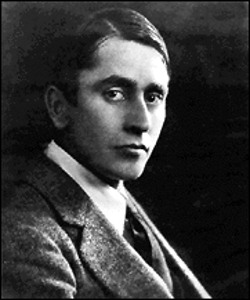
Birth of Artist & Illustrator Harry Clarke

harry-clarke

Henry Patrick (Harry) Clarke, Irish stained-glass artist and book illustrator, is born in Dublin on March 17, 1889. He is a leading figure in the Irish Arts and Crafts movement.

Clarke is the younger son and third child of Joshua Clarke and Brigid Clarke (née MacGonigal). Church decorator Joshua Clarke moves to Dublin from Leeds in 1877 and starts a decorating business, Joshua Clarke & Sons, which later incorporates a stained-glass division. Through his work with his father, Clarke is exposed to many schools of art but Art Nouveau in particular.

Clarke is educated at the Model School in Marlborough Street, Dublin and Belvedere College, which he leaves in 1905. After his mother’s death in 1903, he is apprenticed into his father’s studio and attends evening classes in the Metropolitan College of Art and Design. His The Consecration of St. Mel, Bishop of Longford, by St. Patrick wins the gold medal for stained glass work in the 1910 Board of Education National Competition. At the art school in Dublin, he meets fellow artist and teacher Margaret Crilley. They marry on October 31, 1914.

Clarke moves to London to seek work as a book illustrator. Picked up by London publisher George G. Harrap and Co., he starts with two commissions which are never completed. Difficulties with these projects makes Fairy Tales by Hans Christian Andersen his first printed work, in 1916. It includes 16 colour plates and more than 24 halftone illustrations. This is followed by illustrations for an edition of Edgar Allan Poe‘s Tales of Mystery and Imagination, the second version of which, published in 1923, makes his reputation as a book illustrator. His work can be compared to that of Aubrey Beardsley, Kay Nielsen, and Edmund Dulac. His final book, Selected Poems of Algernon Charles Swinburne, is published in 1928.

Clarke also continues to work in stained-glass, producing more than 130 windows. His glass is distinguished by the finesse of its drawing and his use of rich colours. He is especially fond of deep blues. His use of heavy lines in his black-and-white book illustrations echoes his glass techniques.

Clarke’s stained-glass work includes many religious windows, including the windows of the Honan Chapel in University College Cork. He also produces much secular stained glass such as a window illustrating John KeatsThe Eve of St. Agnes (now in the Hugh Lane Gallery in Dublin) and the Geneva Window, (now in the Wolfsonian Museum, Miami Beach, Florida). Perhaps his most seen works are the windows he creates for Bewley’s on Dublin’s Grafton Street.

Clarke is plagued with ill health, in particular respiratory problems. He is diagnosed with tuberculosis in 1929 and goes to a sanatorium in Davos, Switzerland. Fearing that he will die abroad, he begins his journey back to Dublin in 1931, but dies on this journey on January 6, 1931, in Chur where he is buried. A headstone is erected but local law requires that the family pledge to maintain the grave 15 years after the death. This is not explained to the Clarke family and Harry Clarke’s remains are disinterred in 1946 and reburied in a communal grave.
Leave a comment

Birth of Irish Artist Nano Reid

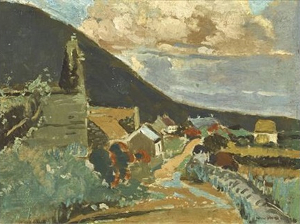
nano-reid-crumphan-achill

Nano Reid, Irish landscape artist, figure painter and portraitist, is born in Drogheda, County Louth on March 1, 1900. An individual, expressionistic artist, Reid is acknowledged to be one of the finest Irish woman painters of twentieth-century visual art in Ireland. Her works are represented in many public collections throughout Ireland.

In 1920, Reid wins a scholarship to study fine art painting and drawing at the Dublin Metropolitan School of Art, now the National College of Art and Design, under Harry Clarke. At the time, she is, in the words of fellow student Hilda van Stockum, “a fierce redhead…uncompromising and looking for truth.” In 1925 she starts showing at the Royal Hibernian Academy (RHA), submitting a total of 42 canvases until the late 1960s.

In 1928, Reid goes to Paris and enrolls briefly at the Académie de la Grande Chaumière, after which she spends a year in London studying fine art at the Central School of Arts and Crafts under Bernard Meninsky. She returns to Ireland in 1931 and once more begins exhibiting her landscape painting at the RHA.

In 1950, with Norah McGuinness, Reid represents Ireland at the Venice Biennale. This is followed by the Exhibition of Contemporary Irish Art in Aberystwyth, Wales (1953), and the Mostra Internazionale di Bianco e Nero in Lugano, Switzerland (1956), the Guggenheim International Award Exhibition in New York City (1960) and the Twelve Irish Painters show in New York City (1963). In 1974, the Arts Council and the Arts Council of Northern Ireland stage a major retrospective of Reid’s artworks.

Nano Reid dies in Drogheda in 1981. Retrospectives are held at Taylor Galleries in Dublin (1984), Droichead Arts Centre in Drogheda (1991), and at Linenhall Arts Centre in Castlebar, County Mayo (1999).

(Pictured: “Crumphan, Achill,” oil on canvas)


Leave a comment

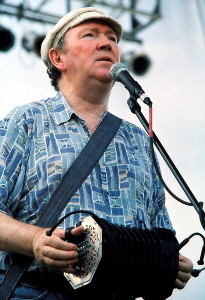
Birth of Liam Clancy

William “Liam” Clancy, Irish folk singer and actor, is born in Carrick-on-Suir, County Tipperary on September 2, 1935. He is the youngest and last surviving member of the influential folk group The Clancy Brothers, who are regarded as Ireland’s first pop stars. They record 55 albums, achieve global sales of millions and appear in sold-out concerts at such prominent venues as Carnegie Hall and the Royal Albert Hall.

Clancy is Robert Joseph Clancy and Joanna McGrath’s ninth and youngest surviving child. He receives a Christian Brothers education before taking a job as an insurance man in Dublin. While there he also takes night classes at the National College of Art and Design.

Clancy begins singing with his brothers, Paddy and Tom Clancy, at fund-raising events for the Cherry Lane Theatre and the Guthrie benefits. The Clancy Brothers and Tommy Makem, begin recording on Paddy Clancy’s Tradition Records label in the late 1950s. Liam plays guitar in addition to singing and also records several solo albums. They record their seminal The Rising of the Moon album in 1959. There are international tours, which include performances at Carnegie Hall and the Royal Albert Hall. The quartet records numerous albums for Columbia Records and enjoys great success during the 1960s folk revival. In 1964, thirty percent of all albums sold in Ireland are Clancy Brothers and Tommy Makem records.

After The Clancy Brothers split up, Liam has a solo career in Canada. In 1975, he is booked to play a festival in Cleveland, Ohio, where Tommy Makem is also playing. The two play a set together and form the group Makem and Clancy, performing in numerous concerts and recording several albums together until 1988. The original Clancy Brothers and Tommy Makem line-up also get back together in the 1980s for a reunion tour and album.

In later life, Liam maintains a solo career accompanied by musicians Paul Grant and Kevin Evans, while also engaging in other pursuits. In 2001, Clancy publishes a memoir titled The Mountain of the Women. He is also in No Direction Home, the 2005 Bob Dylan documentary directed by Martin Scorsese. In 2006, Clancy is profiled in a two-hour documentary titled The Legend of Liam Clancy, produced by Anna Rodgers and John Murray with Crossing the Line Films, which wins the award for best series at the Irish Film and Television Awards in Dublin. His final album, The Wheels of Life, is released in 2009. It includes duets with Mary Black and Gemma Hayes as well as songs by Tom Paxton and Donovan.

Liam Clancy dies from pulmonary fibrosis on December 4, 2009, in Bon Secours Hospital, Cork. He is buried in the new cemetery in An Rinn, County Waterford, where he spent the last number of years of his life, owning a successful recording studio.