seamus dubhghaill

Promoting Irish Culture and History from Little Rock, Arkansas, USA


Leave a comment

Birth of William Orpen, Irish-born Artist

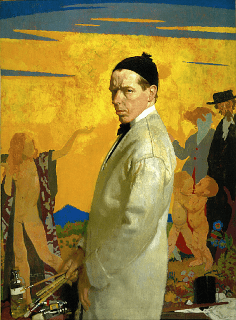
Major Sir William Newenham Montague Orpen, KBE, RA, RHA, Irish artist who mainly works in London and is best known for his vigorously characterized portraits, is born on November 27, 1878, at Oriel, Grove Avenue, Stillorgan, County Dublin. He also works as an official war artist during World War I.

Orpen is the fourth and youngest son of Arthur Herbert Orpen (1830–1926), a solicitor, and his wife, Anne Caulfield (1834–1912), the eldest daughter of the Right Rev. Charles Caulfield (1804–1862), the Bishop of Nassau. Both his parents are amateur painters, and his eldest brother, Richard Caulfield Orpen, becomes a notable architect. His nieces are Bea Orpen and Kathleen Delap. The historian Goddard Henry Orpen is his second cousin. The family lives at “Oriel,” a large house with extensive grounds containing stables and a tennis court. He appears to have a happy childhood there.

Orpen is a naturally talented painter, and six weeks before his thirteenth birthday is enrolled at the Dublin Metropolitan School of Art. During his six years at the college, he wins every major prize there, plus the British Isles gold medal for life drawing, before leaving to study at the Slade School of Fine Art in London between 1897 and 1899. At the Slade he masters oil painting and begins to experiment with different painting techniques and effects.

While at the Slade, Orpen becomes engaged to Emily Scobel, a model and the subject of his painting The Mirror (1900). She ends their relationship in 1901, and he marries Grace Knewstub, the sister-in-law of Sir William Rothenstein. He and Knewstub have three daughters together, but the marriage is not a happy one. By 1908, he has begun a long-running affair with Evelyn Saint-George, a well-connected American millionairess based in London, with whom he also has a child.

Orpen first exhibits at the New English Art Club (NEAC) in 1899, becoming a member in 1900. In 1901, he holds a solo exhibition at the Carfax Gallery in central London. His portraits, which establish his reputation, show the influence of the Realist artist Édouard Manet. He also becomes known as a painter of group portraits such as Homage to Manet (1909), in which he portrays members of the contemporary English art world sitting in conversation beneath a famous portrait by that artist.

At the start of World War I, a number of Irish people living in England return to Ireland to avoid conscription. Among them is Orpen’s studio assistant and former pupil, Seán Keating. Keating encourages him to do likewise, but he refuses and commits himself to supporting the British war effort. In December 1915, he is commissioned into the Royal Army Service Corps and reports for clerical duty at London’s Kensington Barracks in March 1916. Throughout 1916 he continues painting portraits, most notably one of a despondent Winston Churchill, but soon starts using both his own contacts and those of Evelyn Saint-George, to secure a war artist posting.

He is the official painter of the Paris Peace Conference after World War I. Throughout 1919 he paints individual portraits of the delegates to the Conference and these form the basis of his two large paintings, A Peace Conference at the Quai d’Orsay and The Signing of Peace in the Hall of Mirrors. In both pictures, the architecture overwhelms the gathered politicians and statesmen who’s political wranglings and vainglory diminish them in Orpen’s eyes.

Orpen is appointed Knight Commander of the Order of the British Empire in 1918 and is elected an associate of the Royal Academy of Arts in 1919.

Orpen becomes seriously ill in May 1931, and, after suffering periods of memory loss, dies at the age of 52 on September 29, 1931, in South Kensington, London, of liver and heart failure. He is buried at Putney Vale Cemetery in southwest London. A stone tablet in the Island of Ireland Peace Park Memorial at Mesen, Belgium, commemorates him. He is posthumously regarded as a facile and prolific, but somewhat superficial, artist who nevertheless achieves great popularity in his day.

(Pictured: “Self-portrait” (1913), oil on canvas by William Orpen, Saint Louis Art Museum)


4 Comments

Death of American-Born Painter Charles Brady

Charles Brady, American-born painter who spends most of his life in Ireland, dies in Dublin on August 1, 1997.

Brady is born on July 27, 1926, in New York City, the son of Arthur Brady, an industrial hardware merchant. He is best known for small-scale paintings of still life and landscape. At the end of World War II, while serving with the United States Navy, he suffers an accident which results in his discharge. As a result of this, he has the opportunity of pursuing further study. In 1948, he enrolls at the Art Students League of New York. Founded in 1875 and distinguished by its progressive approach to art education, it is one of the most important art schools in the United States in the early twentieth century.

Initially, Brady studies design and fashion before studying fine art under John Groth and Morris Kantor. In 1949, he becomes Groth’s assistant. In 1950, his work is included in the exhibition “American Painting 1950,” held at the Metropolitan Museum of Art, New York, where he is employed as a guard at the time. Around this time, he meets artists associated with abstract expressionism such as Franz Kline, Willem de Kooning, and Jackson Pollock, and exhibits with them in exhibitions such as the “9th Street Show” (1951). Four years later, his first solo exhibition is held at the Urban Gallery, New York. By this time, his father, mother, and a younger brother have all died. In 1956 he decides to leave New York and spend some time in Ireland.

On his arrival, Brady bases himself in Lismore, County Waterford, where the landscapes he begins to paint are in contrast to the abstract style he had developed in New York. In May 1956, he joins his aunt and uncle on a tour that include London and Paris. He remains in Ireland until early in 1958 and during this time becomes acquainted with such figures as Camille Souter, Frank Morris and Desmond McAvock. Though he spends the next year in the United States, he soon decides to return to Ireland. In 1959 he is living in Dublin, where, along with artists such as Noel Sheridan and Patrick Pye, he is involved in founding the Independent Artists group. His work is included in the group’s first exhibition in 1960.

Also in 1960, Brady marries Eelagh Noonan, and the couple go to live in Spain. On their return to Ireland in 1961, they settle in Dún Laoghaire, where he begins to produce still lifes of objects such as envelopes and boxes painted in muted tones. Though figurative, the painterly quality of these works and the way in which they assert the flat nature of the picture plane suggest something of his experience of postwar American abstract art. Soft, hazy light, another key characteristic of his work, can also be seen in his paintings of Sandymount Strand, which might be compared with the work of Nathaniel Hone the Younger, whose work Brady had seen on his first trip to Ireland. He also works in other media, producing lithographs and, from the mid-1980s, small bronzes of such mundane objects as discarded bus tickets.

From 1976 to 1983 Brady lectures in painting at the National College of Art and Design. In 1981 he becomes a member of Aosdána and in 1994 he is elected an honorary member of the Royal Hibernian Academy (RHA). He exhibits regularly in Ireland at venues such as the RHA. He receives a number of awards including the P. J. Carroll award at the Irish Exhibition of Living Art as well as the Douglas Hyde Gold Medal and the landscape award at the Oireachtas exhibitions of 1973 and 1989 respectively.

Brady dies of cancer at the age of 71 on August 1, 1997, in Dublin. He is buried in Shanganagh Cemetery, Shankill, County Dublin. His work can be found in collections such as those of the Arts Council of Ireland, Bank of Ireland, Ulster Museum, Allied Irish Bank, and Dublin City Gallery The Hugh Lane.

(From: “Brady, Charles” by Rebecca Minch, Dictionary of Irish Biography, http://www.dib.ie, October 2009 | Pictured: “Charles Brady, 1967,” oil on board by Koert Delmonte)


Leave a comment

Birth of Letitia Marion Hamilton, Landscape Artist

Letitia Marion Hamilton, Irish landscape artist and Olympic bronze medalist, is born on July 30, 1878, in Hamwood House, County Meath.

Hamilton is the daughter of Charles Robert Hamilton and Louisa Caroline Elizabeth Brooke. She attends Alexandra College. She and her sister Eva are great-granddaughters of the artist Marianne-Caroline Hamilton, and cousins of watercolourist Rose Maynard Barton. The sisters’ father can only afford one dowry, so the sisters remain unmarried, with their artistic careers helping to support the household. Both she and her sister study at the Dublin Metropolitan School of Art under William Orpen. She studies enameling there also, winning a silver medal in 1912 by both the School and the Board of Education National Commission. Her work shows elements of Art Nouveau, foreshadowing her later modernist leanings. She also studies in Belgium with Frank Brangwyn and the Slade School of Fine Art.

Hamilton first exhibits in 1902 and goes go on to become a prolific painter of the Irish countryside, exhibiting more than 200 paintings at the Royal Hibernian Academy (RHA). Both sisters travel widely in Europe, with Letitia being influenced by modern European artistic trends of the early 20th-century. She is internationally exhibited, Royal Academy of Arts, Burlington Gallery and Kensington Art Gallery in London, in Scotland, and Paris. Her exposure to impressionism comes from studying with Anne St. John Partridge in France. Her style matures in the 1920s. That year, she is one of the founding members of the Society of Dublin Painters, along with Paul Henry, Grace Henry, Mary Swanzy, and Jack Butler Yeats. It is around this time that she changes her signature from MH (May Hamilton) to LMH, reflecting her full name. She works on small oil sketches, which later develop into finished works. Her style is rapid, with loose, fluid brush strokes. In the early 1920s, she travels to Venice, painting on a gondola studio loaned to her by artist and friend Ada Longfield. The works from this trip are considered among her best, with her exploring light effects, pastel shades, and strong outlines. She later employs these elements into her works on Irish landscapes.

Hamilton becomes a member of the Royal Hibernian Academy in 1943. In 1948, she becomes the last person to win a bronze medal at the art competitions at the London Olympic Games. She serves as president of the Society of Dublin Painters in the late 1950s. Despite her failing eyesight later in life, she continues to paint, mounting her final exhibition in 1963, a year before her death at the age of 86 in Dublin on August 11, 1964. She is also a committee member of the Water Colour Society of Ireland.

Examples of Hamilton’s work are held in a number of collections, including Hugh Lane Gallery, Limerick City Gallery of Art, Crawford Art Gallery, Ulster Museum, National Gallery of Ireland, and Waterford Art Gallery. Her painting Canal Scene in Venice attains the highest price for a Hamilton work in 2004, which sells at Sotheby’s in London, for £33,600.

(Pictured: “Slieve Donard, Co. Down” by Letitia Marion Hamilton, oil on canvas, signed with monogram lower left)


Leave a comment

Death of Harry Clarke, Stained-Glass Artist & Illustrator

Henry Patrick (Harry) Clarke, Irish stained-glass artist and book illustrator, dies on January 6, 1931, in Chur, Switzerland. He is a leading figure in the Irish Arts and Crafts movement.

Clarke is born in Dublin on March 17, 1889, the younger son and third child of Joshua Clarke and Brigid Clarke (née MacGonigal). Church decorator Joshua Clarke moves to Dublin from Leeds, West Yorkshire, England, in 1877 and starts a decorating business, Joshua Clarke & Sons, which later incorporates a stained-glass division. Through his work with his father, Clarke is exposed to many schools of art but Art Nouveau in particular.

Clarke is educated at the Model School in Marlborough Street, Dublin, and Belvedere College, which he leaves in 1905. After his mother’s death in 1903, he is apprenticed into his father’s studio and attends evening classes in the Metropolitan College of Art and Design. His The Consecration of St. Mel, Bishop of Longford, by St. Patrick wins the gold medal for stained-glass work in the 1910 Board of Education National Competition. At the art school in Dublin, he meets fellow artist and teacher Margaret Crilley. They marry on October 31, 1914.

Clarke moves to London to seek work as a book illustrator. Picked up by London publisher George G. Harrap and Co., he starts with two commissions which are never completed. Difficulties with these projects makes Fairy Tales by Hans Christian Andersen his first printed work, in 1916. It includes 16 colour plates and more than 24 halftone illustrations. This is followed by illustrations for an edition of Edgar Allan Poe‘s Tales of Mystery and Imagination, the second version of which, published in 1923, makes his reputation as a book illustrator. His work can be compared to that of Aubrey Beardsley, Kay Nielsen, and Edmund Dulac. His final book, Selected Poems of Algernon Charles Swinburne, is published in 1928.

Clarke also continues to work in stained-glass, producing more than 130 windows. His glass is distinguished by the finesse of its drawing and his use of rich colours. He is especially fond of deep blues. His use of heavy lines in his black-and-white book illustrations echoes his glass techniques.

Clarke’s stained-glass work includes many religious windows, including the windows of the Honan Chapel in University College Cork. He also produces much secular stained-glass such as a window illustrating John KeatsThe Eve of St. Agnes (now in the Hugh Lane Gallery in Dublin) and the Geneva Window, (now in the Wolfsonian Museum, Miami Beach, Florida). Perhaps his most seen works are the windows he creates for Bewley’s on Dublin’s Grafton Street.

Clarke is plagued with ill health, in particular respiratory problems. He is diagnosed with tuberculosis in 1929 and goes to a sanatorium in Davos, Switzerland. Fearing that he will die abroad, he begins his journey back to Dublin in 1931, but dies on this journey on January 6, 1931, in Chur where he is buried. A headstone is erected but local law requires that the family pledge to maintain the grave 15 years after the death. This is not explained to the Clarke family and Harry Clarke’s remains are disinterred in 1946 and reburied in a communal grave.


Leave a comment

Death of Liam Clancy, Irish Folk Singer

William “Liam” Clancy, Irish folk singer and actor, dies on December 4, 2009, in Bon Secours Hospital, Cork. He is the youngest and last surviving member of the influential folk group The Clancy Brothers, who are regarded as Ireland’s first pop stars. They record 55 albums, achieve global sales of millions and appear in sold-out concerts at such prominent venues as Carnegie Hall and the Royal Albert Hall.

Clancy is born in Carrick-on-Suir, County Tipperary on September 2, 1935, the ninth and youngest surviving child of Robert Joseph Clancy and Joanna McGrath. He receives a Christian Brothers education before taking a job as an insurance man in Dublin. While there he also takes night classes at the National College of Art and Design.

Clancy begins singing with his brothers, Paddy and Tom Clancy, at fund-raising events for the Cherry Lane Theatre and the Guthrie benefits. The Clancy Brothers and Tommy Makem, begin recording on Paddy Clancy’s Tradition Records label in the late 1950s. Liam plays guitar in addition to singing and also records several solo albums. They record their seminal The Rising of the Moon album in 1959. There are international tours, which include performances at Carnegie Hall and the Royal Albert Hall. The quartet records numerous albums for Columbia Records and enjoys great success during the 1960s folk revival. In 1964, thirty percent of all albums sold in Ireland are Clancy Brothers and Tommy Makem records.

After The Clancy Brothers split up, Liam has a solo career in Canada. In 1975, he is booked to play a festival in Cleveland, Ohio, where Tommy Makem is also playing. The two play a set together and form the group Makem and Clancy, performing in numerous concerts and recording several albums together until 1988. The original Clancy Brothers and Tommy Makem line-up also get back together in the 1980s for a reunion tour and album.

In later life, Liam maintains a solo career accompanied by musicians Paul Grant and Kevin Evans, while also engaging in other pursuits. In 2001, Clancy publishes a memoir titled The Mountain of the Women. He is also in No Direction Home, the 2005 Bob Dylan documentary directed by Martin Scorsese. In 2006, Clancy is profiled in a two-hour documentary titled The Legend of Liam Clancy, produced by Anna Rodgers and John Murray with Crossing the Line Films, which wins the award for best series at the Irish Film and Television Awards in Dublin. His final album, The Wheels of Life, is released in 2009. It includes duets with Mary Black and Gemma Hayes as well as songs by Tom Paxton and Donovan.

Liam Clancy dies from pulmonary fibrosis on December 4, 2009, in Bon Secours Hospital, Cork. He is buried in the new cemetery in An Rinn, County Waterford, where he spent the last number of years of his life, owning a successful recording studio.


Leave a comment

Death of Sculptor Conor Fallon

Irish sculptor Conor Hubert Fallon dies of lung cancer at the Blackrock Clinic, County Dublin, on October 3, 2007.

Fallon is born at Holles Street Hospital, Dublin, on January 30, 1939, the third of six sons of Padraic Fallon, the Irish poet and playwright, and Dorothea Maher. The family moves to Clonard, County Wexford, where he grows up. He has three surviving brothers, Brian, Ivan and Padraic, who have all had journalism careers. His early interest in literature and the arts is nourished by his father and elder brothers, and by contact with the cultured circle of writers, artists, musicians and intellectuals within which his father moves.

Fallon is educated at St. Peter’s College, Wexford, and Trinity College, Dublin. He begins painting in 1957 while at Trinity College, where he is studying natural science but is advised to pay more attention to his art. His interest in painting is probably inspired by the example of Tony O’Malley, a close family friend. As a compromise with his father, who does not see his talent, he also studies accountancy at night.

Largely self-taught in painting, he learns fundamentals of technique from Richard Kingston, to whom he is introduced by O’Malley. He largely paints landscapes in acrylic and gouache, in a manner heavily influenced by that of Jack Butler Yeats.

In 1964, Fallon visits O’Malley in St. Ives, Cornwall, where he had emigrated several years earlier, intending also to meet the Cornish abstract landscape painter Peter Lanyon, the chief creative force in the thriving artists’ colony centred on St. Ives. His arrival, however, coincides with Lanyon’s death from injuries suffered in a gliding accident. A gently sympathetic stranger amid the bereaved artistic community, he finds an immediate empathy and rapport with Nancy Wynne-Jones, a Welsh-born painter sixteen years his senior who had studied under Lanyon. They marry in 1966. They adopt two children in 1970, siblings John and Bridget.

Encouraged to take up sculpture, English sculptor Denis Mitchell becomes Fallon’s mentor in Cornwall, and with Breon O’Casey, he develops his sculpting. He becomes notable for his cast steel and bronze work, especially birds, horses and hares. He has his first solo exhibition in Newlyn in 1972, showing both painting and sculpture.

In May 1972, Fallon moves with his family back to Ireland, settling at Scilly House, on a hillside overlooking the harbour at Kinsale, County Cork. Removed from any centre of artistic activity, he devotes himself fulltime to a solitary development of his sculpture, refining his methodology and technique, and his skills in working various metals, beginning in 1974 to work in steel. In 1975, he first exhibits in Ireland at a solo show at the Emmet Gallery, Dublin, again showing both painting and sculpture, including his first steel sculptures to be exhibited.

Beginning in 1983, Fallon exhibits regularly with the Taylor Galleries, Dublin. Desiring closer proximity to Dublin art activities, and with their children attending university in the city, Fallon and his wife move in 1987 to Ballard House, Ballinaclash, Rathdrum, County Wicklow.

In 1980, Fallon is awarded the Oireachtas gold medal for sculpture. He becomes an honorary associate of the National College of Art and Design in 1993. He is secretary of the Royal Hibernian Academy, becoming a full member in 1989, and on the board of the National Gallery of Ireland. He is also elected to Aosdána in 1984.

In the summer of 2007, some six months after his wife’s death, Fallon wis diagnosed with advanced metastatic lung cancer. He dies on October 3, 2007, at the Blackrock Clinic, County Dublin, and is buried beside his wife in Ballinatone churchyard, Greenan, Rathdrum, County Wicklow.


Leave a comment

Death of Irish Sculptor Oliver Sheppard

Oliver Sheppard RHA, Irish sculptor most famous for his 1911 bronze statue of the mythical Cuchulain dying in battle, dies at Knockranny, County Cavan, on September 14, 1941. His work was also part of the art competitions at the 1924 Summer Olympics in Paris and the 1928 Summer Olympics in Amsterdam.

Sheppard is born at Old Town, Cookstown, County Tyrone, on April 10, 1865, to Simpson Sheppard, a sculptor, and Ellen White, of Ormond Quay, Dublin. His main influence is the Frenchman Édouard Lantéri who teaches him at the Royal College of Art in London, and then at the Dublin Metropolitan School of Art (DMSA) in Dublin, now the National College of Art and Design (NCAD), where he later becomes a lecturer.

Sheppard is based in Dublin for almost all of his life, having traveled widely across Europe. His wife Rosie dies in 1931, with whom he has several children. They live at Howth and 30 Pembroke Road in central Dublin.

From 1902 to 1937 Sheppard teaches sculpture at the Dublin Metropolitan School of Art. His annual stipend is £250 but for this he only has to lecture three mornings a week, allowing him plenty of time for work on commissioned projects. One of his most famous students is the sculptor, Kathleen Cox.

The Dying Cuchulain is considered Sheppard’s masterpiece and an important work of Irish art. It is a bronze figure of the mythological warrior-hero Cuchulain, who continued to fight against his enemies while gravely wounded and tied to a tree. It is created in 1911 and later chosen by Éamon de Valera in 1935 as the national memorial to the 1916 Easter Rising. It can still be viewed today in the General Post Office (GPO), O’Connell Street, Dublin.

As a prominent sculptor Sheppard is a member of the Royal Hibernian Academy, the Royal Dublin Society, and is made a governor of the National Gallery of Ireland from 1925–41. He also exhibits works at European exhibitions during his lifetime, occasionally winning prizes.

Sheppard is generally critical of the low standards of sculpture in Ireland: “For the last sixty years or so thousands of figures and groups have been executed in Dublin for ecclesiastical purposes, and, with one or two exceptions … was not up to a reasonable standard. The making of a work of art hardly entered into it at all. The sculptor, well trained and properly encouraged, should collaborate with the architect.”

Sheppard is in the minority of Irish Protestants who support independence, starting with support for the Irish Parliamentary Party in the 1880s, when he is an art student.

In 1890–1910 Sheppard is a part of the Celtic Revival movement, and, from his works such as Inis Fáil, is admired by his student William Pearse. Through him he meets his brother Patrick Pearse who later helps launch the Easter Rising in 1916. While most of the Revival’s artists are writers, playwrights and poets, Sheppard can claim to be the main sculptor working on themes similar to theirs.

After the Irish War of Independence (1919–21) Sheppard says, “They thought me too old to fight but I have tried to help in other ways. My politics are simple. I have always thought that this country should be a free country.” His opinions are not overly dogmatic, considering his work on the war memorials in 1920.

In the mid-1920s the first series of Irish Free State coinage is planned and is finally launched in 1928. Sheppard is one of the designers short-listed but his designs are not accepted.

After his retirement in 1937 from the National College of Art, the now renamed Dublin Metropolitan School of Art, he is appointed in 1938 by the Minister for Education to the College’s standing committee. He is also made a judge in the Royal Dublin Society art competition in 1939 and 1940.

Sheppard dies on September 14, 1941, in Dublin and is buried at Old St. Fintan’s Cemetery, Sutton, Dublin. There is a small retrospective exhibition of fourteen of his works at the Royal Hibernian Academy (RHA) in 1942. There are portraits of Sheppard by George William Russell (Dublin City Gallery The Hugh Lane) and Sir William Orpen (NGI), and photographic portraits in the Sheppard collection, National Irish Visual Arts Library (NIVAL) at the National College of Art and Design, Dublin, where his papers are located.


Leave a comment

Death of Jeanne Rynhart, Sculptor & Creator of the Molly Malone Statue

Jeanne Patricia Rynhart (née Scuffil), Irish sculptor and creator of the Molly Malone statue, dies in Cork, County Cork, on June 9, 2020.

Rynhart is born Jeanne Scuffil in Dublin on March 17, 1946, to Kathleen Connolly and Frederick Scuffil, a sign writer for the Guinness Brewery. She is an apprentice to George Collie RHA for two years and then attends the National College of Art and Design, graduating in 1969 before moving to Coventry, England, where she continues her studies in fine art and sets up a studio with sculptor John Letts. She returns to Ireland in 1981, moving to Ballylickey, near Bantry in County Cork, where she establishes the Rynhart Fine Art gallery and workshop with her husband, Derek.

One of the first bronze craft studios in Ireland, the Rynhart pieces include both small figurative cold cast bronze sculptures of flower sellers, fishermen, horses, sailing boats and musical instruments as well as bronze life-size statues, smelted in a foundry. Her busts of Oscar Wilde and Jonathan Swift are in the Dublin Writers Museum and a Rynhart bust of James Joyce is in New York Public Library.

Rynhart creates the Molly Malone statue for the 1988 Dublin Millennium celebrations. The statue is controversial at the time of its unveiling due to the statue’s revealing dress. Registrar of Aosdána, Adrian Munnelly, writes to the An Bord Fáilte criticising it. The statue is defended by the Lord Mayor of Dublin Ben Briscoe. Rynhart herself writes in The Irish Times that the clothing and appearance are accurate for women of that era. The statue has since become one of the most popular tourist attractions in Dublin and is fondly regarded by locals.

Rynhart also sculpts a statue commemorating the original Rose of Tralee, Mary O’Connor, which stands in Tralee Town Park. In 1993, she produces two statues in honour of Annie Moore, the first passenger processed through the Ellis Island immigration station on January 1, 1892. The statues are located at the Cobh Heritage Centre in Cork and Ellis Island in New York City. The Ellis Island statue is dedicated by the then-President of Ireland, Mary Robinson.

In 1994, Rynhart’s daughter Audrey joins the business. In 2010, Audrey and her husband, Les Elliott, take over the running of the business which is now based in their studio in Glengarriff, County Cork. From then onwards, Rynhart continues to do some modelling work but has largely retired.

Rynhart dies on June 9, 2020, aged 74, in Schull Community Hospital, Cork, following a short illness. She is buried in the Abbey Cemetery, Bantry, and is survived by her husband, Derek, daughter, Audrey, son, Barry, and grandchildren, Lydia and Sophie.


Leave a comment

Birth of Sculptor Oliver Sheppard

Oliver Sheppard RHA, Irish sculptor most famous for his 1911 bronze statue of the mythical Cúchulainn dying in battle, is born at Old Town, Cookstown, County Tyrone on April 10, 1865. His work is also part of the art competitions at the 1924 Summer Olympics and the 1928 Summer Olympics.

Sheppard is born to Simpson Sheppard, a sculptor, and Ellen White, of Ormond Quay, Dublin.

Sheppard is based in Dublin for almost all of his life, having travelled widely across Europe. He and his wife Rosie have several children. They live at Howth and 30 Pembroke Road in central Dublin. She dies in 1931.

Sheppard’s main influence is the Frenchman Édouard Lantéri who teaches him at the Royal College of Art in London, and then at the Dublin Metropolitan School of Art in Dublin (now the National College of Art and Design), where he later becomes a lecturer.

From 1902 to 1937 Sheppard teaches sculpture at the Dublin Metropolitan School of Art, which is renamed the National College of Art in 1936. His annual stipend is £250 but for this he only has to lecture on three mornings per week, allowing him plenty of time for work on commissioned projects. One of his most famous students is the sculptor Kathleen Cox.

As a prominent sculptor Sheppard is a member of the Royal Hibernian Academy, the Royal Dublin Society, and is made a governor of the National Gallery of Ireland from 1925–41. He also exhibits works at European exhibitions during his lifetime, occasionally winning prizes.

Sheppard is generally critical of the low standards of sculpture in Ireland, saying, “For the last sixty years or so thousands of figures and groups have been executed in Dublin for ecclesiastical purposes, and, with one or two exceptions…was not up to a reasonable standard. The making of a work of art hardly entered into it at all. The sculptor, well trained and properly encouraged, should collaborate with the architect.”

In 1890–1910 Sheppard is a part of the Celtic Revival movement, and, from his works such as Inis Fáil, is admired by his student William Pearse. Through him he meets his brother, Patrick Pearse, who later helps launch the Easter Rising in 1916. While most of the Revival’s artists are writers, playwrights and poets, Sheppard can claim to be the main sculptor working on themes similar to theirs.

Sheppard is in the minority of Irish Protestants who support independence, starting with support for the Irish Parliamentary Party in the 1880s, when he is an art student. After the Irish War of Independence (1919–21) he says, “They thought me too old to fight but I have tried to help in other ways. My politics are simple. I have always thought that this country should be a free country.” His opinions are not overly dogmatic, considering his work on the war memorials in 1920.

In the mid-1920s the first series of Irish Free State coinage is planned and is finally launched in 1928. Sheppard is one of the designers short-listed but his designs are not accepted.

Sheppard dies in Dublin on September 14, 1941.

(Pictured: “The Dying Cúchulainn,” sculpture by Oliver Sheppard, now at the General Post Office (GPO) in Dublin)


2 Comments

Birth of Irish Artist Charles Harper

skellig-arrival-by-charles-harper

Irish artist Charles Harper is born on July 30, 1943, on Valentia Island in County Kerry. He studies at the National College of Art and Design, Limerick School of Art and Design and the Graphic Studio in Dublin. He is taught by Maurice MacGonigal and Seán Keating. He also studies filmmaking in Germany.

Harper exhibits regularly in Ireland and abroad. His paintings are well known for their metaphoric themes, including boats, the human form, landscape and angels usually in painterly expressive form.

Harper is influenced by Francis Bacon and David Hockney which is apparent in his portrait work. In his treatment of the human head, the influence of Bacon is obvious as is the work of the Irish artist Louis Le Brocquy. He is also influenced by the Irish artist Patrick Collins. For Harper the actual act of painting is what matters as he sees the actual process as one of exploration and discovery. He says, “the process, the making excites me more than any end product.”

Harper represents Ireland at International Biennials in many countries throughout his career. He receives many national awards for his painting, including first prize for his work commemorating the 1916 Easter Rising at the Municipal Gallery of Modern Art in Dublin, the Carrols Open Award at the Irish Exhibition of Living Art in Dublin and The Arts councils Bonn an Uachtarain de Hide at the Oireachtas Art Exhibition. More recently he is awarded the BulBulia Award at the Royal Hibernian Academy in 2008.

Harper’s work is included in many important public and private collections including the San Francisco Museum of Modern Art, the Irish Museum of Modern Art and the Irish Arts Council. He is also a member of Aosdána and the Royal Hibernian Academy.

“Painting being a cultural and creative activity should be accessible to all. Though it may also confuse the viewer. I find this totally understandable and acceptable, as art should challenge our perception and established aesthetic.”

(Pictured: Skellig Arrival, acrylic on linen by Charles Harper)