seamus dubhghaill

Promoting Irish Culture and History from Little Rock, Arkansas, USA


Leave a comment

Birth of James FitzJames Butler, 2nd Duke of Ormonde

James FitzJames Butler, 2nd Duke of Ormonde, KG, Irish statesman and soldier, is born into a Protestant family on April 29, 1665, at Dublin Castle. He is the third of the Kilcash branch of the family to inherit the earldom of Ormond. He serves in the campaign to put down the Monmouth Rebellion, in the Williamite War in Ireland, in the Nine Years’ War and in the War of the Spanish Succession but is accused of treason and goes into exile after the Jacobite rising of 1715.

Butler is the second but eldest surviving son, and one of eleven children, of Thomas Butler by his wife Emilia van Nassau-Beverweerd. His father is known as Lord Ossory. His father is heir apparent of James Butler, 1st Duke of Ormond but predeceases him and so never becomes duke. His father’s family, the Butler dynasty, is Old English and descends from Theobald Walter, who had been appointed Chief Butler of Ireland by King Henry II in 1177. His mother is Dutch. She descends from a cadet branch of the House of Nassau.

Butler is educated in France and afterwards at Christ Church, Oxford. On the death of his father on July 30, 1680, he becomes Baron Butler in the peerage of England and the 7th Earl of Ossory in the peerage of Ireland.

Butler obtains command of a cavalry regiment in Ireland in 1683 and having received an appointment at court on the accession of James II, he serves against the Duke of Monmouth at the Battle of Sedgemoor in July 1685. Having succeeded his grandfather as 2nd Duke of Ormonde on July 21, 1688, he is appointed a Knight of the Order of the Garter on September 28, 1688. In 1688, he also becomes Chancellor of the University of Dublin and Chancellor of the University of Oxford.

In January and February 1689, Butler votes against the motion to put William of Orange and Mary on the throne and against the motion to declare that James II has abdicated it. Nevertheless, he subsequently joins the forces of William of Orange, by whom he is made colonel of the 2nd Troop of Horse Guards on April 20, 1689. He accompanies William in his Irish campaign, debarking with him in Carrickfergus on June 14, 1690, and commands this troop at the Battle of the Boyne in July 1690. In February 1691 he becomes Lord Lieutenant of Somerset.

Butler serves on the continent under William of Orange during the Nine Years’ War and, having been promoted to major general, he fights at the Battle of Steenkerque in August 1692 and the Battle of Landen in July 1693, where he is taken prisoner by the French and then exchanged for the Duke of Berwick, James II’s illegitimate son. He is promoted to lieutenant general in 1694.

After the accession of Queen Anne in March 1702, Butler becomes commander of the land forces co-operating with Sir George Rooke in Spain, where he fights in the Battle of Cádiz in August 1702 and the Battle of Vigo Bay in October 1702 during the War of the Spanish Succession (1701–1714). Having been made a Privy Councillor, he succeeds Lord Rochester as Lord Lieutenant of Ireland in 1703. In 1704, he leases and rebuilds a property that becomes known as Ormonde Lodge in Richmond outside London.

Following the dismissal of the Duke of Marlborough, Butler is appointed Commander-in-Chief of the Forces and colonel of the 1st Regiment of Foot Guards on January 4, 1712, and Captain General on February 26, 1712. In the Irish Parliament he and the majority of peers support the Tory interest.

Butler plays a dramatic role at the notorious meeting of the Privy Council on March 8, 1711, when Antoine de Guiscard, a French double agent who is being questioned about his treasonable activities, attempts to assassinate Robert Harley, 1st Earl of Oxford, against whom he has a personal grudge for drastically cutting his allowance, by stabbing him with a penknife. Harley is wounded, but not seriously, due largely to the fact that he is wearing a heavy gold brocade waistcoat in which the knife gets stuck. Several Councillors, including Butler, stab Guiscard in return. Guiscard implores Butler to finish the deed, but he replies that it is not for him to play the hangman. In any case, he has the sense to see that Guiscard must be kept alive at least long enough to be questioned, although as it turns out Guiscard’s wounds are fatal, and he dies a week later.

On April 23, 1712, Butler leaves Harwich for Rotterdam to lead the British troops taking part in the war. Once there he allows himself to be made the tool of the Tory ministry, whose policy is to carry on the war in the Netherlands while giving secret orders to him to take no active part in supporting their allies under Prince Eugene. In July 1712, he advises Prince Eugene that he can no longer support the siege of Le Quesnoy and that he is withdrawing the British troops from the action and instead intends to take possession of Dunkirk. The Dutch are so exasperated at the withdrawal of the British troops that they close the towns of Bouchain on Douai to British access, despite the fact that they have plenty of stores and medical facilities available. Butler takes possession of Ghent and Bruges as well as Dunkirk, in order to ensure his troops are adequately provided for. On April 15, 1713, he becomes Lord Lieutenant of Norfolk.

Ormonde’s position as Captain-General makes him a personage of much importance in the crisis brought about by the death of Queen Anne and, during the last years of Queen Anne, he almost certainly has Jacobite leanings and corresponds with the Jacobite Court including his cousin, Piers Butler, 3rd Viscount Galmoye, who keeps barrels of gunpowder at Kilkenny Castle. King George I, on his accession to the throne in August 1714, institutes extensive changes and excludes the Tories from royal favour. Butler is stripped of his posts as Captain-General, as colonel of the 1st Regiment of Foot Guards and as Commander in Chief of the Forces with the first two posts going to the Duke of Marlborough and the role of Commander-in-Chief going to John Dalrymple, 2nd Earl of Stair. On November 19, 1714, Butler is instead made a member of the reconstituted Privy Council of Ireland.

Accused of supporting the Jacobite rising of 1715, Butler is impeached for high treason by Lord Stanhope on June 21, 1715. He might avoid the impending storm of Parliamentary prosecution, if he remains in England and stands trial but instead, he chooses to flee to France in August 1715 and initially stays in Paris with Lord Bolingbroke. On August 20, 1715, he is attainted, his estate forfeited, and honours extinguished. The Earl Marshal is instructed to remove the names and armorial bearings of Butler and Bolingbroke from the list of peers and his banner as Knight of the Garter is taken down in St. George’s Chapel.

On June 20, 1716, the Parliament of Ireland passes an act extinguishing the regalities and liberties of the county palatine of Tipperary; for vesting Butler’s estate in the crown and for giving a reward of £10,000 for his apprehension, should he attempt to land in Ireland. But the same parliament passes an act on June 24, 1721, to enable his brother, Charles Butler, 1st Earl of Arran, to purchase his estate, which he does accordingly.

Butler subsequently moves to Spain where he holds discussions with Cardinal Giulio Alberoni. He later takes part in a Spanish and Jacobite plan to invade England and puts James Francis Edward Stuart on the British throne in 1719, but his fleet is disbanded by a storm in the Bay of Biscay. In 1732, he moves to Avignon, where he is seen in 1733 by the writer Lady Mary Wortley Montagu. He dies at Avignon in exile on November 16, 1745, but his body is returned to London and buried in Westminster Abbey on May 22, 1746.

On July 20, 1682, Butler, then called Lord Ossory, marries Lady Anne Hyde, daughter of Laurence Hyde, who is then Viscount Hyde of Kenilworth but becomes Earl of Rochester in November. The couple has a daughter, Mary, who dies young in 1688.

Following the death of his first wife in 1685, Butler plans to marry again in order to secure a male heir. He gains permission from the House of Lords for the arranging of a jointure for another marriage in May 1685, and in August of that year, he marries Lady Mary Somerset, daughter of the Duke of Beaufort and Mary Capel. The couple has a son, Thomas (1686–1689), and two daughters, Elizabeth (1689–1750) and Mary (1690–1713). His second wife is a Lady of the Bedchamber to Queen Anne. Their younger daughter, Mary, marries John Ashburnham, 1st Earl of Ashburnham.

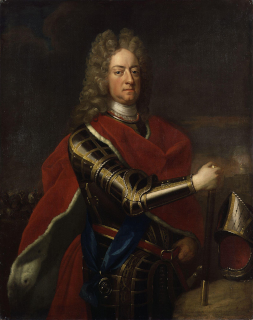
(Pictured: Portrait of James Butler, 2nd Duke of Ormonde, by Michael Dahl, National Portrait Gallery)


Leave a comment

Death of Richard Talbot, 1st Earl of Tyrconnell

Richard Talbot, 1st Earl of Tyrconnell, PC, Irish politician, courtier and soldier, dies of apoplexy on August 14, 1691, in Limerick, County Limerick. He is also known by the nickname “Mad Dick” Talbot.

Talbot is born likely in 1630, probably in Dublin. He is one of sixteen children, the youngest of eight sons of William Talbot and his wife Alison Netterville. His father is a lawyer and the 1st Baronet Talbot of Carton, County Kildare. His mother is a daughter of John Netterville of Castletown, Kildare. The Talbots are descended from a Norman family that had settled in Leinster in the 12th century. They adhere to the Catholic faith, despite the founding of the Reformed Church of Ireland under Henry VIII. Little is recorded of Talbot’s upbringing. As an adult he grows to be unusually tall and strong by standards of the time.

Talbot marries Katherine Baynton in 1669, and they have two daughters, Katherine and Charlotte. Katherine dies in 1679. In 1681, he marries Frances Jennings, sister of Sarah Jennings, the future Sarah Churchill, Duchess of Marlborough.

Talbot’s early career is spent as a cavalryman in the Irish Confederate Wars. Following a period on the European continent, he joins the court of James, Duke of York, then in exile following the English Civil War, becoming a close and trusted associate. After the 1660 restoration of James’s older brother, Charles, to the thrones of England, Ireland and Scotland, he begins acting as agent or representative for Irish Catholics attempting to recover estates confiscated after the Cromwellian conquest, a role that defines the remainder of his career. James converts to Catholicism in the late 1660s, strengthening his association with Talbot.

When James takes the throne in 1685, Talbot’s influence increases. He oversees a major purge of Protestants from the Irish Army, which had previously barred most Catholics. James creates him Earl of Tyrconnell and later makes him Viceroy, or Lord Deputy of Ireland. He immediately begins building a Catholic establishment by admitting Catholics to many administrative, political and judicial posts.

Talbot’s efforts are interrupted by James’s 1688 deposition by his Protestant son-in-law William of Orange. He continues as a Jacobite supporter of James during the subsequent Williamite War in Ireland, but also considers a peace settlement with William that would preserve Catholic rights. Increasingly incapacitated by illness, he dies of a stroke on August 14, 1691, shortly before the Jacobite defeat. He is thought to have been buried in St. Mary’s Cathedral, Limerick. By depriving the Jacobites of their most experienced negotiator, his death possibly has a substantial impact on the terms of the Treaty of Limerick that ends the war.

Talbot’s widow, Frances, and his daughter, Charlotte, remain in France, where Charlotte marries her kinsman, Richard Talbot, son of William Talbot of Haggardstown. Their son is Richard Francis Talbot. Talbot’s other daughter, Katherine, becomes a nun. An illegitimate son, Mark Talbot, serves as an officer in France before his death in the Battle of Luzzara in 1702. Talbot’s estate in nearby Carton, renamed Talbotstown, is uncompleted at the time of his death. Tyrconnell Tower on the site is originally intended by him as a family mausoleum to replace the existing vault at Old Carton graveyard but is also left unfinished.

Talbot is controversial in his own lifetime. His own Chief Secretary, Thomas Sheridan, later describes him as a “cunning dissembling courtier […] turning with every wind to bring about his ambitious ends and purposes.” Many 19th and early 20th century historians repeat this view. Recent assessments have suggested a more complex individual whose career was defined by personal loyalty to his patron James and above all by an effort to improve the status of the Irish Catholic gentry, particularly the “Old English” community to which he belonged.

(Pictured: Watercolour portrait of Richard Talbot by John Bulfinch (d.1728) after painting by Sir Godfrey Kneller)


Leave a comment

Death of Rory O’Moore, Organizer of the Irish Rebellion of 1641

Sir Rory O’Moore (Irish: Ruaidhrí Ó Mórdha), Irish politician and landowner also known Sir Roger O’Moore or O’More or Sir Roger Moore, dies in obscurity on February 16, 1655. He is most notable for being one of the four principal organizers of the Irish Rebellion of 1641.

O’Moore belongs to an ancient Irish noble family descended from Conall Cernach. He is born in either County Laois, around 1600, or more likely at Balyna, his father’s estate in County Kildare.

O’Moore’s uncle, Rory O’More, Lord of Laois, had fought against the English during the Tudor conquest of Ireland. In 1556, Queen Mary I confiscates the O’Mores’ lands and creates “Queens County” (modern-day County Laois). Over 180 family members, who are peaceful and have taken no part in any rebellion, are murdered with virtually all of the leaders of Laois and Offaly by the English at a feast at Mullaghmast, County Kildare, in 1577. Rory Óg and his wife Maighréad O’Byrne, sister of Fiach MacHugh O’Byrne, are hunted down and killed soon afterwards. This leads to the political downfall of the O’Moore family as their estates are given to English settlers.

Given the causes of the rebellion and the Crown’s weakness during the Bishops’ Wars into 1641, O’Moore plans a bloodless coup to overthrow the English government in Ireland. With Connor Maguire, 2nd Baron of Enniskillen, he plans to seize Dublin Castle, which is held by a small garrison, on October 23, 1641. Allies in Ulster led by Sir Phelim O’Neill are to seize forts and towns there. The leaders are to assume the governing of their own country and with this provision offer allegiance to King Charles. They are betrayed, and the plan is discovered on October 22 and the rising fails in its first objective. O’Neill has some success, and O’Moore quickly succeeds in creating an alliance between the Ulster Gaelic clans and the Old English gentry in Leinster.

In November 1641, the Irish forces besiege Drogheda, and a royalist force comes north from Dublin to oppose them. O’Moore is one of the leaders of the rebel army that intercepts and defeats the relief force at the Battle of Julianstown on November 29.

In the ensuing Irish Confederate Wars, a major achievement by O’Moore is to recruit Owen Roe O’Neill from the Spanish service in 1642. He commands the Confederate forces in what is now County Laois and County Offaly, which remain peaceful, and helps arrange alliances with Murrough O’Brien, 1st Earl of Inchiquin, in 1647 and James Butler, 1st Duke of Ormond, in 1648. The resulting larger alliance fails to stop the Cromwellian invasion of Ireland (1649–53) in which an estimated third of the Irish population dies.

The Irish historian Charles Gavan Duffy writes: “Then a private gentleman, with no resources beyond his intellect and his courage, this Rory, when Ireland was weakened by defeat and confiscation, and guarded with a jealous care constantly increasing in strictness and severity, conceived the vast design of rescuing the country from England, and even accomplished it; for, in three years, England did not retain a city in Ireland but Dublin and Drogheda, and for eight years the land was possessed and the supreme authority exercised by the Confederation created by O’Moore. History contains no stricter instance of the influence of an individual mind.”

Bishop Michael Comerford writes that after O’Moore’s defeat at the Battle of Kilrush in April 1642 he retires and dies in Kilkenny city in the winter of 1642–43, having co-founded the Irish Catholic Confederation there a few months earlier. However, this ignores his contacts with Inchiquin and Ormonde in 1647–48.

In 1652, O’Moore goes to Inishbofin off the coast of Galway, one of the last Catholic strongholds, but as the parliamentary forces approach, he makes arrangements to flee. Walter Lynch, Bishop of Clonfert, sails in the last ship to leave the island without waiting for O’Moore, who is forced to make his own way. He finally escapes into Ulster but dies in obscurity on February 16, 1655. He is buried at Steryne churchyard, in the parish of Magilligan, County Londonderry.

St. Colman’s Church on the island once bears a tablet with the inscription: “In memory of many valiant Irishmen who were exiled to this Holy Island and in particular Rory O’More a brave chieftain of Leix, who after fighting for Faith and Fatherland, disguised as a fisherman escaped from his island to a place of safety. He died shortly afterwards, a martyr to his Religion and his County, about 1653. He was esteemed and loved by his countrymen, who celebrated his many deeds of valour and kindness in their songs and reverenced his memory, so that it was a common expression among them; ‘God and Our Lady be our help and Rory O’More’.”

O’More marries Jane Barnewall, daughter of Sir Patrick Barnewall, of Donabate, County Dublin, and his second wife Mary Bagenal. They had two sons and four daughters. His daughter Anne marries Patrick Sarsfield from an Old English Catholic family from The Pale. His grandsons include Patrick Sarsfield, 1st Earl of Lucan, who leads a Jacobite force in the Williamite War in Ireland, and his brother William Sarsfield, whose descendants include all the Earls of Lucan and the 4th and all subsequent Earls Spencer, through which O’More is an ancestor to Diana, Princess of Wales.

The Balyna estate is inherited from Calvagh O’More by Rory’s brother Lewis. Balyna is passed down to Lewis’s last surviving O’More descendant, Letitia, who is also descended from Rory O’More because her grandfather married a second cousin. Letitia marries a Richard Farrell in 1751. This Farrell family henceforth takes the surname More O’Ferrall.

The Rory O’More Bridge in Dublin is renamed after him. The film Rory O’More, made by the Kalem Company in 1911, directed by Sidney Olcott and Robert G. Vignola, sets O’More’s rebellion in 1798 rather than the 17th century, and moves the action to the Lakes of Killarney.


Leave a comment

Death of James Butler, 2nd Duke of Ormonde

James FitzJames Butler, 2nd Duke of Ormonde, KG, Irish statesman and soldier, dies in Avignon on November 16, 1745. He is the third of the Kilcash branch of the family to inherit the earldom of Ormond. He serves in the campaign to put down the Monmouth Rebellion, in the Williamite War in Ireland, in the Nine Years’ War and in the War of the Spanish Succession but is accused of treason and goes into exile after the Jacobite rising of 1715.

Butler is born into a Protestant family on April 29, 1665, at Dublin Castle. He is the second but eldest surviving son, and one of eleven children, of Thomas Butler by his wife Emilia van Nassau-Beverweerd. His father is known as Lord Ossory. His father is heir apparent of James Butler, 1st Duke of Ormond but predeceases him and so never becomes duke. His father’s family, the Butler dynasty, is Old English and descends from Theobald Walter, who had been appointed Chief Butler of Ireland by King Henry II in 1177. His mother is Dutch. She descends from a cadet branch of the House of Nassau.

Butler is educated in France and afterwards at Christ Church, Oxford. On the death of his father on July 30, 1680, he becomes Baron Butler in the peerage of England and the 7th Earl of Ossory in the peerage of Ireland.

Butler obtains command of a cavalry regiment in Ireland in 1683 and having received an appointment at court on the accession of James II, he serves against the Duke of Monmouth at the Battle of Sedgemoor in July 1685. Having succeeded his grandfather as 2nd Duke of Ormonde on July 21, 1688, he is appointed a Knight of the Order of the Garter on September 28, 1688. In 1688, he also becomes Chancellor of the University of Dublin and Chancellor of the University of Oxford.

In January and February 1689, Butler votes against the motion to put William of Orange and Mary on the throne and against the motion to declare that James II has abdicated it. Nevertheless, he subsequently joins the forces of William of Orange, by whom he is made colonel of the 2nd Troop of Horse Guards on April 20, 1689. He accompanies William in his Irish campaign, debarking with him in Carrickfergus on June 14, 1690, and commands this troop at the Battle of the Boyne in July 1690. In February 1691 he becomes Lord Lieutenant of Somerset.

Butler serves on the continent under William of Orange during the Nine Years’ War and, having been promoted to major general, he fights at the Battle of Steenkerque in August 1692 and the Battle of Landen in July 1693, where he is taken prisoner by the French and then exchanged for the Duke of Berwick, James II’s illegitimate son. He is promoted to lieutenant general in 1694.

After the accession of Queen Anne in March 1702, Butler becomes commander of the land forces co-operating with Sir George Rooke in Spain, where he fights in the Battle of Cádiz in August 1702 and the Battle of Vigo Bay in October 1702 during the War of the Spanish Succession (1701–1714). Having been made a Privy Councillor, he succeeds Lord Rochester as Lord Lieutenant of Ireland in 1703. In 1704, he leases and rebuilds a property that becomes known as Ormonde Lodge in Richmond outside London.

Following the dismissal of the Duke of Marlborough, Butler is appointed Commander-in-Chief of the Forces and colonel of the 1st Regiment of Foot Guards on January 4, 1712, and Captain General on February 26, 1712. In the Irish Parliament he and the majority of peers support the Tory interest.

Butler plays a dramatic role at the notorious meeting of the Privy Council on March 8, 1711, when Antoine de Guiscard, a French double agent who is being questioned about his treasonable activities, attempts to assassinate Robert Harley, 1st Earl of Oxford, against whom he has a personal grudge for drastically cutting his allowance, by stabbing him with a penknife. Harley is wounded, but not seriously, due largely to the fact that he is wearing a heavy gold brocade waistcoat in which the knife gets stuck. Several Councillors, including Butler, stab Guiscard in return. Guiscard implores Butler to finish the deed, but he replies that it is not for him to play the hangman. In any case, he has the sense to see that Guiscard must be kept alive at least long enough to be questioned, although as it turns out Guiscard’s wounds are fatal, and he dies a week later.

On April 23, 1712, Butler leaves Harwich for Rotterdam to lead the British troops taking part in the war. Once there he allows himself to be made the tool of the Tory ministry, whose policy is to carry on the war in the Netherlands while giving secret orders to him to take no active part in supporting their allies under Prince Eugene. In July 1712, he advises Prince Eugene that he can no longer support the siege of Le Quesnoy and that he is withdrawing the British troops from the action and instead intends to take possession of Dunkirk. The Dutch are so exasperated at the withdrawal of the British troops that they close the towns of Bouchain on Douai to British access, despite the fact that they have plenty of stores and medical facilities available. Butler takes possession of Ghent and Bruges as well as Dunkirk, in order to ensure his troops are adequately provided for. On April 15, 1713, he becomes Lord Lieutenant of Norfolk.

Ormonde’s position as Captain-General makes him a personage of much importance in the crisis brought about by the death of Queen Anne and, during the last years of Queen Anne, he almost certainly has Jacobite leanings and corresponds with the Jacobite Court including his cousin, Piers Butler, 3rd Viscount Galmoye, who keeps barrels of gunpowder at Kilkenny Castle. King George I, on his accession to the throne in August 1714, institutes extensive changes and excludes the Tories from royal favour. Butler is stripped of his posts as Captain-General, as colonel of the 1st Regiment of Foot Guards and as Commander in Chief of the Forces with the first two posts going to the Duke of Marlborough and the role of Commander-in-Chief going to John Dalrymple, 2nd Earl of Stair. On November 19, 1714, Butler is instead made a member of the reconstituted Privy Council of Ireland.

Accused of supporting the Jacobite rising of 1715, Butler is impeached for high treason by Lord Stanhope on June 21, 1715. He might avoid the impending storm of Parliamentary prosecution, if he remains in England and stands trial but instead, he chooses to flee to France in August 1715 and initially stays in Paris with Lord Bolingbroke. On August 20, 1715, he is attainted, his estate forfeited, and honours extinguished. The Earl Marshal is instructed to remove the names and armorial bearings of Butler and Bolingbroke from the list of peers and his banner as Knight of the Garter is taken down in St. George’s Chapel.

On June 20, 1716, the Parliament of Ireland passes an act extinguishing the regalities and liberties of the county palatine of Tipperary; for vesting Butler’s estate in the crown and for giving a reward of £10,000 for his apprehension, should he attempt to land in Ireland. But the same parliament passes an act on June 24, 1721, to enable his brother, Charles Butler, 1st Earl of Arran, to purchase his estate, which he does accordingly.

Butler subsequently moves to Spain where he holds discussions with Cardinal Giulio Alberoni. He later takes part in a Spanish and Jacobite plan to invade England and puts James Francis Edward Stuart on the British throne in 1719, but his fleet is disbanded by a storm in the Bay of Biscay. In 1732, he moves to Avignon, where he is seen in 1733 by the writer Lady Mary Wortley Montagu. He dies at Avignon in exile on November 16, 1745, but his body is returned to London and buried in Westminster Abbey on May 22, 1746.

On July 20, 1682, Butler, then called Lord Ossory, marries Lady Anne Hyde, daughter of Laurence Hyde, who is then Viscount Hyde of Kenilworth but becomes Earl of Rochester in November. The couple has a daughter, Mary, who dies young in 1688.

Following the death of his first wife in 1685, Butler plans to marry again in order to secure a male heir. He gains permission from the House of Lords for the arranging of a jointure for another marriage in May 1685, and in August of that year, he marries Lady Mary Somerset, daughter of the Duke of Beaufort and Mary Capel. The couple has a son, Thomas (1686–1689), and two daughters, Elizabeth (1689–1750) and Mary (1690–1713). His second wife is a Lady of the Bedchamber to Queen Anne. Their younger daughter, Mary, marries John Ashburnham, 1st Earl of Ashburnham.

(Pictured: Portrait of James Butler, 2nd Duke of Ormonde, by Michael Dahl, National Portrait Gallery)


Leave a comment

Death of Thomas Butler, Viscount Thurles

Thomas Butler, Viscount Thurles, drowns on December 15, 1619, off the coast of The Skerries, Isle of Anglesey. He is the son and heir apparent of Walter Butler, 11th Earl of Ormond (1559–1633), whom he predeceases. He resides at Thurles Castle, Thurles, County Tipperary. He is the father of the Irish statesman and Royalist commander James Butler, 1st Duke of Ormond.

Butler is born the eldest son of Walter Butler and his wife Helen Butler. His father is the 11th Earl of Ormond. His mother is the eldest daughter of Edmund Butler, 2nd Viscount Mountgarret and his wife Grizel FitzPatrick. His father and mother are cousins. Their common great-grandfather is Piers Butler, 8th Earl of Ormond. Their family, the Butler dynasty, is Old English and descends from Theobald Walter, who had been appointed Chief Butler of Ireland by King Henry II of England in 1177.

Some time before 1610, Butler marries Elizabeth Poyntz against his father’s wishes. She is the daughter of Sir John Pointz (died 1633) of Iron Acton in Gloucestershire and his wife Elizabeth Sydenham. He and Elizabeth had seven children, three sons and four daughters:

In 1619 after the beginning of his father’s long imprisonment in the Fleet Prison, Butler is summoned to England to answer charges of treason, specifically, of having garrisoned Kilkenny. However, on December 15 the ship conveying him is wrecked off the coast of The Skerries, Isle of Anglesey and he drowns. Like his father, he is a prominent Catholic and it seems likely that his refusal to conform to the established Anglican religion had angered King James I and may have been the true motive for his summons.

Butler predeceases his father who dies in 1634. His eldest son James, the future 1st Duke of Ormond, succeeds him as heir apparent and bearer of the courtesy title Viscount Thurles until he succeeds his grandfather as the 12th Earl of Ormond.


1 Comment

The Irish Rebellion of 1641

Rory O’Moore and Sir Phelim Roe O’Neill initiate a major revolt in Armagh on October 23, 1641. The Irish Rebellion of 1641 results in the deaths of at least 4,000 Protestants with Catholics massacred in reprisals over the ensuing six months.

The Rebellion comes about because of the resentment felt by the Irish Catholics, both Gael and Old English, in regard to the loss of their lands to Protestant settlers from England and Scotland.

Irish Catholics are frightened by reports that the Covenanter army in Scotland is considering an invasion of Ireland in order to eradicate the Catholic religion. At the same time, there is also a threat of invasion by Oliver Cromwell’s Puritans who are at war against King Charles I. It is hoped that the King would redress the complaints of the Catholics and halt or even reverse the policy of plantation. It is not an act of rebellion against the Royal domain.

The uprising is led by Rory O’ Moore from Leix, with Sir Phelim Roe O’ Neill and his brother Turlough of Tyrone, the Maguires of Fermanagh, the Magennis, O’ Reilly and the MacMahons. They plan to begin the rebellion on October 23, 1641, with attacks on Dublin and various other British strongholds throughout the country. However, their plans are betrayed to the British by a native Irish convert to Protestantism, Owen O’ Connolly.

As a result of this betrayal, Dublin does not fall. However, the rebellion proceeds in the north with the towns of Dungannon, Newry, and Castleblayney, along with the fort at Charlemont falling to the rebels.

Most of the province of Ulster comes under the control of the rebel leaders. The rebel army, consisting of 30,000 men, has been instructed to take no life except in battle, to arrest the gentry and to spare the Scottish planters as they are considered kindred. For a week after the rebellion, these instructions are adhered to but many of the rebels have lost their lands to the Protestant planters, and they want revenge. They attack farms and settlements, killing and turning many people away, robbing and stripping them of all their goods.

Sir Phelim O’ Neill has been himself thought to have ordered the murder of Protestants in Tyrone and Armagh. It is believed that about 12,000 people are slaughtered although contemporary reports put the death toll as much higher. It is thought that up to 30% of the Ulster planters lost their lives while 10% is the figure for the whole of Ireland.

As the rebellion progresses in Ulster there are uprisings in Leinster by November and thereafter throughout the whole of Ireland. In Munster, where many English settlers are planted, the rebels do not shed much blood, but they do turn out these settlers, many of whom flee back to England.

In 1642 the Old English form an alliance with the Gaelic Lords at the Assembly of Killkenny. This alliance causes the rebellion to escalate into the Irish Confederate Wars which continue until Cromwell’s invasion and subjugation of Ireland (1649-53).

In 1642 the Scottish Covenanters invade the North and they, in turn, take to killing Catholics in revenge for the deaths of Protestants. The Covenanter Clan Campbell of Argyll takes the opportunity to attack and slaughter the Catholic Rathlin Islanders who belong to ancient enemies, Clan Mac Donald. The Covenanters also slaughter the approximately 3,000 Catholics on Islandmagee. Catholic prisoners and traders in Newry are murdered.

This ruthless slaughtering of civilians, by both sides, is only brought under control when Owen Roe O’ Neill arrives back from exile in France to take control of the Confederate army and, with Major General Robert Monroe in charge of the Covenanter Army, continues the war under the code of conduct that they had both learned on the Continent. However, the effects of the rebellion last to the present day, especially in Ulster where sectarian divide remains strong during The Troubles.

(Pictured: Depiction of the massacre of Ulster Protestants during the 1641 rebellion, The LIFE Picture Collection via Getty Images)


Leave a comment

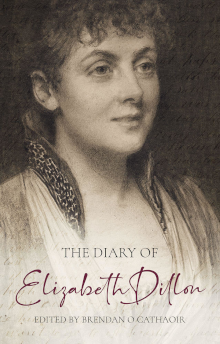
Birth of Elizabeth Dillon, Diarist and Nationalist

Elizabeth Dillon, an Irish diarist and nationalist, is born Elizabeth Mathew in England on March 2, 1865.

Dillon is the eldest of five children of Sir James Charles Mathew and Elizabeth Blackmore Mathew. Her family is related to the Butler family, but she does not visit Ireland until 1886. Living in Queen’s Gate Gardens, Kensington, London, she is educated at home. From a young age she attends the ladies’ gallery of the House of Commons, while mixing a busy social life with charitable works.

Dillon begins keeping a diary in 1879, which she continues to write until her death. Her ancestor, Mary Mathew, is also a diarist and keeps the diary for the discipline of the daily activity. She soon begins to write for the love of it, and some have surmised she wrote with the intention her diaries would be read by others. She attends lectures in Old English and literature at King’s College, London from late 1882 to 1884, and begins to learn Irish in 1893.

Dillon’s father supports land reform in Ireland, chairs the evicted tenants commission in 1892, and is a huge influence on her politics. She makes her first political reference on February 25, 1883, when she notes the arrest of the Invincibles, and she then regularly comments on land reform. She travels to Ireland for the first time in August 1886, staying in Killiney, County Dublin. In October 1886, she meets John Dillon and begins to follow the Plan of Campaign so that she can discuss it with him during his visits to the Mathew house in London.

During this time, John Dillon is deeply immersed in politics and is imprisoned on a number of occasions. Being a careful follower of Irish politics, she becomes an anti-Parnellite. She confronts John Dillon in autumn 1895 about their relationship, saying that they can no longer meet as they had become the subject of gossip. He proposes within two weeks, and they are married on November 21, 1895, in Brompton Oratory. They are busy and often apart, with Dillon spending time in a warm climate due to his ill health. She tries to accompany him when she can, but the couple’s large family makes that difficult. They have one daughter and five sons, John Dillon (1896-1970), Anne Elizabeth Dillon (born October 29, 1897), Theobald Wolfe Tone (1898-1946), Myles, James, and Brian.

Finances are strained until John’s uncle Charles bequeaths him his house, 2 North Great George’s Street, Dublin in 1898, and a business in Ballaghaderreen, County Mayo is bequeathed him by a cousin, Anne Deane, in 1905. Dillon runs the business successfully, while also carrying out duties as a politician’s wife such as opening the Belfast ladies’ branch of the United Irish League in June 1905. Her busy life results in her neglecting her diary.

Dillon dies on May 14, 1907, in Dublin, having given birth to a stillborn daughter that morning. Pneumonia is given as the cause of death, but it could have been medical incompetence. She is buried in the family vault in Glasnevin Cemetery. Her husband writes of her death in June 1907, A short narrative of the illness and death of my dearest love. Trinity College Dublin holds her diary and correspondence. Her diaries, edited by Brendan Ó Cathaoir, are published in 2019.


Leave a comment

Death of Adam Loftus, First Provost of Trinity College, Dublin

adam-loftus

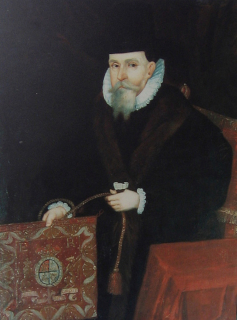
Adam Loftus, Archbishop of Armagh, and later Dublin, and Lord Chancellor of Ireland from 1581, dies in Dublin on April 5, 1605. He is also the first Provost of Trinity College, Dublin.

Loftus is born in 1533, the second son of a monastic bailiff, Edward Loftus, in the heart of the English Yorkshire Dales. He embraces the Protestant faith early in his development. He is an undergraduate at Trinity College, Cambridge, where he reportedly attracts the notice of the young Queen Elizabeth, as much by his physique as through the power of his intellect. Although this encounter may never have happened, Loftus certainly meets with the Queen more than once, and she becomes his patron for the rest of her reign. At Cambridge Loftus takes holy orders as a Catholic priest and is appointed rector of Outwell St. Clement in Norfolk. He comes to the attention of the Catholic Queen Mary, who names him vicar of Gedney, Lincolnshire. On Elizabeth’s accession in 1558 he declares himself Anglican.

Loftus makes the acquaintance of the Queen’s favourite Thomas Radclyffe, 3rd Earl of Sussex and serves as his chaplain in Ireland in 1560. In 1561 he becomes chaplain to Alexander Craike, Bishop of Kildare and Dean of St. Patrick’s Cathedral in Dublin. Later that year he is appointed rector of Painstown in Meath and evidently earns a reputation as a learned and discreet advisor to the English authorities in Dublin. In 1563, he is consecrated Archbishop of Armagh at the unprecedented age of 28 by Hugh Curwen, Archbishop of Dublin.

Following a clash with Shane O’Neill, the real power in Ulster during these years, he comes to Dublin in 1564. To supplement the meager income of his troubled archbishopric he is temporarily appointed to the Deanery of St. Patrick’s Cathedral by the queen in the following year. He is also appointed president of the new commission for ecclesiastical causes. This leads to a serious quarrel with the highly respected Bishop of Meath, Hugh Brady.

In 1567 Loftus, having lobbied successfully for the removal of Hugh Curwen, who becomes Bishop of Oxford, and having defeated the rival claims of the Bishop of Meath, is appointed Archbishop of Dublin, where the queen expects him to carry out reforms in the Church. On several occasions he temporarily carries out the functions of Lord Keeper of the Great Seal, and in August 1581 he is appointed Lord Chancellor of Ireland after an involved dispute with Nicholas White, Master of the Rolls in Ireland. He is constantly occupied in attempts to improve his financial position by obtaining additional preferment and is subject to repeated accusations of corruption in public office.

In 1582 Loftus acquires land and builds a castle at Rathfarnham, which he inhabits from 1585. In 1569–1570 the divisions in Irish politics take on a religious tinge with the First Desmond Rebellion in Munster and Pope Pius V‘s 1570 papal bull Regnans in Excelsis. The bull questions Elizabeth’s authority and thereafter Roman Catholics are suspected of disloyalty by the official class unless they are discreet.

Loftus takes a leading part in the execution of Dermot O’Hurley, Archbishop of Cashel. When O’Hurley refuses to give information, Francis Walsingham suggests he should be tortured. Although the Irish judges repeatedly decide that there is no case against O’Hurley, on June 19, 1584, Loftus and Sir Henry Wallop write to Walsingham “We gave warrant to the knight-marshal to do execution upon him, which accordingly was performed, and thereby the realm rid of a most pestilent member.”

Between 1584 and 1591 Loftus has a series of clashes with Sir John Perrot on the location of an Irish University. Perrot wants to use St. Patrick’s Cathedral, Dublin as the site of the new University, which Loftus seeks to preserve as the principal place of Protestant worship in Dublin, as well as a valuable source of income for himself. The archbishop wins the argument with the help of his patron, Queen Elizabeth I, and Trinity College, Dublin is founded at its current location, named after his old college at Cambridge, leaving the Cathedral unaffected. Loftus is named as its first Provost in 1593.

The issue of religious and political rivalry continues during the two Desmond Rebellions (1569–83) and the Nine Years’ War (1594–1603), both of which overlap with the Anglo-Spanish War (1585–1604), during which some rebellious Irish nobles are helped by the Papacy and by Elizabeth’s arch-enemy Philip II of Spain. Due to the unsettled state of the country Protestantism makes little progress, unlike in Celtic Scotland and Wales at that time. It comes to be associated with military conquest and is therefore hated by many. The political-religious overlap is personified by Loftus, who serves as Archbishop and as Lord Chancellor of Ireland. An unlikely alliance forms between Gaelic Irish families and the Norman “Old English“, who had been enemies for centuries but who now mostly remain Roman Catholic.

Adam Loftus dies in Dublin on April 5, 1605, and is interred in the building he had helped to preserve for future generations, while many of his portraits hang today within the walls of the University which he helped found. Having buried his wife Jane (Purdon) and two sons (of their 20 children) in the family vault at St. Patrick’s, Loftus dies at his Episcopal Palace in Kevin Street “worn out with age” and joins his family in the same vault. His zeal and efficiency are commended by James I upon the king’s accession.


Leave a comment

Enactment of Poyning’s Law

poynings-law-enacted

Poynings’ Law, also known as the Statute of Drogheda, an Act of the Parliament of Ireland which provides that the parliament cannot meet until its proposed legislation has been approved by both Ireland’s Lord Deputy and Privy Council and by England’s monarch and Privy Council, is enacted on December 1, 1494.

Poynings’ Parliament is called by Sir Edward Poynings in his capacity as Lord Deputy of Ireland, appointed by King Henry VII of England in his capacity as Lord of Ireland. Coming in the aftermath of the divisive Wars of the Roses, Poynings’ intention is to make Ireland once again obedient to the English monarchy. Assembling the Parliament on December 1, 1494, he declares that the Parliament of Ireland is thereafter to be placed under the authority of the Parliament of England. This marks the beginning of Tudor direct rule in Ireland, although Henry VII is still forced to rely on Old English nobles (such as Gerald FitzGerald, 8th Earl of Kildare, despite his support for Lambert Simnel) as his deputies in Ireland through the intervening years.

The working of Poynings’ Law takes place in several steps. The first step is for the lieutenant governor and the Irish council, or Irish executive, to decide that a parliament is needed, usually for the purpose of raising funds. At this point the council and lieutenant write drafts of legislation to be proposed to the king and his council. After this has been completed, the lieutenant and council, according to the act, are required to certify the request for parliament “under the great seal of that land [Ireland],” and then forward it to England for approval. Once the request arrives in England, it is reviewed by the King and his council, and a formal licence approving the request for parliament and the draft bills are returned to Ireland. Once the licence is received in Ireland, the governor summons parliament and the bills are passed.

The two important aspects of the procedure presented by Poynings’ Law are transmission and certification. Both of these requirements place limits on various parties within the law-making process in Ireland. The combination of these processes creates a situation where bills can be sent, along with the request for parliament, and the king can amend and remove such bills as he wishes, however he cannot add new bills himself.

Furthermore, the two processes make it impossible for the Irish to add more bills or amendments to a request, after the initial licence request has been granted. This means that any additional bills or amendments that they wish to pass in parliament have to be re-sent along with an entirely new request for parliament. Clearly this creates severe inefficiencies in the legislative process and thus gives the executive in Ireland as well as the Crown an interest in relaxing procedure.

Poynings’ Law is a major rallying point for later groups seeking self-government for Ireland, particularly the Confederate Catholics in the 1640s and Henry Grattan‘s Patriot Party in the late 18th century, who consistently seek a repeal of Poynings’ Law. The Act remains in place until the Constitution of 1782 gives the Irish parliament legislative independence. The Acts of Union 1800 render most of the Constitution of 1782 and Poynings’ Law moot. Poynings’ Law is formally repealed as obsolete by the Statute Law Revision (Ireland) Act 1878.