seamus dubhghaill

Promoting Irish Culture and History from Little Rock, Arkansas, USA


Leave a comment

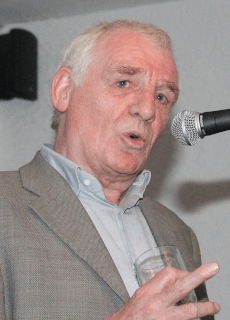
Birth of Eamon Dunphy, Media Personality & Journalist

Eamon Martin Dunphy, Irish media personality, journalist, broadcaster, author, sports pundit and former professional footballer, is born in Dublin on August 3, 1945.

Dunphy grows up in Drumcondra, Dublin, in what he describes as “a one-room tenement flat [with] no electricity, no hot water.” He attends Saint Patrick’s National School, Drumcondra. In 1958, he gets a one-year government scholarship to Sandymount High School but has to work as a messenger at the tweed clothing shop Kevin and Howlin.

A promising footballer, Dunphy leaves Dublin while still a teenager to join Manchester United as an apprentice. He does not break into the first team at United, and subsequently leaves to play for York City, Millwall, Charlton Athletic, Reading and Shamrock Rovers. It is at Millwall that he makes the most impact. He is considered an intelligent and skillful player in the side’s midfield. He is a member of “The Class of ’71,” the Millwall side that fails by just one point to gain promotion to the Football League First Division.

Dunphy plays 23 times for the Republic of Ireland and is Millwall’s most capped international footballer with 22 caps, until surpassed by David Forde and Shane Ferguson. He makes his Ireland debut on November 10, 1965, in the playoff at the Parc des Princes in Paris for the 1966 FIFA World Cup which Spain wins 1–0, thanks to a José Ufarte goal. He goes on to become, in his own words, “a good player, not a great player.”

Dunphy accompanies Johnny Giles back to Ireland to join Shamrock Rovers in 1977. Giles wants to make the club Ireland’s first full-time professional club and hopes to make Rovers into a force in European football by developing talented young players at home who would otherwise go to clubs in England. Dunphy is originally intended to be in charge of youth development. However, despite an FAI Cup winners medal in 1978, his only medal in senior football, and two appearances in the UEFA Cup Winners’ Cup, he becomes disillusioned with the Irish game and drops out of football altogether to concentrate on a career in journalism.

After retiring from the game, Dunphy first begins writing on football for the Sunday Tribune and then contributes regular columns on both football and current events for the Sunday Independent. He currently writes a column on football for the Irish Daily Star. He coins the term “Official Ireland” to refer to the establishment. He also works for Ireland on Sunday (now the Irish Daily Mail), The Sunday Press (now defunct), and the Irish Examiner.

Since the 1980s, Dunphy has written a number of books. His first and most widely praised book is Only a Game? The Diary of a Professional Footballer, which is an autobiographical account of his days playing for Millwall. Written in diary form, it records events from the dressing room of his 1973–74 season, which begins well for him at Millwall but subsequently ends in disillusionment: after being substituted in an October 27, 1973, home loss to eventual league winners Middlesbrough, he does not play another game all season, the club finishing mid-table.

In 1985, rock band U2 and manager Paul McGuinness commission Dunphy to write the story of their origins, formation, early years and the time leading up to their highly successful album The Joshua Tree. His book Unforgettable Fire – Past, Present, and Future – The Definitive Biography of U2 is published in 1988. It receives some favourable reviews, but critics close to the band speak of many inaccuracies. A verbal war erupts in the press during which he calls lead singer Bono a “pompous git.”

Dunphy also writes a biography of long-serving Manchester United manager Matt Busby and in 2002 ghost writes the autobiography of Republic of Ireland and Manchester United player Roy Keane.

Since the mid-1980s, Dunphy has regularly appeared as an analyst during football coverage on Raidió Teilifís Éireann (RTÉ). Since RTÉ acquired the rights to show English football, he has been a regular contributor to Premier Soccer Saturday. He also contributes to analysis of UEFA Champions League games and, in international football, RTÉ’s coverage of FIFA World Cups, UEFA European Football Championships and qualifying matches involving the Republic of Ireland national football team.

In 2001, Dunphy becomes the first male host of the quiz show The Weakest Link, which airs on TV3, for just one series. In 2003, he is hired again by TV3 to host their new Friday night chat show, entitled The Dunphy Show. Pitted head-to-head with RTÉ’s long-running flagship programme, The Late Late Show, Dunphy’s show loses what is a highly publicised “ratings war,” and is cancelled before its original run concludes.

Dunphy is the first presenter of a made-for-mobile television show on the 3 mobile network in Ireland. His rants and “Spoofer of the Week” are watched by thousands of 3 Mobile customers. The shows are awarded “Best Entertainment Show” at Ireland’s Digital Media Awards. He admits he never uses a mobile himself but enjoys filming for a mobile audience from his living room in Ranelagh.

In July 2018, Dunphy announces that he is leaving RTÉ after 40 years with the broadcaster, and that he intends to focus on his podcast The Stand with Eamon Dunphy.

Dunphy has also has a prominent radio career with several stations, including Today FM, Newstalk and RTÉ Radio 1. He is the original host in 1997 of the popular current affairs show The Last Word on Today FM. In September 2004, he takes over The Breakfast Show slot on the Dublin radio station Newstalk 106 from David McWilliams. The show tries to court controversy and listeners in equal measure. He fails to attract the large listenership predicted, with only a few additional thousand tuning in. He announces in June 2006 his intention to leave Newstalk 106, citing an inability to sustain the demands of an early morning schedule. After his departure from Newstalk 106, he confirms he is suffering from a viral illness from which he later recovers.

In July 2006, RTÉ announces that Dunphy will present a new weekly programme as part of the new RTÉ Radio 1 autumn schedule.

Dunphy rejoins Newstalk but leaves again in 2011 “due to interference from management and a push to put a more positive spin on the news.” On his last show he accuses his boss, Denis O’Brien, of “hating journalism.” He quits after Sam Smyth is sacked from Today FM (also owned by O’Brien) and says management at Newstalk is trying to remove “dissenting voices” like Constantin Gurdgiev from the airwaves.

Dunphy is a daily Mass-goer until he is preparing for marriage to his first wife, Sandra from Salford, when he is 21. He is Catholic and she is Protestant. The priest instructing them for marriage disapproves strongly of the mixed couple, saying that he should not marry her because she is “not a proper person.” Dunphy’s observance is already weakening but he quits his daily Mass-going at this point. He and Sandra have two children, a boy and a girl, and he is now a grandfather. His first marriage ends, and he moves to Castletownshend in County Cork for two years in the early 1990s. He lives with another partner, Inge, before meeting his second wife, RTÉ commissioning editor Jane Gogan, in the Horseshoe Bar in Dublin in 1992. They marry at the Unitarian Church on St. Stephen’s Green on September 24, 2009.

In an interview with An Phoblacht, Dunphy, who had previously written highly critical articles on the Provisional IRA and Sinn Féin, states that he is now a Sinn Féin supporter and declares he had voted for them in the 2011 Irish general election. He describes their representatives as “incredibly hard-working and incredibly intelligent.”

Dunphy publishes his autobiography entitled The Rocky Road in October 2013.

Today, Dunphy generally resides at his home near Ranelagh in Dublin. He also owns a holiday home in Deauville, France.

(Pictured: Éamon Dunphy at the Sinn Féin Summer School, 2013)


Leave a comment

Birth of Paul McGuinness, Former Manager of U2

Paul McGuinness, the founder of Principle Management Limited, a popular music act management company based in Dublin, is born on June 16, 1951, in Rinteln, Westphalia, Germany. He is the manager of the rock band U2 from 1978 to 2013.

McGuinness is born in a British military hospital at Rinteln where his father, Philip McGuinness, a native of Liverpool, is serving with the Royal Air Force. His mother, Sheila McGuinness (née Lyne), is a schoolteacher from County Kerry. There are three children in the family: Paul, Niall, and Katy.

McGuinness receives his early formal education in Ireland at the private Jesuit boarding school, Clongowes Wood College. From there he goes on to Trinity College Dublin, where he directs plays, edits the magazine T.C.D. Miscellany, and promotes gigs, but drops out before obtaining a degree.

Before becoming involved with U2, Guinness works as a film assistant director on productions such as John Boorman‘s Zardoz. For a time, he also manages folk-rock group Spud.

McGuinness first meets U2 at a Dublin gig on May 25, 1978, where they are supporting the Gamblers. Following this meeting, he becomes U2’s manager, having been introduced to the band by Bill Graham, a journalist with Hot Press magazine. His original agreement with the band is that the money is to be split equally five ways, though this is later changed.

McGuinness founds Principle Management Limited on March 29, 1984. He and Bill Whelan set up a music publishing company called McGuinness/Whelan Publishing in the late 1980s. Whelan later composes the music for the theatrical show Riverdance.

In 2002, McGuinness is presented with a Lifetime Achievement Award at the Meteor Music Awards at the Point Theatre in Dublin and U2 wins the best Irish Band Award.

Noted for his business acumen, McGuinness is responsible for U2 3D concert films, U2-branded iPods, sponsorship from BlackBerry and the first-ever concert streamed live on YouTube.

McGuinness is regarded as the fifth member of U2, although in an interview with The Irish Press in 1985, when asked if he is the fifth member of U2, he replies, “The fifth member of U2 is in Adam (Clayton)‘s trousers.” He is also regarded as one of the most successful managers in the music business.

McGuinness steps down as manager of U2 after 34 years on November 13, 2013, with Madonna‘s manager, Guy Oseary, succeeding him in 2014 when he sells Principle Management Limited to Live Nation.

McGuinness is a founding partner of TV3 (Ireland) and is one of the owners of Ardmore Film Studios. He becomes a member of the Arts Council of Ireland on January 1, 1988, having been appointed by Charles Haughey. He serves until February 2000 when he resigns.

McGuinness has been an advocate on behalf of artists, record labels, and music publishers. On January 28, 2008, in a speech at the Midem music industry convention in Cannes, he specifically accuses companies such as Apple, Google, Yahoo!, and Facebook of building “multi-billion dollar industries on the back of our content without paying for it.”

In 2015, McGuinness founds Primo Productions, a film and TV company. Primo produces three seasons of Riviera, a drama set in the South of France. He writes the “list of ingredients” for the show: “Rich people behaving badly in the sun, yachts, Maseratis, great clothes, beautiful women, art fraud, money laundering through the auction houses, Russians, English people, American, French. Murder, adultery.” Everyday life on the Côte d’Azur. His production partner is Kris Thykier of Archery Pictures. The show is originally commissioned by Anne Mensah of Sky Atlantic.

McGuinness marries Kathy Gilfillan in 1977. They meet while he is studying at Trinity. Gilfillan is director of The Lilliput Press. They have two children.


Leave a comment

U2’s Los Angeles Rooftop Video Shoot

Irish rock band U2 records the video for “Where the Streets Have No Name” on the rooftop of the Republic Liquor store in downtown Los Angeles on March 27, 1987, at a time when MTV still shows videos and U2 is unquestionably the biggest band in the world. The video shows police advising the U2 crew that they will shut down the performance due to crowd safety.

It takes place on the rooftop of the Republic Liquor store at 7th and Main. The location is now Margarita’s Place, a Mexican restaurant that still draws tourists. The impromptu performance is an homage to the Beatles final concert, as depicted in the film Let It Be. As lead vocalist and primary lyricist Bono says at the time, “It’s not the first time we’ve ripped off the Beatles.

The video shows the police about to shut down the show at any moment with one cop heard saying, “You’re drawing people in here from Orange County and all over the goddamned place. We’re shutting this location down.” According to band manager Paul McGuinness, the confrontation is overly dramatized. The band is hoping to get shut down by the authorities to garner publicity, but the police let them play.

The video is directed by Meiert Avis and produced by Michael Hamlyn and Ben Dossett and goes on to win a Grammy Award for Best Performance Music Video. Hamlyn is almost arrested following a confrontation with the police, according to an interview with Uncut magazine. Avis later says that “getting busted was an integral part of the plan.”

Bass guitarist Adam Clayton later says, “The object was to close down the streets. If there’s one thing people in L.A. hate, it’s streets closing down, and we’ve always felt bands should shake things up. We achieved it because the police stopped us filming. Were we worried about being arrested? Not at the time.”

The performance actually is not quite as impromptu as it appears. Prior to filming, a week is spent reinforcing the roof of the liquor store to ensure it will not collapse if fans swarmed onto it, according to Wikipedia. A backup generator is also put on the roof so shooting can continue if the authorities shut off the power on the primary generator. They also rebuild the sign for The Million Dollar Hotel, which can be seen in the background, as an added draw in case no one shows up.

The performance attracts about 1,000 people, not the 30,000 predicted in the radio clips at the beginning of the video. The audio is actually a studio recording, although the band plays four versions of the opening track hit from their 1987 album The Joshua Tree.

(From: “Flashback Monday: U2 Performs On A Roof In Downtown L.A.” by Sharon Knolle, LAist of Southern California Public Radio, laist.com, September 22, 2013)


Leave a comment

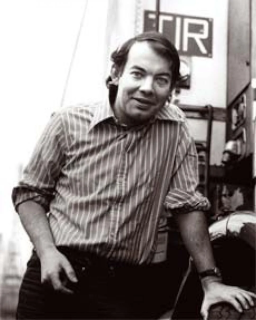
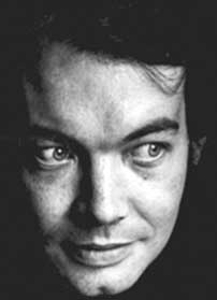
Birth of Bill Graham, Rock Journalist & Author

Bill Graham, Irish rock journalist and author, is born in Belfast, Northern Ireland, on August 29, 1951. He attends Blackrock College and Trinity College, Dublin. In addition to authoring several books, he writes for Hot Press magazine from its founding.

Graham’s long time colleague and Hot Press editor Niall Stokes describes him, “In many ways, he was a founding father of modern Irish music. He inspired a whole generation of Irish fans and musicians to look at the world in a different and broader light. And he was good on more than music too. He felt a kinship with Northern Ireland and the people on both sides of the sectarian and political divide there that was unusual in those who were brought up within the narrow confines of the culture of Ireland in the ‘60s and ‘70s – and his political writing reflected this. And he was also ahead of the game in terms of his appreciation of the importance of the politics of food and the position of the developing world in the new era.”

Graham is instrumental in the formation of Irish rock band U2, having brought them to the attention of their manager Paul McGuinness. At an exhibition of early group photos, McGuinness remembers the role Graham played by introducing him to the band. Despite being widely known as the man who “discovered” U2, it is a title he disavowed. He writes enthusiastically about the band, giving them their first exposure. Both guitarist The Edge and Bono have explained Graham’s role in the band’s development.

John Waters observes that “It is often said that Bill ‘discovered’ U2. This is untrue. Bill created U2, through his enthusiasm for them. He gave them a reflection of their own possibilities and they only looked back that once.” Graham has a deep knowledge of virtually every form of popular and roots music. Waters goes on to credit him as “the first Irish writer to write about the connection between Irish political culture and Irish rock ‘n’ roll.”

A number of music critics/journalists have cited Graham as a primary influence, in some cases suggesting they got into the field as a direct result of his writing.

Graham dies of a heart attack at the age of 44 at his home in Howth, County Dublin, on May 11, 1996. His funeral draws many of the biggest bands from the world of Irish music including Clannad, Altan, U2, and Hothouse Flowers, along with singers Simon Carmody and Gavin Friday.


Leave a comment

Bill Whelan Receives IMRO Lifetime Achievement Award

bill-whelan

Taoiseach Bertie Ahern presents Irish composer and musician Bill Whelan with the IMRO Lifetime Achievement Award at Dublin Castle on March 2, 2001. Such big names as The Corrs, Brian Kennedy, Jean Butler, Jim Sheridan, Paul McGuinness and Moya Doherty join him to celebrate the award.

Whelan is best known for composing a piece for the interval of the 1994 Eurovision Song Contest. The result, Riverdance, is a seven-minute display of traditional Irish dancing that becomes a full-length stage production and spawns a worldwide craze for Irish dancing and Celtic music and also wins him a Grammy Award. It is released as a single in the United Kingdom in 1994, credited to “Bill Whelan and Anúna featuring the RTÉ Concert Orchestra.” It reaches number 9 and stays in the charts for 16 weeks. The album of the same title reaches number 31 in the album charts in 1995. He also composes a symphonic suite version of Riverdance, with its premiere performed by the Ulster Orchestra on BBC Radio 3 in August 2014.

Whelan is a native of Limerick and is educated at Crescent College, University College Dublin and the King’s Inns. While he is best known for his Riverdance composition, he has been involved in many ground-breaking projects in Ireland since the 1970s. As a producer he has worked with U2 (on their War album), Van Morrison, Kate Bush, The Dubliners, Planxty, Andy Irvine & Davy Spillane, Patrick Street, Stockton’s Wing and fellow Limerickman Richard Harris.

In theatre, Whelan receives a Laurence Olivier Award nomination for his adaption of Gilbert and Sullivan‘s H.M.S. Pinafore. He writes original music for fifteen of William Butler Yeats‘s plays for Dublin‘s Abbey Theatre and his film credits include Dancing at Lughnasa (starring Meryl Streep), Some Mother’s Son, Lamb (starring Liam Neeson) and the award-winning At the Cinema Palace.


Leave a comment

Death of Rock Journalist Bill Graham

Bill Graham, Irish rock journalist and author, dies of a heart attack at the age of 44 at his home in HowthCounty Dublin, on May 11, 1996. He attends Trinity College, Dublin. In addition to authoring several books, Graham writes for Hot Pressmagazine from its founding.

Graham’s long time colleague and Hot Press editor Niall Stokes describes him, “In many ways, he was a founding father of modern Irish music. He inspired a whole generation of Irish fans and musicians to look at the world in a different and broader light. And he was good on more than music too. He felt a kinship with Northern Ireland and the people on both sides of the sectarian and political divide there that was unusual in those who were brought up within the narrow confines of the culture of Ireland in the ‘60s and ‘70s – and his political writing reflected this. And he was also ahead of the game in terms of his appreciation of the importance of the politics of food and the position of the developing world in the new era.”

Graham is instrumental in the formation of Irish rock band U2, having brought them to the attention of their manager Paul McGuinness. At an exhibition of early group photos, McGuinness remembers the role Bill Graham played by introducing him to the band. Despite being widely known as the man who “discovered” U2, it is a title he disavowed. He writes enthusiastically about the band, giving them their first exposure. Both guitarist The Edge and Bono have explained Graham’s role in the band’s development.

John Waters observes that “It is often said that Bill ‘discovered’ U2. This is untrue. Bill created U2, through his enthusiasm for them. He gave them a reflection of their own possibilities and they only looked back that once.” Graham has a deep knowledge of virtually every form of popular and roots music. Waters goes on to credit him as “the first Irish writer to write about the connection between Irish political culture and Irish rock’n’roll.”

A number of music critics/journalists have cited Graham as a primary influence, in some cases suggesting they got into the field as a direct result of his writing.

Bill Graham’s funeral draws many of biggest bands from the world of Irish music including ClannadAltan, U2, and Hothouse Flowers, along with singers Simon Carmody and Gavin Friday.


Leave a comment

Birth of U2 Bassist Adam Clayton

adam-clayton

Adam Charles Clayton, Irish musician best known as the bass guitarist of the rock band U2, is born in Chinnor, Oxfordshire, England, on March 13, 1960.

Clayton is the oldest child of Brian and Jo Clayton. His father is a pilot with the Royal Air Force, who moves into civil aviation, and his mother is a former airline flight attendant. When he is 4 years old his father works in Kenya as a pilot with East African Airways. Clayton regards this as the happiest period of his childhood. In 1965 the family moves to Malahide, County Dublin, where Clayton’s brother Sebastian is born. The Clayton family becomes friends with the Evans family, including their son, David, who later becomes a fellow U2 band-member with Clayton.

When he is eight years old Clayton is sent to the private junior boarding Castle Park School in Dalkey, Dublin, which he did not enjoy because he is not particularly sports orientated. At age 13 he enters the private St. Columba’s College secondary school in Rathfarnham, Dublin. Here he makes friends with other pupils who are enthusiastic about pop/rock music. It is here in the school band where Clayton plays the bass guitar for the first time.

Clayton later changes school to Mount Temple Comprehensive School in Dublin, where he meets future bandmates, Paul Hewson (aka “Bono“) and Larry Mullen Jr., and is reunited with his childhood friend David Evans (aka “The Edge”). In September 1976, Mullen puts an advert onto the school’s bulletin board seeking other musicians to form a band. The original band is a five-piece band known as “Feedback,” consisting of Bono, The Edge, Mullen, Dik Evans, and Clayton. The name is subsequently changed to “The Hype,” but changes to “U2” soon after Dik Evans leaves the band. Clayton stands in as the nearest thing that the band has to a manager in its early life, handing over the duties to Paul McGuinness in May 1978.

In 1981, around the time of U2’s second, spiritually charged October album, a rift is created in the band between Clayton and McGuinness, and the three other band members. Bono, The Edge, and Mullen have joined a Christian group, and are questioning the compatibility of rock music with their spirituality. However, Clayton, with his more ambiguous religious views, is less concerned, and so is more of an outsider, until Bono’s wedding to Alison Hewson (née Stewart), in which Clayton is the best man.

Clayton makes international headlines in August 1989 when he is arrested in Dublin for carrying a small amount of marijuana. He avoids conviction by making a large donation to charity. Clayton also has alcohol problems, which come to a head on November 26, 1993, when he is so hung over that he is unable to play that night’s show in Sydney, the dress rehearsal for their Zoo TV concert film. Bass duties are fulfilled by Clayton’s technician Stuart Morgan. After that incident, however, Clayton gives up alcohol.

In 1995, after the Zoo TV Tour and Zooropa album, Clayton heads to New York City with bandmate Mullen to receive formal training in the bass as until then Clayton has been entirely self-taught. Bono says of Clayton’s early bass playing, “Adam used to pretend he could play bass. He came round and started using words like ‘action’ and ‘fret’ and he had us baffled. He had the only amplifier, so we never argued with him. We thought this guy must be a musician; he knows what he’s talking about. And then one day, we discovered he wasn’t playing the right notes. That’s what’s wrong, y’know?”

In 2011 Clayton becomes an ambassador for the Dublin-based St. Patrick’s Hospital‘s Mental Health Service “Walk in My Shoes” facility.

Clayton and U2 have won numerous awards in their career, including 22 Grammy Awards, including seven times for Best Rock Duo or Group, and twice each for Album of the Year, Record of the Year, Song of the Year, and Best Rock Album.