seamus dubhghaill

Promoting Irish Culture and History from Little Rock, Arkansas, USA


Leave a comment

Birth of Explorer Robert O’Hara Burke

robert-o'hara-burke

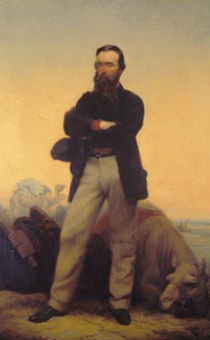
Robert O’Hara Burke, Irish soldier and police officer who achieves fame as an Australian explorer, is born in St. Clerens, County Galway on May 6, 1821. He is the leader of the ill-fated Burke and Wills expedition which is the first expedition to cross Australia from south to north.

Burke is the second of three sons of James Hardiman Burke, an officer in the British army 7th Royal Fusiliers, and Anne Louisa Burke (nee O’Hara).

Burke enters the Royal Military Academy, Woolwich in May 1835. In December 1836 he fails his probationary exam and goes to Belgium to further his education. In 1841, he enters the Austrian army and spends most of his time posted to northern Italy. Towards the end of 1847 he suffers health problems and ultimately resigns from the Austrian army in June 1848.

After returning to Ireland in 1848, he joins the Irish Constabulary (later the Royal Irish Constabulary). He does his cadet training at Phoenix Park Depot in Dublin between November 1849 and January 1850. At the end of 1850 he transfers to the Mounted Police in Dublin.

Burke emigrates to Australia, arriving in Hobart, Tasmania on February 12, 1853, and promptly sails for Melbourne. On April 1, 1853, he joins the recently established Victoria Police force.

After the South Australian explorer John McDouall Stuart reaches the centre of Australia, the South Australian parliament offers a reward of £2,000 for the promotion of an expedition to cross the continent from south to north, generally following Stuart’s route. In June 1860, Burke is appointed to lead the Victorian Exploring Expedition with William John Wills, his third-in-command, as surveyor and astronomical observer.

The expedition leaves Melbourne on August 20, 1860, with a total of 19 men, 27 camels and 23 horses. They reach Menindee on September 23, 1860, where several people resign.

Cooper Creek, 400 miles further on, is reached on November 11, 1860, by the advance group, the remainder being intended to catch up. After a break, Burke decides to make a dash to the Gulf of Carpentaria, leaving on December 16, 1860. William Brahe is left in charge of the remaining party. The small team of Burke, William Wills, John King and Charley Gray reach the mangroves on the estuary of the Flinders River, near where the town of Normanton now stands, on February 9, 1861. They never see open ocean due to flooding rains and swamps.

Already weakened by starvation and exposure, progress on the return journey is slow and hampered by the tropical monsoon downpours of the wet season. Gray dies four days before they reach the rendezvous at Cooper Creek. The other three rest for a day when they bury him. They eventually reach the rendezvous point on April 21, 1861, nine hours after the rest of the party had given up waiting and left, leaving a note and some food, as they have not been relieved by the party supposed to be returning from Menindee.

Burke’s party attempts to reach Mount Hopeless, the furthest outpost of pastoral settlement in South Australia, which is closer than Menindee, but fail and return to Cooper Creek. While waiting for rescue Wills dies of exhaustion and starvation. Soon after, Burke also dies, at a place now called Burke’s Waterhole on Cooper Creek in South Australia. The exact date of Burke’s death is uncertain but has generally been accepted to be June 28, 1861.

King survives with the help of Aborigines until he is rescued in September by Alfred William Howitt. Howitt buries Burke and Wills before returning to Melbourne. In 1862 Howitt returns to Cooper Creek and disinters Burke and Wills, taking them first to Adelaide and then by steamer to Melbourne where they are laid in state for two weeks. On January 23, 1863, Burke and Wills receive a State Funeral and are buried in Melbourne General Cemetery. Ironically, on that same day John McDouall Stuart and his companions, having successfully completed the south-north crossing, are received back at a large ceremony in Adelaide.


1 Comment

Execution of D.I. Gilbert Potter, R.I.C.

gilbert-norman-potter

Gilbert Norman Potter, a District Inspector of the Royal Irish Constabulary, is executed by the Irish Republican Army (IRA) on April 27, 1921, in reprisal for the British execution of Irish republican Thomas Traynor.

Born in Dromahair, County Leitrim on July 10, 1887, Potter receives his commission as District Inspector on April 27, 1901, having completed his cadetship at the Depot, Phoenix Park, Dublin. His first assignment is to Castlepollard, County Westmeath. During the 1909 ITGWU strike in Cork, he is temporarily posted there from Dublin and is also involved in policing the August 14 marches in Portadown. Having had charge of No. 4 Company at the Depot, he is assigned to Cahir in 1912.

On April 23, 1921, District Inspector Potter is captured by the 3rd Tipperary Brigade, IRA, following the Hyland’s Cross Ambush. This occurs near Curraghcloney, close to the village of Ballylooby. The ambush party is initially made up of a combination of the 1st and 2nd Flying Columns 3rd Tipperary Brigade. This is the largest force assembled to date by the Tipperary IRA in anticipation of a major battle. However, the convoy of military lorries that is expected never materialises. Dan Breen and Con Moloney return to Battalion Headquarters, while Seán Hogan‘s Column withdraws northward in the direction of the Galtee Mountains.

As Dinny Lacey‘s No.1 Column prepares to leave towards the south, a small party of British soldiers accompanying two horse-drawn carts unexpectedly approaches from Clogheen and are immediately fired upon. Amid some confusion Lacey’s scattered men withdraw southwards towards the Knockmealdown Mountains. One British soldier, Frank Edward Conday, is fatally wounded and two others from the relieving party are wounded.

By chance, Potter, who is returning by car from police duties at Ballyporeen, drives into a section of the withdrawing No.1 Column. Although in civilian attire, he is recognised by one of the IRA Volunteers and taken prisoner. As part of a new strategy, he is held as a hostage for the safe release of Thomas Traynor, an IRA volunteer and father of ten young children, then under sentence of death at Mountjoy Gaol. The IRA offers to release Potter in exchange for Traynor’s release. Traynor is executed. Traynor has since been honoured by the Irish state as one of “The Forgotten Ten.”

The Column, under sporadic fire from soldiers, alerted at the nearby Clogheen barracks, follow the contours of the mountains to the village of Newcastle. Losing their pursuers, they stay for a period of time at the townland of Glasha. Here Potter is detained in an out-building of a farm which is regularly used by the IRA as a safe house. From there the party is guided into the Nire Valley by a contingent of local Waterford Volunteers and on to the Comeragh Mountains.

Accounts from Rathgormack, County Waterford suggest he is kept for at least one night at a nearby Ringfort before being taken down the hill to a field then owned by Powers of Munsboro, where he meets his ultimate fate. At 7:00 PM, on April 27, following news of Traynor’s execution by hanging, he is shot to death, and hastily buried in a shallow grave on the banks of the River Clodiagh. A diary he kept during his period of captivity and some personal effects and farewell letters, are returned anonymously to his wife. It is the first confirmation she has that he has been killed. The artifacts are later lost when his son’s ship is torpedoed in 1942, during World War II.

(Pictured: Photo of District Inspector Gilbert Potter R.I.C. that appeared in the Press during his time in captivity)


Leave a comment

Death of Martin Fay, Founding Member of The Chieftains

Martin Fay, Irish fiddler and bones player, and a former member of The Chieftains, dies on November 14, 2012. The Chieftains collaborate with musicians from a wide range of genres and cultures and bring in guest performers such as Mick Jagger, Van Morrison and James Galway. Yet traditional tunes lay at the heart of the band, with Fay’s fiddle a vital part of their distinctive sound.

Fay is born in Cabra, Dublin, where his mother teaches him to play the piano. As a boy, he is captivated by the music in the film The Magic Bow (1946), about the life of Niccolò Paganini, and he changes instrument. He progresses well in his classical violin lessons and at fifteen is playing in a Butlins holiday camp orchestra. After leaving school at eighteen, Fay works in an office by day and in the evenings plays in the Abbey Theatre orchestra, where he meets the Abbey’s musical director, Seán Ó Riada.

In the 1950s, traditional music is regarded as distinctly old-fashioned in Ireland, but Ó Riada’s success with a film score, and a play at the Abbey, encourage him to establish a folk orchestra which includes Fay, piper Paddy Moloney and the tin whistle player Seán Potts. Instead of all the musicians playing together in unison, as in the established cèilidh bands, Ó Riada wants to create a chamber orchestra, playing arrangements of folk music. Fay’s classical music background is essential for this approach. The resulting ensemble, Ceoltóirí Cualann, enjoys radio success and, in 1961, plays the soundtrack for a film of The Playboy of the Western World. Fay was soon earning more playing traditional music than in his day job.

Garech Browne, a member of the Guinness family and founder of Claddagh Records, asks Moloney to record some traditional Irish music. Moloney brings in Fay, Potts and Michael Tubridy on flute, and uses a similar approach to arranging the tunes. Their eponymous album, The Chieftains, is released in 1964, before they first perform in public. The success of this new approach to traditional Irish music leads to radio and television work, and they attract celebrity fans. Browne is a great thrower of parties, where the guests included Jagger, Princess Grace of Monaco, Peter O’Toole and Sean Connery, with The Chieftains invariably playing through the night.

By 1968, Moloney is working full time for Claddagh Records, and when he, Potts and Fay are offered a recording contract by a rival company, Gael Linn, Moloney refuses to sign. Potts and Fay believe that their future lay with Gael Linn, and they leave The Chieftains, only to return a year later. In the meantime, Seán Keane has joined to play fiddle, but on Fay’s return the pair work well together.

The Chieftains’ popularity is extending far beyond folk enthusiasts, but they are still playing only in their spare time. That changes in 1975 when they provide music for the Oscar-winning score of Stanley Kubrick‘s film Barry Lyndon and the promoter Jo Lustig books the group into the Royal Albert Hall in London on St. Patrick’s Day. The sell-out concert is a triumph, and Fay and his fellow Chieftains finally give up their day jobs.

The relentless international touring takes its toll on band members with young families, and Tubridy and Potts leave, to be replaced by the flautist Matt Molloy. Fay is happy to continue. A reserved and modest man with a great sense of humour, he is unfazed by the pressures of extensive touring. He is the only Chieftain not to be racked by nerves when playing to well over a million people at Phoenix Park during Pope John Paul II‘s visit to Dublin in 1979.

Although he has a classical training, Fay has a natural understanding of traditional music. He is a master of changing the mood at Chieftains concerts from the lively onstage parties to a more tranquil atmosphere, through his emotional interpretations of the slow airs. In total, Fay records more than 30 albums with the group before he withdraws from touring in 2001 and retires altogether in 2002.

Martin Fay dies in Cabra, Dublin, on November 14, 2012, after a lengthy illness.


2 Comments

Unveiling of the Charles Stewart Parnell Statue in Dublin

The statue of Charles Stewart Parnell on Sackville Street, now known as O’Connell Street, is unveiled in Dublin on October 1, 1911. It is one of the last sculptural initiatives in the city before independence.

On January 3, 1882 a resolution is passed by the Dublin City Council to grant the freedom of the city to Parnell. The plan for the Parnell monument is instigated by John Redmond, who succeeded Parnell as leader of the Irish Parliamentary Party, partly as a symbolic gesture to honour the “uncrowned king of Ireland” and to consolidate his aspiration to reunite the constitutionalists under his own leadership. The monument is funded through the efforts of a voluntary body, the Parnell Committee, founded in 1898. It is first proposed to place the monument on the site of the Thomas Moore statue, which would be moved to another location. The City Council refuses to grant this site and directs that the monument be erected on a site near the Rotunda Hospital, where it now stands.

Augustus Saint-Gaudens, an Irish-born sculptor and the most eminent in the art of public monuments in the United States, accepts the commission. It is however to prove a protracted project as the demand for Saint-Gaudens’ work in America is such that completion of the Parnell project is fraught with delays.

For the Parnell monument, Saint-Gaudens makes a scale replica of the buildings and square in Dublin and also a full scale model of the monument in wood in a field near his studio. In 1904 there is a disastrous fire in his studio and only the head of the statue is saved. The original concept is of an 8-foot high bronze figure placed by a bronze table and set against a 30-foot pyramid. However, as this form is already utilised in the Wellington Monument obelisk in Phoenix Park, Saint-Gaudens and architect Henry Bacon propose a triangular shaft almost double the height of the original.

Saint-Gaudens finally presents Parnell in what he considers a noble and calm manner, depicted in an open frock coat, with one hand resting on a table and the other extended dramatically as if making a point at a parliamentary debate. The shaft of the monument is constructed in undecorated ashlar granite.

On October 1, 1911, the monument is unveiled to a large crowd, many of whom had been absent from the foundation stone ceremony, but there are also strikes and marches indicating the unrest to follow.

In June 1913, John Redmond, as Secretary to the Parnell Monument Committee, writes to the City Council requesting the council to take the
Monument into their charge on behalf of the Citizens of Dublin. The Council agrees to this request and ever since then the Parnell Monument has been in the care of the Dublin Corporation.

The inscription on the monument reads:

To Charles Stewart Parnell

No Man has a right to fix the
Boundary to the march of a nation
No man has a right
To say to his country
Thus far shat thou
Go and no further
We have never
Attempted to fix
The ne-plus-ultra
To the progress of
Ireland’s nationhood
And we never shall

At the base of the statue the Irish inscription reads:

Go roimhigid Dia Éire da Clainn


Leave a comment

The Opening of Dublin Zoo

Dublin Zoo, located in Phoenix Park, Dublin, opens on September 1, 1831. It is the largest zoo in Ireland and one of Dublin’s most popular attractions. The zoo describes its role as conservation, study, and education. Its stated mission is to “work in partnership with zoos worldwide to make a significant contribution to the conservation of the endangered species on Earth.”

Covering over 28 hectares (69 acres) of Phoenix Park, the Dublin Zoo is divided into areas named Asian Forests, Orangutan Forest, The Kaziranga Forest Trail, Fringes of the Arctic, Sea Lion Cove, African Plains, Roberts House, House of Reptiles, City Farm and South American House.

The Royal Zoological Society of Ireland is established at a meeting held at the Rotunda Hospital on May 10, 1830. The zoo, then called the Zoological Gardens Dublin, initially opens to the public with 46 mammals and 72 birds, all donated by London Zoo.

The initial entry charge per person is sixpence, which is a sizable sum at the time and limits admission to relatively wealthy middle-class people. What makes Dublin Zoo very different from some of its contemporaries is a decision to reduce the charge to one penny on Sundays. This makes a day at the zoo something that nearly every Dubliner can afford once in a while and it becomes very popular.

In 1833, the original cottage-style entrance lodge to the zoo is built at a cost of £30. The thatch-roofed building is still visible to the right of the current entrance. In 1838, to celebrate Queen Victoria‘s coronation, the zoo holds an open day on which 20,000 people visit. This remains the highest number of visitors in one day. President of the United States Ulysses S. Grant, after leaving office, is among the celebrities who come to see Dublin’s world-famous lions in the 19th century. In 1844 the zoo receives its first giraffe, and in 1855 it purchases its first pair of lions.

In 2015, Dublin Zoo is the third most popular visitor attraction in Ireland with 1,105,005 visitors.

Dublin Zoo is part of a worldwide programme to breed endangered species. It is a member of the European Endangered Species Programme (EEP), which helps the conservation of endangered species in Europe. Each species supervised by the EEP has a single coordinator that is responsible for the building of breeding groups with the aim of obtaining a genetically balanced population.

Dublin Zoo manages the EEP for the golden lion tamarin and the Moluccan cockatoo. It also houses members of the species Goeldi’s monkey and the white-faced saki monkey which are part of EEPs coordinated by other zoos. The focus is on conservation, which includes breeding and protecting endangered species, as well as research, study and education.


Leave a comment

James Mulroy Awarded the First Walter Scott Medal for Valour

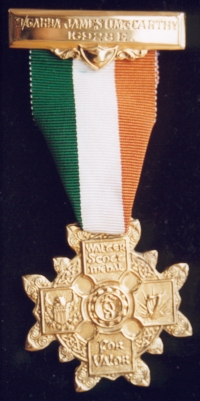
The first Walter Scott Medal for Valour, a medal awarded annually for bravery in the Garda Síochána, is awarded to Garda James Mulroy on August 18, 1924. The award is presented by Colonel Scott himself at the Depot, Phoenix Park. It is not a state award, being in the gift of the commissioner, but the medals are awarded by the Minister for Justice and Equality.

The Garda medal is instituted at the behest of Colonel Walter Scott, a New York City philanthropist who took an interest in policing. In 1923 he gives a one thousand dollar gold Bond which pays for in perpetuity a gold medal. The award is to be presented under the following condition: No action, however heroic, will merit the award of the Scott medal unless it takes the shape of an act of most exceptional bravery and heroism involving the risk of life in the execution of duty, and armed with full previous knowledge of the risk involved.

Guard Mulroy is accosted by two armed men who tell him he has five minutes to live. He waits for his opportunity, springs upon the man with the revolver, tackles him and holds him, but is shot and seriously wounded by the other man who fires his single barreled shotgun and then proceeds to beat Guard Mulroy on the head with the shotgun. The struggle ends when the stock of the shotgun separates from the barrel and Guard Mulroy grabs the barrel with one hand while still holding the other man with the loaded revolver with the other. Guard Mulroy disarms the man with the revolver while the other runs off. He then tells the remaining man to go home. Guard Mulroy falls unconscious and later awakes to find himself in the ditch with the revolver in one hand and the barrel in the other. He returns to his station at 5:00 AM, gets his wounds dressed, and then goes out with another Guard and arrests one of the men.


Leave a comment

Richard Pigott Exposed as Forger of Phoenix Park Letters

richard-pigott

Richard Pigott, an Irish journalist, is exposed as the forger of The Times Phoenix Park letters on February 10, 1889.

Pigott is born in 1835 in Ratoath, County Meath. As a young man he supports Irish nationalism and works for The Nation and The Tablet before acting as manager of The Irishman, a newspaper founded by Denis Holland. James O’Connor later claims Pigott embezzled funds from the paper and covered his tracks by not keeping written records. Pigott also works for the Irish National Land League, departing in 1883 after accusing its treasurer, Mr. Fagan, of being unable to account for £100,000 of its funds, and for keeping inadequate records. Nothing is done about his accusation, which is publicised in the newspapers, and he turns against the League, which is allied to several Irish nationalist groups including the Irish Parliamentary Party led by Charles Stewart Parnell.

In 1879 Pigott is proprietor of three newspapers, which he soon sells to the Irish Land League, of which Charles Stewart Parnell is president. Hitherto a violent Nationalist, from 1884 Pigott begins to vilify his former associates and to sell information to their political opponents. In an effort to destroy Parnell’s career, Pigott produces fake letters, which purports that Parnell had supported one of the Phoenix Park murders.

The Times purchases Pigott’s forgeries for £1,780 and publishes the most damning letter on April 18, 1887. Parnell immediately denounces it as “a villainous and barefaced forgery.” In February 1889, the Parnell Commission vindicates him by proving that the letters are forgeries. They include misspellings which Pigott has written elsewhere. A libel action instituted by Parnell also vindicates him and his parliamentary career survives the Pigott accusations.

The Commission eventually produces 37 volumes in evidence, covering not just the forgeries but also the surrounding violence that follows from the Plan of Campaign.

After admitting his forgeries to Henry Labouchère, Pigott flees to Spain, and shoots himself in a Madrid hotel room. Parnell then sues The Times for libel, and the newspaper pays him £5,000 in an out-of-court settlement, as well as considerably more in legal fees. When Parnell next enters the House of Commons, he receives a hero’s reception from his fellow Members of Parliament.

(Pictured: Pigott as caricatured by Spy (Leslie Ward) in Vanity Fair, March 1889)


Leave a comment

Death of Dan Breen, Irish Patriot & Politician

Irish republican Dan Breen (1967)

Daniel “Dan” Breen, volunteer in the Irish Republican Army during the Irish War of Independence and the Irish Civil War, dies in Dublin on December 27, 1969. In later years, he was a Fianna Fáil politician.

Breen is born in Grange, Donohill parish, County Tipperary, on August 11, 1894. His father dies when he is six, leaving the family very poor. He is educated locally before becoming a plasterer and later a linesman on the Great Southern Railways.

Breen is sworn into the Irish Republican Brotherhood in 1912 and the Irish Volunteers in 1914. On January 21, 1919, the day the First Dáil meets in Dublin, Breen takes part in the Soloheadbeg Ambush. The ambush party of eight men, led by Seán Treacy, attacks two Royal Irish Constabulary (RIC) men who are escorting explosives to a quarry. The two policemen, James McDonnell and Patrick O’Connell, are fatally shot during the incident. The ambush is considered to be the first incident of the Irish War of Independence.

During the conflict, the British put a £1,000 price on Breen’s head, which is later increased to £10,000. He quickly establishes himself as a leader within the Irish Republican Army (IRA). He is known for his courage. On May 13, 1919 he helps rescue his comrade Seán Hogan at gunpoint from a heavily guarded train at Knocklong station in County Limerick. Breen, who is wounded, remembers how the battalion is “vehemently denounced as a cold-blooded assassins” and roundly condemned by the Catholic Church. After the fight, Treacy, Séamus Robinson, and Breen meet Michael Collins in Dublin, where they are told to make themselves scarce although they do not necessarily agree.

Breen and Sean Treacy shoot their way out through a British military cordon in the northern suburb of Drumcondra (Fernside). They escape, only for Treacy to be killed the next day. Breen is shot at least four times, twice in the lung.

The British reaction is to make Tipperary a “Special Military Area,” with curfews and travel permits. Volunteer GHQ authorises entrerprising attacks on barracks. The British policy forces Breen and Treacy to retreat to Dublin. They join Michael Collins’ Squad of assassins, later known as the Dublin Guard, and Dublin becomes the centre of the war.

Breen is present in December 1919 at the ambush in Ashtown beside Phoenix Park in Dublin where Martin Savage is killed while trying to assassinate the Lord Lieutenant of Ireland, Viscount John French. The IRA hides behind hedges and a dungheap as the convoy of vehicles drives past. They have been instructed to ignore the first car but this contains their target, Lord French. Their roadblock fails as a policeman removes the horse and cart intended to stop the car.

Breen utterly rejects the Anglo-Irish Treaty, which makes him, like many others, angry and embittered. In the June 1922 elections Breen is nominated as a candidate by both the pro- and anti-Treaty sides, but is not elected.

Breen is elected to Dáil Éireann at the 1923 general election as a Republican anti-Treaty Teachta Dála (TD) for the Tipperary constituency. Following the Anglo-Irish Treaty, Breen joins the Anti-Treaty IRA in the civil war, fighting against those of his former comrades in arms who support the Treaty. He is arrested by the National Army of the Irish Free State and interned at Limerick Prison. He spends two months there before going on hunger strike for six days followed by a thirst strike of six days, prompting his release.

Breen writes a best-selling account of his guerrilla days, My Fight for Irish Freedom, in 1924. He represents Tipperary from the Fourth Dáil in 1923 as a Republican with Éamon de Valera and Frank Aiken. He is defeated in the June 1927 general election and travels to the United States where he opens a prohibition speakeasy. In 1932 he returns to Ireland and regains his seat as a member of Fianna Fáil in the Dáil at that year’s general election. During World War II he is said to hold largely pro-Axis views. He represents his Tipperary constituency without a break until his retirement at the 1965 election.

Breen dies in Dublin on December 27, 1969 and is buried in Donohill, near his birthplace. His funeral is the largest seen in west Tipperary since that of his close friend and comrade-in-arms Seán Treacy at Kilfeacle in October 1920. An estimated attendance of 10,000 mourners assemble in the tiny hamlet, giving ample testimony to the esteem in which he was held.

Breen is the subject of a 2007 biography Dan Breen and the IRA by Joe Ambrose.


Leave a comment

Death of IRA Chief of Staff Cathal Goulding

cathal-goulding

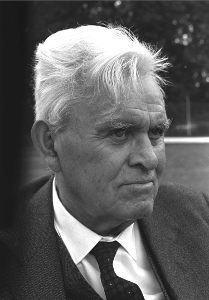
Cathal Goulding, former Chief of Staff of the Irish Republican Army and the Official IRA, dies in Dublin on December 26, 1998.

Goulding is born on January 2, 1923, one of seven children born on East Arran Street, north Dublin to an Irish republican family. As a teenager Goulding joins Fianna Éireann, the youth wing of the Irish Republican Army (IRA). He joins the IRA in 1939. In December of that year, he takes part in a raid on Irish Army ammunition stores in Phoenix Park, Dublin. In November 1941 he is gaoled for a year in Mountjoy Prison for membership in an unlawful organisation and possession of IRA documents. Upon his release in 1942, he is immediately interned at the Curragh Camp, where he remains until 1944.

In 1945, he is involved in the attempts to re-establish the IRA which has been badly affected by the authorities in both the Irish Free State and Northern Ireland. He is among twenty-five to thirty men who meet at O’Neill’s Pub, Pearse Street, to try to re-establish the IRA in Dublin. He organises the first national meeting of IRA activists after the World War II in Dublin in 1946 and is arrested along with John Joe McGirl and ten others and sentenced to twelve months in prison when the gathering is raided by the Garda Síochána.

Upon his release in 1947, Goulding organises IRA training camps in the Wicklow Mountains and takes charge of the IRA’s Dublin Brigade in 1951. In 1953, Goulding, along with Seán Mac Stíofáin and Manus Canning, is involved in an arms raid on the Officers Training Corps armoury at Felsted School, Essex. The three are arrested and sentenced to eight years’ imprisonment, but are released in 1959 after serving only six years at Pentonville, Wakefield, and Stafford prisons. During his time in Wakefield prison, he befriends EOKA members and Klaus Fuchs, a German-born spy who has passed information about the U.S. nuclear programme to the Soviet Union, and becomes interested in the Russian Revolution.

In 1959, Goulding is appointed IRA Quartermaster General and in 1962 he succeeds Ruairí Ó Brádaigh as IRA Chief of Staff. In February 1966, together with Sean Garland, he is arrested for possession of a revolver and ammunition. In total, Goulding spends sixteen years of his life in British and Irish jails.

Goulding is instrumental in moving the IRA to the left in the 1960s. He argues against the policy of abstentionism and develops a Marxist analysis of Irish politics. He believes the British state deliberately divides the Irish working class on sectarian grounds to exploit them and keep them from uniting and overthrowing their bourgeois oppressors. This analysis is rejected by those who later go on to form the Provisional IRA after the 1969 IRA split.

Goulding remains chief of staff of what becomes known as the Official IRA until 1972. Although the Official IRA, like the Provisional IRA, carries out an armed campaign, Goulding argues that such action ultimately divides the Irish working class. After public revulsion regarding the shooting death of William Best, a Catholic from Derry who is also a British soldier, and the bombing of the Aldershot barracks, the Official IRA announces a ceasefire in 1972.

Goulding is prominent in the various stages of Official Sinn Féin‘s development into the Workers’ Party. He is also involved in the anti-amendment campaign in opposition to the introduction of a constitutional ban on abortion along with his partner, Dr. Moira Woods. However, in 1992, he objects to the political reforms proposed by party leader Proinsias De Rossa and remains in the Workers’ Party after the formation of Democratic Left. He regards the Democratic Left as having compromised socialism in the pursuit of political office.

In his later years, Goulding spends much of his time at his cottage in Raheenleigh near Myshall, County Carlow. He dies of cancer in his native Dublin and is survived by three sons and a daughter. He is cremated and his ashes scattered, at his directive, at the site known as “the Nine Stones” on the slopes of Mount Leinster.


Leave a comment

Pope John Paul II’s Visit to Ireland

pope-john-paul-ii

Pope John Paul II becomes the first pontiff to set foot on Irish soil with his pastoral visit to the Republic of Ireland beginning on September 29, 1979. Over 2.5 million people attend events in Dublin, Drogheda, Clonmacnois, Galway, Knock, Limerick, and Maynooth during what is one of Pope John Paul’s first foreign visits. The visit is occasioned by the centenary of the reputed apparition of Blessed Virgin Mary, Saint Joseph, and Saint John the Evangelist in Knock, County Mayo.

An Aer Lingus Boeing 747, named the St. Patrick, brings Pope John Paul II from Rome to Dublin Airport. The Pope kisses the ground as he disembarks. After being greeted by the President of Ireland, Dr. Patrick Hillery, the Pope flies by helicopter to the Phoenix Park where he celebrates Mass for 1,250,000 people, one quarter of the population of the island of Ireland, one third of the population of the Republic of Ireland. Afterwards he travels to Killineer, near Drogheda, where he leads a Liturgy of the Word for 300,000 people, many from Northern Ireland. There the Pope appeals to the men of violence, “on my knees I beg you to turn away from the path of violence and return to the ways of peace.” The Pope has hopes of visiting Armagh, but the security situation in Northern Ireland renders it impossible. Drogheda is selected as an alternative venue as it is situated in the Catholic Archdiocese of Armagh. Returning to Dublin that evening, the Pope is greeted by 750,000 people as he travels in an open top popemobile through the city centre and visits Aras an Uachtarain, the residence of the Irish President.

The Pope begins the second day of his tour with a short visit to the ancient monastery at Clonmacnois in County Offaly. With 20,000 in attendance, he speaks of how the ruins are “still charged with a great mission.” Later that morning he celebrates a Youth Mass for 300,000 at Ballybrit Racecourse in Galway. It is here that the Pope utters perhaps the most memorable line of his visit, “Young people of Ireland, I love you.” That afternoon, he travels by helicopter to Knock Shrine in County Mayo which he describes as “the goal of my journey to Ireland.” The outdoor Mass at the shrine is attended by 450,000. The Pope meets with the sick and elevates the church to the title of Basilica.

The final day of the visit begins with a trip to St. Patrick’s College, Maynooth, the National Seminary, in County Kildare. Some 80,000 people pack the grounds of the college for the brief visit. A dense fog delays the Pope’s arrival from Dublin by helicopter. The final Mass of the Pope’s visit to Ireland is celebrated at Greenpark Racecourse in Limerick before 400,000 people, many more than had been expected. The Mass is offered for the people of Munster. Pope John Paul leaves Ireland from nearby Shannon Airport travelling to Boston where we begins a six-day tour of the United States.