A native of Carlanstown, near Kells in the north of County Meath, Tully is educated in Carlanstown schools and in St Patrick’s Classical School in Navan. He is elected to Dáil Éireann as a Labour Party TD for the Meath constituency at the 1954 Irish general election. He loses his seat at the 1957 Irish general election, but is re-elected at the 1961 Irish general election and serves until 1982. When Labour enters into a coalition government with Fine Gael in 1973, he is appointed Minister for Local Government. While serving in that post he gains prominence for a massive increase in the building of public housing, and notoriety for an attempt to gerrymander Irish constituencies to ensure the re-election of the National Coalition at the 1977 Irish general election. His electoral reorganisation effort via the Electoral (Amendment) Act 1974, which comes to be called a “Tullymander,” backfires spectacularly and helps engineer a landslide for the opposition, Fianna Fáil. He is regarded as a conservative within the Labour Party, though tends to support party decisions, even if he disagrees with them. For many years he is opposed to coalition, though finding the years in opposition fruitless, he changes his mind and becomes increasingly in favour of coalition with Fine Gael.
Also as Minister for Local Government, Tully decides on alterations to the plans for the controversial Dublin CorporationCivic Offices.
Tully is appointed deputy leader of the Labour Party under Michael O’Leary in 1981, and Minister for Defence in the short-lived 1981–82 Fine Gael-Labour Party government. In that capacity he travels to Cairo, in 1981, as the Republic of Ireland‘s representative in Egypt‘s annual October 6 military victory parade. While in the reviewing stand, next to PresidentAnwar Sadat, he suffers a shrapnel injury to his face when Sadat was assassinated by members of Egyptian Islamic Jihad who had infiltrated the Egyptian Army.
In 1982, a few months after the event, Tully retires from politics. He dies ten years later, on May 20, 1992, at the age of 76.
(Pictured: Portrait of James Tully taken from his 1954 election poster)
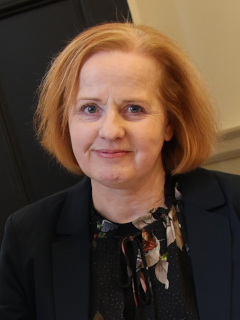
Coppinger is a member of Fingal County Council for the Mulhuddart local electoral area from 2003 to 2014. She is co-opted to the council in 2003, replacing Joe Higgins, and is elected in 2004 and re-elected in 2009. She is an unsuccessful candidate for the Socialist Party at the 2011 Dublin West by-election.
Following victory in the 2014 Dublin West by-election, Coppinger joins her party colleague Joe Higgins in the Dáil. After being elected, she calls for a mass campaign of opposition to water charges being implemented by the Fine Gael–Labour Partycoalition.
In November 2014, Coppinger calls for the gradual nationalisation of U.S. multinationals to prevent job losses. In response, Fianna Fáil’s jobs spokesperson Dara Calleary calls the idea “reckless and ludicrous,” as it would “place a massive burden on taxpayers and the public finances.”
In September 2015, Coppinger joins homeless families from Blanchardstown, in occupying a NAMA-controlled property as part of a campaign to raise awareness of the housing crisis. In October 2015, she joins families in their occupation of a show house in her constituency, to protest the lack of availability of affordable social housing. She also supports the tenants of Tyrrelstown, who are made homeless when a Goldman Sachsvulture fund sells their houses.
Coppinger is re-elected to the Dáil at the 2016 Irish general election, this time under the Anti-Austerity Alliance–People Before Profit banner. On March 10. 2016, at the first sitting of the 32nd Dáil, she nominates Richard Boyd Barrett for the office of Taoiseach, quoting James Connolly from a hundred years previously when she says, “The day has passed for patching up the capitalist system. It must go,” and declaring, “We will not vote for the identical twin candidates” of Fine Gael and Fianna Fáil after they “imposed austerity.” On April 6, 2016, following the failure of the Dáil to elect a Taoiseach at that first sitting, she is nominated for the role of Taoiseach, becoming the first female nominee in the history of the state.
In 2018 Coppinger praises the MeToo movement for exposing patterns of abuse and systemic inequality. However, she also notes the limitations of achieving justice through traditional channels and calls for a stronger focus on combating intimate partner violence and societal tolerance of such abuse.
In April 2018, in the lead-up to the repeal of the Eighth Amendment, Coppinger, along with her colleague Paul Murphy, holds up a Repeal sign during leader’s questions and is reprimanded by the Ceann Comhairle. She is an advocate for abortion rights in Ireland, and is a founding member of ROSA, a movement for reproductive justice in Ireland. Earlier, in 2016, she tables the private members’ motion to repeal the Eighth Amendment.
In November 2018, Coppinger protests in the Dáil against the conduct of a rape trial in Ireland. During the trial, the defence team, as part of their argument that the sex had been consensual, states that the 17-year-old victim had worn a thong with a lace front. The defendant is subsequently found not guilty. During a sitting of the Dáil, Coppinger holds up a similar pair of underwear and admonishes the conduct of the trial, suggesting victim blaming tactics had been used and suggests this is a routine occurrence in Irish courts. She calls on Taoiseach Leo Varadkar to support her party’s bill that would increase sex education in Irish schools and provide additional training to the Irish judiciary and jurors on how to handle cases of rape. Varadkar responds that victims should not be blamed for what happens to them, irrespective of how they are dressed, where they are or if they have consumed alcohol.
In 2019 Coppinger sponsors a private member’s bill – the Domestic Violence (No-contact order) (Amendment) Bill 2019. The bill lapses with the dissolution of the Dáil and Seanad.
In June 2024, Coppinger is elected to Fingal County Council for the Castleknock local electoral area on the 7th Count. At the 2024 Irish general election, she is re-elected to the Dáil.
Coppinger is an advocate of secularism and believes in abolishing both the Angelus and the Dáil prayer, viewing them as relics of an outdated intertwining of religion and governance. She supports the separation of Church and State, criticising the Catholic Church‘s historical influence in education and health, as well as its financial privileges, including exemptions from accountability under regulations like SIPO. She has called for the requisitioning of Church lands and property, citing the Church’s failure to meet commitments to abuse victims and the necessity of addressing historical injustices.
On drug policy, Coppinger supports decriminalisation and endorses the Portuguese model, which treats addiction as a health issue rather than a criminal matter. She emphasises the hypocrisy of criminalising drug use while overlooking the societal harm caused by alcohol and advocates for expanding access to medicinal cannabis, criticising the political inertia in addressing this need.
In 2013, during referendum to abolish the Irish senate, Coppinger campaigns for a yes vote, calling the institution elitist and undemocratic. However, in 2020, following the loss of her Dáil seat, she runs unsuccessfully for a seat in the Senate. Challenged by the Irish Examiner on this, she states that so long as the Senate continues to exist, it should be used to further progressive causes.
Coppinger lives in Mulhuddart and is a secondary school teacher. Her eldest brother, Eugene Coppinger, serves on Fingal County Council from 2011 to 2019.
O’Riordan joins the Communist Party of Ireland in 1935 while still in the IRA and works on the communist newspaper The Irish Workers’ Voice. In 1937, following the urgings of Peadar O’Donnell, several hundred Irishmen, mostly IRA or ex-IRA men, go to fight for the Spanish Republic in the Spanish Civil War with the XVth International Brigade. They are motivated in part by enmity towards the 800 or so Blueshirts, led by Eoin O’Duffy who go to Spain to fight on the “nationalist” side in the Irish Brigade. He accompanies a party led by Frank Ryan. In the Republic’s final offensive of July 25, 1938, he carries the flag of Catalonia across the River Ebro. On August 1, he is severely injured by shrapnel on the Ebro front. He is repatriated to Ireland the following month, after the International Brigades are disbanded.
In 1938 O’Riordan is offered an Irish Army commission by the Irish Free State but chooses instead to train IRA units in Cork. As a result of his IRA activities during World War II, or the Emergency as it is known in neutral Ireland, he is interned in the Curragh internment camp from 1939 until 1943 where he is Officer Commanding of the Cork Hut and partakes in Máirtín Ó Cadhain’s Gaelic League classes as well as publishing Splannc (Irish for “Spark,” named after Vladimir Lenin‘s newspaper).
In 1944 O’Riordan is founding secretary of the Liam Mellows Branch of the Labour Party and in 1945 is a founding secretary of the Cork Socialist Party, whose other notable members include Derry Kelleher, Kevin Neville and Máire Keohane-Sheehan.
In 1947, O’Riordan is a founding secretary of the Irish Workers’ League and general secretary thereafter, and of its successor organisation the Irish Workers’ Party from 1962–70.
In all O’Riordan runs for election five times, campaigning throughout for the establishment of a socialist republic in Ireland but given Ireland’s Catholic conservatism and fear of communism, he does so without success. He does, however, receive playwright Sean O’Casey‘s endorsement in 1951.
O’Riordan’s participation in the Spanish Civil War is always an important part of his political identity. In 1966 he attends the International Brigades’ Reunion in Berlin and is instrumental in having Frank Ryan’s remains repatriated from Germany to Ireland in 1979.
O’Riordan is a member of the Irish Chile Solidarity Committee and attends the 1st Party Congress of the Communist Party of Cuba in 1984. He also campaigns on behalf of the Birmingham Six and attends their Appeal trial in 1990. He serves as General Secretary of the Communist Party of Ireland (1970–83) and as National Chairman of the party (1983–88). He publishes many articles under the auspices of the CPI.
O’Riordan’s last major public outing comes in 2005 at the re-dedication of the memorial outside Dublin’s Liberty Hall to the Irish veterans of the Spanish Civil War. He and other veterans are received by President of IrelandMary McAleese. He is also presented with Cuba’s Medal of Friendship by the Cuban Consul Teresita Trujillo to Ireland on behalf of Cuban President Fidel Castro.
In 1969, according to Soviet dissident Vasili Mitrokhin, O’Riordan is approached by IRA leaders Cathal Goulding and Seamus Costello with a view to obtaining guns from the Soviet KGB to defend Irish republican areas of Belfast during the communal violence that marks the outbreak of the Troubles. Mitrokhin alleges that O’Riordan then contacts the Kremlin, but the consignment of arms does not reach Ireland until 1972. The operation is known as Operation Splash. The IRA splits in the meantime between the Provisional IRA and the Official IRA and it is the latter faction who receives the Soviet arms. Mitrokhin’s allegations are repeated in Boris Yeltsin‘s autobiography.
O’Riordan’s book, Connolly Column – The Story of the Irishmen who fought for the Spanish Republic 1936–1939, is published in 1979 and deals with the Irish volunteers of the International Brigade who fought in support of the Spanish Republic against Francisco Franco in the Spanish Civil War (1936–1939). An updated version of the book is reprinted in 2005 and is launched by the Lord Mayor of Dublin, Cllr. Michael Conaghan at a book launch at SIPTU headquarters, Liberty Hall. The book is the inspiration for Irish singer-songwriter Christy Moore‘s famous song “Viva la Quinta Brigada.”
In 1991, O’Riordan’s wife dies at the age of 81 at their home. He continues to live in their family home before moving to Glasnevin in 2000 to be close to his son Manus who lives nearby. He lives there until falling ill in November 2005 and is taken to the Mater Hospital. His health rapidly deteriorates, and he quickly develops Alzheimer’s disease. Soon afterwards he is moved to St. Mary’s Hospital in the Phoenix Park where he spends the final few months of his life, before his death at the age of 88 on May 18, 2006.
O’Riordan’s funeral at Glasnevin Crematorium is attended by over a thousand mourners. Following a wake the previous night at Finglas Road, hundreds turn up outside the house of his son Manus and traffic grounds to a halt as family, friends and comrades – many of whom are waving the red flag of the Communist Party of Ireland – escort O’Riordan to Glasnevin Cemetery. A secular ceremony takes place led by Manus O’Riordan, Head of Research at SIPTU, with contributions from O’Riordan’s family, Communist Party general secretary Eugene McCartan and IBMT representative Pauline Frasier.
Roddy Doyle, novelist, dramatist and screenwriter known for his unvarnished depiction of the working class in Ireland, is born in Dublin on May 8, 1958. His distinctively Irish settings, style, mood, and phrasing make him a favourite fiction writer in his own country as well as overseas.
Doyle grows up in a middle-class family in Kilbarrack. His mother, Ita Bolger Doyle, is a first cousin of the short story writer Maeve Brennan. After majoring in English and geography at University College Dublin, he teaches those subjects for fourteen years at Greendale Community School, a Dublin grade school. During the summer break of his third year of teaching, he begins writing seriously. In the early 1980s he writes a heavily political satire, Your Granny’s a Hunger Striker, but it is never published.
Doyle publishes the first editions of his comedy The Commitments (1987; film 1991) through his own company, King Farouk, until a London-based publisher takes over. The work is the first installment of his internationally acclaimed The Barrytown Trilogy novels, which also include The Snapper (1990; film 1993), and The Van (1991; film 1996). The series centres on the ups and downs of the never-say-die Rabbitte family, who temper the bleakness of life in an Irish slum with familial love and understanding.
Doyle’s fourth novel, Paddy Clarke Ha Ha Ha (1993), wins the 1993 Booker Prize. Set in the 1960s in a fictional working-class area of northern Dublin, the book examines the cruelty inflicted upon children by other children. The protagonist, 10-year-old Paddy Clarke, fears his classmates’ ostracism, especially after the breakup of his parents’ marriage. In 1994 he writes the BBC miniseries Family, which generates heated controversy throughout conservative Ireland. The program sheds harsh light on a family’s struggle with domestic violence and alcoholism and portrays the bleaker side of life in a housing project, the same venue he had used in the more comedic Barrytown novels. The Woman Who Walked into Doors (1996) and its sequel, Paula Spencer (2006), concern the ramifications of domestic abuse and alcoholism.
A Star Called Henry (1999) centres on an Irish Republican Army (IRA) soldier named Henry Smart and his adventures during the Easter Rising. Smart’s further adventures are detailed in Oh, Play That Thing (2004), which follows him as he journeys through the United States, and The Dead Republic (2010), which chronicles his return to Ireland. In Smile (2017) a lonely middle-aged man looks back on his life, especially his troubled childhood. His next novel, Love (2020), follows two old friends as they spend a night drinking and looking back at their lives. The Deportees and Other Stories (2007), Bullfighting (2011), and Life Without Children (2021) are short-story collections. He also writes a number of books for children, including Wilderness (2007) and A Greyhound of a Girl (2011).
In 1987 Doyle marries Belinda Moller, granddaughter of former Irish PresidentErskine Childers. They have three children – Rory, Jack and Kate.
In the television series Father Ted, the character Father Dougal Maguire‘s unusual sudden use of (mild) profanities, such as saying “I wouldn’t know, Ted, you big bollocks!,” is blamed on his having “been reading those Roddy Doyle books again.”
Since Northern Ireland’s creation in 1922, the Catholic minority suffers from varying degrees of discrimination from the Protestant and Unionist majority. Many nationalist historians regard the ethos of Northern Ireland as unambiguously sectarian, however, academic and author Senia Paseta posits that discrimination was never as calculated as republicans maintained nor as fictional as unionists claimed. In fact, laws against religious discrimination are enshrined in the Government of Ireland Act 1920, Northern Ireland’s constitution. No government of Northern Ireland, even if they want to, can create laws which overtly discriminated against any religious body of peoples.
The genesis of NICRA lay in a meeting in Maghera in August 1966 between the Wolfe Tone Societies which is attended by Cathal Goulding, then chief of staff of the Irish Republican Army (IRA). During its formation, NICRA’s membership extends to trade unionists, communists, liberals, socialists, with republicans eventually constituting five of the thirteen members of its executive council. The organisation initially also has some unionists, with Young Unionist Robin Cole taking a position on its executive council. Official Sinn Féin and Official Irish Republican Army influence over NICRA grows in later years, but only as the latter’s importance declines, when violence escalated between late 1969 until 1972, when NICRA ceased its work.
Events escalate in Northern Ireland until August 1969, when the annual Apprentice Boys of Derry march is attacked as it marches through the city’s walls and past a perimeter with the nationalist Bogside. Initially some loyalist supporters throw pennies down from the walls onto Catholics in the Bogside. Catholics then throw nails and stones at loyalists leading to an intense confrontation. The Royal Ulster Constabulary (RUC) intervenes, and a three-day riot known as the Battle of the Bogside ensues. Rioting quickly spreads throughout nationalist areas in Northern Ireland, where at least seven are killed and hundreds wounded. Thousands of Catholics are driven from their homes by loyalists. These events are often seen as the start of the Troubles.
In a subsequent official inquiry, Lord Leslie Scarman concludes, “We are satisfied that the spread of the disturbances [in Derry in August 1969] owed much to a deliberate decision of some minority groups to relieve police pressure on the rioters in Londonderry. Amongst these groups must be included NICRA, whose executive decided to organise demonstrators in the province so as to prevent reinforcement of the police in Londonderry.” In December 1969 and January 1970, both Sinn Féin and the IRA split into “Official” and “Provisional” wings, with the “Official” wings retaining influence in NICRA.
The British government introduces internment on August 9, 1971, at the request of Northern Ireland Prime MinisterBrian Faulkner. The British Army, in co-operation with the RUC, intern 342 people. One hundred sixteen of those interned are innocent of involvement with the IRA and are quickly released.
The introduction of internment is not a closely guarded secret, with newspaper editorials appearing and discussion on television. The IRA goes underground or flees across the border. As a result, fewer than 100 arrests are from the IRA. By this stage, support for NICRA begins to wane, however NICRA continues to organise anti-internment marches. In Derry on January 30, 1972, NICRA takes part in a mass anti-internment march which had also been banned. Fourteen unarmed demonstrators are shot and killed by British troops during the march which becomes known as Bloody Sunday.




 seamus dubhghaill