O’Rourke makes his debut on the inter-county scene when he is picked for the Meath minor team. He later joins the under-21 side but enjoys little success in these grades. He makes his senior debut during the 1975-1976 league. Over the course of the next twenty years he is a regular member of the starting fifteen and wins back-to-back All-Ireland medals in 1987 and 1988. He also wins five Leinster Senior Football Championship medals, three National Football League titles and is named Texaco Footballer of the Year in 1991. He plays his last game for Meath in July 1995.
In retirement from playing O’Rourke combines his teaching career with a new position as a sports broadcaster. His media career begins with RTÉ where he has worked as a studio analyst with the flagship programme The Sunday Game for over twenty-five years. He also writes a weekly column for the Sunday Independent.
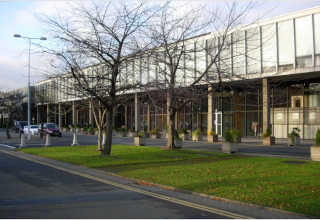
The RTÉ Television Centre is a television studio complex which is owned by Raidió Teilifís Éireann (RTÉ) and has been home to Ireland’s national public service broadcaster since 1961. The building houses the main production studios for RTÉ Television, the control rooms for all RTÉ’s TV channels, and RTÉ’s main newsroom.
At 1:30 AM on the morning of August 5, a bomb explodes at the RTÉ Television Centre causing damage primarily to the western end of the studios. The explosion is heard over a wide area of Dublin. Only a skeleton staff are on duty and nobody is injured. The bombing takes place during the protest campaign by the Northern Ireland Civil Rights Association but before the 1969 Northern Ireland riots.
The bomb, which is believed to be a time bomb placed at the rear wall of the studio building, causes no structural damage to the building but destroys the wardrobe department and shatters windows in a large section of the building, including the large structural plate glass panels which are a feature of the building.
Army explosive experts are called in to investigate the cause of the explosion and determine who planted it.
After she graduates, her father employs her at his company but, following his death three years later, she changes professions and starts a public relations firm in 1983, which she runs for seven years. In 1983–84, she serves as secretary to the Fianna Fáil group at the New Ireland Forum. She serves as Charles Haughey‘s personal assistant, and becomes a family friend, taking holidays with his children. In 1987 she serves as election agent and party treasurer in Dublin North for Seán Haughey.
In 1990, she changes careers again, switching to journalism as a reporter with The Sunday Business Post and Sunday Tribune, working under editor Damien Kiberd. Craving first-hand information, she pursues a story directly to the source with little regard for her personal safety, to engage those she deems central to a story. This allows her to build close relationships with both the legitimate authorities, such as the Garda Síochána, and the criminals, with both sides respecting her diligence by providing highly detailed information. She also reports on Irish Republican Army activities in the Republic of Ireland.
From 1994 onwards, she begins to write about criminals for the Sunday Independent. Using her accountancy knowledge to trace the proceeds of illegal activity, she uses street names or pseudonyms for organized crime figures to avoid Irish libel laws.
When she begins to cover drug dealers, and gains information from convicted drugs criminal John Traynor, she receives numerous death threats. The first violence against her occurs in October 1994, when two shots are fired into her home after her story on murdered crime kingpin Martin Cahill is published. Guerin dismisses the “warning.” The day after writing an article on Gerry “The Monk” Hutch, on January 30, 1995, she answers her doorbell to a man pointing a revolver at her head. The gunman misses and shoots her in the leg. Regardless, she vows to continue her investigations.
On September 13, 1995, convicted criminal John Gilligan, Traynor’s boss, attacks her when she confronts him about his lavish lifestyle with no source of income. He later calls her at home and threatens to kidnap and rape her son and kill her if she writes anything about him.
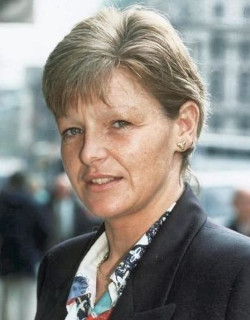
On the evening of June 25, 1996, Gilligan drug gang members Charles Bowden, Brian Meehan, Kieran ‘Muscles’ Concannon, Peter Mitchell and Paul Ward meet at their distribution premises on the Greenmount Industrial Estate. The following day, while driving her red Opel Calibra, Guerin stops at a red traffic light on the Naas Dual Carriageway near Newlands Cross, on the outskirts of Dublin, unaware she is being followed. She is shot six times, fatally, by one of two men sitting on a motorcycle.
About an hour after Guerin is murdered, a meeting takes place in Moore Street, Dublin, between Bowden, Meehan, and Mitchell. Bowden later denies under oath in court that the purpose of the meeting is the disposal of the weapon but rather that it was an excuse to appear in a public setting to place them away from the incident.
At the time of her murder, Traynor is seeking a High Court order against Guerin to prevent her from publishing a book about his involvement in organised crime. Guerin is killed two days before she is due to speak at a Freedom Forum conference in London.
Guerin’s funeral is attended by Ireland’s TaoiseachJohn Bruton, and the head of the armed forces. It is covered live by Raidió Teilifís Éireann. On July 4, labour unions across Ireland call for a moment of silence in her memory, which is duly observed by people around the country. Guerin is buried in Dardistown Cemetery, County Dublin.
James Plunkett Kelly, Irish writer who writes under the pseudonym of James Plunkett, is born in Dublin on May 21, 1920.
Plunkett is the son of a World War I veteran who was a member of James Larkin‘s Irish Transport and General Workers Union, which had a life-long impact on the young writer. He is educated at Synge Street CBS. He works as a clerk in the Dublin Gas Company and later joins the trade union movement, serving under Larkin between 1946 and 1947.
Plunkett grows up among the Dublin working class and they, along with the petite bourgeoisie and lower intelligentsia, make up the bulk of the dramatis personae of his oeuvre. His best-known works are the novel Strumpet City, set in Dublin in the years leading up to the lockout of 1913 and during the course of the strike, and the short stories in the collection The Trusting and the Maimed. His other works include a radio play on Larkin, who figures prominently in his work.
During the 1960s, Plunkett works as a producer at Telefís Éireann. He wins two Jacob’s Awards, in 1965 and 1969, for his TV productions. In 1971 he writes and presents “Inis Fail – Isle of Destiny,” his very personal appreciation of Ireland. It is the final episode of the BBC series Bird’s Eye View, shot entirely from a helicopter, and the first co-production between the BBC and RTÉ. He is a member of Aosdána.
Plunkett dies in a Dublin nursing home at the age of 83 on May 28, 2003. A second-year class, “2 Plunkett” at Synge Street CBS, is named in his honour.
De Paor is born Máire MacDermott to Eamonn MacDermott and Delia MacVeigh. She is educated in the Convent of Mercy in Buncrana before going to University College Dublin, where she completes a master’s degree and a doctorate on early Christian archaeology and metalwork.
De Paor works in the Department of Archeology at UCD from 1946 to 1958. She marries Liam de Paor in 1946, and they have a daughter and four boys. They collaborate on a number of publications. She publishes her papers in the Proceedings of the Royal Irish Academy, Archaeologia, Seanchas Armagh and Comhar. Her husband also works at the university and, as a result of policies about married women, she is forced to leave. Initially she lectures in the United States, Canada, Scandinavia, France and the United Kingdom. She works as lecturer in archaeology at Trinity College, Dublin. The de Paors spend a year in Nepal on a UNESCO project in 1963.
De Paor works as a freelance researcher for Raidió Teilifís Éireann until she is given a full-time position in the 1970s.
De Paor is elected a member of the Royal Irish Academy in 1960 and is a member of the Arts Council from 1973. She becomes a member of Conradh na Gaeilge from 1962. From 1968 she is working with Cumann Merriman, the Irish cultural organisation named after Brian Merriman, working with the group as a director of the schools and spends four years as chairperson. In 1992 she is appointed to the board of Amharclann de hÍde.
Máire de Paor dies on December 6, 1994, at the age of 69.
University College Dublin has created the Dr. Máire de Paor Award for best PhD thesis. Her biographer identifies her as a committed republican, socialist and feminist.
RTÉ Lyric FM develops from FM3 Classical Music, which begins broadcasting on November 6, 1984. FM3 broadcasts classical music on the RTÉ Raidió na Gaeltachta (RnaG) network at breakfast time, lunchtime and in the evenings. The station is rarely marketed, except via promotions on RTÉ Radio 1, and has low listenership ratings. It is probably best known for occasionally simulcasting the stereo soundtrack of movies being shown on the RTÉ television channels prior to RTÉ’s deployment of NICAM digital stereo.
As Raidió na Gaeltachta expands broadcast hours, FM3’s service hours changed to 7:30 PM until 1:00 AM and 6:30 AM until 8:00 AM. Eventually it stays on air until breakfast time when RnaG comes back on.
On May 1, 1999, RTÉ puts in place an additional national FM transmitter network, and it is decided to separate FM3 from Radio na Gaeltachta, and expand its remit to include other types of minority music. The resulting station is Lyric FM (currently styled RTÉ lyric fm). It also moves from Dublin to Limerick as part of a policy of regionalisation. At the time of the station’s launch, RTÉ lyric fm’s digital studios in Cornmarket Row, Limerick, are the most advanced in the country.
RTÉ Lyric FM wins PPI National Station of the Year for the second time in 2004.
RTÉ Lyric FM attracts an audience share of 1.6%. The current head of the station is Aodán Ó Dubhghaill.
Recent schedule changes have caused some dissent amongst listeners and the station has been accused of dumbing down. A petition is also launched to save the Sunday early morning programme “Gloria” presented by Tim Thurston.
MacManus begins writing while still teaching, first publishing a trilogy set in Penal times and concerning the life of the Gaelic poet Donncha Rua Mac Conmara comprising the novels Stand and Give Challenge (1934), Candle for the Proud (1936) and Men Withering (1939). A second trilogy follows which turns its attention to contemporary Ireland: This House Was Mine (1937), Flow On, Lovely River (1941), and Watergate (1942). The location is the fictional “Dombridge,” based on Kilkenny, and deals with established themes of Irish rural life including obsessions with land, sexual frustration, and the trials of emigration and return. Other major works include the novel The Greatest of These (1943), concerning religious conflict in nineteenth-century Kilkenny, and the biographies Boccaccio (1947) and Saint Columban (1963). In his last two novels, he descends into the depths of theological debate: The Fire in the Dust (1950) is followed by American Son (1959), a remarkable dialogue between conflicting modes of belief which reveals the strong influence of Roman Catholicism on the author.
Francis MacManus dies of a heart attack at the age of 56 in Dublin on November 27, 1965.
The RTÉ Francis MacManus Short Story Award is established in his memory in 1985. The competition is run by RTÉ, Ireland’s national broadcaster, and is open to entries written in Irish or English from authors born or resident in Ireland. The total prize fund is €6000, out of which the winning author receives €3,000. Sums of €2,000 and €1,000 are awarded to the second and third prize winners.
In 1948 he is joint composer of music for a song in a play by Irish playwrightTeresa Deevy called Light Falling. This is performed by the Abbey Experimental Theatre Company in the Peacock Theatre, Dublin.
The Gerard Victory Commission is a prize named in his honour that is awarded to the most promising individual composer.
Gerard Victory dies in Dublin on March 14, 1995. His papers are held in Trinity College and a number of his scores are held at the Contemporary Music Centre.
Together with Kevin Gildea and Barry Murphy, O’Hanlon founds the International Comedy Cellar, upstairs in the International Bar on Dublin’s South Wicklow Street. Dublin has no comedy scene at the time. As a stand up, he wins the Hackney Empire New Act of the Year competition in 1994. For a time, he is the presenter of The Stand Up Show.
O’Hanlon moves into straight acting alongside Emma Fielding and Beth Goddard in the ITV comedy-drama Big Bad World, which airs for two series in summer 1999 and winter 2001. He also plays a minor role in The Butcher Boy and appears in an episode of the original Whose Line is it Anyway?.
In 2000, O’Hanlon stars in the comedy series My Hero, in which he plays a very naive superhero from the planet Ultron. His character juggles world-saving heroics with life in suburbia. He stays in the role until the first episode of series 6 in July 2006 where he is replaced by James Dreyfus during the same episode.
O’Hanlon also provides the voice of the lead character in the three Christmas television cartoon specials of Robbie the Reindeer. He appears in the 2005 BBC One sitcom Blessed, written by Ben Elton. Towards the end of 2005, he plays an eccentric Scottish character, Coconut Tam, in the family-based film, The Adventures of Greyfriars Bobby. Although more commonly on television, he also appears on radio. In 2015 he appears as incompetent angel Smallbone in the sitcom The Best Laid Plans, also on BBC Radio 4.
In 2006, O’Hanlon writes and presents an RTÉ television series called Leagues Apart, which sees him investigate the biggest and most passionate football rivalries in a number of European countries. He follows this with another RTÉ show, So You Want To Be Taoiseach? in 2007. It is a political series where he gives tongue-in-cheek advice on how to go about becoming Taoiseach of Ireland.
O’Hanlon appears in the Doctor Who episode “Gridlock“, broadcast on April 14, 2007, in which he plays a cat-like creature named Thomas Kincade Brannigan. He appears in Series 3 of the TV show Skins, playing Naomi Campbell’s Politics teacher named Kieran. He then goes on to form a relationship with Naomi’s mother, played by Olivia Colman. He plays the lead role in Irish comedy television programme Val Falvey, TD on RTÉ One.
O’Hanlon has written a novel, The Talk of the Town, which is published in 1998. The novel is about a teenage boy, Patrick Scully, and his friends.
In February 2015 O’Hanlon officially launches the 2015 Sky Cat Laughs Comedy Festival which takes place in Kilkenny from May 28–June 1. In 2015 he plays the role of Peter the Milkman in the Sky One sitcom After Hours.
On February 2, 2017, it is announced O’Hanlon will play the lead role in the BBC crime drama Death in Paradise taking the role of DI Jack Mooney following Kris Marshall‘s departure the same day.
Gabriel Mary “Gay” Byrne, veteran Irish presenter of radio and television for several decades and affectionately known as Uncle Gay, Gaybo or Uncle Gaybo, is born in Rialto, Dublin on August 5, 1934. His most known role is as the first host of The Late Late Show over a 37-year period spanning 1962 until 1999.
Byrne attends Rialto National School and a number of other schools for short periods. Subsequently, he is educated by the Irish Christian Brothers at Synge Street CBS.
When he is young, Byrne is inspired by the broadcaster Eamonn Andrews, who has a successful career on British television. In 1958 he moves over to broadcasting when he becomes a presenter on Radio Éireann. He also works with Granada Television and the BBC in England. At Granada, Byrne becomes the first person to introduce the Beatles on television when they make their small screen debut on local news programme People and Places. In 1961, Telefís Éireann, later Radio Telefís Éireann and now Raidió Teilifís Éireann, is established. Byrne works exclusively for the new Irish service after 1969. He introduced many popular programmes, with his most popular and successful programme being The Late Late Show.
On July 5, 1962, the first episode of The Late Late Show is aired on Irish television. Originally the show is scheduled as an eight-week summer filler. The programme, which is still broadcast, has become the world’s second longest running chat show. The show has much to do in shaping the new Ireland that emerges from the 1960s. Byrne presents his last edition of The Late Late Show on May 21, 1999, where he is presented with a Harley-Davidson motorcycle by Bono and Larry Mullen, Jr.Pat Kenny succeeds him as presenter in September 1999.
From 1973 until 1998, Byrne also presents The Gay Byrne Hour, later The Gay Byrne Show when it expands to two hours, on RTÉ Radio 1 each weekday morning.
Byrne does not completely retire in 1999 and continues to feature occasionally on radio and television after leaving The Late Late Show and The Gay Byrne Show, presenting several other programmes, including Who Wants to Be a Millionaire?, The Meaning of Life and For One Night Only on RTÉ One and Sunday Serenade/Sunday with Gay Byrne on RTÉ lyric fm. He launches Joe Duffy‘s autobiography Just Joe in Harry’s Bar in October 2011.
In 1988, Byrne is presented an honorary doctorate in literature from Trinity College, Dublin. In 2006 he is elected Chairman of Ireland’s Road Safety Authority, a public body given the task of improving road safety in the Republic of Ireland. Since retiring he has become the “Elder Lemon of Irish broadcasting.”
On a November 21, 2016 live radio broadcast Byrne reveals that he is to begin treatment for prostate cancer and that the cancer may have also spread to his lower back. He tells listeners he will be taking a break of just one week before returning to work, however, he continues to recover from treatment and he has not yet been back on air.




 The prolific Irish

 seamus dubhghaill