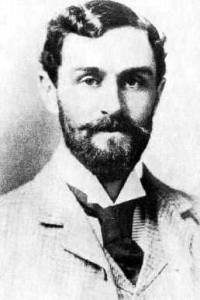
Casement is an Irish Protestant who serves as a British diplomat during the early part of the 20th century. He wins international acclaim after exposing the illegal practice of slavery in the Congo and parts of South America. Despite his Ulster Protestant roots, he becomes an ardent supporter of the Irish independence movement and, after the outbreak of World War I, travels to the United States and then to Germany to secure aid for an Irish uprising against the British.
Germany, which is at war with Great Britain, promises limited aid, and Casement is transported back to Ireland in a German submarine. On April 21, 1916, just a few days before the outbreak of the Easter Rising in Dublin, he lands in County Kerry and is picked up by British authorities almost immediately. By the end of the month, the Easter Rising has been suppressed and a majority of its leaders executed.
Casement is tried separately because of his illustrious past but nevertheless is found guilty of treason on June 29. On August 3, he is hanged by John Ellis and his assistants at Pentonville Prison in London. Casement is the last to be executed as a result of the Easter Rebellion.
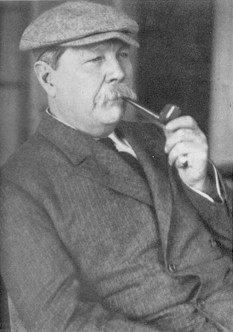
Sir Arthur Ignatius Conan Doyle, British writer and physician, most noted for creating the fictional detective Sherlock Holmes and writing stories about him which are generally considered milestones in the field of crime fiction, is born at 11 Picardy Place, Edinburgh, Scotland, on May 22, 1859.
Doyle’s father, Charles Altamont Doyle, is an Englishman of Irish Catholic descent and his mother, Mary (née Foley), is Irish Catholic. Charles dies in 1893, in the Crichton Royal Hospital, Dumfries, after many years of psychiatric illness. Supported by wealthy uncles, Doyle is sent to the Jesuit preparatory school Hodder Place, Stonyhurst, at the age of nine. He then goes on to Stonyhurst College until 1875. From 1875 to 1876, he is educated at the Jesuit school Stella Matutina in Feldkirch, Austria. Doyle later rejects the Catholic faith and becomes an agnostic. He also later becomes a spiritualist mystic.
From 1876 to 1881 Doyle studies medicine at the University of Edinburgh Medical School. While studying, he begins writing short stories. His first published piece, The Mystery of Sasassa Valley, is printed in Chambers’s Edinburgh Journal on September 6, 1879. After stints as a ship’s doctor and a failed medical practice with former classmate George Turnavine Budd, Doyle arrives in Portsmouth in June 1882 and sets up a medical practice at 1 Bush Villas in Elm Grove, Southsea. The practice is slow to develop and while waiting for patients, Doyle again begins writing fiction. In 1890, Doyle studies ophthalmology in Vienna and moves to London.
A sequel to A Study in Scarlet is commissioned and The Sign of the Four appears in Lippincott’s Magazine in February 1890, the last under agreement with the Ward Lock company. Short stories featuring Sherlock Holmes are published in TheStrand Magazine.
In December 1893, wanting to dedicate more time to historical novels, Doyle has Holmes and Professor Moriarty plunge to their deaths together down the Reichenbach Falls in the The Final Problem. Public outcry, however, leads him to feature Holmes in 1901 in the novel The Hound of the Baskervilles. Holmes is ultimately featured in a total of 56 short stories, the last published in 1927, and four novels by Doyle.
Between 1888 and 1906, Doyle writes seven historical novels, which many critics regard as his best work. He also authors nine other novels and, later in his career between 1912 and 1929, five stories, two of novella length, featuring the irascible scientist Professor Challenger.
Doyle is a supporter of the campaign for the reform of the Congo Free State, led by the journalist E. D. Morel and diplomat Roger Casement. He becomes acquainted with Morel and Casement and, together with Bertram Fletcher Robinson, they inspire several characters in the 1912 novel The Lost World. When Casement is found guilty of treason against the Crown during the 1916 Easter Rising, Doyle tries unsuccessfully to save him from facing the death penalty, arguing that Casement has been driven mad and cannot be held responsible for his actions.
Found clutching his chest in the hall of Windlesham Manor, his house in Crowborough, East Sussex, on July 7, 1930, Doyle dies of a heart attack at the age of 71. At the time of his death there is some controversy concerning his burial place, as he is avowedly not a Christian, but rather considers himself a Spiritualist. He is first buried on July 11, 1930, in Windlesham rose garden. He is later reinterred together with his wife in Minstead churchyard in the New Forest, Hampshire.
Irish nationalist Thomas Kent is executed at Cork Detention Barracks on May 9, 1916. Kent’s story is one of the stranger episodes that happens after the rebellion in Dublin has been quelled. Unlike the Dublin rebels, Kent does not go out to fight. Rather the British come to him looking for trouble.
The Kent family is prepared to take part in the Easter Rising but when the mobilisation order is countermanded by Eoin MacNeill, commander of the Irish Volunteers, on April 22, they stay at home. The rising nevertheless goes ahead in Dublin on Easter Monday. The Royal Irish Constabulary (RIC) is dispatched to arrest well-known sympathizers throughout the country including, but not limited to, known members of the Irish Republican Brotherhood, Sinn Féin, and the Irish Volunteers.
When the Kent residence is raided at 3:45 AM on May 2, the RIC is met with resistance from Thomas and his brothers Richard, David, and William. A gunfight lasts for four hours, during which RIC officer Head Constable William Rowe is killed and David Kent is seriously wounded. Eventually the Kents are forced to surrender, although Richard makes a last-minute dash for freedom and is fatally wounded.
Thomas and William are tried by court martial on May 4 on a charge of “armed rebellion.” William, who is not political, is found innocent, but Thomas is found guilty in the death of Constable Rowe and is sentenced to death. Before being led out for his execution, Kent says, “I have done my duty as a soldier of Ireland and in a few moments, I hope to see the face of God.” He is executed by firing squad in Cork in the early morning hours of May 9. David Kent is brought to Dublin where he is charged with the same offence, found guilty, and sentenced to death, but the sentence is commuted, and he is sentenced to five years penal servitude.
Apart from the singular case of Roger Casement, Thomas Kent is the only person outside of Dublin to be executed for his role in the events surrounding Easter Week. He is buried on the grounds of Cork Prison, formerly the Military Detention Barracks at the rear of Collins Barracks, Cork. The former army married quarters at the rear of Collins Barracks are named in his honour.
TaoiseachEnda Kenny offers a state funeral to the Kent family early in 2015 which they accept. Kent’s remains are exhumed from Cork prison in June 2015 after being buried for 99 years. The state funeral is held on September 18, 2015, at St. Nicholas’ Church in Castlelyons. Kent lay in state at Collins Barracks in Cork the day before. The requiem mass is attended by President Michael D. Higgins, with Enda Kenny delivering the graveside oration.
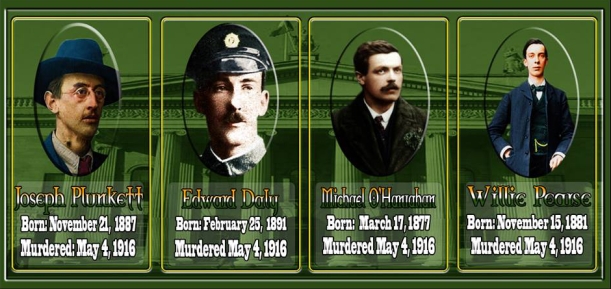
Edward Daly is born in Limerick in 1891 to a family that has a history of republican activity. His uncle, John Daly, had taken part in the rebellion of 1867. Edward Daly leads the First Battalion during the 1916 Easter Rising, which raids the Bridewell and Linenhall Barracks, eventually seizing control of the Four Courts. A close friend of Tom Clarke, their ties are made even stronger by the marriage of Clarke to Daly’s sister.
Michael O’Hanrahan is born in Wexford in 1877. As a young man, O’Hanrahan shows great promise as a writer, becoming heavily involved in the promotion of the Irish language. He founds the first Carlow branch of the Gaelic League, and publishes two novels, A Swordsman of the Brigade and When the Norman Came. Like many of the other executed leaders, he joins the Irish Volunteers from their inception and is second in command to Thomas MacDonagh at Jacob’s Biscuit Factory during the Rising, although this position is largely usurped by the arrival of John MacBride.
Joseph Mary Plunkett is born in Dublin in 1887, the son of a papal count. Plunkett is initially educated in England, though he returns to Ireland and graduates from University College Dublin in 1909. After his graduation, Plunkett spends two years traveling due to ill health, returning to Dublin in 1911. Plunkett shares Thomas MacDonagh’s enthusiasm for literature and is an editor of the Irish Review. Along with MacDonagh and Edward Martyn, he helps to establish an Irish national theatre. He joins the Irish Volunteers in 1913, subsequently gaining membership of the Irish Republican Brotherhood in 1914. Plunkett travels to Germany to meet Roger Casement in 1915. During the planning of the Rising, Plunkett is appointed Director of Military Operations, with overall responsibility for military strategy. Plunkett is stationed in the General Post Office during the Rising. Seven hours prior to his execution, Plunkett marries his sweetheart, Grace Gifford, in the prison chapel.
William “Willie” Pearse, the younger brother of Patrick, is born in Dublin in 1881. Willie shares his brother’s passion for an independent Ireland. He assists Patrick in running St. Enda’s School. The two brothers are extremely close and fight alongside each other in the General Post Office. He is not one of the planners of the revolt, nor is he one of its commanders. Willie is merely one of the soldiers involved with the Dublin actions. No other participant in Dublin whose actions or responsibilities are similar to Willie’s is executed in the days following the Rising, save perhaps John MacBride, whose earlier service with the Boers probably marks him for death. It seems likely that the sole reason Willie is executed by the British government is for the crime of being Patrick’s brother. It is repugnant British excesses such as this that soon reverse the Irish people’s initially negative opinion of the 1916 Easter Rising.
On Saturday, April 22, 1916, the Easter Rising, originally planned for the following day, Easter Sunday, is postponed for one day.
At dawn a messenger from the Kerry Volunteers arrives in Dublin and informs James Connolly, Commandant of the Dublin Brigade, that Roger Casement had been arrested in County Kerry the previous day during a failed attempt to smuggle arms into Ireland on board the German ship Aud. A meeting of the Military Council is hastily organised, and the decision is made not to inform Chief-of-Staff of the Irish Volunteers, Eoin MacNeill, about Casement’s arrest.
Later in the morning, after attempting to escape the area, Karl Spindler, captain of the Aud, makes the decision to scuttle his ship after it is intercepted by the Royal Navy. Although Spindler and the crew are rescued, the armaments on board the Aud are lost. By early afternoon the Military Council is made aware of the loss of their arms shipment.
At 6:00 PM, Sean Fitzgibbon, Colm O’Loughlin, and Michael Joseph O’Rahilly arrive at Woodtown Park and inform MacNeill of the arrests and the loss of the Aud. After confronting Patrick Pearse at St. Enda’s School, a bilingual school for boys founded by Pearse, MacNeill and others, including O’Rahilly and Bulmer Hobson, gather at the house of Seumas O’Kelly on Rathgar Road and a decision is made to issue countermanding orders cancelling the Rising planned for Easter Sunday. To make sure that the countermanding order is received and understood, James Ryan is sent overnight to Cork, Colm O’Loughlin to Dundalk and Coalisland, Sean Fitzgibbon to Waterford, and Min Ryan to Wexford. O’Rahilly travels to Limerick, Kerry, Cork, and Tipperary. This succeeds in delaying the rising for only one day, although it greatly reduces the number of Volunteers who turn out.
During the evening, Major-General Sir Lovick Friend, General Officer Commanding of British forces in Ireland, travels to London on leave in wake of the capture of the Aud believing that any potential insurgency has been stopped. Chief Secretary Augustine Birrell is also in London having attended a Cabinet meeting. Both men remain in London through Easter, leaving Under Secretary Matthew Nathan as the most senior British official remaining in Dublin. Lord Lieutenant of Ireland, Ivor Churchill Guest, 1st Viscount Wimborne, urges Nathan to order the arrest of a large number of rebel leaders however he is unwilling to do so without the authorisation of Chief Secretary Birrell.
The German merchant steam ship SS Libau, also known as SS Castro and masquerading under the cover name of SS Aud, sets sail from the Baltic port of Lübeck on April 9, 1916, loaded with guns and ammunition for the Irish Republican Brotherhood (IRB) as part of the preparation for the Easter Rising.
Masquerading as SS Aud, an existing Norwegian vessel of similar appearance, SS Libau sets sail from the port of Lübeck, under the command of Karl Spindler, bound for the southwest coast of Ireland. Under Spindler is a crew of 22 men, all of whom are volunteers. SS Libau, laden with an estimated twenty thousand rifles, one million rounds of ammunition, ten machine guns, and explosives under a camouflage of a timber cargo, evade patrols of both the British 10th Cruiser Squadron and local Auxiliary patrols.
After surviving violent storms off Rockall, SS Libau arrives in Tralee Bay on April 20. There they are due to meet Roger Casement and others, with Casement having been landed nearby by the German submarine U-19. The SS Libau has no communications equipment aboard, giving them no means of contacting the Irish while en route. As a result, they are unaware that the date for its arrival off Fenit has been altered from Thursday, April 20 to Sunday, April 23.
One of the two cars carrying Volunteers who are supposed to meet SS Libau crash into the River Laune, many miles away, at Ballykissane pier, Killorglin, resulting in the death of three of the four occupants of the car. This leads to no hope of an organised transfer of arms and the gun-running plan nears an end.
SS Libau, attempting to escape the area, is trapped by a blockade of British ships. Captain Spindler allows himself to be escorted towards Cork Harbour, in the company of the Acacia-class sloopHMS Bluebell. The German crew then scuttles the ship. Spindler and his crew are interned for the duration of the war. Roger Casement and his companions are captured in an old ringfort or rath between Ardfert and Tralee.
A number of rifles are recovered from SS Libau before the vessel is scuttled. Several examples exist in various museums in Britain and Ireland. Among these are the Cork Public Museum in Fitzgerald’s Park in Cork, a museum in Lurgan County Armagh, the National Museum of Ireland in Dublin, and the Imperial War Museum in London.
Irish patriot Roger Casement‘s body is returned to Ireland from the United Kingdom on February 23, 1965, forty-nine years after his execution for treason.
In October 1914, Roger Casement sails for Germany where he spends most of his time seeking to recruit an Irish Brigade from among more than 2,000 Irish prisoners-of-war taken in the early months of World War I and held in the prison camp of Limburg an der Lahn. His plan is that they will be trained to fight against Britain in the cause of Irish independence.
In April 1916, Germany offers the Irish 20,000 Mosin–Nagant 1891 rifles, ten machine guns and accompanying ammunition, but no German officers. It is a fraction of the quantity of arms that Casement has hoped. Casement does not learn of the Easter Rising until after the plan is fully developed. The German weapons never land in Ireland as the Royal Navy intercepts the ship transporting them.
In the early hours of April 21, 1916, three days before the beginning of the rising, Casement is taken by a German submarine and is put ashore at Banna Strand in Tralee Bay, County Kerry. Suffering from a recurrence of malaria and too weak to travel, he is discovered at McKenna’s Fort in Rathoneen, Ardfert, and arrested on charges of treason, sabotage, and espionage against the Crown. He is imprisoned in the Tower of London.
Casement’s trial for treason is highly publicized and he is ultimately convicted and sentenced to be hanged. He unsuccessfully appeals the conviction and death sentence. Among the many people who plead for clemency are Sir Arthur Conan Doyle, W. B. Yeats, and George Bernard Shaw.
On the day of his execution, Casement is again received into the Catholic Church at his request. He is attended by two Irish Catholic priests, Dean Timothy Ring and Father James Carey, from the East London parish of St. Mary and St. Michael’s. Casement is hanged at Pentonville Prison in London on August 3, 1916. His body is buried in quicklime in the prison cemetery at the rear of the prison.
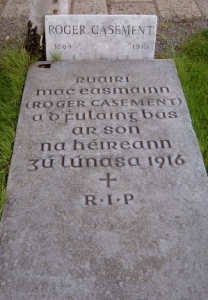
During the decades after his execution, many formal requests for repatriation of Casement’s remains are refused by the U.K. government. Finally, February 23, 1965, Casement’s remains are repatriated to the Republic of Ireland. Casement’s last wish, to be buried at Murlough Bay on the North Antrim coast, in what is now Northern Ireland, may never be satisfied as U.K. Prime Minister Harold Wilson‘s government releases the remains only on condition that they cannot be brought into Northern Ireland, as “the government feared that a reburial there could provoke Catholic celebrations and Protestant reactions.”
Casement’s remains lay in state at Arbour Hill in Dublin for five days, during which time an estimated half a million people file past his coffin. After a state funeral on March 1, the remains are buried with full military honours in the Republican plot in Glasnevin Cemetery in Dublin, with other militant republican heroes. The President of the Republic of Ireland, Éamon de Valera, who is in his mid-eighties and the last surviving leader of the Easter Rising, defies the advice of his doctors and attends the ceremony, along with an estimated 30,000 others.
The first burial takes place at Glasnevin Cemetery in Glasnevin, Dublin, on February 22, 1832.
Prior to the establishment of Glasnevin Cemetery, Irish Catholics have no cemeteries of their own in which to bury their dead. The repressive Penal Laws of the eighteenth-century place heavy restrictions on the public performance of Catholic services, forcing Catholics to conduct a limited version of their own funeral services in Protestant churchyards or graveyards. This situation continues until an incident at a funeral held at St. Kevin’s Churchyard in 1823 provokes public outcry when a Protestant sexton reprimands a Catholic priest for proceeding to perform a limited version of a funeral mass. The outcry prompts Daniel O’Connell, champion of Catholic rights, to launch a campaign and prepare a legal opinion proving that there is actually no law forbidding praying for a dead Catholic in a graveyard. O’Connell pushes for the opening of a burial ground in which both Irish Catholics and Protestants can give their dead a dignified burial.
Glasnevin Cemetery is consecrated and opened to the public for the first time on February 21, 1832. The first burial, that of eleven-year-old Michael Carey from Francis Street in Dublin, takes place on the following day in a section of the cemetery known as Curran’s Square. The cemetery is initially known as Prospect Cemetery, a name chosen from the townland of Prospect, which surrounds the cemetery lands.
Originally covering nine acres of ground, the area of the cemetery has now grown to approximately 124 acres and is the final resting place of some 1.5 million people. The cemetery consists of two parts. The main part, with its trademark high walls and watchtowers, is located on one side of the road from Finglas to the city centre, while the other part, called St. Paul’s, is located across the road and beyond a green space, between two railway lines.
Glasnevin is one of the few cemeteries that allows stillborn babies to be buried in consecrated ground and contains an area called the Angels Plot for that purpose. In 1982, a crematorium is constructed within the cemetery grounds by Glasnevin Trust and has since been used for people of various religious denominations who wish to be cremated.
Glasnevin Cemetery remains under the care of the Dublin Cemeteries Committee and the development, expansion, and refurbishment of the cemetery is an ongoing task.
The Catholic Mass is celebrated by members of the parish clergy every Sunday at 9:45 AM. An annual blessing of the graves takes place each summer as it has since the founding of the cemetery in 1832.






 seamus dubhghaill