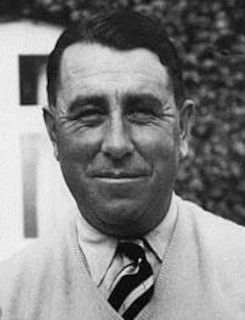
Harry Bradshaw, a leading Irish professional golfer of the 1940s and 1950s, dies on December 22, 1990, in St. Vincent’s hospital, County Dublin.
Bradshaw is born on October 9, 1913, in Killincarrig, County Wicklow, eldest among four sons and two daughters of Edward ‘Ned’ Bradshaw, golf caddie and later golf professional, and Elizabeth Bradshaw (née Walsh) of Killincarrig. He is educated locally. A golf prodigy, he has a hole-in-one at the age of ten on an 80-yard par three at Delgany Golf Club, County Wicklow. He joins Delgany Golf Club, where he progresses from caddie to assisting his father, who is the club’s professional. As a teenager, he tends to hook the ball wildly, before he develops a grip that allows him to hit with great accuracy. Thereafter, he concentrates on honing his peerless approach play from within 100 yards of the hole. Another feature of his game is what is called his “hit and hark” approach to putting: he never lifts his head to follow the ball until he hears it drop.
Bradshaw plays in his first tournament as a professional in 1932, the same year he shoots a course record 68 at Delgany. In 1938, he wins his first professional tournament, the Bromford-Adgey Cup at Skerries Golf Club, County Dublin. In 1941, he is appointed golf professional at Kilcroney, County Wicklow, and in 1950 he begins his long association with Portmarnock Golf Club, County Dublin, when he is appointed golf professional there. By then he has already made his mark on domestic Irish golf, having won the Irish Open in 1947 and 1949. In Ireland he wins the Irish Dunlop Trophy three times, the Willie Nolan Trophy eleven times, the Moran Cup twelve times and the Irish Professional Championship ten times, the last a record later equaled by Christy O’Connor Snr.
Bradshaw is not well known outside of Ireland prior to the famous “bottle” incident at the 1949 Open Championship at Royal St. George’s Golf Club in Sandwich, Kent, England. Having headed the qualifiers and shooting an opening 68, he continues his good form into the second round when his drive at the par four fifth hole just misses the fairway and lands in a beer bottle that is standing upright with the neck and shoulder broken off. The rules are unclear on whether the bottle constitutes a hazard, and he elects to play the ball where it lay, judging (correctly) that he is not entitled to a free drop. Closing his eyes and turning his head away, he swings, shattering the bottle and advancing the ball about twenty-five yards. He is shaken and records a lacklustre round of 77. Back to his best in the next two rounds, he would win the title had his putt on the last not stopped just short. Instead, he ties with the South AfricanBobby Locke who defeats him by twelve strokes in the thirty-six-hole play-off with superlative rounds of 67 and 68. As a result of his experience with the broken bottle, the rules are changed to cater for the possibility of such an incident recurring. It is the closest a golfer from the Republic of Ireland comes to winning the Open Championship until Pádraig Harrington’s victory in 2007.
Bradshaw subsequently revenges himself on Locke by narrowly beating him to the Irish Open title the following month. He is then one of four British and Irish golfers to participate in a sixteen-week tour of South Africa from December 1950 to March 1951 during which he engages in further jousts with Locke, deepening their new-found friendship.
Establishing himself on the international golf circuit, Bradshaw goes on to win the DunlopBritish Masters on two occasions (1953, 1955), and in 1958 he becomes the first Irishman to win the PGA Close Championship. He had also won the Dunbar Open Tournament in Scotland in 1953 and the Gleneagles Hotel Foursomes Tournament pro-am with Joe Carr in 1955. The highlight of his career comes in Mexico City in 1958, when, in partnership with Christy O’Connor Snr, he wins the Canada Cup, later known as the World Cup, for Ireland, also losing a play-off for the individual title. His performance is particularly impressive, given that he is forty-five and carrying weight while competing at altitude in oppressive heat. He and O’Connor are fêted upon their return home, and their victory is considered to play the determining role in popularising golf in Ireland. He caps a memorable year by receiving the Association of Golf Writers’ Trophy for 1958.
Bradshaw appears on three Ryder Cup teams. At the Wentworth Club in 1953, he wins his foursomes match partnering Fred Daly and his singles match against Fred Haas, but in 1955 he loses both his foursomes and singles matches at the Thunderbird Country Club in California. In 1957, he is a member of the side that defeats the American team 7–4 at Lindrick Golf Club in South Yorkshire, only the third victory by the Britain and Ireland side in the twelve matches played up to that time. He holes a five-footer to tie his match with U.S. Open champion Dick Mayer after a classic encounter. In 1963, he takes on Billy Casper, one of America’s top golfers, in a match at Portmarnock televised as part of the prestigious Shell’s Wonderful World of Golf series. Bradshaw’s three-stroke victory earns him $3,000, which is then considered a bonanza in golfing terms.
Bradshaw remains the golf professional at Portmarnock until 1983, latterly spending most of his day in the club shop. Even after his formal retirement, he remains on the payroll at Portmarnock as an informal ambassador for the club. Nicknamed “the Brad,” he is extremely popular with amateur and professional alike, is a great raconteur and tremendous company, and is noted for his lack of rancor towards, or criticism of, other players.
Bradshaw marries Elizabeth Foley from Carlow in 1944 and they have four children. His three brothers, Eddie, Hughie and Jimmy, are all professional golfers.
(From: “Bradshaw, Harry” by Jim Shanahan, Dictionary of Irish Biography, http://www.dib.ie, November 2022)
The 36th Ryder Cup Matches officially open on September 22, 2006, at the Palmer North Course of the K Club in Straffan, County Kildare, west of Dublin. It is the first time golf’s premier team tournament has come to Ireland and to date it is the biggest sporting event ever staged in the country.
Europe wins by 18-1⁄2 to 9-1⁄2 points, equalling their record winning margin of two years earlier for their third consecutive win, a first for Europe. Swedish rookie Henrik Stenson makes the winning putt, just moments after Luke Donald sinks a putt to ensure Europe retains the trophy.
The K Club has two Arnold Palmer-designed championship courses and the 36th Ryder Cup is held on the Palmer North Course (also known as the Old Course). The course is a parkland course located on the banks of the River Liffey, threaded through mature woodlands on the Straffan country estate.
Domestically, Sky Sports provides live coverage of all sessions. In the United States, coverage of the first day is recorded live, but presented on tape-delay by USA Network. Bill Macatee hosts from the 18th tower. On Saturday, NBC Sports presents coverage on tape, but recorded live. NBC then airs the singles live on Sunday morning. Dan Hicks and Johnny Miller host from the 18th tower, Gary Koch and Bob Murphy call holes, while on-course reporters are Mark Rolfing, Roger Maltbie, and Dottie Pepper. To provide a European perspective, NBC uses former European team player Nick Faldo as a guest analyst on the Saturday afternoon session. Faldo had worked in the same role for NBC at the 2002 Ryder Cup, and at the time of the 2006 edition is in between jobs, having worked as an analyst for ABC Sports from 2004 to 2006, but having signed with CBS Sports for 2007 and beyond.
The Ryder Cup is a match play event, with each match worth one point. The competition format used in 2004 and 2006 is as follows:
Day 1 (Friday) – 4 four-ball (better ball) matches in a morning session and 4 foursome (alternate shot) matches in an afternoon session
Day 2 (Saturday) – 4 fourball matches in a morning session and 4 foursome matches in an afternoon session
Day 3 (Sunday) – 12 singles matches
With a total of 28 points, 14-1⁄2 points are required to win the Cup, and 14 points are required for the defending champion to retain the Cup. All matches are played to a maximum of 18 holes.
After finishing his schooling at fifteen, O’Herlihy follows his grandfather into journalism and secures a job in the reading room of The Cork Examiner. He is only seventeen years-old when he subsequently becomes sub-editor of the Evening Echo, a position he holds for five years. He also graduates to the positions of news, features and sports reporter.
In the early 1960s O’Herlihy begins his broadcasting career when he starts to do local association football reports from Cork for Radio Éireann. In 1965, he makes his first television broadcast in a programme commemorating the sinking of the RMS Lusitania off the Cork coast. After three years O’Herlihy is asked to join RTÉ’s current affairs programme 7 Days to add the required field-reporting skills to the studio-based interviews. The programme has a reputation for its hard-hitting investigative reporting, and he reports on many varying stories from illegal fishing in Cork to the outbreak of the crisis in Northern Ireland. In November 1970, the 7 Days programme comes into controversy when O’Herlihy reports a story on illegal money lending. The report is unconventional as it is one of the first television pieces to use hidden cameras, it claims the government is not responding to illegal moneylending. A tribunal of inquiry follows, and O’Herlihy is forced to move away from current affairs.
Following this controversy, while O’Herlihy is not sacked as he has fifteen months left on his contract with RTÉ, he is moved to the RTÉ Sports department. There he works under Michael O’Hehir, who dislikes him and his broadcasting style. In spite of this O’Herlihy fronts RTÉ’s television coverage of the Olympic Games that year. He also becomes involved in the production of various sports programmes.
O’Herlihy is not long in the RTÉ Sports department when he becomes a regular presenter for such programmes as Sunday Sport and Sports Stadium. In 1978 he becomes RTÉ Soccer host alongside Eamon Dunphy and, in 1984, Johnny Giles joins the panel and Liam Brady follows in 1998. Since 1974 O’Herlihy becomes RTÉ’s chief sports presenter for such events as all Olympic Games until 2012, FIFA World Cups until 2014, UEFA European Football Championships until 2012 and European and World Track and Field Championships. He hosts RTÉ highlights of the Ryder Cup in 2006 when it is at the K Club in County Kildare and continues to present coverage of Ireland’s soccer internationals for RTÉ, along with Dunphy, Giles and Brady.
O’Herlihy hosts RTÉ’s coverage of rugby union in the 1980s and early 1990s. However, when RTÉ attains the rights to cover the English Premier League in 1992, Tom McGurk takes over as host of RTÉ’s coverage of rugby union. O’Herlihy covers the Premier League, Irish Internationals and The Champions League before dropping the Premier League in 2008. He continues to cover the Olympic Games and International Athletic Championships such as the European and World Athletics. He presents the first Rugby World Cup on RTÉ television in 1987 and, with Jim Carney, co-presents the first edition of The Sunday Game in 1979.
In 2012, while covering Chloe Magee‘s progress at the 2012 Summer Olympics O’Herlihy remarks that badminton was once considered “a mainly Protestant sport.” RTÉ subsequently receives a number of complaints, and while Magee criticises the remarks, the argument is made that the incident inadvertently reflected a complex historical reality.
O’Herlihy presents RTÉ Sport‘s coverage of the 2010 FIFA World Cup, his ninth FIFA World Cup. He fronts 18 European Championships and FIFA World Cups for RTÉ, the last of which comes in 2014. This proves to be the final tournament with O’Herlihy at the helm. He retires at its conclusion and dies the following year.
O’Herlihy attends the 12th Irish Film & Television Awards on Sunday, May 24, 2015. He dies peacefully in his sleep at his home the following day at the age of 76 nearly a year after his retirement. He is survived by wife Hillary and daughters Jill and Sally. Giles, Brady and Dunphy appear on The Late Late Show in tribute later that week. At the time of his death O’Herlihy is working on a sports version of Reeling in the Years, which RTÉ immediately cancels.
Bradshaw loses the 1949 The Open Championship following a playoff against Bobby Locke at Royal St. George’s Golf Club, after an extraordinary incident in the second round when his drive at the 5th hole comes to rest against broken glass from a beer bottle on the fairway. Rather than taking a drop (to which he is probably entitled) he elects to play the ball as it lay, but is only able to move it slightly forward, dropping the shot. The setback results in his tying with Locke with an aggregate of 283, thereby equaling the championship record. However he loses the playoff to Locke. Arguably the incident with the bottle costs Bradshaw the tournament.
Bradshaw dies at the age of 77 on December 22, 1990.
In 1987 Clarke plays collegiate golf at Wake Forest University in the United States. He is a junior member of Dungannon Golf Club, whose junior section also includes three others who are current PGA Golf Professionals: Alistair Cardwell, Barry Hamill and Gary Chambers. He represents his school, Royal School Dungannon, together with Cardwell and Chambers.
A stalwart of the European Tour since 1991, Clarke is no stranger to firsts. In the 1999 Smurfit European Open he becomes the first player on the European Tour to shoot 60 for a second time, having achieved it first in the 1992 European Monte Carlo Open. In 2002 he becomes the first player to win the English Open three times and in 2003 becomes the first player outside Tiger Woods to capture more than one World Golf Championships title.
Three weeks after the untimely death of his wife, Heather, to cancer in August 2006, Clarke is picked as one of the wild cards for the Ryder Cup at K Club. In an emotionally charged week he produces one of his most memorable performances, winning all three of his matches.
Clarke assures his place in history by earning a place in the renowned ‘Who’s Who‘ guide for 2008, and in 2005 he even appears on an Irish postage stamp. A difficult 2007, where he juggles looking after his two sons with his golf regime, sees him slip down the rankings, but he begins to find his form again in South Africa before the winter break.
In 2010 Clarke beats a world-class field in the J. P. McManus Invitational Pro-Am at Adare Manor in Ireland where he has a one-shot victory over Luke Donald. He secures his spot in the 139th Open Championship at the Old Course at St. Andrews by finishing second in the Barclays Scottish Open. He finishes 30th in the European Tour Race. He rounds off 2010 in great style with the announcement of his engagement to Alison Campbell.
In February 2015, Clarke is named as Europe’s Ryder Cup captain and dedicates the next 18 months to the role. Ultimately, Europe is beaten 17-11 by the United States at Hazeltine National Golf Club.
A dedicated worker for charity, Clarke sets up his own Darren Clarke Foundation, which not only helps further the development of junior golf in Ireland, but also now raises money for Breast Cancer Awareness.
O’Connor is born in Knocknacarra, County Galway, near Salthill, on August 19, 1948, the son of Elizabeth (née Noone) and John O’Connor. The family farms cattle and pigs near a golf club.
O’Connor turns professional in 1967. The PGA European Tour officially begins in 1972, and O’Connor makes the top hundred on the Order of Merit in each of its first twenty-one seasons, with a best ranking of seventh in 1975. He wins four European Tour events. As a senior he competes on both the European Senior Tour and the United States-based Champions Tour and wins two Senior British Open titles (before it becomes one of the senior majors) and two Champions Tour events.
In 1992 O’Connor wins the Dunhill British Masters at the Woburn Golf Club, his fourth and final European Tour victory, with scores of 71, 67, 66, 66. A weather-interrupted tournament means that 36 holes have to be played on Sunday. At 44 years, O’Connor is the oldest player in the field.
O’Connor plays in the Ryder Cup twice. In 1975 he is a member of a losing Great Britain & Ireland team and in 1989 he is part of a European team which ties the match to retain the trophy. His personal record is one win, three losses and no ties. His win over Fred Couples is best remembered for a stunning 2 iron shot on the last hole at The Belfry which he leaves just 4 feet from the hole.
O’Connor is also active in golf course design, being involved in the design of at least 18 courses in Ireland, and many more abroad.
Christy O’Connor Jnr dies while on holiday with his wife Ann on January 6, 2016, in Tenerife, Canary Islands.
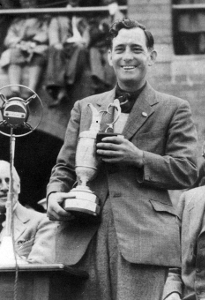
During his acceptance speech at Royal Liverpool, Daly says he is very honoured to receive the Claret Jug and take it back to Northern Ireland. He goes on to say that the trophy has never been to Ireland and that he is hoping that the change of air will help it. There is much applause and laughter at his humorous comments.
In addition, he adds the News of the World Match Play tournament, which is the main British Match Play Championship, becoming the first since James Braid (1905) to win both the Open and the Match Play title in the same year.
At the 2007 Open Championship, Harrington defeats Sergio García in a four-hole playoff at Carnoustie, becoming the first Irishman to win The Open Championship in 60 years, and the first ever from the Republic of Ireland. Both players go into the playoff having shot a 7-under 277 for the championship. Harrington subsequently wins by one stroke in the playoff.
Harrington is the first European golfer to secure a major victory since Paul Lawrie on the same course in 1999 and Ireland’s first since Fred Daly in 1947. President Mary McAleese is the first to convey her congratulations to Harrington, while Labour sports spokesman Jack Wall says, “Pádraig Harrington’s magnificent victory in the Open without doubt represents one of the greatest days in the history of Irish sport.”
A year later at the 2008 Open Championship, it is unclear if Harrington would get a chance to defend his Open title at Royal Birkdale Golf Club as eight days prior to the event he injures his wrist. However, he successfully defends his title, overcoming a 2-shot deficit to Greg Norman with a final round 69. He shoots a four-under-par 32 on the back nine, which enables him to pull away from Norman and Ian Poulter. His eagle on the par-5 17th all but seals the tournament. He is the first European golfer since James Braid in 1906 to retain the Claret Jug. The win moves him from fourteenth to third in the world rankings, behind only Tiger Woods and Phil Mickelson.
Just three weeks after winning the 2008 Open Championship, Harrington wins the PGA Championship over the South Course of the Oakland Hills Country Club, for his third major. Although at five over par after two rounds, he shoots eight under par for the weekend, carding successive scores of 66 in both the third and fourth rounds. His three under par 277 is two shots ahead of Sergio García and Ben Curtis. Harrington becomes the first European to win the PGA Championship since Tommy Armour in 1930 and is the first winner from Ireland.
Harrington’s victory in the PGA Championship secures his position as the number one player in Europe, earning him a spot in the 2008 European Ryder Cup team under captain Nick Faldo.





 seamus dubhghaill