More than 30 people are killed or fatally wounded in a day of violence in Dublin on November 21, 1920, during the Irish War of Independence. It goes down in Irish history as the first “Bloody Sunday,” though unfortunately not the last.
Through the centuries the British have crushed Irish revolutionary movements through the use of spies and informers. Michael Collins, Minister for Finance of the Irish Republic, head of the secretive Irish Republican Brotherhood and Irish Republican Army (IRA) Chief of Intelligence, is in the process of beating the British at their own game. The day begins in the early morning hours with an IRA operation, organised by Collins, to assassinate members of the “Cairo Gang” – a team of undercover British intelligence agents working and living in Dublin. IRA members go to a number of addresses and kill or fatally wounded 16 men, mostly British Army intelligence officers. Five other men are wounded.
When word of the success of the operation gets back to Collins, knowing the caliber of the men in England‘s infamous “Black and Tan” force, he sends a message to the Gaelic Athletic Association, telling them to cancel that day’s Gaelic football match between Dublin and Tipperary. However, it is too late, and the match goes on.
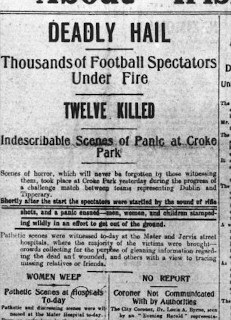
Later that afternoon, lashing out blindly, the Black and Tans surround Croke Park during the match and move in. Their supposed purpose is to attempt to capture members of Sinn Féin who might be in the crowd, but they soon open fire indiscriminately on the players and spectators. They kill or fatally wound fourteen civilians and wound at least sixty others before members of the Auxiliary Division, another brutal force created to crush the Irish insurrection, finally manages to get them to cease-fire.
That evening, two Irish republicans and members of Collins’ squad, Dick McKee and Peadar Clancy, who had helped plan the earlier assassinations, along with a third man, a civilian named Conor Clune, who happened to be caught with the others, are beaten and shot dead in Dublin Castle by their captors, who claim they were killed during an escape attempt.
Overall, Bloody Sunday is considered a victory for the IRA, as Collins’s operation severely damages British intelligence, while the later reprisals do no real harm to the guerrillas but increase support for the IRA at home and abroad.
(Pictured: The headline of the Dublin Evening Herald reads ‘Latest Stories about Irish Tragedies’, 22nd November 1920. The newspaper reports on the massacre at a Croke Park football match, shootings in Dublin, and the discovery of a priest’s corpse in a Galway bog. Photo by Hulton Archive/Getty Images)
Barry is born into a farming family in Riverstick, ten miles south of Cork city, on July 15, 1883. He enjoys Gaelic culture and sport and is a prominent member of the Ballymartlehurling club. He later joins the famous Blackrock National Hurling Club where he wins four senior county championships in a row during the years of 1910 to 1913.
In 1913, Barry joins the newly formed Irish Volunteers. He is a member of the first Cork brigade and has been politically active in Sinn Féin. In 1915, he moves to Kilkenny to take up employment there, where he continues his volunteer activities. Shortly after the Easter Rising in 1916, he is arrested in Kilkenny in a British Government crackdown and sent to Frongoch internment camp in North Wales. In 1917 he becomes election agent for W. T. Cosgrave in the Kilkenny by-election, one in which Cosgrave is successfully elected. However, just six years later he finds himself imprisoned by Cosgrave’s own government.
In 1922 Barry is imprisoned in Newbridge camp in Kildare and takes part in the hunger strike of 1923. On November 20, 1923, after 34 days protesting against the harsh regime and undignified conditions, he dies but even in death he is still refused dignity.
Barry’s body is not released to his family and is instead, on the orders of Minister of Defence, Richard Mulcahy, buried in the grounds of Newbridge internment camp. The Barry family takes legal action against this and eventually receives the body, but this is not the last of their troubles.
Upon their arrival in Cork with Barry’s body, the Bishop of Cork, Daniel Cohalan, instructs his priests not to allow Barry’s funeral in any church. Ironically just a few short years before, Bishop Cohalan had been a strong vocal supporter of Terence MacSwiney, Sinn Féin Lord Mayor of Cork, who died on hunger strike in Brixton Prison.
Shortly after MacSwiney’s death, Bishop Cohalan’s attitude towards the Irish Republican Army (IRA) changes and he issues a decree condemning the IRA in which he states, “Anyone who shall within the diocese of Cork organise or take part in an ambush or in kidnapping or otherwise, shall be guilty of murder or attempted murder and shall incur by the very fact the censure of excommunication.”
On December 10, 1922, Bishop Cohalan preaches publicly his support for the Anglo-Irish Treaty which establishes the Irish Free State, and he urges his flock to do the same. This leads to an even greater wedge between the Catholic Church and many IRA members, yet it is the incident with Barry that seriously taints the Bishop of Cork and the Catholic Church in republican eyes.
Because of Bishop Cohalan’s stern objection to Barry’s body being permitted into a Catholic church, his body has to lay in state in the Cork Sinn Féin headquarters on the Grand Parade in Cork city. He is then taken in a funeral procession to St. Finbarr’s Cemetery where he is buried in the Republican plot next to Terence MacSwiney, whose funeral Bishop Cohalan had presided over three years previously. In place of a priest is David Kent, Sinn Féin Teachta Dála for Cork and brother of Thomas Kent, who was executed for his part in the 1916 Rising. Kent gives an oration, recites the Rosary and sprinkles holy water on the grave.
On November 28, 1923, the day Barry is buried, Bishop Cohalan sends an open letter to The Cork Examiner publicly denying a Christian burial for Barry and urging all men of the cloth to stay away from any such attempts for such a funeral. He goes so far as to write to the Bishop of Kildare and Leighlin, Dr. Patrick Foley, to enquire about Barry getting the last sacraments. Barry did indeed receive the last rites from a Fr. Doyle who was serving as prison chaplain, and this does not impress the Bishop of Cork.
Barry’s funeral precession through Cork City draws massive crowds with people from all walks of Cork’s political, social and sporting life attending to pay their respects to this man who had been at the heart of the revolution in Cork during the last decade of his life. The IRA, Cumann na mBan and Na Fíanna Éireann march in military formations with the funeral party.
Two days after Barry’s death another IRA prisoner, Andrew O’Sullivan, from Cork dies and the strike is called off the following day. Women prisoners are then released while men remain in prison until the following year.
A memorial to Barry is unveiled in Riverstick in 1966.
Logue is born in Kilmacrennan, County Donegal in the west of Ulster on October 1, 1840. He is the son of Michael Logue, a blacksmith, and Catherine Durning. From 1857 to 1866, he studies at Maynooth College, where his intelligence earns him the nickname the “Northern Star.” Before his ordination to the priesthood, he is assigned by the Irish bishops as the chair of both theology and belles-lettres at the Irish College in Paris in 1866. He is ordained priest in December of that year.
Logue remains on the faculty of the Irish College until 1874, when he returns to Donegal as administrator of a parish in Letterkenny. In 1876, he joins the staff of Maynooth College as professor of Dogmatic Theology and Irish language, as well as the post of dean.
On May 13, 1879, Logue is appointed Bishop of Raphoe by Pope Leo XIII. He receives his episcopal consecration on the following July 20 from Archbishop Daniel McGettigan, with Bishops James Donnelly and Francis Kelly serving as co-consecrators, at the pro-cathedral of Raphoe. He is involved in fundraising to help people during the 1879 Irish famine, which, due to major donations of food and government intervention never develops into a major famine. He takes advantage of the Intermediate Act of 1878 to enlarge the Catholic high school in Letterkenny. He is also heavily involved in the Irish temperance movement to discourage the consumption of alcohol.
Logue publicly supports the principle of Irish Home Rule throughout his long reign in both Raphoe and Armagh, though he is often wary of the motives of individual politicians articulating that political position. He maintains a loyal attitude to the British Crown during World War I, and on June 19, 1917, when numbers of the younger clergy are beginning to take part in the Sinn Féin agitation, he issues an “instruction” calling attention to the teaching of the Roman Catholic Church as to the obedience due to legitimate authority, warning the clergy against belonging to “dangerous associations,” and reminding priests that it is strictly forbidden by the statutes of the National Synod to speak of political or kindred affairs in the church.
Logue opposes the campaign of murder against the police and military begun in 1919, and in his Lenten pastoral of 1921 he vigorously denounces murder by whomsoever committed. This is accompanied by an almost equally vigorous attack on the methods and policy of the government. He endorses the Anglo-Irish Treaty in 1921.
In 1921, the death of Cardinal James Gibbons makes Logue archpriest (protoprete) of the College of Cardinals. He is more politically conservative than Archbishop of DublinWilliam Joseph Walsh, which creates tension between Armagh and Dublin. In earlier life he was a keen student of nature and an excellent yachtsman.
Cardinal Michael Logue dies in Ara Coeli, the residence of the archbishop, on November 19, 1924, and is buried in a cemetery in the grounds of St. Patrick’s Cathedral, Armagh.
The province’s institutions are suspended on October 14 following a row over allegations of Irish Republican Army (IRA) activity, including alleged spying within the Northern Ireland Office (NIO).
Speaking after a 40-minute meeting with Trimble, Adams says they had had a “useful exchange of views.” But he adds, as expected, “there were very few conclusions in terms of the big picture….I asked Mr. Trimble how he thought things could be sorted out and Mr. Trimble had no particular suggestion to offer. But it was a good meeting.”
The Sinn Féin president says he had suggested to Trimble that each leader could address the executive of the opposite’s party. “He declined. But I hope he will think about the suggestion.”
Trimble says no significant developments came out of the meeting. He adds that the onus is on the republican movement to move the process forward. He dismisses Adams’s suggestion that they should address each other’s parties as a “stunt.”
MacSwiney is born at 23 North Main Street, Cork, County Cork, one of eight children of John and Mary MacSwiney. Following the failure of this business, John MacSwiney emigrates to Australia in 1885 leaving the children in the care of their mother and his eldest daughter.
MacSwiney is educated by the Christian Brothers at the North Monastery school in Cork but leaves at fifteen to help support the family. He becomes an accountancy clerk but continues his studies and matriculates successfully. He continues in full-time employment while he studies at the Royal University (now University College Cork), graduating with a degree in Mental and Moral Science in 1907.
In 1901 MacSwiney helps to found the Celtic Literary Society, and in 1908 he founds the Cork Dramatic Society with Daniel Corkery and writes a number of plays for them. His first play, The Last Warriors of Coole, is produced in 1910. His fifth play, The Revolutionist (1915), takes the political stand made by a single man as its theme.
Described as a sensitive poet-intellectual, MacSwiney’s writings in the newspaper Irish Freedom bring him to the attention of the Irish Republican Brotherhood. He is one of the founders of the Cork Brigade of the Irish Volunteers in 1913 and is President of the Cork branch of Sinn Féin. He founds a newspaper, Fianna Fáil, in 1914, but it is suppressed after only 11 issues. In April 1916, he is intended to be second in command of the Easter Rising in Cork and Kerry but stands down his forces on the order of Eoin MacNeill.
Following the rising, MacSwiney is imprisoned by the British Government under the Defence of the Realm Act 1914 in Reading and Wakefield Gaols until December 1916. In February 1917 he is deported from Ireland and imprisoned in Shrewsbury and Bromyardinternment camps until his release in June 1917. It is during his exile in Bromyard that he marries Muriel Murphy of the Cork distillery-owning family. In November 1917, he is arrested in Cork for wearing an Irish Republican Army (IRA) uniform, and inspired by the example of Thomas Ashe, goes on a hunger strike for three days prior to his release.
In the 1918 Irish general election, MacSwiney is returned unopposed to the first Dáil Éireann as Sinn Féin representative for Mid Cork, succeeding the Nationalist MP D. D. Sheehan. After the murder of his friend Tomás Mac Curtain, the Lord Mayor of Cork on March 20, 1920, he is elected as Lord Mayor. On August 12, 1920, he is arrested in Cork for possession of “seditous articles and documents,” and also possession of a cipher key. He is summarily tried by a court on August 16 and sentenced to two years’ imprisonment at Brixton Prison in England.
In prison MacSwiney immediately starts a hunger strike in protest of his internment and the fact that he was tried by a military court. Eleven other Irish Republican prisoners in Cork Jail go on hunger strike at the same time. On August 26, the British Government states that “the release of the Lord Mayor would have disastrous results in Ireland and would probably lead to a mutiny of both military and police in south of Ireland.”
MacSwiney’s hunger strike gains world attention. The British Government is threatened with a boycott of British goods by Americans, while four countries in South America appeal to Pope Benedict XV to intervene. Protests are held in Germany and France as well. An Australian member of Parliament, Hugh Mahon, is expelled from the Parliament of Australia for “seditious and disloyal utterances at a public meeting,” after protesting against the actions of the British Government. Two weeks later, the Spanish Catalan organization Autonomous Center of Employees of Commerce and Industry (CADCI) sends a petition to British Prime MinisterDavid Lloyd George calling for his release and the newspaper of the organization, Acció (Acción in Spanish), begins a campaign for MacSwiney.
Food is often placed near MacSwiney to persuade him to give up the hunger strike. Attempts at force-feeding are undertaken in the final days of his strike. On October 20, 1920, he slips into a coma and dies five days later after 73 days on hunger strike. His body lay in St. George’s Cathedral, Southwark in London where 30,000 people file past it. Fearing large-scale demonstrations in Dublin, the authorities divert his coffin directly to Cork, and his funeral in the Cathedral of St. Mary and St. Anne on October 31 attracts huge crowds. He is buried in the Republican plot in St. Finbarr’s Cemetery in Cork. Arthur Griffith delivers the graveside oration.
Kelly is the eldest of ten children born into a staunchly Irish republican family. His father, also named James Kelly, had stood for Sinn Féin in local elections in 1918, topping the poll. An ancestor from the late 18th century, Robert Kelly, was a member of the Society of United Irishmen, and was supposedly a Officer Commanding of the United Irishmen in the East Cavan/South Monaghan area. Kelly joins the Irish Army in 1949. By 1960 he has been promoted to captain and appointed to the intelligence section at army headquarters.
Kelly is a central figure in the Arms Trial, having travelled to Hamburg to arrange the purchase of arms. It emerges later that Neil Blaney had ordered him to do so outside normal legal channels, but before the weapons arrive the GardaSpecial Detective Unit has heard of the plan and informs TaoiseachJack Lynch, aborting the importation and resulting in criminal charges for the plotters. Although in his summation the judge says it is no defence for Kelly to say that he believed that the government had authorised the importation of arms, Kelly is acquitted.
Although he is acquitted, Kelly suffers financially because he had felt compelled to resign from the Army even before the prosecution is brought. He prints and publishes a personal memoir in paperback format called Orders for the Captain? in 1971.
Kelly never denies that he had been involved in extra-legal arms purchase talks but contends that he had been ordered to do so by some ministers. A typical version of the events is found in a 1993 hostile biography of Charles Haughey, claiming: “As early as October 1969, to the certain knowledge of Charles Haughey, James Gibbons, the Department of Justice, the Special Branch and Army Intelligence, there were meetings with leading members of the Irish Republican Army (IRA), when they were promised money and arms. The critical encounter took place in Bailieborough [sic], County Cavan, on Saturday, 4 October 1969. It had been arranged by Captain James Kelly, an army intelligence officer, and Cathal Goulding. Kelly, at that stage, was already the subject of several security reports to the Secretary of the Department of Justice, Peter Berry, from the Special Branch, implicating Kelly with subversives and with promises of money and of arms.” Kelly never objects to such versions of the events of 1969.
Following the Arms Trial, Kelly joint-founds Aontacht Éireann, a political party directly born out of the scandal. He is elected vice-chairman of the party and stands in Dáil elections for them unsuccessfully on two occasions in 1973 and 1977 in the Cavan-Monaghan constituency. Aontacht Éireann meets with little success at the polls and by 1980 he has joined Fianna Fáil, becoming a member of its national executive. Following the first applications of the 1987 Extradition (European Convention on the Suppression of Terrorism) Act, he resigns from the party in 1989 in opposition to the extradition of Provisional IRA prisoners to the United Kingdom. He also serves twice as President of the “1916-1921” Club.
Kelly is heavily involved in the Northern Ireland peace process. In 1989 he publishes his own draft on how a peace process could proceed. His document called The Courage of the Brave is launched in Conway Mill, Belfast on August 24, 1989. Present on the platform party at the launch of the document are Fianna Fáil Councillor Macarten McCormack, Ernest Cowan, Chairman of Kentstown Fianna Fáil who had served with Captain Kelly on the Fianna Fáil National Executive, Robert C. Linnon, National President, Irish American Unity Conference, Kate Lavery, representing John J. Finucane, National President, American Irish Political Education Committee and Father Des Wilson of Belfast.
Kelly dies on July 16, 2003, and is buried in Glasnevin Cemetery in Dublin. The epitaph on his grave is “Put not your trust in princes,” which is a quote from Niccolò Machiavelli.
Treacy is picked up in the mass arrests following the Easter Rising in 1916. He spends much of the following two years in prison, where he goes on hunger strike on several occasions. In 1918, he is appointed Vice Officer-Commanding of the Third Tipperary Brigade of the Irish Volunteers, which becomes the Irish Republican Army in 1919.
On January 21, 1919, Treacy and Dan Breen, together with Seán Hogan, Séamus Robinson, and five other volunteers, help to ignite the conflict that is to become the Irish War of Independence. They ambush and shoot dead Constables Patrick MacDonnell and James O’Connell of the Royal Irish Constabulary (RIC), who are guarding a transport of gelignite explosives, during the Soloheadbeg Ambush near Treacy’s home. Treacy leads the planning of the ambush and briefs the brigade’s OC Robinson on his return from prison in late 1918. Robinson supports the plans and agrees they will not go to GHQ for permission to undertake the attack.
As a result of the Soloheadbeg Ambush, South Tipperary is placed under martial law and declared a Special Military Area under the Defence of the Realm Act. After Soloheadbeg ambush party member Seán Hogan is arrested on May 12, 1919, Treacy, Breen, and Séamus Robinson are joined by five men from the IRA’s East Limerick Brigade to organise Hogan’s rescue. Hogan is brought to the train which is intended to take him from Thurles to Cork on May 13, 1919. As the train steams across the Tipperary border and into County Limerick, the IRA party boards the train in Knocklong. A close-range struggle ensues on the train. Treacy and Breen are seriously wounded in the gunfight and two RIC men die, but Hogan is rescued. His rescuers rush him into the village of Knocklong where a butcher cuts off his handcuffs using a cleaver.
A search for Treacy and the others is mounted across Ireland. Treacy leaves Tipperary for Dublin to avoid capture. In Dublin, Michael Collins employs Treacy on assassination operations with “the Squad“. In the summer of 1920, he returns to Tipperary and organises several attacks on RIC barracks before again moving his base of operations to Dublin.
By spring 1920 the political police of both the Crimes Special Branch of the Royal Irish Constabulary (RIC) and G-Division (Special Branch) of the Dublin Metropolitan Police (DMP) have been effectively neutalised by IRA counterintelligence operatives working for Michael Collins. The British thoroughly reorganise their administration at Dublin Castle and begin to import dozens of professional secret service agents from all parts of the British Empire into Ireland to track down IRA operatives and Sinn Féin leaders.
On October 11, 1920, Treacy and Breen are holed up in a safe house on the north side of Dublin when it is raided by a police unit. In the ensuing shootout, two senior British officers are wounded and die the next day while Treacy and Breen are wounded, Breen seriously. Treacy and Breen manage to escape through a window and shoot their way through the police cordon.
Treacy is discovered at the Republican Outfitters shop at 94 Talbot Street on October 14 a British Secret Intelligence Service surveillance team led by Major Carew and Lt. Gilbert Price. They are stalking him in hopes that he will lead them to Collins or to other high-value IRA targets. Treacy realises that he is being followed and runs for his bicycle but grabs the wrong bike, taking one that is far too big for him, and falls. Price draws his pistol and closes in on Treacy. Treacy draws his parabellum automatic pistol and shoots Price and another British agent before he is hit in the head, dying instantly.
Treacy is buried at Kilfeacle graveyard where, despite a large presence of British military personnel, a volley of shots is fired over the grave.
In 1916 Flannery joins the Irish Volunteers alongside his brother Peter, although he does not take part in the Easter Rising. However, he does participate in the Irish War of Independence. Following the outbreak of the Irish Civil War, he fights as part of the Anti-Treaty IRA until his capture by the National Army on November 11, 1922, in Roscrea, County Tipperary. He is imprisoned for nearly a year and a half in Dublin’s Mountjoy Prison (C Wing). While there he witnesses the execution of Anti-Treaty IRA leaders Richard Barrett, Joe McKelvey, Liam Mellows and Rory O’Connor from his cell window. Following a 28-day hunger strike, he is placed in the Curragh Camp until May 1, 1924, when he is finally released, a full year after the end of the civil war.
Following the creation of Fianna Fáil and their entry into the Irish Parliament Dáil Éireann, Flannery becomes affiliated with Sinn Féin, who had voted to retain their abstentionist policy towards the Dáil and their refusal to acknowledge it as the legitimate government of Ireland. Sinn Féin tasks him with drumming up support for the party in New York. However, following the start of the Great Depression he finds it difficult to focus on politics in the face of mounting poverty. By 1933 finding support for Sinn Féin and the IRA becomes particularly tough when Fianna Fáil expands greatly the range of people eligible for military pensions, which under the previous government had been biased against members of the Anti-Treaty IRA. For the next 40 years Flannery works for the Metropolitan Life Insurance Company.
Upon the onset of The Troubles in Northern Ireland, Flannery is once again drawn into the world of Irish Republicanism. In a response to the mounting violence, he sets up the Irish Northern Aid Committee, or as it became better known as, NORAID. The official purpose of NORAID is to provide funds to the families of imprisoned Irish Republicans and victims of violence. However, opponents level the accusation against the organisation that it is also providing funding directly to the Provisional Irish Republican Army, and perhaps even also supplying firearms.
In 1970 Flannery travels around America and sets up 62 chapters of NORAID. In 1971 he says, “The more coffins sent back to Britain, the sooner this will be all over,” referring to British soldiers.
In 1982 Flannery is indicted, with four other members of NORAID, for arms smuggling, but all defendants are acquitted after their legal defence is able to successfully argue their actions had been sanctioned the CIA.
In 1986 Flannery quietly resigns from NORAID following the decision by Sinn Féin to drop its abstentionist policy in the Republic of Ireland and to recognise Dáil Éireann as the legitimate governing body of Ireland.
Flannery opposes the Northern Ireland peace process, believing that Sinn Féin and the Provisionals have “sold out,” and believes the removal of British troops from Northern Ireland is the only starting point upon which negotiations can begin.
Flannery dies at the age of 92 in New York City on September 30, 1994. He is buried in Mount Saint Mary’s Cemetery in Flushing, Queens, New York.
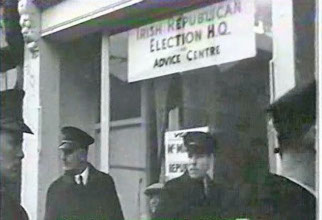
This takes place during a general election for Westminster. Republicans have nominated Liam McMillan to contest in West Belfast. McConnell, under pressure from Ian Paisley and other unionists, holds a conference of his senior RUC officers on the morning of September 28 and orders that the tricolour flown at Liam McMillan’s headquarters be removed. Under the Flags and Emblems Display Act of 1954, it is an offence to display the tricolour anywhere in the six counties of Northern Ireland.
That evening, when it becomes known that the RUC are coming to seize the flag, more than 2,000 republican supporters block the roadway. Scores of RUC are rushed to the scene in armoured cars. The RUC, though heavily armed with sten guns, rifles, revolvers and riot batons, are made to look ridiculous by groups of children, who run about with miniature tricolour stickers which they stick on walls and police cars.
The RUC, using pickaxes, smashes down the doors of the Republican headquarters and takes the flag. They carry it away through a hail of stones and to the prolonged jeers of the people.
The following day the RUC clears Divis Street to make way for an armoured car. Their new perilous mission is to seize a new replacement tricolour. The armoured car stops outside the Republican headquarters, eight policemen emerge and begin another attack with crowbars and pickaxes. They fail to break down the door but one of them smashes the window, reaches in and pulls out the second tricolour.
By September 30, news of the events in Divis Street have spread throughout the media. Belfast begins attracting television reporters and newspaper men from all around the world. That night, thousands of republicans, armed with petrol bombs, sticks, stones and rotten vegetables, gather outside their headquarters to defend their identity and their flag. A battle begins at 11:00 PM when the RUC tries to disperse them. The television cameras are there to record all that happens. For the first time ever, people in many parts of the world are able to watch a sectarian police force in action.
When the republicans indicate that they will stand their ground, fifty RUC men, who had been held in reserve in the small streets between Falls Road and Shankill Road, are deployed but the republicans, in accordance with a pre-arranged strategy, drive them back. By midnight, the police have succeeded in sealing off Divis Street and dispersing the crowd but thirty people, including at least eighteen members of the RUC, have been injured.
One week later, on October 5, republicans carry the tricolour at the head of a parade of 5,000 people who march from Beechmount on Falls Road, through Divis Street, to an election rally near Smithfield. RUC men line the entire route but make no attempt to seize the flag.
(From: “The Tricolour Riots,” An Phoblacht (www.anphoblacht.com), September 23, 2004 edition)
Peter Burke, the Head Constable of the Royal Irish Constabulary (RIC), is accompanied by his brother William, a Sergeant, as they enter Smyth’s pub (now the Millrace Pub) for a drink. There are confusing accounts of what transpires there but shortly afterwards Burke is shot dead and his brother is seriously wounded.
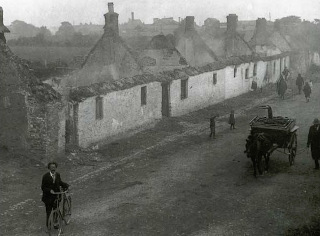
Word quickly reaches Gormanston Camp where the Black and Tans are stationed. A large body of them arrive a short time later in two or three lorries, firing indiscriminately in the streets. They station their vehicles outside the barracks on Bridge Street. They also burn twenty houses and many families spend several nights sleeping outdoors in fear for their lives.
The Black and Tans loot the business of John Derham, a local Town Commissioner, on corner of Bridge Street and Clonard Street and they burn several local businesses and several houses including eight cottages on Clonard Street, known locally as Sinn Féin Alley.
Several licensed premises are also destroyed including Landy’s and the Gladstone Inn, now Harvest Pub and Milestone Inn. The Black and Tans are set on destroying the premises of Smyth and Co. on Railway Street however they burn down another factory, Balbriggan Sea Mills, built by the English company, Deeds Templar. Only the factory chimney remains.
Several locals are dragged into the barracks for questioning and two are murdered, Seamus Lawless, a local barber, and Sean Gibbons, a dairy farmer. A plaque on Bridge Street commemorates them. Both are buried in Balscadden cemetery. Peter Burke is buried in Glenamaddy, County Galway.
Fulham Terrace has been named in honour of the bravery of Dr. Fulham on the night along with the names given to Lawless and Gibbons Terrace in the town.





 seamus dubhghaill