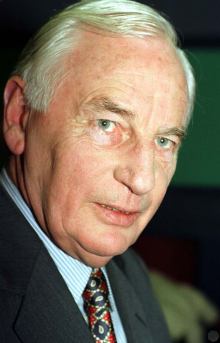
Barry is first elected to Dáil Éireann as a Fine Gael Teachta Dála (TD) for the Cork City South-East constituency at the 1969 Irish general election. He goes go on to win a Dáil seat at eight successive general elections, changing constituency to Cork City in 1977 and Cork South-Central in 1981. When Fine Gael comes to power following the 1973 Irish general election, he is appointed Minister for Transport and Power. In 1976, he becomes Minister for Education. In 1979, after Garret FitzGerald becomes leader of Fine Gael, he is elected deputy leader. From June 1981 to March 1982, he serves as Minister for the Environment.
From December 1982 to 1987, Barry is Minister for Foreign Affairs. In this capacity he is heavily involved in the negotiations which result in the 1985 Anglo-Irish Agreement. He also becomes the first joint chairman of the Anglo-Irish Intergovernmental Conference, established under the Agreement by the Irish and British governments. Following the Labour Party‘s withdrawal from the coalition government in 1987, he becomes Tánaiste, for a brief period. He is the first member of Fine Gael to hold the office of Tánaiste.
When FitzGerald resigns as Fine Gael leader after the 1987 Irish general election, Barry is one of three candidates, along with Alan Dukes and John Bruton, who contest the party leadership. Dukes is the eventual victor.
Barry dies in Cork at the age of 88 on August 26, 2016, following a short illness. Irish PresidentMichael D. Higgins says Barry will be deeply missed. “His view of Irish history was a long one and he brought all that wisdom to bear in his contributions to achieving the Anglo-Irish Agreement. As a person he was immensely popular across all parties and, of course, he had a deep commitment to Cork city and its heritage.”
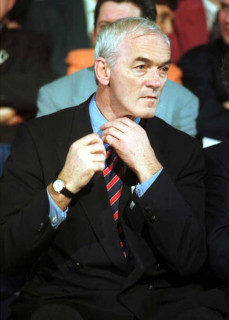
Doherty is the third son in a family of six. He is born on October 16, 1955, in the Andersonstown area of Belfast and is educated at St. Theresa’s Primary School and Glen Road Christian Brothers School (CBS). The Doherty brothers are known cyclists and sportsmen in the Andersontown area. He wins an AntrimGaelic football medal at minor level in 1971.
Doherty joins Fianna Éireann in 1971 and is interned by the British Government between February 1973 and November 1975. His brothers Michael and Terence are interned between 1972 and 1974.
Doherty works as an apprentice heating engineer. His girlfriend is Geraldine Scheiss and, although they never become formally engaged, they become very close toward the end of his life. Before his arrest, she had not known that he is in the IRA.
In August 1976, while he is out to set a bomb, the van in which he is riding is chased by the Royal Ulster Constabulary (RUC). During the chase Doherty manages to leave the van and hijack a car. He later ditches the car and is found one mile away from the car. He is convicted and sentenced to 18 years for possession of firearms and explosives, with another four years for the hijack.
Doherty starts his hunger strike on May 22, 1981. While on hunger strike, he is elected as an Anti H-Block TD for the Cavan–Monaghan constituency at the 1981 Irish general election, which is held on June 11. He receives 9,121 (15.1%) first preference votes and is elected on the fourth count. The two seats gained by Anti H-Block candidates denies TaoiseachCharles Haughey the chance to form a government, and the 22nd Dáil Éireann sees a Fine Gael–Labour Party coalition government come to office, with Garret FitzGerald as Taoiseach.
Doherty dies at the age of 25 on August 2, 1981. He lasts 73 days on hunger strike, the longest of the 1981 hunger strikers, and only one day short of Terence MacSwiney. He is the shortest-serving Dáil deputy ever, serving as a TD for only two months.
Coveney is interested in yachting throughout most of his adult life. His yacht Golden Apple of The Sun, designed by Cork-based designer Ron Holland, is a successful competitor in the Admiral’s Cup in the 1970s. A later 50-foot yacht, Golden Apple, is used by the family for the “Sail Chernobyl” project. The family sails around the world to raise €650,000 for Chernobyl Children’s Project International, a charity which offers assistance to children affected by the 1986 Chernobyl disaster.
In March 1998 it becomes publicly known that the Moriarty Tribunal has questioned Coveney about whether he had a secret offshore account with Ansbacher Bank, a bank which had become notorious for facilitating tax evasion. Ten days later, on March 13, 1998, Coveney visits his solicitor to change his will. The following day, he dies in a fall from a seaside cliff while out walking alone. His son, Simon Coveney, insists that his father had never held an Ansbacher account. It later emerges that Hugh Coveney had $175,000 on deposit in the secret Cayman Islands-based bank. The account was closed in 1979.
The funeral of Hugh Coveney takes place at St. Michael’s Church in Blackrock, Cork on March 18, 1998. Simon Coveney is later elected to succeed his father in the resulting by-election on November 3, 1998.
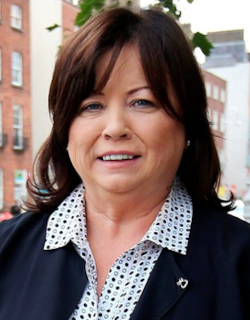
Harney studies economics at Trinity College Dublin and is the first woman auditor of the College Historical Society, popularly referred to as “The Hist.” After graduation she spends a year teaching mathematics and economics at Castleknock College in Dublin. In 1977, her political career begins when she is appointed to Seanad Éireann, becoming the youngest ever member of the Seanad in Ireland. She continues to make history throughout here 34-year career in politics.
Ever ready to challenge the status quo, Harney’s entire political life is characterised by a passion for reform, innovation and enterprise. After seventeen years in government, she reaches the height of her career. She serves as Tánaiste from 1997 to 2006, becomes the first woman to lead a political party in Ireland and holds many important ministerial portfolios. She is also notably the longest serving female Government minister and Teachta Dála (TD) in the state’s history.
Harney’s work in environmental protection leads to major improvement in the air quality in Dublin as she tackles the problem of smog in the capital by making Dublin a smokeless fuel city. By founding the Environmental Protection Agency (EPA) she leads a unified response among all 31 local authorities in their responsibility towards licensing and monitoring environmental standards. She establishes the first recycling initiative in the country.
During her tenure as Minister for Enterprise, Trade and Employment (1997-2004), Harney promotes indigenous industry and foreign direct investment in the country and leads many trade and investment missions to various parts of the world, working with both national and international companies. She works particularly to enhance the presence of high technology companies both indigenous and international in Ireland. She leads a major drive to increase employment in Ireland through a combination of activation measures for unemployed people and improving incentives for people to take up jobs. She pioneers the first ever major programme of investment in basic research in Ireland through Science Foundation Ireland based on internationally peer-reviewed projects. She establishes the Personal Injuries Assessment Board, avoiding unnecessary legal intervention and in turn dramatically cuts the cost of insurance in Ireland, notably in the areas of Employers’ and Public Liability and Motor Insurance. She strengthens competition law and enforcement and establishes an independent office for corporate enforcement.
As Minister for Health and Children (2004-2011), Harney begins the move towards a unified Health Service by replacing a number of politically-dominated Health Boards with the Health Service Executive (HSE). She establishes an independent Health Information and Quality Authority (HIQA) to provide an independent inspector of the delivery of health services in Ireland and leads the reform of cancer services by consolidating them to eight specialist centres. She introduces “Fair Deal,” a financing mechanism to deliver nursing home care for the elderly. She reforms the regulation of the Medical and Pharmacy Professions, introducing statutory requirements to maintain professional competence. She introduces, for the first time, a lay majority on the boards of the Medical Council of Ireland and of the Pharmaceutical Society of Ireland (PSI).
Harney wins a number of awards as employment minister and for promoting science and innovation. She serves as president of the Council of the European Union during Irish presidency and is a member of International Women’s Forum. She is the youngest member of Seanad Éireann and the longest serving female member of Dáil Éireann. She is the first woman leader of an Irish political party and the first woman to be Tánaiste. She is twice selected as Woman of the Year in Ireland. She is awarded an honorary doctorate from Trinity College Dublin in recognition of her contributions as Minister to science and innovation.
Harney is now the director of a number of private companies in pharmaceutical, healthcare, technology and financial services sectors. She provides business advisory services to a range of companies and organisations. She also undertakes speaking engagements, particularly in a business context. She is the current Chancellor of the University of Limerick.
TaoiseachEnda Kenny conveys his resignation to PresidentMichael D. Higgins at Áras an Uachtaráin on March 10, 2016, after failing to get re-elected to the position in a Dáil vote, becoming acting Taoiseach as the Dáil adjourns until March 22. “It’s not the outcome that I personally would have liked to see but I respect the verdict of the people,” Kenny says. The vote for the former Taoiseach stands at: For 57, Against 94, Abstain 5.
Kenny, the MayoTD, says the Cabinet will continue its work while the various parties try to form a government. A government statement issued in the evening reads, “The Taoiseach, Mr. Enda Kenny, T.D., has this evening conveyed to the President his resignation from office. In accordance with the Constitution, the Government and the Taoiseach will continue to carry on their duties until successors have been appointed.”
Kenny says when Fine Gael and the Labour Party entered government five years earlier “our very survival was in doubt.” He adds, “The Government had to face unprecedented sets of difficulties. Many believed the situation was hopeless. The country is in a different place now.”
The outgoing Taoiseach says he is “fully committed” to working with other parties and independents to form a new government. He adds that “a substantial number of people do not want to serve in government.” Fianna Fáil leader Micheál Martin says the situation is not unprecedented and people should put aside the notion that “speed” is an issue in forming a government. “Ireland is relatively unusual in how fast it carries out the formation of government,” he says.
A total of 50 Fine Gael TDs are re-elected to the 32nd Dáil. The five abstentions in the Enda Kenny vote are TDs Michael Harty, Noel Grealish, Denis Naughten, Michael Collins and Mattie McGrath. They say they will abstain on each vote for Taoiseach in an indication they are willing to hold further coalition talks.
The vote for the other nominees are: Fianna Fáil leader Micheál Martin: For 43, Against 108, 5 Abstain. Sinn Féin leader Gerry Adams: For 24, Against 116. AAA-PBP candidate Richard Boyd Barrett: For 9, Against 111.
(From: “Enda Kenny resigns as Taoiseach after failing to get re-elected as leader” by Kevin Doyle and Niall O’Connor, http://www.independent.ie, March 10, 2016)
Mac Eoin is born John Joseph McKeon on September 30, 1893, at Bunlahy, Granard, County Longford, the eldest son of Andrew McKeon and Catherine Treacy. After a national school education, he trains as a blacksmith at his father’s forge and, on his father’s death in February 1913, he takes over the running of the forge and the maintenance of the McKeon family. He moves to Kilinshley in the Ballinalee district of County Longford to set up a new forge.
Mac Eoin comes to prominence in the Irish War of Independence as leader of an Irish Republican Army (IRA) flying column. In November 1920, he leads the Longford brigade in attacking Crown forces in Granard during one of the periodic government reprisals, forcing them to retreat to their barracks. On October 31, Inspector Philip St. John Howlett Kelleher of the RIC is shot dead in the Greville Arms Hotel in Granard. Members of the British Auxiliary Division set fire to parts of the town. The following day, Mac Eoin holds the village of Ballinalee situated on the Longford Road between Longford and Granard. They stand against superior British forces, forcing them to retreat and abandon their ammunition. In a separate attack on November 8, he leads his men against the RIC at Ballinalee. One constable is killed, and two others are wounded.
On the afternoon of January 7, 1921, a joint RIC and British Army patrol consisting of ten policemen appears on Anne Martin’s street. According to Mac Eoin’s own testimony at his trial he is in the house in partial uniform, wearing Sam Browne belt and revolver with two Mills No. 4 bombs in his pocket. Owing to some females being in the house, he has to get out as to not endanger them. He steps out on the street and opens fire with his revolver. The leading file falls and the second file brings their rifles to the ready. He then throws a bomb, after which he sees that the entire force has cleared away, save the officer who was dead or dying on the street.
On February 2, 1921, the Longford IRA ambushes a force of the Auxiliaries on the road at Clonfin, using a mine it had planted. Two lorries are involved, the first blown up, and the second strafed by rapid rifle fire. Four auxiliaries and a driver are killed and eight wounded. The IRA volunteers capture 18 rifles, 20 revolvers and a Lewis gun. At the Clonfin Ambush, Mac Eoin orders his men to care for the wounded British, at the expense of captured weaponry, earning him both praise and criticism. He is admired by many within the IRA for leading practically the only effective column in the midlands.
Mac Eoin is captured at Mullingar railway station on March 1, 1921, imprisoned and sentenced to death for the murder of an RIC district inspector in the shooting at Anne Martin’s street in January 1921.
In June 1921, Henry Wilson, the British Chief of the General Staff (CIGS), is petitioned for clemency by Mac Eoin’s mother, his brother Jemmy, and the local Church of Irelandvicar, but passes on the appeals out of respect for the latter two individuals. Three auxiliaries had already given character references on his behalf after he had treated them chivalrously at the Clonfin Ambush in February 1921. However, Nevil Macready, British Commander-in-Chief, Ireland, confirms the death sentence describing Mac Eoin as “nothing more than a murderer.”
While imprisoned Mac Eoin is elected to Dáil Éireann at the 1921 Irish elections, as a TD for Longford–Westmeath. He is eventually released from prison, along with all other members of the Dáil, after Michael Collins threatens to break off treaty negotiations with the British government unless they are freed.
Mac Eoin joins the National Army and is appointed GOC Western Command in June 1922. His military career soars after the Irish Civil War. He is appointed GOC Curragh Training Camp in August 1925, Quartermaster General in March 1927, and Chief of Staff in February 1929.
Mac Eoin resigns from the Army in 1929 and is elected at a by-election to Dáil Éireann for the Leitrim–Sligo constituency, representing Cumann na nGaedheal. At the 1932 Irish general election, he returns to the constituency of Longford–Westmeath and continues to serve the Longford area as TD until he is defeated at the 1965 Irish general election.
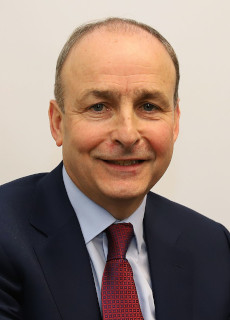
While Martin is Minister for Health and Children in 2004, he introduces a ban on tobacco smoking in all Irish workplaces and establishes the Health Service Executive (HSE). Ireland is the first country to introduce a full workplace smoking ban. As Foreign Minister, in 2009, he travels to Latin America for the first time and makes the first official visit to Cuba by an Irish Minister. That same year, he travels to Khartoum following the kidnapping of Sharon Commins and Hilda Kawuki. In 2010, he becomes the first Western foreign minister to visit Gaza since Hamas took control there in 2007.
In January 2011, Martin resigns as Minister for Foreign Affairs and is subsequently elected as the eighth leader of Fianna Fáil following Cowen’s resignation as party leader. In the 2011 Irish general election, he leads the party to its worst showing in its 85-year history, with a loss of 57 seats and a drop in its share of the popular vote to 17.4%. In the 2016 Irish general election, Fianna Fáil’s performance improves significantly, more than doubling their Dáil representation from 20 to 44 seats. In the 2020 Irish general election, Fianna Fáil becomes the largest party, attaining the most seats at 38, one seat ahead of Sinn Féin with 37 seats. He is appointed Taoiseach on June 27, 2020, leading a grand coalition with longtime rival Fine Gael and the Green Party as part of a historic deal. Under the terms of the agreement, Martin’s predecessor, Leo Varadkar, becomes Tánaiste, and will swap roles with Martin in December 2022.
After months of negotiations and two special delegate conferences, Democratic Left merges with the Labour Party on January 24, 1999.
Democratic Left is formed after a split in the Workers’ Party of Ireland, which in turn has its origins in the 1970 split in Sinn Féin and, after seven years in existence, it is incorporated into the Labour Party in 1999. Although never formally styled as a communist party, the Workers’ Party has an internal organisation based on democratic centralism, strong links with the Soviet Union, and campaigns for socialist policies. However, between 1989 and 1992 the Workers’ Party is beset by a number of problems.
On February 15, 1992, a special conference is held in Dún Laoghaire to reconstitute the party. A motion proposed by Proinsias De Rossa and general secretary Des Geraghty seek to stand down the existing membership, elect an 11-member provisional executive council and make several other significant changes in party structures but it is defeated by nine votes.
After the conference it is clear a split is inevitable. At an Ard Chomhairle meeting held on February 22, 1992, in Wynn’s Hotel in Dublin, six of the party’s TDs resign from the party along with more than half of the Ard Chomhairle. The new breakaway party is provisionally named New Agenda with De Rossa becoming leader of the party.
In the 1997 Irish general election Democratic Left loses two of its six seats, both of its by-election victors, Eric Byrne in Dublin South-Central and Kathleen Lynch in Cork North-Central, being unseated. The party wins 2.5% of the vote. The party also is in significant financial debt because of a lack of access to public funds, due to its size. Between 1998 and 1999 the party enters discussions with the Labour Party which culminates in the parties’ merger in 1999, keeping the name of the larger partner but excluding members in Northern Ireland from organising. This leaves Gerry Cullen, their councillor in Dungannon Borough Council, in a state of limbo, representing a party for whom he can no longer seek election.
The launch of the merged party is in the Pillar Room of the Rotunda Hospital in Dublin on January 24, 1999. Labour Party leader Ruairi Quinn remains leader of the unified party, while De Rossa takes up the largely titular position of party president. Only 10% of Democratic Left delegates at the special conference had voted against the merger. De Rossa successfully contests the 1999 European Parliament election in Dublin. He holds his Dáil seat until he stands down at the 2002 Irish general election. He holds his European Parliament seat in the 2004 election and 2009 election.
In 2002, former Democratic Left TDs Pat Rabbitte and Liz McManus are elected as Labour Party leader and deputy leader respectively. When Rabbite steps down as Labour leader after the 2007 Irish general election, Eamon Gilmore is elected unopposed as his successor.
The party archives are donated to the National Library of Ireland by the Labour Party in 2014. The records can be accessed by means of the call number: MS 49,807.
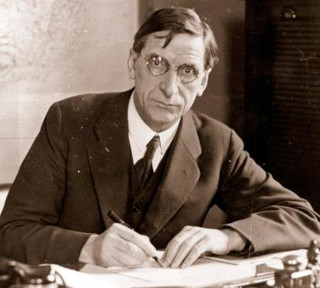
Éamon de Valera’s new constitution, with its assertions of Ireland as a sovereign 32-county state, and its definition of Catholic morality and “women’s place” is approved on January 14, 1937.
De Valera’s 1937 constitution (Bunreacht na hÉireann) evokes a passionate rebuke of the articles defining the role and rights of women. The aspirations of 1916 had been eroded to the extent that the rights of half of the State’s citizens were reduced and effectively became second-class citizens. In 1936, while formulating the new constitution, Éamon de Valera establishes a civil service committee to assist him. They are all men. He also takes extensive advice from the president of the Supreme Court and the High Court. Both again are men. Archbishop of Dublin, John Charles McQuaid, also heavily influences the final text. There are only three women TDs at the time and none of them say a word in the Dáil debates on the draft.
Women are told that marriage should be their highest aspiration, child rearing their only creative outlet, and that economic dependence their civic duty. That in its turn produces levels of misogyny, emotional sterility and civic immaturity.
Article 41.2.1 becomes famous as ‘a woman’s place is in the home’ statement: “the State recognises that by her life within the home, woman gives to the State a support without which the common good cannot be achieved.”
Many women protest in public and in private during the drafting of de Valera’s constitution. The Irish Women Workers Union, many of whose members had been involved in the 1916 Easter Rising, express outrage. A letter from the secretary to de Valera, quoting the clauses which refer to the position of women says, “it would hardly be possible to make a more deadly encroachment upon the liberty of the individual.” The constitution is accepted and a combination of revisionism and isolationism in the years that follow leave the majority of Ireland’s citizens ignorant of the legacy woman had been denied.
The fundamental principle of the 1916 proclamation, which guaranteed religious and civil liberty, equal rights and equal opportunities to all citizens, echoed by the 1922 Constitution of the Irish Free State, guaranteeing those rights to every person “without distinction of sex,” had been changed.
As commander of the Boland’s Mill outpost in 1916, de Valera had been the only leader to refuse women’s participation in the Rising. As with many of the woman who fought in the Rising, in the same streets where Elizabeth O’Farrell walked through gunfire, now with Article 41 of the Constitution, de Valera closes the door on women’s progress in a more definitive way.
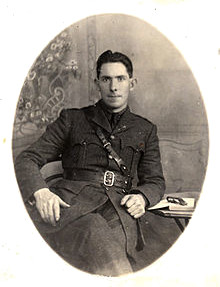
Mac Eoin is a soldier and eventual politician of the Fine Gael party. He is commonly referred to as the “Blacksmith of Ballinalee.” He is born John Joseph McKeon on September 30, 1893, at Bunlahy, Granard, County Longford, the eldest son of Andrew McKeon and Catherine Treacy. He joins the United Irish League in 1908. His Irish nationalist activities begin in earnest in 1913, when he joins the Clonbroney Company of the Irish Volunteers. Late that year he is sworn into the Irish Republican Brotherhood and joins the Granard circle of the organization.
Mac Eoin comes to prominence in the Irish War of Independence as leader of an Irish Republican Army (IRA) flying column. On November 4, 1920, his column holds the village of Ballinalee situated on the Longford Road between Longford and Granard. They stand against superior British forces, forcing them to retreat and abandon their ammunition. In a separate attack on November 8, he leads his men against the RIC at Ballinalee. An eighteen-year-old Constable Taylor is killed. Constable E. Shateford and two others are wounded. The story is that the small garrison sings “God Save the King” as they take up positions to return fire.
On the afternoon of January 7, 1921, a joint RIC and British Army patrol consisting of ten policemen led by an Inspector, with a security detachment of nine soldiers, appears on Anne Martin’s street. Mac Eoin’s own testimony at his trial, which is not contested by any parties present, states, “I was at the table writing when I was informed of the advance of the party. My account books were left in this house for safety. I was in partial uniform, wearing Sam Browne belt and revolver with two Mills No. 4 bombs in my pocket. Owing to some females being in the house, I had to get out as I could not endanger them by putting up a defence in the house, and as this Officer and Police Force had already signified to my sister and mother their intention to shoot me on sight, I decided to give them a run for their money. I stepped out on the street, about three paces directly in front of the oncoming force and opened fire with my revolver. The leading file fell, and then the second file in the gateway brought their rifles to the ready. I then threw a bomb and jumped back behind the porch to let it burst. When it had burst and the smoke had lifted, I saw that the whole force had cleared away, save the officer who was dead or dying on the street.” The casualties from this incident are District Inspector Thomas McGrath killed, and a police constable wounded.
Mac Eoin is captured at Mullingar railway station in March 1921, imprisoned and sentenced to death for the murder of RIC District Inspector McGrath in the shooting at Anne Martin’s street in January 1921. Michael Collins organises a rescue attempt in June 1921. Six IRA Volunteers, led by Paddy Daly and Emmet Dalton, capture a British armoured car and, wearing British Army uniforms, gain access to Mountjoy Prison. However, Mac Eoin is not in the part of the jail they believed and, after some shooting, the party retreats.
Within days, Mac Eoin is elected to Dáil Éireann at the 1921 Irish elections, as a TD for Longford–Westmeath. He is eventually released from prison, along with all other members of the Dáil, after Collins threatens to break off treaty negotiations with the British government unless he is freed. It is rumoured that Sean Mac Eoin serves as the best man at Collins’ wedding.