McCann’s career includes parts in many plays from the Irish literary canon, including Tarry Flynn, The Shaughran, and the Gate Theatre‘s highly acclaimed production of Seán O’Casey‘s classic Juno and the Paycock in the 1980s (McCann plays the “Paycock” (Captain Boyle) opposite Geraldine Plunkett as Juno and John Kavanagh as Joxer Daly) as well as a subsequent production of O’Casey’s The Plough and the Stars.
McCann develops a particularly fruitful relationship with the playwright Brian Friel. He plays the role of Gar O’Donnell, the public figure, in a film adaptation of Philadelphia, Here I Come! in 1970 and, despite popular belief, he never plays either public or private Gar on stage. He gives a landmark performance as Frank Hardy, the title character, in Faith Healer in 1980 (a role he reprised in 1994), continuing his relationship with Friel through productions of Translations (1988) and Wonderful Tennessee (1993).
Friel says that McCann’s work “contains extraordinary characteristics that go beyond acting … it is deeply spiritual.” Perhaps McCann’s most renowned role is as Thomas Dunne in Sebastian Barry‘s The Steward of Christendom. He wins the London Critics’ Circle Theatre Award (Drama Theatre) as best actor for this role in 1995. He reprises this role in a 1996 production at the Gate Theatre, Dublin and, following a twelve-week run at the Brooklyn Academy of Music in 1997, his “performance of unarguable greatness” (The New York Observer) had Newsweekhailing him as “a world-class star,” and The New York Times referring to this “astonishing Irish actor…widely regarded as the finest of them all.”
On the London stage, McCann plays in Prayer for My Daughter opposite Antony Sher (1978), and is Jean to Dame Helen Mirren‘s Julie in Miss Julie (1971). This is filmed for the BBC, and he much later plays Judge Brack with Fiona Shaw in the title role of Henrik Ibsen‘s Hedda Gabler, a production filmed for the BBC in 1993.
His best-known film role is as Gabriel Conroy in The Dead (1987), starring opposite Anjelica Huston and directed by her father, John Huston. Significant late roles include Bernardo Bertolucci‘s Stealing Beauty (1996) and in John Turturro‘s Illuminata (released in 1999, after McCann’s death).
McCann’s television work includes the featured role of Phineas Finn in the BBC’s serialised adaptation of Anthony Trollope‘s The Pallisers, Willie Burke in RTÉ‘s Prix Italia drama entry The Burke Enigma (1979) and Barney Mulhall in RTÉ’s Strumpet City (1980), as well as many one-off parts.
McCann plays in Bob Quinn‘s Irish language film Poitín (1979) and in Quinn’s somewhat experimental The Bishop’s Story (1995). After hearing that McCann is ill, Tom Collins asks Quinn to make a TV documentary about McCann for RTÉ called It Must Be Done Right (1999), after a remark by McCann on his craft. The film airs on RTÉ a week before McCann’s death.
In his private life, McCann is a quiet and unassuming man, but he battles both depression and alcoholism all his life. He has many friends in Irish theatre and artistic circles but also across all strata of life. His hobbies include sketching and he is passionate about horse racing.
Remembering McCann on the 25th anniversary of his death, Gerald Smyth writes, “In the melancholy of that life-worn voice could be heard the cadences of a lyric heart.”
Gwynn spends his early childhood in rural County Donegal, which is to shape his later view of Ireland. He attends Brasenose College, Oxford, where, as scholar, in 1884 he is awarded first-class honours in classical moderations and in 1886 literae humaniores. During term holidays he returns to Dublin, where he meets several of the political and literary figures of the day.
After graduating, Gwynn spends ten years from 1886 tutoring as a schoolmaster, for a time in France, which creates a lifelong interest in French culture, as expressed in his Praise of France (1927). By 1896 he has developed an interest in writing, becoming a writer and journalist in London focused on English themes, until he comes into contact with the emerging Irish literary revival, when he serves as secretary of the Irish Literary Society.
This is the beginning of a long and prolific career as a writer covering a wide range of literary genres, from poetry and biographical subjects to general historical works. The eighteenth century is Gwynn’s particular specialism. He writes numerous books on travel and on the topography of his own homeland, as well as on his other interests: wine, eighteenth-century painting and fishing.
Gwynn returns to Ireland in 1904 when he enters politics. In the 1906 Galway Borough by-election he wins a seat for Galway Borough, which he represents as a member of the Irish Parliamentary Party until 1918. During this period, he is active in the Gaelic League and is one of the few Irish MPs to have close links to the Irish literary revival. Along with Joseph Maunsel Hone and George Roberts he founds the Dublin publishing house of Maunsel and Company. He is opposed to the demand for the Irish language to be a compulsory subject for matriculation. He supports the campaign which wins the establishment of a Catholic university when he serves on the Irish University Royal Commission in 1908. During the debate on the third Home Rule Bill, and at the request of his party leader John Redmond, he writes The case for Home Rule (1911) and is in charge of much of the party’s official publicity and its replies to criticism from Sinn Féin.
On the outbreak of World War I in August 1914, Gwynn strongly supports Redmond’s encouragement of Irish nationalists and the Irish National Volunteers to support the Allied and British war effort by enlisting in Irish regiments of the Irish Divisions, especially as a means to ensure the implementation of the suspended Home Rule Act at the end of an expectedly short war. Now over fifty, he enlists in January 1915 with the 7th Leinster Regiment in the 16th (Irish) Division. In July he is commissioned as a captain in the 6th (Service) Battalion, Connaught Rangers and serves with them on the Western Front at Messines, the Somme and elsewhere.
Gwynn is one of five Irish Nationalist MPs who enlist and serve in the army, the others being John L. Esmonde, Willie Redmond, William Redmond and D. D. Sheehan, as well as former MP Tom Kettle. Together with Kettle and William Redmond, he undertakes a recruitment drive for the Irish divisions, co-operating with Kettle on a collection of ballads called Battle Songs for the Irish Brigade (1915). He is made a chevalier of the Legion of Honour in July 1915. In 1916, he is appointed to the Dardanelles Commission.
Recalled to Ireland in late 1917 to participate in the Irish Convention chaired by Sir Horace Plunkett, Gwynn sides with the Redmondite faction of the Irish Party in supporting a compromise with the southern unionists in an attempt to reach consensus on a Home Rule settlement which would avoid partition. On the death of Redmond in March 1918, he takes over as leader of the moderate nationalists in the Convention. He opposes the threat of compulsory military service during the Conscription Crisis of 1918, though as a member of the Irish Recruiting Council he continues to support voluntary recruitment, encountering intense opposition led by Sinn Féin.
Gwynn forms the Irish Centre Party in 1919 and stands unsuccessfully as an Independent Nationalist for Dublin University in the 1918 Irish general election. The party merges with Plunkett’s Irish Dominion League to press for a settlement by consent on the basis of dominion status, but Gwynn subsequently breaks with Plunkett due to his willingness to accept partition as a temporary compromise. The polarities which divide Ireland during the Irish War of Independence and Irish Civil War increasingly sideline his brand of moderate cultural nationalism. Although he supports the newly emergent nation, he equally condemns some of the excesses, such as the burning of houses belonging to Free State senators.
Gwynn’s personal life also becomes complicated at this stage and around 1920. He has a romantic association with married artist Grace Henry who is perhaps the best-known female artist in Ireland at the time. During this period, he and Grace travel in France and Italy and at various stages in his life she painted portraits of him including a very distinguished looking one of him in his late 60s or early 70s. Their relationship contributes significantly to the separation of Henry from her artist husband Paul Henry in 1930.
During the 1920s, Gwynn also devotes himself to writing, covering political events as Irish correspondent to The Observer and The Times. Later in his career, he writes some substantial works, and together with his son Denis Gwynn (The Life of John Redmond, 1932) does much to shape the retrospective image and self-justification of John Redmond. In the mid-1930s he authors three books with a connecting theme of fishing with the artist Roy Beddington serving as illustrator: The Happy Fisherman (1936), From River to River (1937), and Two in a Valley (1938).
Gwynn is awarded an honorary D.Litt. by the National University of Ireland in 1940, and a Litt.D. by the University of Dublin in 1945. The Irish Academy of Letters awards him the Gregory Medal in April 1950. In his literary writings he stands for a humanism and tolerance, which qualities, due to political upheavals, were relatively rare in the Ireland of his day.
Gwynn dies on June 11, 1950, at his home in Terenure, Dublin, and is buried at Tallaght Cemetery, south County Dublin.
Gwynn marries his cousin Mary Louisa (d. 1941), daughter of Rev. James Gwynn. She later converts to Catholicism. They have three sons and two daughters who are brought up in her religion, of whom Aubrey (1892–1983) becomes a Jesuit priest and professor of medieval history at University College Dublin (UCD). Their second son, Denis Rolleston (1893–1971), is professor of modern Irish history at University College Cork (UCC).
Gwynn’s brother Edward John (1868–1941) becomes provost of Trinity College and another brother Robert Malcolm becomes its senior dean. His sister Lucy Gwynn is the first woman registrar of Trinity. A third brother, Charles, has a successful career in the British Army and retires as a Major General. Younger brothers Lucius and Jack are noted cricketers.
Sir Maziere Brady, 1st Baronet, PC (Ire), Irish judge, notable for his exceptionally long, though not particularly distinguished tenure as Lord Chancellor of Ireland, is born on July 20, 1796.
The Bradys are an old and distinguished Munster family who are particularly associated with the town of Bandon, County Cork. Probably the most celebrated of his ancestors is the poet and psalmist Nicholas Brady (1659–1726), who collaborated with Nahum Tate, the Poet Laureate, on New Version of the Psalms of David.
Other notable forebears include Hugh Brady, the first ProtestantBishop of Meath (d. 1584), his father-in-law Robert Weston who, like Maziere serves as Lord Chancellor of Ireland, and the judge and author Luke Gernon (d. 1672), who is now best remembered for his work A Discourse of Ireland (1620), which gives a detailed and (from the English colonial point of view) not unsympathetic picture of the state of Ireland in 1620.
In politics Brady is a Liberal and supports Catholic emancipation. He sits on a commission of inquiry into Irish municipal corporations in 1833. He is appointed Solicitor-General for Ireland in 1837 and Attorney-General for Ireland the following year. In 1840 he is appointed Lord Chief Baron of the Irish Exchequer. In 1846 he is appointed Lord Chancellor of Ireland and serves in that office, with short intervals, for the next 20 years. He retires in 1866 and is made a baronet, of Hazelbrook in the County of Dublin, in 1869. His appointment ends the practice which grew after the Acts of Union 1800 of appointing only English lawyers as Lord Chancellor of Ireland. He sits on the Government Commission on Trinity College Dublin in 1851 and is nominated as Vice-Chancellor of Queen’s University Belfast in 1850. All through his life he shows a keen interest in education.
According to Elrington Ball, Brady’s Lord Chancellorship is notable for its length but for nothing else. Ball calls him “a good Chief Baron spoiled to make a bad Chancellor.” By general agreement he had been an excellent Chief Baron of the Exchequer, having a reputation for being fair-minded, courteous and approachable, but in Ball’s view the more onerous (and partly political) office of Lord Chancellor is beyond his capacity. Unlike some judges whose training had been in the common law, he never quite masters the separate code of equity. Delaney takes a somewhat more favourable view of Brady as Lord Chancellor, arguing that while his judgements do not show any great depth of learning they do show an ability to identify the central issue of any case and to apply the correct legal principle to it.
An anonymous pamphlet from 1850, which is highly critical of the Irish judiciary in general, describes Brady as being unable to keep order in his Court, and easily intimidated by counsel, especially by that formidable trio of future judges, Jonathan Christian, Francis Alexander FitzGerald, and Abraham Brewster. The author paints an unflattering picture of Brady as sitting “baffled and bewildered” in a Court where he is “a judge but not an authority.” On the other hand, Jonathan Christian, who had often clashed with Brady in Court, later praises him as “no ordinary man” despite his shortcomings as a judge. He describes him as “independent-minded, patriotic, natural and unaffected.”
Brady is a founder member of the Stephen’s Green Club and a member of the Royal Dublin Society and the Royal Irish Academy. In addition to the arts, he shows a keen interest in science, especially after his retirement. Like most judges of the time, he has both a town house in central Dublin and a place some distance from the city centre. His country house is Hazelbrook, Terenure, Dublin. He changes his town house several times, settling finally in Pembroke Street.
Brady marries firstly Elizabeth Anne Buchanan, daughter of Bever Buchanan, apothecary of Dublin, and his wife Eleanor Hodgson, in 1823 and they have five children. Elizabeth dies in 1858. In 1860, Brady marries Mary Hatchell, daughter of John Hatchell, Attorney-General for Ireland and Elizabeth Waddy, who survives him. He dies at his house in Pembroke Street on April 13, 1871. He is buried in Mount Jerome Cemetery.
Boylan is born in Dublin on April 21, 1948, the youngest of three daughters of Patrick Boylan, a clerk, and his wife Evelyn (née Selby). Her mother feels trapped by the limitations that domesticity imposes on women in 1950s Ireland, and had wanted to have a writing career. She encourages her daughter to send off stories and poems to newspapers. The first piece is published when she is 14, and she wins a prize in the national Texaco Children’s Art Competition when she is about 10 years old.
The family lives in the Dublin suburb of Terenure. Boylan goes to school in the Presentation convent, then St. Louis convent in Rathmines, and does her leaving certificate in Rathmines College.
After leaving St. Louis convent, Boylan takes a job as a sales assistant in a bookshop before beginning her career as a journalist at The Irish Press, now defunct. She marries Alan Wilkes, a journalist who is a colleague at The Irish Press, in St. Patrick’s Church in Straffan, County Kildare, on September 18, 1970. In 1974 she wins the Journalist of the Year award when working in the city for the Evening Press. Later in her career she edits the glossy magazine Image, before largely giving up journalism to focus on a career as an author.
Boylan’s novels are Holy Pictures (1983), Last Resorts (1984), Black Baby (1988), Home Rule (1992), Beloved Stranger (1999), Room for a Single Lady (1997), which wins the Spirit of Light Award and is optioned for a film, and Emma Brown (2003). The latter work is a continuation of a 20-page fragment written by Charlotte Brontë before her death.
Boylan’s short stories are collected in A Nail on the Head (1983), Concerning Virgins (1990) and That Bad Woman (1995). The film Making Waves, based on her short story “Some Ladies on a Tour”, is nominated for an Oscar in 1988.
Boylan’s non-fiction includes The Agony and the Ego (1994) and The Literary Companion to Cats (1994). She writes introductions to the novels of Kate O’Brien and Molly Keane and adapts Keane’s novel Good Behaviour as the classic serial for BBC Radio 4 (2004). Her work has been translated as far afield as Russia and Hong Kong.
In later life, Boylan lives in County Wicklow with her husband. When she is diagnosed with ovarian cancer, she faces her illness with characteristic strength. She takes up kickboxing and spends time in France, shopping, cooking and entertaining friends. She succumbs to cancer at the age of 58 on May 16, 2006.
At the 1992 Irish general election, Upton stands again in Dublin South-Central, and in Labour’s “Spring Tide” surge at that election, he tops the poll with nearly 12,000 first-preference votes, a remarkable 1.48 quotas. He is re-elected at the 1997 Irish general election with a considerably reduced vote.
In the 28th Dáil Upton is appointed as Labour’s spokesperson on Justice, Equality and Law Reform. A leading critic of Labour’s 1999 merger with the Democratic Left, he nonetheless becomes the party’s spokesman on communications and sport after the merger.
Upton dies suddenly of a heart attack on February 22, 1999, at the UCD Veterinary College, where he is an occasional lecturer. He is taken to St. Vincent’s Hospital, and his death is officially confirmed. He is survived by his wife and their four children. Politicians of all parties pay glowing tributes to him for his outspoken but “erudite and incisive” contributions to politics and to Irish culture.
The by-election for Upton’s Dáil seat in Dublin South-Central is held on October 27, 1999, and won for the Labour Party by his sister Mary Upton.
Following Upton’s death, the University College Dublin branch of the Labour party is named in his honour due to his involvement with the college. It has since been renamed to honour the Spanish Civil War veteran Charlie Donnelly.
Pearse follows his brother into the Irish Volunteers and the republican movement. He takes part in the Easter Rising in 1916, always staying at his brother’s side at the General Post Office. Following the surrender, he is court-martialed and sentenced to death. It has been said that as he is only a minor player in the struggle it is his surname that condemns him. However, at his court martial he emphasizes his involvement.
On May 3, 1916, Pearse is granted permission to visit his brother in Kilmainham Gaol, to see him for the final time. However, while he is en route, Patrick is executed. He is executed on May 4. He and his brother are the only two brothers to be executed after the Easter Rising.
There are many more public commemorations of Patrick Pearse than of William. In 1966, Dublin’s Westland Row railway station is renamed Dublin Pearse railway station to honour both brothers. Pearse Square and Pearse Street in Dublin are renamed in honour of both, Pearse Street (then Great Brunswick Street) having been their birthplace. Many streets and roads in Ireland bear the name Pearse. Few name William, but there is a Pearse Brothers Park in Rathfarnham. The bridge over the River Dodder on the Rathfarnham Road, between Terenure and Rathfarnham is named after them and carries a plaque depicting the brothers in profile.
Brothers Pearse Athletic Club, founded in Rathfarnham, is named after the two brothers. A number of Gaelic Athletic Association clubs and playing fields are named after both Pearses, and at least one after William.
Gwynn spends his early childhood in rural County Donegal, which shapes his later view of Ireland. He is educated at St. Columba’s College and goes on to Brasenose College, Oxford, where, as scholar, in 1884 he is awarded first-class honours in classical moderations and in 1886 literae humaniores. During term holidays he returns to Dublin, where he meets several of the political and literary figures of the day.
After graduating Gwynn moves to France where he works as a schoolmaster for ten years. In December 1889 he marries his cousin Mary Louisa Gwynn. They have four sons and two daughters. Having dabbled in journalism since his student days, he moves to London in 1896 to pursue a career as a writer. He soon becomes a prominent figure in literary and journalistic circles.
At the outbreak of World War I, Gwynn gives his support to John Redmond that Irishmen should enlist in the British forces. At the age of fifty-one he enlists as a private in the 7th Leinster Regiment and is later commissioned lieutenant in the 6th Battalion Connaught Rangers, attached to the 16th (Irish) Division. He is promoted to captain in 1915 and serves with his battalion at the battles of Ginchy and Guillemont during the Somme offensive and also at Messines in 1917, leaving the front line shortly afterwards.
After the war Gwynn continues with his writing and political life. He receives honorary doctorates from the National University of Ireland in 1940 and the University of Dublin in 1945. He dies on June 11, 1950, at his home in Terenure, Dublin and is buried at Tallaght cemetery.
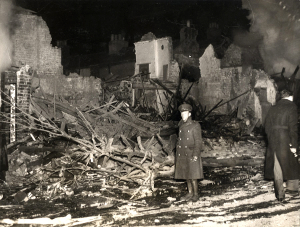
Four German bombs are dropped on north Dublin at approximately 2:00 AM on May 31, 1941. One bomb falls in the Ballybough area, demolishing the two houses at 43 and 44 Summerhill Park, injuring many but with no loss of life. A second bomb falls at the Dog Pond pumping works near the zoo in Phoenix Park, again with no casualties but damaging Áras an Uachtaráin, the official residence of the Irish President. A third bomb makes a large crater in the North Circular Road near Summerhill, again causing no injuries. A fourth bomb falls in North Strand destroying seventeen houses and severely damaging about fifty others, the worst damage occurring in the area between Seville Place and Newcomen Bridge. The raid claims the lives of 28 people, injures 90, destroys or damages approximately 300 houses, and leaves 400 people homeless.
The first bombing of Dublin during World War II occurs early on the morning of January 2, 1941, when German bombs are dropped on the Terenure area of south Dublin. This is followed, early on the following morning of January 3, 1941, by further German bombing of houses on Donore Terrace in the South Circular Road area of south Dublin. A number of people are injured, but no one is killed in these bombings.
After the war, what becomes West Germany accepts responsibility for the raid, and by 1958 it has paid compensation of £327,000. Over 2,000 claims for compensation are processed by the Irish government, eventually costing £344,000. East Germany and Austria, which are both part of Nazi Germany in 1941, make no contribution. The amounts are fixed after the 1953 London Agreement on German External Debts, allowing maximum compensation.
Several reasons for the raid have been asserted over time. German Radio, operated by the Ministry of Public Enlightenment and Propaganda, broadcasts that “it is impossible that the Germans bombed Dublin intentionally.” Irish airspace has been violated repeatedly, and both Allied and German airmen are being interned at the Curragh Camp. A possible cause is a navigational error or a mistaken target, as one of the pathfinders on the raid later recounts. Numerous large cities in the United Kingdom are targeted for bombing, including Belfast, which like Dublin, is across the Irish Sea from Great Britain. War-time Germany’s acceptance of responsibility and post-war Germany’s payment of compensation are cited as further indications that the causation is error on the part of the Luftwaffe pilots.
Another possible reason is that in April 1941, Germany has launched the Belfast blitz, which results in Belfast being heavily bombed. In response, Ireland sends rescue, fire, and emergency personnel to Belfast to assist the city. Éamon de Valera, the Taoiseach, formally protests the bombing to the German government, as well as making his famous “they are our people” speech. Some contend that the raid serves as a warning to Ireland to keep out of the war. This contention is given added credibility when Colonel Edward Flynn, second cousin of Ireland’s Minister for Coordination of Defensive Measures, recalls that Lord Haw Haw has warned Ireland that Dublin’s Amiens Street Railway Station, where a stream of refugees from Belfast is arriving, will be bombed. The station, now called Connolly Station, stands a few hundred metres from North Strand Road, where the bombing damage is heaviest. Flynn similarly contends that the German bombing of Dundalk on July 4 is also a pre-warning by Lord Haw Haw as a punishment for Dundalk being the point of shipment of Irish cattle sold to the United Kingdom.





 seamus dubhghaill