A New York city schoolteacher for more than thirty years, McCourt achieves literary fame later in life with his best-selling childhood memoir of the misery and squalor of his childhood, Angela’s Ashes. With a first printing of just 25,000 copies, the book becomes an instant favourite with critics and readers and is perhaps the ultimate case of the non-celebrity memoir, the extraordinary life of an ordinary man.
McCourt wins the annual Pulitzer Prize for Biography or Autobiography in 1997 and one of the annual National Book Critics Circle Awards for the book, which is eventually published in 25 languages and 30 countries. It is a bestseller and makes him a millionaire. Three years later, a movie version of Angela’s Ashes opens to mixed reviews with Northern Irish actor Michael Legge playing McCourt as a teenager.
McCourt is also the author of ‘Tis (1999), which continues the narrative of his life, picking up from the end of Angela’s Ashes and focusing on his life after returning to New York. He subsequently writes Teacher Man (2005) which details his teaching experiences and the challenges of being a teacher.
It is announced in May 2009 that McCourt has been treated for melanoma and that he is in remission, undergoing home chemotherapy. On July 19, 2009, he died from the cancer, with meningeal complications, at a hospice in Manhattan.
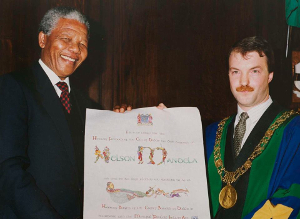
Nelson Rolihlahla Mandela, the first president of South Africa to be elected in a fully representative democratic election, is awarded the Freedom of the City of Dublin on his 70th birthday, July 18, 1988. Mandela is not available to receive his award on the date it is conferred, however, as he is a prisoner in South Africa at the time. On July 1, 1990, after his release from prison, Mandela finally receives the Freedom of the City of Dublin at a ceremony in the Mansion House Dublin.
The Freedom of the City of Dublin is awarded by Dublin City Council after approving a person nominated by the Lord Mayor of Dublin. Eighty people have been honoured under the current process introduced in 1876. Most honourees have made a contribution to the life of the city or of Ireland in general, including politicians, public servants, humanitarians, artists, and entertainers. Others have been distinguished members of the Irish diaspora and foreign leaders, honoured visiting Dublin. Honourees sign the roll of freedmen in a ceremony at City Hall or the Mansion House and are presented with an illuminated scroll by the Lord Mayor.
Mandela is honoured with the Freedom of Dublin city for his contribution to society and commitment to the study and promotion of Human Rights and also his work in the area of development and social inclusion, which has enhanced the lives of local communities in Ireland and fostered global links with institutions and organisations.
Holders of this award have some ancient privileges and duties such as the right to bring goods into Dublin through the city gates without paying customs duties, the right to pasture sheep on common ground within the city boundaries including College Green and St. Stephen’s Green (this right is exercised as a publicity stunt by U2 members the day after their 2000 conferring), and the right to vote in municipal and parliamentary elections. Some of the ancient duties are that freemen/women must be ready to defend the city of Dublin from attack and, at short notice, can be called up to join a city militia. Also a law which was passed in 1454 states that freemen/women must own a bow, a coat of mail, a helmet, and a sword.
The Dublin Millennium Commission proclaims in 1988 that June 13 is to be designated as “Molly Malone Day.”
Molly Malone is a popular song, set in Dublin, which has become the unofficial anthem of Dublin City. The song tells the fictional tale of a fishmonger who plies her trade on the streets of Dublin, but who dies of a fever at a young age. In the late 20th century a legend grows that there is a historical Molly, who lived in the 17th century. She is typically represented as a hawker by day and part-time prostitute by night. In contrast she has also been portrayed as one of the few chaste female street-hawkers of her day. However, there is no evidence that the song is based on a real woman of the 17th century or any other time for that matter. The name “Molly” originated as a familiar version of the names Mary and Margaret. While many such “Molly” Malones are born in Dublin over the centuries, no evidence connects any of them to the events in the song. Nevertheless, in 1988 the Dublin Millennium Commission endorses claims about a Mary Malone who died on June 13, 1699, and proclaims June 13 to be “Molly Malone Day.”
Molly Malone is commemorated in a statue designed by Jeanne Rynhart and unveiled by then Lord Mayor of Dublin, Alderman Ben Briscoe during the 1988 Dublin Millennium celebrations. The statue is presented to the city by Jury’s Hotel Group to mark the Millennium. Originally placed at the bottom of Grafton Street in Dublin, the statue is known colloquially as “The Tart With The Cart,” “The Dish with the Fish,” and “The Trollop With The Scallops.” The statue portrays Molly as a busty young woman in seventeenth-century dress. Her low-cut dress and large breasts were justified on the grounds that as “women breastfed publicly in Molly’s time, breasts were popped out all over the place.”
The statue is later removed and placed in storage to make way for new tracks for Luas, Dublin’s tram/light rail system. On July 18, 2014, it is temporarily placed outside the Dublin Tourist Office on Suffolk Street. The statue is expected to be returned to its original location in late 2017.
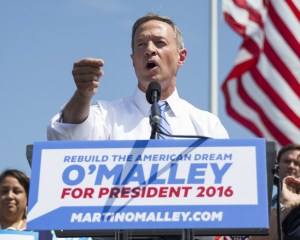
First elected Mayor of Baltimore in 1999, O’Malley is re-elected as mayor in 2003. Considering a run for governor in 2002, O’Malley instead focuses on his mayoralty. In 2006, nearing the end of his second term as mayor, O’Malley announces his candidacy for Governor of Maryland, an office he wins by a sizeable margin. He is re-elected by a wider margin in a rematch against Bob Ehrlich in 2010. O’Malley has been seen as a potential presidential candidate since at least November 2012.
O’Malley’s announcement includes a swing at Democratic candidate Hillary Rodham Clinton and Republican candidate Jeb Bush, “Recently, the CEO of Goldman Sachs let his employees know that he’d be just fine with either Bush or Clinton. Well, I’ve got news for the bullies of Wall Street—the presidency is not a crown to be passed back and forth by you between two royal families.”
During his speech, O’Malley cast Baltimore’s recent racial unrest, including a night of riots after the funeral of Freddie Gray who died of injuries sustained in police custody, as a symptom of a larger American problem. “What took place here was not only about race…not only about policing in America. It’s about everything it is supposed to mean to be an American,” he said. “The scourge of hopelessness that happened to ignite here that evening, transcends race or geography.”
O’Malley also takes swings at Wall Street. “Tell me how it is, that you can get pulled over for a broken taillight in our country, but if you wreck the nation’s economy you are untouchable.”
Highlighting his record as Maryland’s governor, O’Malley notes that he supported a successful bid to legalize gay marriage and helped raise the minimum wage.
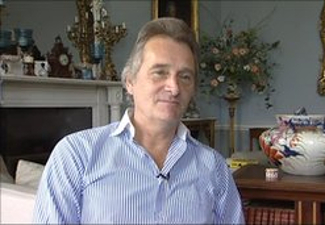
Styled Viscount Slane until 1974 and Earl of Mount Charles from 1974 until 2009, he succeeds his father in the marquessate and other titles in 2009. However, in the Republic of Ireland frequently, and erroneously, he remains referred to as Lord Mountcharles, his former courtesy title. He also inherits the U.K. peerage title Baron Minster, of Minster Abbey in the County of Kent, created in 1821 for his ancestor, the 1st marquess thereby giving the Marquesses Conyngham the automatic right to sit in the British House of Lords until 1999.
Lord and Lady Conyngham divide their time between Beauparc House and Slane Castle in County Meath. The latter is the family’s principal ancestral seat until it is badly damaged by fire in 1992. The castle has now been restored.
The Marquess Conyngham enjoys a high profile in Ireland as the author of a weekly column in the Daily Mirror. He has been dubbed the rock and roll aristocrat or the rock and roll peer owing to the very successful series of rock concerts he has hosted since 1981, held in the natural amphitheatre on the grounds of Slane Castle. These concerts have included performances by The Rolling Stones, Thin Lizzy, Queen, U2, Bob Dylan, Bruce Springsteen, David Bowie, Guns N’ Roses, Oasis, and Madonna. Lord Conyngham receives the Industry Award at the 2010 Meteor Awards. In his autobiography Public Space–Private Life: A Decade at Slane Castle, he describes his business career and the challenges of being an Anglo-Irish peer in modern Ireland, and how being Anglo-Irish has gradually become more accepted there.
Paul David Hewson, Irish singer-songwriter, musician, venture capitalist, businessman, and philanthropist known by his stage name Bono, is born in the Rotunda Hospital, Dublin, on May 10, 1960.
Bono writes almost all U2 lyrics, frequently using religious, social, and political themes. During U2’s early years, his lyrics contribute to their rebellious and spiritual tone. As the band matures, his lyrics become inspired more by personal experiences shared with the other members. Bono wins numerous awards with U2, including twenty-two Grammy Awards and the 2003 Golden Globe Award for best original song, “The Hands That Built America,” for the film Gangs of New York.
In 2005, the U2 band members are inducted into the Rock and Roll Hall of Fame in their first year of eligibility. In November 2008, Rolling Stone magazine ranks Bono as the 32nd-greatest singer of all time.
In 1992, Bono, along with The Edge, purchase and refurbish Dublin’s two-star 70-bedroom Clarence Hotel, converting it into a five-star 49-bedroom hotel.
Bono is on the board of Elevation Partners, a private equity firm, which attempts to purchase Eidos Interactive in 2005 and has since gone on to invest in other entertainment businesses. Bono invests in the Forbes Media group in the United States through Elevation Partners. Elevation Partners becomes the first outsider to invest in the company, taking a minority stake in Forbes Media LLC, a new company encompassing the 89-year-old business which includes Forbes magazine, the Forbes.com website and other assets. The terms of the deal are not disclosed, but reports say the stake is worth about $250 million. The firm also owns a 1.5 percent stake in the social networking site Facebook, originally purchased for $210 million.
Bono is also widely known for his activism concerning Africa, for which he co-founds DATA, EDUN, the ONE Campaign and Product Red. He organises and plays in several benefit concerts and meets with influential politicians. Over the years, Bono is praised and criticised for his activism and involvement with U2.
In 2007, Bono is named in the UK‘s New Year Honours list as an honorary Knight Commander of the Order of the British Empire. On March 29, 2007, he is formally granted knighthood by Queen Elizabeth II of the United Kingdom for “his services to the music industry and for his humanitarian work.” He is also made a Commandeur of the French Ordre des Arts et des Lettres (Order of Arts and Letters). Together with Bill and Melinda Gates, Bono is named Time Person of the Year in 2005, among other awards and nominations.
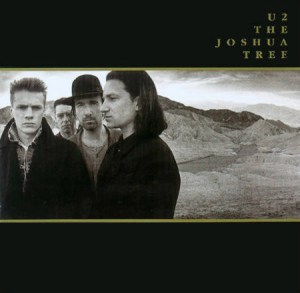
In contrast to the ambient experimentation of their 1984 release The Unforgettable Fire, the band aims for a harder-hitting sound within the limitation of conventional song structures on The Joshua Tree. The album is influenced by American and Irish roots music, and depicts the band’s love–hate relationship with the United States, using socially and politically conscious lyrics embellished with spiritual imagery.
Inspired by American tour experiences, literature, and politics, U2 chooses America as a theme for the album. Recording begins in Ireland in January 1986. Several events during the recording sessions help shape the conscious tone of the album, including the band’s participation in A Conspiracy of Hope tour, the death of roadie Greg Carroll, and lead vocalist Bono’s travels to Central America. Recording is completed in November 1986 and additional production continues into January 1987. Throughout the sessions, U2 seeks a “cinematic” quality for the record, one that will evoke a sense of location, in particular, the open spaces of America. They represent this in the sleeve photography depicting them in American desert landscapes.
The Joshua Tree receives critical acclaim, topping the charts in over 20 countries, and selling in record-breaking numbers. According to Rolling Stone, the album increases the band’s stature “from heroes to superstars.” It produces the hit singles With or Without You, I Still Haven’t Found What I’m Looking For, and Where the Streets Have No Name. The album wins Grammy Awards for Album of the Year and Best Rock Performance by a Duo or Group with Vocal in 1988. The group supports the record with the Joshua Tree Tour throughout 1987.
Frequently featured on critics’ lists of music’s greatest records, The Joshua Tree is one of the world’s best-selling albums, with over 25 million copies sold. U2 releases a remastered edition of the record in 2007 to commemorate its 20th anniversary. In 2014, it is deemed “culturally, historically, or aesthetically significant” by the U.S. Library of Congress and selected for preservation in the National Recording Registry.




 seamus dubhghaill