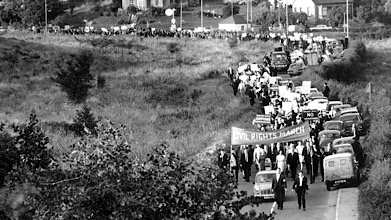
The protest is a direct response to the Caledon Protest just two months earlier, when Member of the Parliament of Northern IrelandAustin Currie “squats” in a house allocated by the Dungannon Rural District Council to a single, childless Protestant woman employed by a Unionistpolitician. The house has been given ahead of older married Catholic families with children, highlighting systemic housing discrimination. NICRA’s broader goals include ending gerrymandering, securing a universal franchise, and repealing discriminatory laws.
Around 2,000 people participate in the march, including men, women, and children, carrying banners and holding signs. The march is modeled on civil rights marches in the United States, using nonviolent direct action such as marches and sit‑ins. The atmosphere is initially described as a “holiday” by some participants, with a festive mood until police intervention.
As the march approaches Dungannon’s Market Square, the Royal Ulster Constabulary (RUC) orders a ban on entry and a meeting there. Behind the RUC line are 1,500 loyalists armed with cudgels and staves. The anti-civil rights countermarch has been organized by the Ulster Protestant Volunteers (UPV) with the help of the Rev. Ian Paisley. Confronted with this massive force, the civil rights marchers merely sit down and listen to a number of speeches, while Paisley and his followers sing sectarian songs and shout abuse from behind the RUC barricades. Police separate the two groups, preventing direct confrontation. On this day, the civil rights marchers escape harm but very soon all that would change.
Paisley rapidly makes a name for himself among hard-line loyalist groups. He later helps form a loyalist paramilitary group, the Ulster Defense Association (UDA). In the near future, his followers use their cudgels and staves in the streets of the six counties in an attempt to physically beat back the rising tide of the civil rights movement. The cycle of violence in the six counties rapidly spins out of control, and Paisley is one of the individuals driving the surge of violence.
While the march is peaceful and well‑attended, it does not immediately lead to policy changes. It, however, is a pivotal moment in the Northern Ireland civil rights movement, raising national attention to housing discrimination and galvanising further protests, including a later demonstration at DerryGuildhall.
This event is remembered as a symbol of early, nonviolent resistance in Northern Ireland’s struggle for civil and political equality.
(Pictured: The first civil rights procession from Coalisland to Dungannon on August 24, 1968. Photo credit: Belfast Telegraph)
McKeague is born in 1930 at Messines Cottage, Bushmills, County Antrim, Northern Ireland, one of six children of Thomas McKeague and his wife, Isabella. The family operates a guesthouse in Portrush before moving to Belfast, where they open a stationer’s shop on Albertbridge Road. It is inherited by McKeague and in the late 1970s it becomes a confectioner’s shop and café.
In 1969, McKeague and his associates take over the nascent Shankill Defence Association (SDA), which had been formed to oppose a destructive redevelopment scheme. He becomes its chairman and, despite his outsider status and eccentricities, is given to strutting around wearing a helmet and brandishing a stick, often seen as offering communal defence against a perceived Catholic threat. The organisation acquires 1,000 members. In August 1969, he orchestrates mob attacks on Catholic enclaves in Belfast, including Bombay Street. He boasts of these activities, becoming a figure of hate for Catholics. In October 1969, he is arrested and charged with conspiracy to cause an explosion but is cleared in February 1970. The sentence is reduced to three months on appeal. He testifies before Justice Leslie Scarman‘s tribunal, appointed to inquire into the unrest. In the course of his evidence, he exults over the August 1969 riots and the tribunal’s report condemns him by name. He later further enrages Catholics by calling the events of Bloody Sunday in January 1972 “Good Sunday” in a television interview.
McKeague seeks publicity and power, but his eccentricity and unwillingness to participate where he cannot command dooms his political ambitions. In the 1970 United Kingdom general election he wins only 441 votes in Belfast North. He is expelled from the UPV after being prosecuted in February–March 1970 over the loyalist bombing campaign of 1969, even though he is acquitted. He and Ian Paisley exchange bitter invective and he subsequently supports William Craig‘s Vanguard movement. In 1971, he and two associates are prosecuted under the new Incitement to Hatred Act for publishing a Loyalist song book, which includes verses, probably composed by McKeague, reveling in the murder of Catholics. The defendants plead that the book is purely a historical record, and their acquittal vitiates the act. After he quarrels with the newly formed Ulster Defence Association (UDA), which is created by a federation of the SDA with other local vigilante groups, his elderly mother is burned alive when the UDA petrol-bombs the family shop on May 9, 1971.
Early in 1972 McKeague is expelled from the SDA. He founds the Red Hand Commandos (RHC), centered on east Belfast and north Down, which perpetrates numerous sectarian murders. As RHC leader, he allegedly participates in murders involving torture and mutilation. He aligns the RHC with the UVF in 1972 and in February 1973 he is one of the first loyalist internees. He is subsequently imprisoned for three years for armed robbery, although he always asserts his innocence of this charge. During his imprisonment he assumes a leadership role among loyalist prisoners, undertaking two short hunger strikes in protest against the Special Powers Act and prison conditions. Later, in December 1981, he acts as an intermediary during a loyalist prison protest. On his release in 1975, the RHC splits and thereafter he denies any connection with the organisation, threatening to sue newspapers that link him with it. Until his death he is co-chair of the Ulster Loyalist Central Co-ordinating Committee (ULCCC), a paramilitary umbrella group established in 1974. On October 6, 1975, a Catholic customer is killed and McKeague’s sister severely injured when his shop is bombed by the Irish Republican Army (IRA).
From the mid-1970s McKeague advocates negotiated independence for Northern Ireland, arguing that this can accommodate republican anti-British feeling and unionist fears of a united Ireland. “The days of the Orange card are gone forever,” he says (Sunday World, January 31, 1982). He is a founder and deputy leader of the minuscule Ulster Independence Association and suggests that the “Londonderry Air” become Ulster‘s national anthem. In talks with nationalists and republicans, he tells the Catholic priest Des Wilson that a united Ireland would be acceptable to Protestants, provided “we enter as a free people, even if we’re only independent for five minutes.” However, his record is an insuperable barrier to these initiatives.
In his last years, McKeague is chairman of the Frank Street–Cluan Place–Stormont Street Housing Association. He lobbies for a security wall to shield this Protestant district of Belfast from the Catholic Short Strand on which it borders. Construction of the wall begins just before his death. He is shot dead by the INLA at his shop on Albertbridge Road on January 29, 1982. Shortly before his death, he is linked to the rape and prostitution of teenage boys at Kincora Boys’ Home in east Belfast. He had apparently been an informer to the security forces, and it is sometimes suggested that his murder is part of an official cover-up. He is buried in Bushmills, with Church of Ireland rites.
McKeague exemplifies the social deviant who can gain prominence during political instability, projecting and legitimising his hatreds and obsessions through extremist politics. In his last years, he accepts that he will die violently. He says that if loyalists kill him, “I want . . . to be left in the Republican area so that they’re blamed” (Sunday World, January 31, 1972).
(From: “McKeague, John Dunlop” by Patrick Maume, Dictionary of Irish Biography, http://www.dib.ie, October 2009)
Robinson serves in the role of General Secretary of the DUP from 1975, a position he holds until 1979 and which affords him the opportunity to exert unprecedented influence within the fledgeling party. In 1977, he is elected as a councillor for the Castlereagh Borough Council in Dundonald, County Down, and in 1979, he becomes one of the youngest Members of Parliament (MP) when he is narrowly elected for Belfast East. He holds this seat until his defeat by Naomi Long in 2010, making him the longest-serving Belfast MP since the Acts of Union 1800.
In January 2010, following a scandal involving his wife Iris (née Collins), Robinson temporarily hands over his duties as First Minister to Arlene Foster under the terms of the Northern Ireland Act 2006. Following a police investigation, which recommends that he should not be prosecuted following allegations made by the BBC in relation to the scandal, he resumes his duties as First Minister. The Official Assembly Commissioner’s Investigation and Report clears Robinson of any wrongdoing.
In September 2015, Robinson again stands aside to allow Arlene Foster to become acting First Minister after his bid to adjourn the assembly is rejected. His action is a response to a murder for which a member of Sinn Féin, a party in the Northern Ireland Executive, had been questioned. He resumes his duties on October 20, 2015. On November 19, 2015, he announces that he will be stepping down as First Minister and as leader of the DUP. He subsequently steps down as First Minister on January 11, 2016 and is now fully retired from frontline politics.
Robinson is the author of a number of books and pamphlets on local politics and history including: Capital Punishment for Capital Crime (1974), Savagery and Suffering (1975), Ulster the Facts (1981), Self-Inflicted (1981), A War to be Won (1983), It’s Londonderry (1984), Carson – Man of Action (1984), Ulster in Peril (1984), Their Cry was no Surrender (1986), Hands Off the UDR (1990), Sinn Féin – A Case for Proscription (1993), The Union Under Fire (1995), Give Me Liberty (no date), Ulster—the Prey (no date).