In July 2015 there are 4,242 applications submitted by people in Great Britain compared to 7,321 in July 2016. Meanwhile 6,638 passport requests are submitted from Northern Ireland.
Within in a day of the Brexit vote there is a surge in online interest in Irish passports and moving to Ireland. While the UK as a whole vote to leave the EU in the referendum, Northern Ireland votes to remain by a majority of 56 percent to 44 percent. The Department of Foreign Affairs says there is “an increase in queries in respect of entitlements to Irish passports” the very next day. The year-on-year figures for January show a 20 percent increase in applications prior to the vote.
Google Trends says UK searches for “getting an Irish passport” jump more than 100% after the Brexit result comes through. And while the data analysts do not reveal the exact number of searches for information on the Republic of Ireland‘s citizenship rules, they say most interest is shown in Northern Ireland with the normally unionist heartland of Holywood, County Down, taking top spot.
Sinn Féin repeatedly says that Northern Ireland must not be “dragged out of Europe.” Up to this point the British government dismisses calls from its representatives and others for a border poll in Irish unity.
In 1846, William Smith O’Brien, alongside John Mitchel, form the Irish Confederation with the Young Ireland movement which is dedicated to direct action against the British. Two short years later they are already calling for open rebellion, despite the fact that Ireland is now in the third year of the devastating famine which is leaving millions of the country’s people in brutal starvation.
Just a year after Black ‘47, the worst year of the Great Famine, the Young Ireland movement is hoping to uprise and overthrow the British but with the starving Irish just struggling to stay alive, dying or emigrating in their thousands, their revolutionary talk does little to act as a call to arms for the average Irish person.
Whereas the mistreatment of the Irish people by the British had rightly led to an increased radicalism in Irish nationalist movement, without the general Irish population able to think of anything other than staying alive, it seems doomed to failure, especially after the arrest of Mitchel before the rebellion is even started. He is convicted of sedition and transported to a penal colony in Australia before the revolt begins, a move that leads to an increased furor to revolt among the leaders that remain.
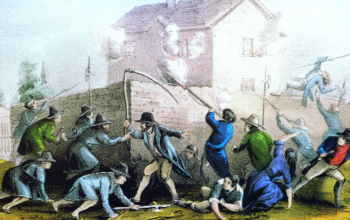
On July 29, 1848, O’Brien launches his rebellion. After being chased by a force of Young Irelanders and their supporters, a Royal Irish Constabulary unit takes refuge in a house and holds those inside as hostages.
It was evident to the rebels that the position of the police is almost impregnable. When a party of the Cashel police are seen arriving over Boulea Hill, the rebels attempt to stop them even though they are low on ammunition. The police continue to advance, firing up the road. It becomes clear that the police in the house are about to be reinforced and rescued. The rebels then fade away, effectively terminating both the era of Young Ireland and Repeal, but the consequences of their actions follow them for many years. This event is colloquially known as “The Battle of Widow McCormack’s cabbage plot.”
In O’Brien’s subsequent trial, the jury finds him guilty of high treason. He is sentenced to be hanged, drawn, and quartered. Petitions for clemency are signed by 70,000 people in Ireland and 10,000 people in England. On June 5, 1849, the sentences of O’Brien and other members of the Irish Confederation are commuted to transportation for life to Van Diemen’s Land (Tasmania in present-day Australia). In 1854, after five years in Van Diemen’s Land, O’Brien is released on the condition he never return to the United Kingdom. He settled in Brussels.
(Pictured: The attack on the Widow McCormack’s house on Boulagh Common, Ballingarry, County Tipperary)
In January 1941 Picture Post publishes their “Plan for Britain.” This includes minimum wages throughout industry, full employment, child allowances, a national health service, the planned use of land and a complete overhaul of education. This document leads to discussions about post-war Britain and is a populist forerunner of William Beveridge‘s November 1942 Social Insurance and Allied Services (known as the Beveridge Report).
Sales of Picture Post increase further during World War II and by December 1943 the magazine is selling 1,950,000 copies a week. By the end of 1949 circulation declines to 1,422,000.
Founding editor Stefan Lorant, who has some Jewish ancestry, had been imprisoned by Adolf Hitler in the early 1930s, and wrote a best-selling book thereafter, I Was Hitler’s Prisoner. By 1940, he fears he will be captured in a Nazi invasion of Britain and flees to Massachusetts in the United States, where he writes important illustrated U.S. histories and biographies. He is succeeded by Sir Tom Hopkinson following his departure in 1940.
During World War II, the art editor of the magazine, Edgar Ainsworth, serves as a war correspondent and accompanies the United States 7th Army on their advance across Europe in 1945. He visits the Bergen-Belsen concentration camp three times after the British army liberates the complex in April 1945. Several of his sketches and drawings from the camp are published in a September 1945 article, Victim and Prisoner. Ainsworth also commissions the artist Mervyn Peake to visit France and Germany at the end of the war, and he too reports from Bergen-Belsen.
On June 17, 1950, Leader Magazine is incorporated in Picture Post. Hopkinson is often in conflict with Sir Edward George Warris Hulton, the owner of Picture Post. Hulton mainly supports the Conservative Party and objects to Hopkinson’s socialist views. This conflict leads to Hopkinson’s dismissal in 1950 following the publication of James Cameron‘s article about South Korea‘s treatment of political prisoners in the Korean War.
By June 1952, circulation has fallen to 935,000. Sales continue to decline in the face of competition from television and a revolving door of new editors. By the time the magazine closes in July 1957, circulation is less than 600,000 copies a week.
Picture Post has been digitised as The Picture Post Historical Archive, 1938-1957 and consists of the complete, fully searchable facsimile archive of Picture Post. It is made available in 2011 to libraries and institutions.
(Pictured: Cover of the Picture Post Vol. 8, No. 12, dated September 21, 1940)
Keane is the son of a national school teacher, William B. Keane, and his wife Hannah Purtill. He is educated at Listowel National School and then at St. Michael’s College, Listowel. He works as a chemist’s assistant for A.H. Jones who dabbles in buying antiques. He has various jobs in the United Kingdom between 1951 and 1955 working as a street cleaner and a bartender and lives in a variety of places including Northampton and London. It is while he is in Northampton that he is first published in an unnamed women’s magazine for which he receives £15.
After returning from the UK, Keane is a pub owner in Listowel from 1955 where he writes plays for the local theatre company and sponsors, from 1971, the annual Listowel Writers’ Week. He marries Mary O’Connor at Knocknagoshel Church on January 5, 1955 and they have four children: Billy, Conor, John and Joanna.
His first play, Sive (1959), is initially rejected by the Abbey Theatre in Dublin but goes on to win the amateur All-Ireland Drama Festival. Later plays include The Field (1965), which is released in a bowdlerized film version in 1990, and Big Maggie (1969), which is produced on Broadway in 1982. In 1998 Keane is honoured with a medal from the Abbey for his contribution to Irish theatre.
Keane is an Honorary Life Member of the Royal Dublin Society from 1991, serves as president of Irish club of PEN International and is a founder member of the Society of Irish Playwrights as well as a member of Aosdána. He is named the patron of the Listowel Players after the Listowel Drama Group fractures. He remains a prominent member of the Fine Gael party throughout his life, never being shy of political debate.
John Keane dies of prostate cancer on May 30, 2002, in Listowel at the age of 73.
Keane’s nephew is the investigative journalist Fergal Keane. His son John is a journalist with the Kilkenny People while his son Billy regularly writes a column for the Irish Independent.
The hospital is founded by Bartholomew Mosse, a surgeon and man-midwife who is appalled at the conditions that pregnant women have to endure, in George’s Lane as the Dublin Lying-In Hospital in March 1745. Lying-in is an archaic term for childbirth, referring to the month-long bed rest prescribed for postpartum confinement. The venture is very successful and Mosse raises money through concerts, exhibitions and even a lottery to establish larger premises.
The hospital moves to new premises, designed by Richard Cassels, where it becomes known as “The New Lying-In Hospital” in December 1757. The rotunda itself, which is designed by James Ensor, is completed just in time for a reception hosted by the Marquess of Kildare in October 1767. Extensive new rooms, designed by Richard Johnston and built adjacent to the rotunda, are completed in 1791.
Records indicate that around 1781, “when the hospital was imperfectly ventilated, every sixth child died within nine days after birth, of convulsive disease; and that after means of thorough ventilation had been adopted, the mortality of infants, within the same, in five succeeding years, was reduced to one in twenty.” This issue is not limited to the Lying-In-Hospital. In that era, ventilation improvement is a general issue in patient care, along with other issues of sanitation and hygiene, and the conditions in which surgeons such as Robert Liston in Britain and elsewhere, have to operate. Florence Nightingale famously works on the design of safe and healthy hospitals.
By the early 19th century the facility becomes known as the Rotunda Hospital, after its prominent architectural feature. The first Caesarean section in Ireland is undertaken at the hospital in 1889.
The Rotunda Hospital, as both a maternity hospital and also as a training centre (affiliated with Trinity College Dublin) is notable for having provided continuous service to mothers and babies since inception, making it the oldest continuously operating maternity hospital in the world. It is estimated that over 300,000 babies have been born there.
Rotunda Hospital is currently managed by RCSI Hospitals.
Ní Scolaí is born in May 24, 1909 in Dublin. She is the daughter of Michael Scully, a commercial traveler and Mary Scully (née Kavanagh). She attends the Central Model Schools, were she learns Irish through the pilot Irish language courses. She studies Irish further at Ring College, County Waterford. She moves to Galway with her sister Mona as a young adult, and begins teaching Irish singing and dancing. With the Irish language theatre, An Taibhdhearc, she plays a number of leading roles. In Micheál Mac Liammóir‘s 1928 production of Diarmaid agus Gráinne, she plays Gráinne.
Ní Scolaí’s interpretation of traditional Irish songs gains her fame, and she sings many times on 2RN as well as radio in France, Italy, the United States and the United Kingdom. She trains as a mezzo-soprano and licentiate of the Trinity College of Music, London, and is noted as one of the few people who combines classical music with sean-nós singing successfully. She wins awards at feiseanna such as Feis Chonnacht and Feis Shligigh, later becoming a judge. She is also an award winner at Aonach Tailteann, as well at the Welsh Eisteddfod, the Scottish mòd, the Manx Tynwald, and the Breton Bretagne celebrations. She performs at London’s Covent Garden and Queen’s Hall. She travels around Gaeltacht areas in Ireland to collect and save songs that might have otherwise been lost. The traditional singers she collects from included Cáit Uí Chonláin in Spiddal and Labhras “Binn” Ó Cadhla. HMV records and releases her performances of Seacht ndolas na Maighduine Mhuire, Caoineadh na dtrí Muire, and Eibhlín a Rún.
On September 9, 1931 she marries Liam Ó Buachalla at University Church, St. Stephen’s Green, Dublin. She dies on June 29, 1985, and is buried in Galway.
(Pictured: Ciarán Mac Mathúna and Máire Ní Scolaí (1976))
Roberts’s father, Rex Roberts, played double bass with a dance band called The Melodists in the 1940s. The headmaster at The High School, Dublin, calls his father in one day to suggest that he consider move his son to a boarding school as he is spending a lot of time in detention.
After being bribed with the promise of a bicycle, Roberts is moved to a Quaker-run boarding school, Newtown School, Waterford. The move proves successful but not for the anticipated reasons. He quickly takes notice of the electric guitars of the school band and realizes that is to be his future.
In 1976, Roberts and Johnnie Fingers (Moylett) decide to put a band together and, between them, they recruit the other four members, Pete Briquette (bass), Gerry Cott (guitar), Simon Crowe (drums) and singer Bob Geldof to form The Boomtown Rats.
Following the breakup of The Boomtown Rats in 1986, Roberts works with Simply Red, Orchestral Manoeuvres in the Dark and Flesh For Lulu in the role of audio engineer on tours in the UK and the United States. He avoids playing the guitar in public for ten years, after which he and Simon Crowe play together for four years in the rhythm and blues four-piece band The Velcro Flies.
After fifteen successful years as an Independent Financial Adviser, Roberts becomes disillusioned with the life insurance industry and becomes a central heating engineer to keep himself occupied between gigs. Roberts and Crowe, with Darren Beale on second lead guitar, and Peter Barton on bass guitar and lead vocals, are now playing together as Boomtown Rats Roberts and Crowe, and are performing material from the Boomtown Rats’ first three albums across Europe and the UK.
Gallagher is born in Ballyshannon, County Donegal, on March 2, 1948. Both he and his brother Dónal are musically inclined and encouraged by their parents. At age nine, Gallagher receives his first guitar from them. After winning a talent contest when he is twelve, he begins performing with both his acoustic guitar and an electric guitar that he purchases with his prize money. It is, however, his purchase three years later of a 1961 Fender Stratocaster for £100 that becomes his primary instrument and most associated with him for the span of his lifetime.
Gallagher is initially attracted to skiffle after hearing Lonnie Donegan on the radio. While still in school, playing songs by Buddy Holly and Eddie Cochran, he discovers his greatest influence in Muddy Waters. He begins experimenting with folk, blues, and rock music.
While still a young teenager, Gallagher begins playing after school with Irish showbands. In 1963, he joins one named Fontana, a sextet playing the popular hit songs of the day. The band tours Ireland and the United Kingdom, earning enough money for Gallagher to make the payments on his Stratocaster guitar. Gallagher begins to influence the band’s repertoire and successfully moulds Fontana into The Impact, changing the line-up into a rhythm and blues group. The band plays gigs in Ireland and Spain until it disbands in London, with Gallagher and the bassist and drummer continuing to perform as a trio in Hamburg, Germany.
In 1966, Gallagher returns to Ireland and forms Taste, a blues rock and R&B power trio. Initially, the band is composed of Gallagher and Cork musicians Norman Damery and Eric Kitteringham. However, by 1968, Damery and Kitteringham are replaced by Belfast musicians John Wilson on drums and Richard McCracken on bass. Performing extensively in the UK, the group supports both Cream at their Royal Albert Hall farewell concert and the blues supergroup Blind Faith on a tour of North America.
After the break-up of Taste in 1970, Gallagher tours under his own name. He hires former Deep Joy bass player Gerry McAvoy to play on his self-titled debut album, Rory Gallagher. This is the beginning of a twenty-year musical relationship between Gallagher and McAvoy. The 1970s are Gallagher’s most prolific period, producing ten albums in the decade. In 1971 he is voted Melody Maker‘s International Top Guitarist of the Year, ahead of Eric Clapton. However, despite a number of his albums reaching the UK Albums Chart, Gallagher does not attain major star status. Though he sells over thirty million albums worldwide, it is his marathon live performances that win him the greatest acclaim.
In the 1980s Gallagher continues recording and embarks on a tour of the United States. In addition, he plays with Box of Frogs, a band formed in 1983 by former members of The Yardbirds.
In the later years of his life, Gallagher develops a phobia of flying. To overcome this he receives a prescription for a powerful sedative. This medication, combined with his alcohol use, results in severe liver damage. Despite his condition he continues touring. By his final performance on January 10, 1995 in the Netherlands, he is visibly ill and the remainder of the tour is cancelled. He is admitted to King’s College Hospital in London in March 1995. His liver is failing and the doctors determine that a liver transplant is the only possible course of action. After 13 weeks in intensive care, his health suddenly worsens when he contracts a Staphylococcal infection. Gallagher dies on June 14, 1995, and is buried in St. Oliver’s Cemetery just outside Ballincollig near Cork.
Keane is born on Church Street in Listowel on July 21, 1928, the son of a national school teacher, William B. Keane, and his wife Hannah (née Purtill). He is educated at Listowel National School and then at St. Michael’s College, Listowel. He works as a chemist’s assistant for A.H. Jones who dabbles in buying antiques. He has various jobs in the UK between 1951 and 1955 working as a street cleaner and a bartender, living in a variety of places including Northampton and London. It is while he is in Northampton that Keane is first published in an unnamed women’s magazine for which he receives £15.
After returning from the United Kingdom, Keane is a pub owner in Listowel from 1955.
Keane marries Mary O’Connor at Knocknagoshel Church on January 5, 1955 and they have four children: Billy, Conor, John and Joanna. He is an Honorary Life Member of the Royal Dublin Society from 1991, serves as president of Irish PEN and is a founder member of the Society of Irish Playwrights as well as a member of Aosdána. He is named the patron of the Listowel Players after the Listowel Drama Group fractures. He remains a prominent member of the Fine Gael party throughout his life, never being shy of political debate.
Keane cites many literary influences including Bryan MacMahon and George Fitzmaurice, fellow Kerry writers and playwrights. His personal influences are numerous but, most notably he thanks his father and his wife, Mary. He is grateful for his father’s help with early editing, allowing him access to his personal library, and encouraging him to continue his work until he is successful. He is also influenced by the local population and the patrons of his pub from which he bases some of his characters.
Keane dies on May 30, 2002 of complications from prostate cancer, which he had been battling for eight years. His death comes on the eve of the annual Listowel Writers’ Festival, a week-long event at which he had long been a dominating and avuncular presence.
Keane’s nephew is the investigative journalist Fergal Keane. His son John is a journalist with the Kilkenny People while his son Billy regularly writes a column for the Irish Independent.
Widgery receives promotion to the Court of Appeal in 1968. He has barely gotten used to his new position when Lord Parker of Waddington, who had been Lord Chief Justice of England and Wales since 1958, announces his retirement. There is no obvious successor and Widgery is the most junior of the possible appointees. The Lord Chancellor, Quintin Hogg, Baron Hailsham of St. Marylebone, chooses Widgery largely on the basis of his administrative abilities. On April 20, 1971, he is created a life peer taking the title Baron Widgery, of South Molton in the County of Devon.
Shortly after taking over, Widgery is handed the politically sensitive job of conducting an inquiry into the events of January 30, 1972, in Derry, where troops from 1st Battalion, Parachute Regiment had murdered 13 civil rights marchers, commonly referred to as Bloody Sunday. A 14th person dies shortly after Widgery’s appointment. He hears testimony from the paratroopers, who claim they had been shot at, while the marchers insist that no one from the march was armed. Widgery produces a report that takes the British Army‘s side. He placed the main blame for the deaths on the march organisers for creating a dangerous situation where a confrontation was inevitable. His strongest criticism of the Army is that the “firing bordered on the reckless.”
The Widgery Report is accepted by the British government and Northern Ireland‘s unionists but is immediately denounced by Irish nationalist politicians, and people in the Bogside and Creggan areas are disgusted by his findings. The British Government had acquired some goodwill because of its suspension of the Stormont Parliament, but that disappears when Widgery’s conclusions are published. The grievance with Widgery’s findings lingers and the issue remains live as the Northern Ireland peace process advances in the 1990s.
In January 1998, on the eve of the 26th anniversary of Bloody Sunday, Prime MinisterTony Blair announces a new inquiry, criticising the rushed process in which Widgery failed to take evidence from those wounded and did not personally read eyewitness accounts. The resulting Bloody Sunday Inquiry lasts 12 years before the Saville Report is published on June 15, 2010. It demolishes the Widgery Report, finding that soldiers lied about their actions and falsely claimed to have been attacked.
Prime Minister David Cameron, on behalf of the United Kingdom, formally apologises for the “unjustified and unjustifiable” events of Bloody Sunday. As a result of the Saville Report, even observers who are natural supporters of the British Army now regard Widgery as discredited. The conservative historian and commentator Max Hastings describes the Widgery report as “a shameless cover-up.”