In 1778, English Catholics are relieved of the restrictions on land inheritance and purchase. A savage reaction to these concessions produces the Gordon Riots of 1780, and the whole history of Catholic Emancipation is one of struggle against great resistance. In 1791 the Roman Catholic Relief Act repeals most of the disabilities in Great Britain, provided Catholics take an oath of loyalty. In 1793 the army, the navy, the universities, and the judiciary are opened to Catholics, although seats in Parliament and some offices are still denied. These reforms are sponsored by William Pitt the Younger, who hopes thereby to split the alliance of Irish Catholics and Protestants. But Pitt’s attempt to secure a general repeal of the Penal Laws is thwarted by George III. Pope Pius VII consents to a royal veto on episcopal nominations if the Penal Laws are repealed, but the move fails. In Ireland the repeal of Poynings’ Law in 1782 is followed by an act (1792) of the Irish Parliament relaxing the marriage and education laws and an act (1793) allowing Catholics to vote and hold most offices.
The Roman Catholic Relief Act 1829 permits members of the Catholic Church to sit in the parliament at Westminster and to hold all but a handful of public offices. O’Connell had won a seat in a by-election for Clare in 1828 against an Anglican. Under the then extant penal law, O’Connell as a Catholic, is forbidden to take his seat in Parliament. Peel, the Home Secretary, until then is called “Orange Peel” because he always supports the Orange (anti-Catholic) position. Peel now concludes, “Though emancipation was a great danger, civil strife was a greater danger.” Fearing a revolution in Ireland, Peel draws up the Catholic Relief Bill and guides it through the House of Commons. To overcome the vehement opposition of both the House of Lords and King George IV, the Duke of Wellington works tirelessly to ensure passage in the House of Lords and threatens to resign as Prime Minister if the King does not give Royal Assent.
With the Universities Tests Act 1871, which opens the universities to Roman Catholics, Catholic Emancipation in the United Kingdom is virtually complete.
At the start of the twentieth century, the people of Ireland are divided into two mutually hostile factions. Nationalists, the much larger group, are mostly Roman Catholic, identify primarily as Irish, and want some form of Irish home rule or independence from Britain. Unionists, the smaller group, concentrates primarily in the province of Ulster, are mostly Protestant, identify primarily as British (although many see themselves as Irish and British), and are committed to remaining within the United Kingdom.
Partition is formally established with the Government of Ireland Act 1920. This also establishes the Parliament of Northern Ireland, which comes into being the following year. Partition is followed by high levels of inter-communal violence, especially in Belfast. The Irish Republican Army (IRA), although it spends most of these years fighting in the Irish Civil War, aims to use armed force to end partition and compel the United Kingdom to withdraw sovereignty from Northern Ireland.
The Act is presented as being necessary to re-establish peace and law and order in Northern Ireland and enables the government to “take all such steps and issue all such orders as may be necessary for preserving the peace and maintaining order,” although it is specified that the ordinary course of law should be interfered with as little as possible. Because it is presented as emergency legislation, the Act is initially current only for one year and has to be renewed annually. In 1928, however, it is renewed for five years and when this period expires in 1933 the Act is made permanent.
Despite rhetoric accompanying the Act which asserts that it is for the purpose of restoring public order, its provisions continue to be used for the entire period of the Northern Irish parliament’s existence. Because the Ulster Unionist Party is the only party ever to form a government in this parliament, the Act is used “almost exclusively on the minority population.” Initially, regulations under the Act are used mostly to curb immediate violence and disorder. One of the most controversial of these is internment without trial.
After the troubles of the early 1920s dies down, the provision for internment is not used until the IRA’s Border Campaign of the 1950s, in which several hundred republicans are interned. Following the outbreak of The Troubles in 1968, many within the Protestant community call for the reintroduction of internment. This occurs in 1971 and authorises internment of those suspected to be involved in terrorism. Although there are loyalist as well as republican terrorists at this time, of the 1,981 men interned, only 107 are loyalists. Due to inadequate intelligence-gathering, many of the interned republicans are members of the Official Irish Republican Army rather than the recently formed Provisional Irish Republican Army (PIRA), which is much more heavily involved in terrorist activity at the time.
Internment ends in 1975 but is credited with increasing support and sympathy for the PIRA amongst the Catholic community and outside of Northern Ireland. It helps to create political tensions which culminate in the 1981 Irish Hunger Strike and the death of MPBobby Sands. Imprisonment under anti-terrorism laws specific to Northern Ireland continue until the 1998 Good Friday Agreement, but these laws require the right to a fair trial be respected.
On April 4, 2001, former employees and staff join three generations of the Barry family in a celebration of 100 years in business for Barry’s Tea which has become an Irish institution.
Barry’s Tea is an Irish tea company founded in 1901 by James J. Barry in Cork, County Cork. In 1934, Anthony Barry, son of the founder, is awarded the Empire Cup for Tea Blending, confirming his expertise in the tea trade. Until the 1960s, the tea is only sold from a shop in Prince’s Street, but thereafter the company expands its wholesaling and distribution operations.
In 1960, Peter Barry, Anthony’s son, pioneers the concept of wholesaling tea and begins sourcing tea from East Africa. There is an incredible reaction to these new blends, and they become something of a Barry’s Tea signature.
By the mid-1980s Barry’s Tea has become a national brand. According to their website, www.barrystea.ie, they are currently responsible for 38% of all tea sales in the Irish market, which is worth an estimated €85 million annually. Today, Barry’s Tea is also available in the United Kingdom, Spain, and in some areas of Canada, Australia, France, Luxembourg and the United States where there are significant Irish immigrant communities.
Members of the Barry family have been elected representatives for Fine Gael: the founder’s son Anthony Barry (TD 1954–1957 and 1961–1965), Anthony’s son Peter Barry (TD 1969–1997) and Peter’s daughter Deirdre Clune (TD 1997–2001 and 2007–2011, and MEP since 2014).
In May 2018, it was revealed that many of Barry’s Tea teabags are made with polypropylene and are not compostable.
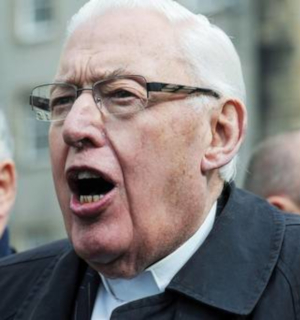
On March 23, 2011, Ian Paisley calls for a new era of sharing and reconciliation in an emotional farewell at his final sitting of the power-sharing Assembly he helped to create at Stormont. Dr. Paisley continues his political career in the House of Lords.
Protestant and Catholic leaders in Northern Ireland‘s unity government celebrate their first full four-year term in power and lauded Paisley, the unlikely peacemaker who made it possible, on his effective retirement day.
Paisley, a stern anti-Catholic evangelist who spent decades rallying pro-British Protestants against compromise, stuns the world in 2007 by agreeing to forge a coalition alongside senior Irish Republican Army (IRA) veterans. Their polar-opposite combination governs Northern Ireland with surprising harmony for the four years leading up to his retirement.
The Northern Ireland Assembly that elects the administration is dissolved on March 14, 2011, in preparation for a May 5 election in the British territory. The 84-year-old Paisley makes his last debate in an elected chamber on March 6, 2011, noting that this local government is not ending in chaos and acrimony, as 1999-2002 attempts at power-sharing repeatedly had done.
At this point, Paisley has already stepped down as a member of the British and European parliaments and as leader of the Democratic Unionists, a party of hard-line Protestant protesters that he founded in 1970 and watched grow over the previous decade into the most popular in Northern Ireland.
Those lauding him include Peter Robinson, who succeeded him in 2008 as leader of both the government and the Democratic Unionists and Sinn Féin‘s Martin McGuinness, the senior Catholic politician who spends decades as a commander of Paisley’s archenemy, the IRA.
The IRA kills nearly 1,800 people in a failed 1970-1997 effort to force Northern Ireland out of the United Kingdom. Northern Ireland remains part of the United Kingdom when the overwhelmingly Catholic rest of Ireland gains its independence in 1922. The outlawed IRA formally renounces violence and disarms in 2005, clearing the way for its allied Sinn Féin party to recognize the legal authority of Northern Ireland and its police.
Still, few observers expected Paisley to agree to a pact so quickly after the IRA-Sinn Féin peace moves or to get along so warmly with McGuinness during their year in partnership.
McGuinness, whose organization once considered Paisley a prime target for assassination, addressing his remarks to the stooped, silver-haired Paisley across the chamber, notes that Ulster wits had christened the two of them “the Chuckle Brothers.” He adds, “And I would like to think that we showed leadership. I think my relationship with him will undoubtedly go down in the history books.”
(From: “Northern Ireland power-sharing marks 1st full term,” the Associated Press and CTV News, March 23, 2011)
“Whiskey in the Jar” is the tale of a highwayman or footpad who, after robbing a military or government official, is betrayed by a woman. Whether she is his wife or sweetheart is not made clear. Various versions of the song take place in County Kerry, Kilmoganny, Cork, Sligo, and other locales throughout Ireland. It is also sometimes placed in the American South, in various places among the Ozarks or Appalachians, possibly due to Irish settlement in these places. Names in the song change, and the official can be a Captain or a Colonel, called Farrell or Pepper among other names. The protagonist’s wife or lover is sometimes called Molly, Jenny, Emzy, or Ginny among various other names. The details of the betrayal are also different, being either betraying him to the person he robbed and replacing his ammunition with sand or water, or not, resulting in his killing the person.
The song’s exact origins are unknown. The song first gains wide exposure when the Irish folk band The Dubliners perform it internationally as a signature song and record it on three albums in the 1960s. In the United States, the song is popularized by The Highwaymen, who record it on their 1962 album Encore. Building on their success, the Irish rock band Thin Lizzy hits the Irish and British pop charts with the song in 1973. In 1990 The Dubliners re-record the song with The Pogues with a faster rocky version charting at No.4 in Ireland and No.63 in the UK. The American metal band Metallica brings it to a wider rock audience in 1998 by playing a version very similar to that of Thin Lizzy’s, though with a heavier sound, winning a Grammy Award for the song in 2000 for Best Hard Rock Performance.
Thin Lizzy’s 1972 single stays at the top of the Irish charts for 17 weeks, and the British release stays in the top 30 for 12 weeks, peaking at No. 6, in 1973. This version has since been covered by U2, Pulp (first released on a 1996 various artist compilation album Childline and later on deluxe edition of Different Class in 2006), Smokie, Metallica (Garage Inc. 1998, which wins a Grammy), Belle and Sebastian (The Blues Are Still Blue EP 2006), Gary Moore (2006), Nicky Moore (Top Musicians Play Thin Lizzy 2008), Simple Minds (Searching for the Lost Boys 2009), and Israeli musician Izhar Ashdot. The song is also on the Grateful Dead live compilation So Many Roads(1965-1995) disc five.
Sackville serves twice as Lord Lieutenant of Ireland, from 1731 to 1737 and again from 1751 to 1755. In 1739, at the foundation of the Foundling Hospital, he is one of that charity’s original governors. His first term as Lord Lieutenant is uneventful. His second takes place at a time of acute political tension between the two main factions in the Irish Government, one led by Henry Boyle, the Speaker of the Irish House of Commons, the other by George Stone, the Anglican Archbishop of Armagh. Sackville, now heavily influenced by his son George Sackville, makes the mistake of openly backing the archbishop. He is unable to oust Boyle from power and is accused of being the archbishop’s tool. He becomes extremely unpopular, leading to his eventual recall.
Sackville’s last years are uneventful, apart from a riot in 1757 caused by the passage of the Militia Act to raise an army for the Seven Years’ War, in which he narrowly escapes injury. He dies at Knole, a country house in west Kent, on October 9, 1765, and is buried at Withyham in East Sussex.
(Pictured: Oil on canvas Portrait of Lionel Sackville, 1st Duke of Dorset (1688-1765) by Godfrey Kneller (1646-1723), 1719, currently displayed at Commonwealth Secretariat, Marlborough House, London)
More broadly, the term “Wild Geese” is used in Irish history to refer to Irish soldiers who leave to serve in continental European armies in the 16th, 17th and 18th centuries, or even, poetically, Irish soldiers in British armies as late as World War I.
Irish recruitment for continental armies dries up after it is made illegal in 1745. In 1732 Sir Charles Wogan indicates in a letter to Jonathan Swift, Dean of St. Patrick’s Cathedral, Dublin, that 120,000 Irishmen have been killed and wounded in foreign service “within these forty years.” Swift later replies, “I cannot but highly esteem those gentlemen of Ireland who, with all the disadvantages of being exiles and strangers, have been able to distinguish themselves by their valour and conduct in so many parts of Europe, I think, above all other nations.”
It was some time before the British armed forces begin to tap into Irish Catholic manpower. In the late eighteenth century, the Penal Laws are gradually relaxed and in the 1790s the laws prohibiting Catholics bearing arms are abolished.
Sarsfield is honored to this day in the crest of County Limerick. The Flight of the Wild Geese is remembered in the poetic words… “War-battered dogs are we, Fighters in every clime, Fillers of trench and of grave, Mockers, bemocked by time. War-dogs, hungry and grey, Gnawing a naked bone, Fighters in every clime, Every cause but our own.”
(Pictured: ‘Irish Troops Leaving Limerick’, 1692, (Cassell Petter & Galpin, London, Paris & New York, c1880), Artist Unknown)
Daniel Francis Noel O’Donnell, singer, television presenter and philanthropist affectionately known as “Wee Daniel,” is born in Kincasslagh, County Donegal on December 12, 1961. After rising to public attention in 1983 he has since become a household name in Ireland and Britain. He has also had considerable success in the United States and Australia. In 2012, he becomes the first artist to have a different album in the British charts every year for 25 consecutive years.
Known for his close relationship with his fanbase, and his charismatic and engaging stage presence, O’Donnell’s music has been described as a mix of country and Irish folk. He has had twenty UK Top 40 albums as well as fifteen Top 40 singles and has sold 10 million records to date. He is widely considered a “cultural icon” in Ireland, and is often parodied in the media.
During his school years, O’Donnell considers pursuing a career in banking. Despite this, a career in music is also always a possibility. As a youngster, O’Donnell performs in the local religious choir. In 1980, he goes to Galway to pursue business studies, however, he never settles down and by Christmas he is in his sister Margo‘s band.
Not getting enough opportunities to perform solos with the band, in 1983 O’Donnell decides to record his own record. On February 9, 1983, he records his first single, Johnny McCauley‘s My Donegal Shore, with £1,200 of his own money, selling all the copies himself. Later that year, he forms his own musical group, Country Fever. After the group disbands, he forms The Grassroots. In 1985, the manager of the Ritz label, Mick Clerkin, sees him perform and introduces him to Sean Reilly, who remains as his manager to this day.
Under Reilly’s management, O’Donnell starts to sell concerts out in England on a regular basis. By January 1992, he has hit rock bottom with exhaustion. After a three-month recovery break, he returns to the stage, this time at the Point Theatre, Dublin.
By the mid-1990s, O’Donnell has become a household name across Ireland and Great Britain. He appears on popular television shows in both countries and wins various awards. Among the accolades, he is named Donegal Person of the Year in 1989, which he still rates as the best award. He is given the Irish Entertainer of the Year award in 1989, 1992 and 1996. His first chart hit single in the UK is in 1992 with I Just Want to Dance With You (later covered by George Strait). This also leads to his first-ever appearance on Top of the Pops.
During his lengthy career, O’Donnell has made friends with his childhood idols, including Cliff Richard and Loretta Lynn. He has also forged a close professional relationship with the Irish songstress Mary Duff, who regularly tours with O’Donnell.
On November 4, 2002, O’Donnell marries Majella McLennan from Thurles, whom he had met on holiday in Tenerife three years previously. The couple lives in Meenbanad, County Donegal, and spend time at their second home in Tenerife.
Christie Hennessy, Irish folk singer-songwriter, dies in London on December 11, 2007. Although Hennessy is unable to read or write due to severe dyslexia, he still writes his own songs such as “Roll back the Clouds” and “All the lies that you told me.”
Hennessy is born in Tralee, County Kerry on November 19, 1945. His first guitar is made, especially for him, from a tea chest when he is six years old by his friend Jerry Quirke. He leaves school at the age of eleven.
Hennessy’s first job is as a messenger boy, and it is then that he discovers that it is important to be able to read. He is unable to read or write due to severe dyslexia, but still enjoys his library of books. He later works on building sites in London.
In 1972 Hennessy releases his first record, The Green Album, on Westwood, a small label. With scant publicity or promotion, the album makes little impact and only 500 copies of the record are pressed. He returns to labouring on building sites in the UK and does not release another album for twenty years. When he does, his 1992 release The Rehearsal outsells U2 in Ireland, eventually attaining triple platinum status. His following albums, A Year in the Life and Box also sell extremely well in Ireland.
A renowned songwriter as well as performer, Hennessy writes several songs that become hits for other singers including Don’t Forget your Shovel, made famous by Christy Moore, and All the Lies that You Told Me, recorded by Frances Black. He also composes the theme tune and incidental music for the BBC TV series Get Well Soon written by Ray Galton (of Steptoe & Son fame) and composes and writes a musical/feature film about his native Ireland, Two Stops to Paradise.
In 2005, Christy Moore’s rendition of Hennessy’s Don’t Forget Your Shovel is referenced in a UK Number One single JCB by Nizlopi. It is further referenced in the video for the same song. As the line is sung, the characters in the JCB pass a shop called “Christie’s Shovels.”
Hennessy returns to the studio in 2007, one final time to record an album with both Luka Bloom and Christy Moore sharing vocals on one of the tracks.
Christie Hennessy dies on December 11, 2007 in a London hospice, at the age of 62. He is reported to have died from pleuralmesothelioma, a rare form of lung cancer, which has been attributed to his younger years spent working on building sites in London where he was exposed to asbestos dust. Just before he dies he had been touring in Ireland but had to cancel due to the illness. His ashes are buried in Old Rath Cemetery, Tralee. A commemorative statue of Christie is erected in Central Plaza, just off the town square in Tralee in November 2009.
The Anglo-Irish Agreement, an accord that gives the government of Ireland an official consultative role in the affairs of Northern Ireland, is signed by TaoiseachGarret FitzGerald and British Prime MinisterMargaret Thatcher on November 15, 1985, at Hillsborough Castle in County Down, Northern Ireland. Considered one of the most significant developments in British-Irish relations since the establishment of the Irish Free State in 1922, the agreement provides for regular meetings between ministers in the Irish and British governments on matters affecting Northern Ireland. It outlines cooperation in four areas: political matters, security and related issues, legal matters, including the administration of justice, and the promotion of cross-border cooperation.
The agreement is negotiated as a move toward easing long-standing tension between Britain and Ireland on the subject of Northern Ireland, although Northern Irish unionists, who are in favour of remaining part of the United Kingdom, are themselves strongly opposed to giving their southern neighbour a say in domestic matters. Many political leaders, including Thatcher, who has been strongly committed to British sovereignty in Northern Ireland, have come to believe that a solution to years of sectarian violence in Northern Ireland can only be achieved by means of an all-Ireland arrangement.
Such an attempt had previously been made in 1973. A power-sharing executive, composed of Irish nationalists as well as unionists, was set up in Northern Ireland, and Taoiseach Liam Cosgrave participated in talks with British Prime Minister Edward Heath that resulted in the Sunningdale Agreement. That accord recognized that Northern Ireland’s relationship with Britain could not be changed without the agreement of a majority of its population, and it provided for the establishment of a Council of Ireland composed of members from both the Dáil Éireann (the lower chamber of the Oireachtas) and the Northern Ireland Assembly. That agreement collapsed in May 1974 because of a general strike inspired by unionist opponents of power sharing.
In 1981 FitzGerald launches a constitutional crusade to make the reunification of Ireland more attractive to Northern Ireland’s Protestants. At the end of the year, the Irish and British governments set up an Anglo-Irish intergovernmental council to discuss matters of common concern, especially security. In 1984 the report of the New Ireland Forum, a discussion group that includes representatives of political parties in Ireland and Northern Ireland, sets out three possible frameworks for political development in Ireland: a unitary state, a federal state, and joint sovereignty. Of Ireland’s major political parties, Fianna Fáil prefers a unitary state, which Fine Gael and the Irish Labour Party regard as unrealistic. They prefer the federal option.
In the improved political climate between Britain and Ireland, leaders of the two countries sit down to negotiations. Ireland and Britain agree that any change in the status of Northern Ireland would come about only with the consent of the majority of the people of Northern Ireland, and an intergovernmental conference is established to deal with political, security, and legal relations between the two parts of the island. The agreement is a blow to Northern Ireland’s unionists, because it establishes a consultative role for the government of Ireland in the affairs of Northern Ireland through the Anglo-Irish Secretariat. The Ulster Unionist Party (UUP) and other unionists denounce the agreement, and UUP members of Parliament resign their seats over the issue, although 14 are returned in by-elections in 1986. The party organizes mass protests and boycotts of local councils and files a lawsuit challenging the legality of the agreement. However, these efforts, which are joined by the Democratic Unionist Party, fail to force abrogation of the agreement.
Contacts between the Irish and British governments continue after February 1987 within the formal structure of the intergovernmental conference. Fears that the violence in Northern Ireland would spill into Ireland as a consequence of closer Anglo-Irish cooperation in the wake of the agreement proves unfounded, and the UUP decides to participate in new negotiations on the constitutional future of Northern Ireland in 1990–93. After republican and unionist forces declare cease-fires in 1994, the UUP reluctantly joins discussions with the British and Irish governments and other political parties of Northern Ireland. No deal accepted by all sides is reached until the Good Friday Agreement in April 1998, which creates the Northern Ireland Assembly and new cross-border institutions.