In 1922, Éamon de Valera speaks at a League of Nations meeting and is critical of Article 10 of the League Covenant which preserves the existing of territorial integrity of member states. This article prevents Ireland from gaining membership in the League of Nations, because it is a territory of the United Kingdom, who is a member state. However, it does not clarify what rights dominion states have and if they can have their own seat. This means that when the Constitution of the Irish Free State goes into effect, the Irish government does not know what type of role it can play in the League of Nations and if, at that point, it is possible to become a member. The League of Nations final decision is that Ireland can not become a member until it’s constitution is officially enacted and it officially becomes a free state.
The Constitution of the Irish Free State is enacted on December 6, 1922, and is recognized as an official international instrument. This allows Ireland to submit an application for entry into the League of Nations.
The applications process goes smoothly until the spring of 1923 when the Seanad Éireann, the upper house of the Oireachtas, complains that only Dáil Éireann, the lower house, has approved the application. A previous decision has made the application an Executive Council decision, and under the Provisional Government, the Seanad has approved the application process. With this approval, the Executive Council continues the application process, however, the new Seanad is upset about their lack of input. This problem is settled when the Attorney-General creates the League of Nations (Guarantee) Bill, which gives both Houses an opportunity to discuss and approve the application.
With this approval in September, Ireland is admitted as a full and equal member to the League of Nations on September 10, 1923, giving it access to the rest of the world. This membership means that Ireland now has representatives in one place, who can meet with other representatives, instead of sending delegates to each country. One location not only saves time, but money. Early Irish foreign policy is driven by the need to stress the country’s legal status as a platform from which to pursue a fuller foreign policy. With admission to the League of Nations this is now possible. Ireland’s acceptance into the League of Nations helps create legitimacy for the new nation.
(Pictured: Irish Delegation to the League of Nations, 1923)
Although a version of the band still tours today, the definitive Thin Lizzy lineup, according to the official Thin Lizzy website, plays its last concert at the Monsters Of Rock festival in Nuremburg, Germany, on September 4, 1983. Afterwards the band members go their separate ways.
After the success of the Jailbreak album, Thin Lizzy’s popularity begins to subside in the United States, with each successive album finding less success. They manage, however, to maintain a presence in the United Kingdom. Another problem contributing to the band’s demise is Lynott’s drug use, which begins to escalate around this time and eventually ruins his marriage.
Two more Thin Lizzy albums, Renegade and Thunder and Lightning, follow over the next two and half years, as does a second solo offering by Lynott, The Phillip Lynott Album. Despite this, things continue to unravel for Lynott and company.
They plan a farewell tour to coincide with the March 1983 release of Thunder and Lightning, which features a heavier approach and proves to be their most popular album in some time. This ends up being a year-long adventure whose high point is a special performance at the legendary Hammersmith Odeon. For the show, Lynott brings in former band members Brian Robertson, Eric Bell, and Gary Moore as special guests.
The final concert in the United Kingdom takes place on August 28, 1983, at the Reading Festival, while their final concert with Lynott in the lineup finds them in Nuremberg on a bill that includes Whitesnake, Ozzy Osbourne, Blue Öyster Cult, Motörhead, and others. Lizzy’s set features old favorites along with a few new songs.
Lynott dies on January 4, 1986, of heart failure and pneumonia. Although the band eventually regroups with various ex-members trying to sail the ship, it never rekindles its past success without their leader.
Flatley begins dancing lessons at age 11 and, at age 17, is the first American to secure a World Irish Dance title at the World Irish Dance Championships, the Oireachtas Rince na Cruinne. He is also an accomplished flautist, having won twice in the All-Ireland Fleadh Cheoil Concert Flute competitions from 1975-1976.
Flatley is taught dance by Dennis Dennehy at the Dennehy School of Irish Dance in Chicago. After graduating from Brother Rice High School, on Chicago’s Southwest Side, he opens a dance school but later closes it to focus on performing.
In 1978 and 1979 Flatley tours with Green Fields of America and then with The Chieftains in the 1980s. In May 1989, Flatley sets a Guinness Book world record for tapping speed at 28 taps per second, and subsequently breaks his own record in 1998 with 35 taps per second.
Flatley creates and choreographs the original Riverdance and leads the show to great success as the intermission act in the Eurovision Song Contest staged in Ireland on April 30, 1994. Flatley abruptly leaves the show over creative control disputes in October 1995.
Shortly after the Riverdance split, Flatley creates Lord of the Dance, which plays mostly in arenas and stadiums instead of stage theaters. He also puts together a dance production called Feet of Flames in 1998. Flately’s Irish dance show Celtic Tiger opens in July 2005. The show explores the history of the Irish people and Irish emigration to the United States, fusing a wide range of dance styles, including jazz.
Flatley returns to the stage in 2009 for a limited run of the “Hyde Park” version of Feet of Flames in Taiwan. His return is met with multiple standing ovations and the run of shows has to be extended to meet the demand for tickets.
Flatley premiers Lord of the Dance: Dangerous Games at the celebrated Palladium Theatre on London’s West End in 2014 and moves to the Dominion Theatre in 2015 where he makes his final appearance on the West End stage before revisiting another sold out Wembley Arena for his final performance in the United Kingdom.
Flatley embarks on his final tour on February 19, 2016 and performs on stage for the last time at The Colosseum at Caesar’s Palace in Las Vegas, NV, on March 17, 2016. He continues as the show’s creator, producer, and choreographer.
Francis McCloskey, a 67-year-old Catholic civilian, dies on July 14, 1969, one day after being hit on the head with a baton by an officer of the Royal Ulster Constabulary (RUC) during street disturbances in Dungiven, County Derry. McCloskey is sometimes considered to be the first fatality of The Troubles.
McCloskey is found unconscious on July 13 near the Dungiven Orange Hall following a police baton charge against a crowd who had been throwing stones at the hall. Witnesses later say they had seen police beating a figure with batons in the doorway where McCloskey is found, although police claim he had been unconscious before the baton charge and may have been hit with a stone.
The conflict is primarily political, but it also has an ethnic or sectarian dimension, although it is not a religious conflict. A key issue is the constitutional status of Northern Ireland. Unionists and loyalists, who are mostly Protestants and consider themselves British, generally want Northern Ireland to remain within the United Kingdom. Irish nationalists and republicans, who are mostly Catholic and consider themselves Irish, generally want it to leave the United Kingdom and join a united Ireland. The conflict begins amid a campaign to end discrimination against the Catholic/nationalist minority by the Protestant/unionist government and police force in 1968. The campaign is met with violence, eventually leading to the deployment of British troops and subsequent warfare.
The main participants in the Troubles are republican paramilitaries such as the Provisional Irish Republican Army (IRA) and Irish National Liberation Army (INLA), loyalist paramilitaries such as the Ulster Volunteer Force (UVF) and Ulster Defence Association (UDA), the British Army and Royal Ulster Constabulary (RUC), and political activists and politicians. The security forces of the Republic of Ireland play a smaller role. More than 3,500 people are killed in the conflict, of whom 52% were civilians, 32% are members of the British security forces, and 16% are members of paramilitary groups. There has been sporadic violence since the signing of the Good Friday Agreement, including a campaign by anti-ceasefire republicans.
The Armagh rail disaster occurs on June 12, 1889, near Armagh, County Armagh, when a crowded Sunday school excursion train fails to negotiate a steep incline. The steam locomotive is unable to complete the climb and the train stalls. The train crew decides to divide the train and take the front portion forward, leaving the rear portion on the running line. The rear portion has inadequate brakes and rolls back down the gradient, colliding with a following train. Eighty people are killed and 260 are injured, about a third of them children. It is the worst rail disaster in the United Kingdom in the nineteenth century and remains Ireland’s worst railway disaster ever.
Armagh Sunday school organises a day trip to the seaside resort of Warrenpoint, a distance of about 24 miles. A special Great Northern Railway of Ireland train is arranged for the journey, intended to carry about eight hundred passengers. The railway route is steeply graded and curved.
Asked to provide a train to take 800 excursionists, the locomotive department at Dundalk sends fifteen vehicles however instructions provided to the engineer are that the train is to consist of thirteen vehicles. The engineer objects to the use of fifteen vehicles. Witnesses say that the engineer asks for a second engine if the additional carriages are added but his request is refused by the station master as no additional engines are available.
Initially, the train progresses up the steep gradient at about 10 mph but stalls about 200 yards from the top of the gradient. To prevent the train from rolling back, the brakes are applied. The chief clerk directs the train crew to divide the train and proceed with the front portion to Hamilton’s Bawn station about two miles away, leaving it there and returning for the rear portion.
After uncoupling the rear portion, the engineer attempts to proceed on with the front portion. Initially, it rolls back slightly, jolting the rear portion which begins to roll back and gathers speed down the steep gradient back towards Armagh station. The train crew reverses the front portion and tries to catch the rear portion, but this proves to be impossible.
The line is operated on a time interval system so there is no means at Armagh of knowing that the line is not clear. The following scheduled passenger train leaves Armagh after the required 20-minute interval. It is proceeding up the gradient at about 25 mph when the engineer sees the approaching runaway vehicles at a distance of about 500 yards. He brakes his train and has reduced speed to 5 mph at the moment of collision. The two rearmost vehicles of the excursion train are utterly destroyed, and the third rearmost is very badly damaged.
After a successful juvenile boxing career, McGuigan begins his professional boxing career on May 10, 1981, beating Selwyn Bell by knockout in two rounds in Dublin. He wins four out of five additional bouts in 1981. In 1982, McGuigan wins eight fights, seven by knockout, although one of these almost destroys his career and his life. Opposed by Young Ali, on June 14, 1982, McGuigan wins by a knockout in six rounds. Ali falls into a coma and dies five months later.
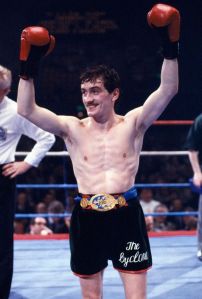
In 1985, McGuigan meets former world featherweight champion Juan Laporte and wins a 10-round decision. Following one more win, he finally gets his world title attempt when the long reigning WBA featherweight champion, Eusebio Pedroza of Panama, comes to London to put his title on the line at Loftus Road soccer stadium. McGuigan becomes the champion by dropping Pedroza in the seventh round and winning a unanimous fifteen-round decision in a fight refereed by hall of fame referee Stanley Christodoulou. McGuigan and his wife are feted in a public reception through the streets of Belfast that attracts several hundred thousand spectators. Later that year, he is named BBC Sports Personality of the Year, becoming the first person not born in the United Kingdom to win the award.
McGuigan twice successfully defends his title, first against American Bernard Taylor, who is stopped in nine rounds, and then against Dominican Danilo Cabrera in a controversial knock out in fourteen rounds. The fight is stopped after Cabrera bends over to pick up his mouthpiece after losing it, a practice that is allowed in many countries but not in Ireland. Cabrera is not aware of this, and the fight is stopped.
McGuigan’s next defence takes place in Las Vegas in June 1986, where he faces the relatively unknown Steve Cruz of Texas, in a gruelling 15-round title bout under a blazing sun. McGuigan holds a lead halfway through, but suffers dehydration due to the extreme heat and wilts near the end, being dropped in the tenth and fifteenth rounds. He eventually loses the world title, which he never reclaims, in a close decision. After the fight McGuigan requires hospitalisation because of his dehydrated state.
McGuigan retires after the fight but returns to the ring between 1988 and 1989, beating former world title challengers Nicky Perez and Francisco Tomas da Cruz, as well as contender Julio César Miranda, before losing to former EBU featherweight champ and future WBC and WBA super featherweight challenger Jim McDonnell by a technical knockout. After the McDonnell fight he permanently retires from boxing. His record is 32 wins and 3 losses, with 28 knockouts. In January 2005, McGuigan is elected into the International Boxing Hall of Fame.
McGuigan founds and is the current President of the Professional Boxing Association (PBA). He is also the CEO and founder of Cyclone Promotions.
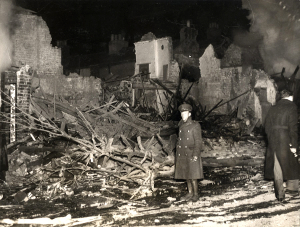
Four German bombs are dropped on north Dublin at approximately 2:00 AM on May 31, 1941. One bomb falls in the Ballybough area, demolishing the two houses at 43 and 44 Summerhill Park, injuring many but with no loss of life. A second bomb falls at the Dog Pond pumping works near the zoo in Phoenix Park, again with no casualties but damaging Áras an Uachtaráin, the official residence of the Irish President. A third bomb makes a large crater in the North Circular Road near Summerhill, again causing no injuries. A fourth bomb falls in North Strand destroying seventeen houses and severely damaging about fifty others, the worst damage occurring in the area between Seville Place and Newcomen Bridge. The raid claims the lives of 28 people, injures 90, destroys or damages approximately 300 houses, and leaves 400 people homeless.
The first bombing of Dublin during World War II occurs early on the morning of January 2, 1941, when German bombs are dropped on the Terenure area of south Dublin. This is followed, early on the following morning of January 3, 1941, by further German bombing of houses on Donore Terrace in the South Circular Road area of south Dublin. A number of people are injured, but no one is killed in these bombings.
After the war, what becomes West Germany accepts responsibility for the raid, and by 1958 it has paid compensation of £327,000. Over 2,000 claims for compensation are processed by the Irish government, eventually costing £344,000. East Germany and Austria, which are both part of Nazi Germany in 1941, make no contribution. The amounts are fixed after the 1953 London Agreement on German External Debts, allowing maximum compensation.
Several reasons for the raid have been asserted over time. German Radio, operated by the Ministry of Public Enlightenment and Propaganda, broadcasts that “it is impossible that the Germans bombed Dublin intentionally.” Irish airspace has been violated repeatedly, and both Allied and German airmen are being interned at the Curragh Camp. A possible cause is a navigational error or a mistaken target, as one of the pathfinders on the raid later recounts. Numerous large cities in the United Kingdom are targeted for bombing, including Belfast, which like Dublin, is across the Irish Sea from Great Britain. War-time Germany’s acceptance of responsibility and post-war Germany’s payment of compensation are cited as further indications that the causation is error on the part of the Luftwaffe pilots.
Another possible reason is that in April 1941, Germany has launched the Belfast blitz, which results in Belfast being heavily bombed. In response, Ireland sends rescue, fire, and emergency personnel to Belfast to assist the city. Éamon de Valera, the Taoiseach, formally protests the bombing to the German government, as well as making his famous “they are our people” speech. Some contend that the raid serves as a warning to Ireland to keep out of the war. This contention is given added credibility when Colonel Edward Flynn, second cousin of Ireland’s Minister for Coordination of Defensive Measures, recalls that Lord Haw Haw has warned Ireland that Dublin’s Amiens Street Railway Station, where a stream of refugees from Belfast is arriving, will be bombed. The station, now called Connolly Station, stands a few hundred metres from North Strand Road, where the bombing damage is heaviest. Flynn similarly contends that the German bombing of Dundalk on July 4 is also a pre-warning by Lord Haw Haw as a punishment for Dundalk being the point of shipment of Irish cattle sold to the United Kingdom.
Aer Lingus, the flag carrier airline of Ireland and the second-largest airline in Ireland, is founded on April 15, 1936, with a capital of £100,000. Its first chairman is Seán Ó hUadhaigh. Pending legislation for Government investment through a parent company, Aer Lingus is associated with Blackpool and West Coast Air Services which advance the money for the first aircraft, and operate with Aer Lingus under the common title Irish Sea Airways. Aer Lingus Teoranta is registered as an airline on May 22, 1936. The name Aer Lingus is an anglicisation of the Irish form Aer Loingeas, which means Air Fleet. The name is proposed by Richard F. O’Connor, who is County Cork Surveyor, as well as an aviation enthusiast.
Later that year, the airline acquires its second aircraft, a four-engined biplane De Havilland 86 Express named “Éire”, with a capacity of 14 passengers. This aircraft provides the first air link between Dublin and London by extending the Bristol service to Croydon. At the same time, the DH84 Dragon is used to inaugurate an Aer Lingus service on the Dublin-Liverpool route.
Aer Lingus currently operates an all-Airbus aircraft fleet serving Europe, North Africa, Turkey, and North America. The airline’s head office is on the grounds of Dublin Airport in Collinstown, County Fingal, Ireland.
Sheehy is educated at the Dominican Convent on Eccles Street, where she is a prize-winning pupil. She then enrolls at St. Mary’s University College, a third level college for women established by the Dominicans in 1893, to study modern French and German. She sits for examinations at Royal University of Ireland and receives a Bachelor of Arts degree in 1899, and a Master of Arts Degree with first-class honours in 1902. This leads to a career as a teacher in Eccles Street and an examiner in the Intermediate Certificate examination.
Sheehy marries Francis Skeffington in 1903, and they both take the surname Sheehy Skeffington, which they do not hyphenate but use as a double name. In 1908, they found the Irish Women’s Franchise League, a group aiming for women’s voting rights.
Sheehy-Skeffington gets into numerous scuffles with the law. She is jailed in 1912 for breaking windows of government buildings in support of suffrage as part of an IWFL campaign. That same year she also throws a hatchet at visiting British Prime Minister Herbert Asquith. She loses her teaching job in 1913 when she is arrested and imprisoned for three months after throwing stones at Dublin Castle and assaulting a police officer in a feminist action. While in jail she goes on hunger strike and is released under the Prisoner’s Temporary Discharge of Ill Health Act but is soon rearrested.
Being free from her teaching job enables Sheehy-Skeffington to devote more time to the fight for suffrage. She is influenced by James Connolly and during the 1913 lock-out works with other suffragists in Liberty Hall, providing food for the families of the strikers.
She strongly opposes participation in World War I which breaks out in August 1914 and is prevented by the British government from attending the International Congress of Women held in The Hague in April 1915. The following June her husband is imprisoned for anti-recruiting activities. He is later shot dead during the 1916 Easter Rising after having been arrested by British soldiers.
Sheehy-Skeffington refuses compensation for her husband’s death, which is offered on condition of her ceasing to speak and write about the murder. Rather, she travels to the United States to publicise the political situation in Ireland. In October 1917, she is the sole Irish representative to League for Small and Subject Nationalities where, along with several other contributors, she is accused of pro-German sympathies. She publishes British Militarism as I Have Known It, which is banned in the United Kingdom until after the World War I. Upon her return to Britain she is once again imprisoned, this time in Holloway prison. After release, Sheehy-Skeffington attends the 1918 Irish Race Convention in New York City and later supports the anti-Treaty Irish Republican Army (IRA) during the Irish Civil War.
In 1926, Sheehy-Skeffington becomes a founding member of Fianna Fáil and is elected to the party’s Ard Comhairle. During the 1930s, she is assistant editor of An Phoblacht. In January 1933, she is arrested in Newry for breaching an exclusion order banning her from Northern Ireland. At her trial she says, “I recognize no partition. I recognize it as no crime to be in my own country. I would be ashamed of my own name and my murdered husband’s name if I did…Long live the Republic!” She is sentenced to a month’s imprisonment.
Paul David Hewson, Irish singer-songwriter, musician, venture capitalist, businessman, and philanthropist known by his stage name Bono, is born in the Rotunda Hospital, Dublin, on May 10, 1960.
Bono writes almost all U2 lyrics, frequently using religious, social, and political themes. During U2’s early years, his lyrics contribute to their rebellious and spiritual tone. As the band matures, his lyrics become inspired more by personal experiences shared with the other members. Bono wins numerous awards with U2, including twenty-two Grammy Awards and the 2003 Golden Globe Award for best original song, “The Hands That Built America,” for the film Gangs of New York.
In 2005, the U2 band members are inducted into the Rock and Roll Hall of Fame in their first year of eligibility. In November 2008, Rolling Stone magazine ranks Bono as the 32nd-greatest singer of all time.
In 1992, Bono, along with The Edge, purchase and refurbish Dublin’s two-star 70-bedroom Clarence Hotel, converting it into a five-star 49-bedroom hotel.
Bono is on the board of Elevation Partners, a private equity firm, which attempts to purchase Eidos Interactive in 2005 and has since gone on to invest in other entertainment businesses. Bono invests in the Forbes Media group in the United States through Elevation Partners. Elevation Partners becomes the first outsider to invest in the company, taking a minority stake in Forbes Media LLC, a new company encompassing the 89-year-old business which includes Forbes magazine, the Forbes.com website and other assets. The terms of the deal are not disclosed, but reports say the stake is worth about $250 million. The firm also owns a 1.5 percent stake in the social networking site Facebook, originally purchased for $210 million.
Bono is also widely known for his activism concerning Africa, for which he co-founds DATA, EDUN, the ONE Campaign and Product Red. He organises and plays in several benefit concerts and meets with influential politicians. Over the years, Bono is praised and criticised for his activism and involvement with U2.
In 2007, Bono is named in the UK‘s New Year Honours list as an honorary Knight Commander of the Order of the British Empire. On March 29, 2007, he is formally granted knighthood by Queen Elizabeth II of the United Kingdom for “his services to the music industry and for his humanitarian work.” He is also made a Commandeur of the French Ordre des Arts et des Lettres (Order of Arts and Letters). Together with Bill and Melinda Gates, Bono is named Time Person of the Year in 2005, among other awards and nominations.

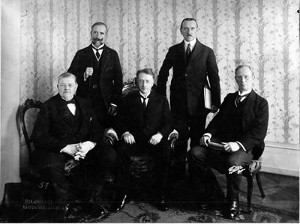 The Irish Free State is admitted into the League of Nations on September 10, 1923.


 Five days after being registered as an airline, the inaugural


