seamus dubhghaill

Promoting Irish Culture and History from Little Rock, Arkansas, USA


Leave a comment

Birth of P. S. O’Hegarty, Writer, Editor & Historian

Patrick Sarsfield O’Hegarty (Irish: Pádraig Sáirséal Ó hÉigeartaigh), Irish writereditor and historian and a member of the Supreme Council of the Irish Republican Brotherhood, is born on December 29, 1879, at CarrignavarCounty Cork.

O’Hegarty is born to John and Katherine (née Hallahan) Hegarty. His parents’ families emigrate to the United States after the Great Famine, and his parents are married in BostonMassachusetts. His father is a member of the Irish Republican Brotherhood (IRB).

O’Hegarty is educated at North Monastery CBS, where he forms an enduring friendship with Terence MacSwiney. In 1888, his father dies of tuberculosis at the age of 42. Left destitute, his mother pawns her wedding ring to pay for an advertisement looking for work, and eventually becomes a cook.

O’Hegarty joins the postal service in Cork in 1897. Along with J. J. Walsh, he plays on the Head Post Office hurling team. He joins the IRB and represents Munster on the IRB Supreme Council. He starts writing for Arthur Griffith‘s United Irishman and The Shan Van Vocht, a periodical established by Alice Milligan and Ethna Carbery.

O’Hegarty serves at the main Postal Sorting Office in Mount Pleasant, London, from 1902 to 1913. Along with J. J. Walsh, he spends three years at King’s College London, studying for the Secretary’s Office. While he succeeds in his studies, Walsh does not and returns to Ireland. O’Hegarty becomes the IRB representative for South East England and joins the Gaelic League and Sinn Féin and becomes a strong advocate of the Irish language. In 1905, he is elected secretary of the local Dungannon Club, which draws in as members Robert LyndHerbert Hughes and George Cavan. In 1907, as Sinn Féin’s London Secretary, he approves and signs the membership card of Michael Collins, later becoming friend and mentor to Collins.

O’Hegarty has to return to Ireland for a break due to overwork in 1909 and gives up some of his work for the Gaelic League. However, he takes over as editor of the IRB publication, Irish Freedom. It is in this publication that he famously writes, concerning the visit of King George V to Ireland in 1911: “Damn your concessions, England: we want our country!” In 1912, at the height of the Playboy riots, he writes four articles entitled “Art and the Nation” in Irish Freedom, which take a very liberal and inclusionist approach to Anglo-Irish literature and art in general but invokes the wrath of many of the paper’s readers.

In 1913, he is re-posted to Queenstown (present-day Cobh) as postmaster. He continues editing nationalist newspapers such as Irish Freedom (founded in 1910 and suppressed in December 1914 on account of its seditious content) and An tÉireannach and joins the Irish Volunteers. At the outbreak of war he is moved to Shrewsbury, probably on account of his political activities. In 1915, he marries Wilhelmina “Mina” Smyth, a schoolteacher and suffragist, and is then moved to WelshpoolMontgomeryshire. In the aftermath of the 1916 Easter Rising, he is opposed to physical force. In 1918, he refuses to take the British Oath of Allegiance and resigns his position in the Post Office.

O’Hegarty feels that the Abbey Theatre is “doing good for Ireland” and supports W. B. Yeats against attacks from Arthur Griffith and like-minded Nationalists. He opposes the extremist views of D. P. Moran, who seeks a Roman Catholic Irish-speaking Ireland.

O’Hegarty is Secretary of the Irish Department of Post and Telegraphs from 1922 to 1945. He is elected a member of the Irish Academy of Letters in 1954.

O’Hegarty’s son, Seán Ó hÉigeartaigh, is a founder of the Irish-language publishing house Sáirséal agus Dill. His daughter Gráinne, a harpist, marries Senator Michael Yeats, son of W. B. Yeats.

O’Hegarty dies on December 17, 1955.

O’Hegarty’s papers are acquired by the Kenneth Spencer Research Library at the University of Kansas. This includes an outstanding collection of books, pamphlets and periodicals of W. B. Yeats.

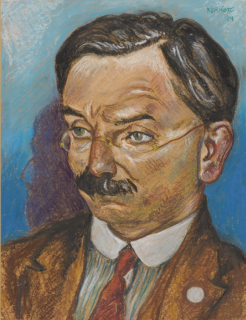
(Pictured: “P. S. O’Hegarty, 1929,” pastel on paper by Harry Kernoff, RHA, property from the Yeats family)
Leave a comment

Death of P. S. O’Hegarty, Writer, Editor & Historian

Patrick Sarsfield O’Hegarty (Irish: Pádraig Sáirséal Ó hÉigeartaigh), Irish writer, editor and historian and a member of the Supreme Council of the Irish Republican Brotherhood, dies on December 17, 1955.

O’Hegarty is born on December 29, 1879, at Carrignavar, County Cork, to John and Katherine (née Hallahan) Hegarty. His parents’ families emigrate to the United States after the Great Famine, and his parents are married in Boston, Massachusetts. His father is a member of the Irish Republican Brotherhood (IRB).

He is educated at North Monastery CBS, where he forms an enduring friendship with Terence MacSwiney. In 1888, his father dies of tuberculosis at the age of 42. Left destitute, his mother pawns her wedding ring to pay for an advertisement looking for work, and eventually becomes a cook.

He joins the postal service in Cork in 1897. Along with J. J. Walsh, he plays on the Head Post Office hurling team. He joins the IRB and represents Munster on the IRB Supreme Council. He starts writing for Arthur Griffith‘s United Irishman and the Shan van Vocht, a periodical established by Alice Milligan and Ethna Carbery.

He serves at the main Postal Sorting Office in Mount Pleasant, London, from 1902 to 1913. Along with J. J. Walsh, he spends three years at King’s College London, studying for the Secretary’s Office. While he succeeds in his studies, Walsh does not and returns to Ireland. O’Hegarty becomes the IRB representative for South East England and joins the Gaelic League and Sinn Féin and becomes a strong advocate of the Irish language. In 1905, he is elected secretary of the local Dungannon Club, which draws in as members Robert Lynd, Herbert Hughes and George Cavan. In 1907, as Sinn Féin’s London Secretary, he approves and signs the membership card of Michael Collins, later becoming friend and mentor to Collins.

He has to return to Ireland for a break due to overwork in 1909 and gives up some of his work for the Gaelic League. However, he takes over as editor of the IRB publication, Irish Freedom. It is in this publication that he famously writes, concerning the visit of King George V to Ireland in 1911: “Damn your concessions, England: we want our country!” In 1912, at the height of the Playboy riots, he writes four articles entitled “Art and the Nation” in Irish Freedom, which take a very liberal and inclusionist approach to Anglo-Irish literature and art in general but invokes the wrath of many of the paper’s readers.

In 1913, he is re-posted to Queenstown (present-day Cobh) as postmaster. He continues editing nationalist newspapers such as Irish Freedom (founded in 1910 and suppressed in December 1914 on account of its seditious content) and An tÉireannach and joins the Irish Volunteers. At the outbreak of war he is moved to Shrewsbury, probably on account of his political activities. In 1915, he marries Wilhelmina “Mina” Smyth, a schoolteacher and suffragist, and is then moved to Welshpool, Montgomeryshire. In the aftermath of the 1916 Easter Rising, he is opposed to physical force. In 1918, he refuses to take the British Oath of Allegiance and resigns his position in the Post Office.

O’Hegarty feels that the Abbey Theatre is “doing good for Ireland” and supports W. B. Yeats against attacks from Arthur Griffith and like-minded Nationalists. He opposes the extremist views of D. P. Moran, who seeks a Roman Catholic Irish-speaking Ireland.

He is Secretary of the Irish Department of Post and Telegraphs from 1922 to 1945. He is elected a member of the Irish Academy of Letters in 1954.

His son, Seán Ó hÉigeartaigh, is a founder of the Irish-language publishing house Sáirséal agus Dill. His daughter Gráinne, a harpist, marries Senator Michael Yeats, son of W. B. Yeats.

O’Hegarty’s papers are acquired by the Kenneth Spencer Research Library at the University of Kansas. This includes an outstanding collection of books, pamphlets and periodicals of W. B. Yeats.

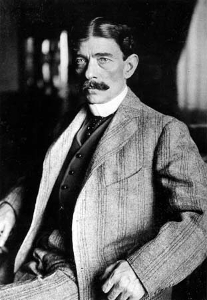
(Pictured: “P. S. O’Hegarty, 1929,” pastel on paper by Harry Kernoff, RHA, property from the Yeats family)


Leave a comment

Birth of Frank Harris, Journalist & Novelist

frank-harris

Frank Harris, Irish American editor, novelist, short story writer, journalist and publisher, is born James Thomas Harris to Welsh parents in Galway, County Galway on February 14, 1855. He is friendly with many well-known figures of his day.

Harris’s father, Thomas Vernon Harris, is a naval officer from Fishguard, Pembrokeshire, Wales. While living with his older brother he is, for a year or more, a pupil at The Royal School, Armagh. At the age of twelve he is sent to Wales to continue his education as a boarder at the Ruabon Grammar School in Denbighshire, a time he is to remember later in My Life and Loves. He is unhappy at the school and runs away within a year.

Harris runs away to the United States in late 1869, arriving in New York City virtually penniless. The 13-year-old takes a series of odd jobs to support himself, working first as a shoeshiner, a porter, a general laborer, and a construction worker on the erection of the Brooklyn Bridge. He later turns these early occupational experiences into art, incorporating tales from them into his book The Bomb (1908).

From New York Harris moves to Chicago, where he takes a job as a hotel clerk and eventually a manager. Owing to Chicago’s central place in the meat packing industry, he makes the acquaintance of various cattlemen, who inspire him to leave the big city to take up work as a cowboy. He eventually grows tired of life in the cattle industry and enrolls at the University of Kansas, where he studies law and earns a degree, gaining admission to the Kansas Bar Association.

Harris is not cut out to be a lawyer and soon decides to turn his attention to literature. He returns to England in 1882, later traveling to various cities in Germany, Austria, France, and Greece on his literary quest. He works briefly as an American newspaper correspondent before settling down in England to seriously pursue the vocation of journalism.

Harris first comes to general notice as the editor of a series of London papers including The Evening News, The Fortnightly Review and the Saturday Review, the latter being the high point of his journalistic career, with H. G. Wells and George Bernard Shaw as regular contributors.

From 1908 to 1914 Harris concentrates on working as a novelist, authoring a series of popular books such as The Bomb, The Man Shakespeare, and The Yellow Ticket and Other Stories. With the advent of World War I in the summer of 1914, he decides to return to the United States.

From 1916 to 1922 Harris edits the U.S. edition of Pearson’s Magazine, a popular monthly which combines short story fiction with socialist-tinted features on contemporary news topics. One issue of the publication is banned from the mails by United States Postmaster General Albert S. Burleson during the period of American participation in World War I. Despite this Harris manages to navigate the delicate situation which faces the left-wing press and keeps Pearson’s Magazine functioning and solvent during the war years.

Harris becomes an American citizen in April 1921. In 1922 he travels to Berlin to publish his best-known work, his four-volume autobiography My Life and Loves (1922–1927). It is notorious for its graphic descriptions of his purported sexual encounters and for its exaggeration of the scope of his adventures and his role in history. A fifth volume, supposedly taken from his notes but of doubtful provenance, is published in 1954, long after his death.

Harris also writes short stories and novels, two books on William Shakespeare, a series of biographical sketches in five volumes under the title Contemporary Portraits and biographies of his friends Oscar Wilde and George Bernard Shaw. His attempts as a playwright are less successful. Only Mr. and Mrs. Daventry (1900), which is based on an idea by Oscar Wilde, is produced on the stage.

Married three times, Harris dies of a heart attack in Nice, France on August 26, 1931. He is buried at Cimetière Sainte-Marguerite, adjacent to the Cimetière Caucade, in Nice. Just after his death a biography written by Hugh Kingsmill (pseudonym of Hugh Kingsmill Lunn) is published.


Leave a comment

Death of Frank Harris, Novelist & Journalist

Frank Harris, British editor, novelist, short story writer, journalist and publisher, dies on August 26, 1931. He is friendly with many well-known figures of his day.

Harris is born James Thomas Harris on February 14, 1855, in Galway, County Galway, to Welsh parents. While living with his older brother he is, for a year or more, a pupil at The Royal School, Armagh. At the age of twelve he is sent to Wales to continue his education as a boarder at the Ruabon Grammar School in Denbighshire, a time he is to remember later in My Life and Loves. Harris is unhappy at the school and runs away within a year.

Harris runs away to the United States in late 1869, arriving in New York City virtually penniless. The 13-year-old takes a series of odd jobs to support himself, working first as a shoeshiner, a porter, a general laborer, and a construction worker on the erection of the Brooklyn Bridge. He later turns these early occupational experiences into art, incorporating tales from them into his book The Bomb.

From New York Harris moves to the American Midwest, settling in Chicago, where he takes a job as a hotel clerk and eventually a manager. Owing to Chicago’s central place in the meat packing industry, Harris makes the acquaintance of various cattlemen, who inspire him to leave the big city to take up work as a cowboy. He eventually grows tired of life in the cattle industry and enrolls at the University of Kansas, where he studies law and earns a degree, gaining admission to the Kansas state bar association.

Harris is not cut out to be a lawyer and soon decides to turn his attention to literature. He returns to England in 1882, later traveling to various cities in Germany, Austria, France, and Greece on his literary quest. He works briefly as an American newspaper correspondent before settling down in England to seriously pursue the vocation of journalism.

Harris first comes to general notice as the editor of a series of London papers including The Evening News, The Fortnightly Review and the Saturday Review, the last-named being the high point of his journalistic career, with H. G. Wells and George Bernard Shaw as regular contributors.

From 1908 to 1914 Harris concentrates on working as a novelist, authoring a series of popular books such as The Bomb, The Man Shakespeare, and The Yellow Ticket and Other Stories. With the advent of World War I in the summer of 1914, Harris decides to return to the United States.

From 1916 to 1922 he edits the U.S. edition of Pearson’s Magazine, a popular monthly which combines short story fiction with socialist-tinted features on contemporary news topics. One issue of the publication is banned from the mails by United States Postmaster General Albert S. Burleson during the period of American participation in the Great War. Despite this Harris manages to navigate the delicate situation which faces the left wing press and to keep the Pearson’s Magazine functioning and solvent during the war years.

Harris becomes an American citizen in April 1921. In 1922 he travels to Berlin to publish his best-known work, his autobiography My Life and Loves. It is notorious for its graphic descriptions of Harris’ purported sexual encounters and for its exaggeration of the scope of his adventures and his role in history. Years later, Time Magazine reflects in its March 21, 1960 issue “Had he not been a thundering liar, Frank Harris would have been a great autobiographer….he had the crippling disqualification that he told the truth, as Max Beerbohm remarked, only ‘when his invention flagged’.” A fifth volume, supposedly taken from his notes but of doubtful provenance, is published in 1954, long after his death.

Harris also writes short stories and novels, two books on Shakespeare, a series of biographical sketches in five volumes under the title Contemporary Portraits and biographies of his friends Oscar Wilde and George Bernard Shaw. His attempts at playwriting are less successful. Only Mr. and Mrs. Daventry (1900), which is based on an idea by Oscar Wilde, is produced on the stage.

Married three times, Harris dies of a heart attack in Nice at the age of 75 on August 26, 1931. He is subsequently buried at Cimetière Caucade in the same city. Just after his death a biography written by Hugh Kingsmill (pseudonym of Hugh Kingsmill Lunn) is published.