seamus dubhghaill

Promoting Irish Culture and History from Little Rock, Arkansas, USA


Leave a comment

Birth of Thomas Butler, 6th Earl of Ossory

Vice Admiral Thomas Butler, 6th Earl of Ossory, KG, PC, PC (Ire), Irish soldier and politician, is born on July 8, 1634, at Kilkenny Castle. He is the eldest son of James Butler, 1st Duke of Ormond, and Elizabeth Preston. He predeceases his father and therefore never becomes duke.

When Butler is born, his father is then the 12th Earl of Ormond but is raised to marquess and duke. His family, the Butler dynasty, is Old English and descends from Theobald Walter, who had been appointed Chief Butler of Ireland by King Henry II in 1177. His mother is a second cousin once removed of his father as she is a granddaughter of Black Tom, 10th Earl of Ormond. Her father, however, is Scottish, Richard Preston, 1st Earl of Desmond, a favourite of James I. Both parents are Protestants. They married on Christmas Day 1629.

Butler is one of ten siblings, eight brothers and two sisters, but five of the sons die in childhood. As the eldest living son, he is the heir apparent and is styled with the corresponding courtesy title, which at first is Viscount Thurles but changed to Earl of Ossory when his father becomes marquess in 1642. His early years are spent in Ireland until 1647 when he accompanies his father to England. In 1648 his father renews his support for the royalist cause and he and his son have to flee to France, arriving in Caen in February 1648. Lady Ormond also moves to Caen, where she arrives on June 23, 1648, with his siblings.

Butler is an accomplished athlete and a good scholar. Having come to London in 1652 he is rightly suspected of sympathising with the exiled royalists, and in 1655 is jailed by Oliver Cromwell. After his release about a year later he goes into exile to the Netherlands where Charles II has his exile court at the time.

On November 17, 1659, while in exile, Butler marries Emilia van Nassau, the second daughter of Louis of Nassau, Lord of De Lek and Beverweerd. They have eleven children, including two sons: James (1665–1745), who becomes the 2nd Duke of Ormonde in 1688; Charles (1671–1758), who becomes the de jure 3rd Duke of Ormonde following his elder brother’s attainder in 1715; Elizabeth (died 1717), who marries William Stanley, 9th Earl of Derby in 1673; Amelia (died 1760), who inherits the estates of her brother Charles and never marries; and Henrietta (died 1724), who marries Henry de Nassau d’Auverquerque, 1st Earl of Grantham.

Butler accompanies Charles II back to England in 1660. In 1661 he becomes a member of both the English and the Irish houses of commons, representing in the former Bristol and Dublin University in the latter.

In 1662 Butler is called to the Irish House of Lords under a writ of acceleration as the Earl of Ossory. His father holds the title “5th Earl of Ossory” as one of his subsidiary titles. The acceleration makes Thomas Butler the 6th Earl of Ossory. This is the only substantive title he ever holds, as he predeceases his father and therefore never succeeds to his father’s titles. His eldest son, however, would later become the 2nd Duke of Ormond and the 7th Earl of Ossory.

Butler holds several military appointments: lieutenant-general of the army in Ireland (appointed in 1665); created an English peer as Lord Butler (in 1666); Lord of the Bedchamber to Charles II (appointed in 1660), a post he holds until his death.

In 1665 a fortunate accident allows Butler to take part in the Battle of Lowestoft against the Dutch, and in May 1672, being now in command of a ship, he fights against the same enemies in the Battle of Solebay, serving with great distinction on both occasions. He is partly responsible for this latter struggle, as on March 12, 1672, before war is declared, he attacks the Dutch Smyrna fleet, an action which he greatly regrets later in life. While visiting France in 1672 he rejects the liberal offers made by Louis XIV to induce him to enter the service of France and returning to England he adds to his high reputation by his conduct during the Battle of Texel in August 1673. From 1677 until 1679, he serves alongside his father as a Lord of the Admiralty.

Butler is intimate with William, Prince of Orange, and in 1677 he joins the allied army in the Netherlands, commanding the British contingent and winning great fame at the siege of Mons in 1678. He acts as deputy for his father, who is Lord Lieutenant of Ireland, and in parliament he defends Ormond’s Irish administration with great vigour. In 1680 he is appointed governor of English Tangier, but his death prevents him from taking up his new duties.

Butler dies on July 30, 1680, at Arlington House in London. He is buried provisionally in Westminster Abbey on July 31, 1680. The ceremony of burial is performed belatedly on November 13, 1680. Some say Butler’s body is later taken to Ireland and reburied in the family vault in St. Canice’s Cathedral, Kilkenny. James, his eldest son, succeeds him as the 7th Earl of Ossory and in 1688 becomes the 2nd Duke of Ormond.

One of Butler’s most intimate friends is John Evelyn, who eulogises him in his Diary.

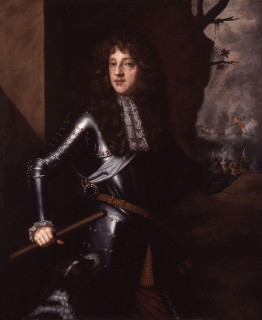
(Pictured: “Thomas Butler, Earl of Ossory” by Peter Lely, painting, circa 1678, National Portrait Gallery)


Leave a comment

Birth of Stephen Clegg Rowan, Vice Admiral in the U.S. Navy

Stephen Clegg Rowan, a vice admiral in the United States Navy, who serves during the Mexican–American War and the American Civil War, is born in Dublin on December 25, 1808. He has a 63-year career, which is one of the longest in the history of the United States Navy.

Rowan comes to the United States at the age of ten and lives in Piqua, Ohio. He is a graduate of Miami University and is appointed as a midshipman in the U.S. Navy on February 1, 1826, at the age of seventeen. Later, he takes an active role in the Mexican–American War, serving as executive officer of the sloop-of-war USS Cyane during the capture of Monterey, California on July 7, 1846, and in the occupation of both San Diego and Los Angeles. In January 1847 he leads a provisional battalion, with the nominal rank of major, of seven companies of naval infantry (along with a company of artillery and a company of sappers and miners) for the recapture of Los Angeles.

Captain of the steam sloop USS Pawnee at the outbreak of the American Civil War, he attempts to relieve Fort Sumter and burn the Norfolk Naval Shipyard. In the fall of 1861, he assists in the capture of the forts at Hatteras Inlet. Then, taking command of a flotilla in the North Carolina sounds, he cooperates in the capture of Roanoke Island in February 1862. Promoted simultaneously to captain and commodore for gallantry, he then supports the capture of Elizabeth City, Edenton, and New Bern. During the summer of 1863, he commands the broadside ironclad USS New Ironsides on blockade duty off Charleston, South Carolina and the following August assumes command of Federal forces in the North Carolina sounds. During this time the rebel semi-submersible CSS David attacks the USS New Ironsides with a spar torpedo. In the ensuing explosion, one man is killed, and a large hole is torn into the ironclad, but she continues her blockading duties.

Commissioned rear admiral on July 25, 1866, Rowan serves as commandant of the Norfolk Naval Shipyard until 1867, when he assumes command of the Asiatic Squadron. Returning in 1870, he is appointed vice admiral, following the death of Admiral David Farragut and the promotion of Vice Admiral David Dixon Porter in August of that year. In December 1870 he reaches the mandatory retirement age of 62 but, like admirals Farragut and Porter before him, he is allowed to remain on active duty.

Rowan serves as commandant of the New York Navy Yard from 1872 to 1876, as governor of the Philadelphia Naval Asylum at Philadelphia, Pennsylvania, in 1881, and as superintendent of the United States Naval Observatory, Washington, D.C., from 1882 until his retirement in 1889.

In 1882 Rowan is elected as a First Class Companion of the District of Columbia Commander of the Military Order of the Loyal Legion of the United States (MOLLUS). He is assigned MOLLUS insignia number 2510. His son, Hamilton Rowan, an officer in the United States Army, is elected as a Second Class Companion of MOLLUS and becomes a First Class Companion upon his father’s death.

Rowan dies at the age of 81 in Washington, D.C. on March 31, 1890.


Leave a comment

Death of Thomas Butler, 6th Earl of Ossory

Vice Admiral Thomas Butler, 6th Earl of Ossory, KG, PC, PC (Ire), Irish soldier and politician, dies in London on July 30, 1680.

Thomas is born on July 8, 1634, at Kilkenny Castle, the eldest son and one of ten siblings of James Butler, 1st Duke of Ormond and his wife Elizabeth Preston. His father is then the 12th Earl of Ormond but would be raised to marquess and duke. His family, the Butler dynasty, is Old English and descends from Theobald Walter, who had been appointed Chief Butler of Ireland by Henry II of England in 1177. His mother is a second cousin once removed of his father as she is a granddaughter of Thomas Butler, 10th Earl of Ormond. Her father, however, is Scottish, Richard Preston, 1st Earl of Desmond, a favourite of James I. Both parents are Protestants.

As the eldest living son, he is the heir apparent and is styled with the corresponding courtesy title, which at first is Viscount Thurles but changed to Earl of Ossory when his father becomes marquess in 1642. His early years are spent in Ireland until 1647 when he accompanies his father to England. In 1648 his father renews his support for the royalist cause and he and his son have to flee to France, arriving in Caen in February 1648. Lady Ormond also moves to Caen, where she arrives on June 23, 1648, with his siblings.

Butler is an accomplished athlete and a good scholar. Having come to London in 1652 he is rightly suspected of sympathising with the exiled royalists, and in 1655 is jailed by Oliver Cromwell. After his release about a year later he goes into exile to the Netherlands where Charles II has his exile court at the time.

On November 17, 1659, while in exile, Butler marries Emilia van Nassau, the second daughter of Louis of Nassau, Lord of De Lek and Beverweerd. They have eleven children.

Butler accompanies Charles II back to England in 1660. In 1661 he becomes a member of both the English and the Irish houses of commons, representing in the former Bristol and Dublin University in the latter.

In 1662 Butler is called to the Irish House of Lords under a writ of acceleration as the Earl of Ossory. His father holds the title “5th Earl of Ossory” as one of his subsidiary titles. The acceleration makes Thomas Butler the 6th Earl of Ossory. This is the only substantive title he ever holds, as he predeceases his father and therefore never succeeds to his father’s titles.

Butler holds several military appointments including lieutenant-general of the army in Ireland, created an English peer as Lord Butler in 1666, and Lord of the Bedchamber to Charles II (appointed in 1660 and held until his death).

In 1665 a fortunate accident allows Butler to take part in the Battle of Lowestoft against the Dutch, and in May 1672, being now in command of a ship, he fights against the same enemies in the Battle of Solebay, serving with great distinction on both occasions. While visiting France in 1672 he rejects the liberal offers made by Louis XIV to induce him to enter the service of France and returning to England he adds to his high reputation by his conduct during the Battle of Texel in August 1673. From 1677 until 1679, he serves alongside his father as a Lord of the Admiralty.

Butler is intimate with William II, Prince of Orange, and in 1677 he joins the allied army in the Netherlands, commanding the British contingent and winning great fame at the siege of Mons in 1678. He acts as deputy for his father, who is Lord Lieutenant of Ireland. In 1680 he is appointed governor of English Tangier, but his death prevents him from taking up his new duties.

Butler dies on July 30, 1680, at Arlington House in London. He is buried provisionally in Westminster Abbey on July 31, 1680. The ceremony of burial is performed belatedly on November 13, 1680. Some say his body is later taken to Ireland and reburied in the family vault in St. Canice’s Cathedral, Kilkenny. James, his eldest son, succeeds him as the 7th Earl of Ossory and becomes the 2nd Duke of Ormond in 1688.

(Pictured: “Thomas Butler, Earl of Ossory,” painting by Peter Lely, circa 1678, Source: National Portrait Gallery)


Leave a comment

National Day of Commemoration 2017

national-day-of-commemoration-2017

President Michael D. Higgins and Taoiseach Leo Varadkar lead the ceremony to mark the National Day of Commemoration at the Royal Hospital Kilmainham in Kilmainham, Dublin on July 9, 2017. The event is a multi-faith service of prayer and a military service honouring all Irish people who died in past wars or on service with the United Nations. Events are also held in Cork, Galway, Limerick, Sligo, Kilkenny and Waterford.

The National Day of Commemoration is held on the Sunday closest to July 11, the anniversary of the date the truce was signed in 1921 to end the Irish War of Independence.

Leaders from Christian, Coptic Christian, Jewish and Islamic denominations read or sing prayers and readings, and President Higgins lays a laurel wreath. The service is observed by more than 1,000 guests, including Government Ministers, the Council of State, which advises the Taoiseach, members of the judiciary, members of the diplomatic corps, TDs and Senators, representatives of ex-servicemen’s organisations and relatives of the leaders of the 1916 Easter Rising.

The national flag is lowered to half-mast while the “Last Post” and “Reveille” are sounded. After a minute of silence, a gun salute is sounded, and the flag is raised again before the national anthem is played with a fly-by by three Pilatus PC-9 aircraft.

The Army band of the 1st Brigade and pipers play music including “Limerick’s Lament” and “A Celtic Lament” as guests arrive at the quadrangle of the former British Army veterans’ hospital, now the Irish Museum of Modern Art.

The prayer service begins with Imam Sheikh Hussein Halawa of the Islamic Cultural Centre of Ireland, father of Ibrahim Halawa, who is in prison in Cairo, singing verses from the Quran in Arabic and praying in English, “I ask Allah, the Mighty, the Lord, to bless our country, Ireland, and give the people of our country a zeal for justice and strength for forbearance.”

Soloist Sharon Lyons sings hymns between prayers and readings from all denominations, ending with Rabbi Zalman Lent: “May the efforts and sacrifice of those we honour today be transformed into the blessing of people throughout the world.”

Speaking to reporters, Chief of Staff of the Defence Forces Vice Admiral Mark Mellett says more than 650 personnel are serving in eleven countries and on the Mediterranean Sea. “In the Defence Forces we have over 80 people who have given their lives in the cause of peace internationally, and I think it’s a sign of a State that recognises those who give this service,” he says. “The military of our State serve the political and serve the people. And it’s this loyalty to the State which is actually critical, and I’m delighted that we have a day like this.”

Mellett’s views are echoed by former sergeant Denis Barry, who says 47 Irish soldiers died in Lebanon and it is important to pay respects for that sacrifice. “None of us who served ever thought we would see the day we could travel in Lebanon without weapons, heavy armaments or flak jackets.” That United Nations mission paid off, he says.

Former British soldier Ron Hammond says the event reflects positive developments, such as the creation of the veterans’ Union of British and Irish Forces. He served from 1960 to 1980 in the Royal Irish Fusiliers and Royal Irish Rangers, spending time in Germany, Canada, Yemen and north and south Africa. He joined the British rather than the Irish forces because at the time “a home posting in the Defence Forces was Collins Barracks and an overseas posting was the Curragh encampment.”

(From: “Irish military dead honoured in National Day of Commemoration” by Marie O’Halloran, The Irish Times, July 9, 2017)


Leave a comment

Birth of Arctic Explorer Robert McClure

robert-mcclure

Sir Robert John Le Mesurier McClure, Irish explorer of the Arctic, is born in Wexford, County Wexford on January 28, 1807.

McClure is the posthumous son of one of James Abercrombie‘s captains, first cousin of Oscar Wilde and spends his childhood under the care of his godfather, General John Le Mesurier, governor of Alderney, by whom he is educated for the army. The McClures are of Highland Scots ancestry, being a sept of Clan MacLeod of Harris. He enters the navy, however, in 1824, and twelve years later gains his first experience of Arctic exploration as mate of HMS Terror in the expedition (1836–1837) commanded by Captain George Back.

Upon his return he obtains his commission as lieutenant, and from 1838 to 1839 serves on the Canadian lakes, being subsequently attached to the North American and West Indian naval stations, where he remains until 1846. Two years later he joins John Franklin‘s search expedition (1848–1849) under James Clark Ross as first lieutenant of HMS Enterprise.

After he returns from the first Franklin search expedition, a new search expedition is launched in 1850, with Richard Collinson commanding the HMS Enterprise and McClure, as his subordinate, given the command of HMS Investigator. The two ships set out from England, sail south on the Atlantic Ocean, navigate through the Strait of Magellan to the Pacific Ocean with the assistance of steam-sloop HMS Gorgon, where they become separated and have no further contact for the rest of their respective journeys.

The HMS Investigator sails north through the Pacific and enters the Arctic Ocean by way of the Bering Strait, and sails eastward past Point Barrow, Alaska to eventually link up with another British expedition from the northwest. Although the HMS Investigator is abandoned to the pack ice in the spring of 1853, McClure and his crew are rescued by a party from the HMS Resolute, one of the ships under the command of Sir Edward Belcher that are sailing from the east, after a journey over the ice by sledge. Subsequently he completes his journey across the Northwest Passage. HMS Resolute itself does not make it out of the Arctic that year and is abandoned in ice, but later recovered. The wood from that ship becomes quite famous later.

Thus, McClure and his crew are the first both to circumnavigate the Americas, and to transit the Northwest Passage, considerable feats at that time. The HMS Enterprise, meanwhile, having arrived at Point Barrow in 1850 a fortnight later than the HMS Investigator, finds its passage blocked by winter ice and has to turn back and return the following year.

Upon his return to England, in 1854, McClure is court martialed for the loss of the HMS Investigator, which is automatic when a captain loses his ship. Following an honourable acquittal, he is knighted and promoted to post-rank, his commission being dated back four years in recognition of his special services. McClure and his crew share a great monetary reward of £10,000 awarded them by the British Parliament. He subsequently is also awarded gold medals by the English and French geographical societies. In 1855 he is elected a member of the American Antiquarian Society.

From 1856 to 1861 McClure serves in Eastern waters, commanding the division of the Naval Brigade before Canton in 1858, for which he receives a CB in the following year. His latter years are spent in a quiet country life. He attains the rank of rear admiral in 1867, and of vice admiral in 1873. He dies on October 17, 1873 and is buried in Kensal Green Cemetery, London.

McClure Strait is later named after Robert McClure, as well as the crater McClure on the Moon.