seamus dubhghaill

Promoting Irish Culture and History from Little Rock, Arkansas, USA


Leave a comment

Death of Major General William Hickie, Irish-Born British Army Officer

Major General Sir William Bernard Hickie, KCB, Irish-born senior British Army officer and Irish nationalist politician dies in Dublin on November 3, 1950. He sees active service in the Second Boer War from 1899 to 1902, is Assistant Quartermaster General in the Irish Command from 1912 to 1914 and serves in World War I from 1914 to 1918. He commands a brigade of the British Expeditionary Force in 1914 and is commander of the 16th (Irish) Division from 1915 on the Western Front.

Hickie is born on May 21, 1865, at Slevoir, Terryglass, near Borrisokane, County Tipperary, the eldest of the eight children of Colonel James Francis Hickie and his wife Lucila Larios y Tashara, originally of Castile. He is educated at St. Mary’s College, Oscott, Birmingham, England, a renowned seminary for training youths of prosperous Roman Catholic families.

Hickie attends the Royal Military College, Sandhurst, from 1882 to 1885. He is commissioned into his father’s regiment, the Royal Fusiliers at Gibraltar, in 1885 and serves with them for thirteen years in the Mediterranean, Egypt, and India, during which time he is promoted to captain on November 18, 1892. In 1899 he graduates as captain at the Staff College, Camberley, and is selected when the Second Boer War breaks out as a Special Service Officer in which capacity he acts in various positions of authority and command. He leaves Southampton for South Africa on board the SS Canada in early February 1900 and is promoted from captain of mounted infantry to battalion command as major on March 17, 1900. He is subsequently in command of a corps until eventually at the end of 1900 he is given command of an independent column of all arms. He holds this position for eighteen months. He serves with distinction at the Battle of Bothaville in November 1900 and receives the brevet promotion to lieutenant colonel on November 29, 1900. He serves in South Africa throughout the war, which ends with the Treaty of Vereeniging in June 1902. Four months later he leaves Cape Town on the SS Salamis with other officers and men of the 2nd battalion Royal Fusiliers, arriving at Southampton in late October, when the battalion is posted to Aldershot Garrison. In December 1902 he is elected a Fellow of the Royal Geographical Society (FRGS).

After the end of the war in South Africa there follows various staff appointments, the first from December 1902 as deputy-assistant adjutant general for district staff in the Cork district. In 1907 Hickie is back in regimental service in Dublin and Mullingar with the 1st Royal Fusiliers, where he is in command of the regiment for the last two years. From 1909 to 1912 is appointed to the Staff of the 8th Infantry Division in Cork where for four years he is well known in the hunting field and on the polo ground. In May 1912, he is promoted to colonel and becomes Quartermaster General of the Irish Command at Royal Hospital Kilmainham for which he is appointed a Companion of the Order of the Bath.

When war is declared, the Staff of the Irish Command becomes automatically the staff of the II Army Corps and accordingly with the outbreak of World War I in August 1914, Hickie is promoted to brigadier general and, as part of the British Expeditionary Force in France, takes charge of the Adjutant and Quartermaster-General’s Department during the retreat of the II Corps after the Battle of Mons, to Paris, and during the First Battle of the Marne. In mid-September 1914, he relieves one of the brigadiers in the fighting line as commander of the 13th Brigade (5th Infantry Division) and then commands the 53rd Brigade (18th Infantry Division) until December 1915, when he is ordered home to assume command of the 16th (Irish) Division at Blackburn.

Promoted to major general, Hickie takes over from Lieutenant General Sir Lawrence Parsons. It is politically a highly sensitive appointment which requires the professionalism and political awareness he, fortunately, possesses as the division is formed around a core of Irish National Volunteers in response to Edward Carson‘s Ulster Volunteers. He is much more diplomatic and tactful than his predecessors and speaks of the pride which his new command gives him but does not hesitate to make sweeping changes amongst the senior officers of the Irish Division. After putting the division through intensive training, it leaves under Irish command of which each man takes personal pride. It arrives in December 1915.

In the next two years and four months during which Hickie commands the 16th (Irish) Division, it earns a reputation for aggression and élan and wins many memorials and mentions for bravery in the engagements during the 1916 Battle of Guillemont and the capture of Ginchy, both of which form part of the Battle of the Somme, then during the Battle of Messines, the Third Battle of Ypres and in attacks near Bullecourt in the Battle of Cambrai offensive in November 1917.

During this period the Division makes considerable progress in developing its operational techniques but at a price in losses. The growing shortage of Irish replacement recruits, due to nationalist disenchantment with the war and the absence of conscription in Ireland, is successfully met by Hickie by integrating non-Irish soldiers into the division.

In February 1918, Hickie is invalided home on temporary sick leave, but when in the hospital the German spring offensive begins on March 21, with the result that after his division moves under the command of General Hubert Gough it is practically wiped out and ceases to exist as a division. Although promised a new command, this does not happen before the Armistice in November. He typifies the army’s better divisional commanders, is articulate, intelligent and is competent and resourceful during the BEF’s difficult period 1916–17, laying the foundations for its full tactical success in 1918. He is advanced to Knight Commander of the Order of the Bath in 1918.

Hickie retires from the army in 1922, when the six Irish line infantry regiments that have their traditional recruiting grounds in the counties of the new Irish Free State are all disbanded. He identifies himself strongly with the Home Rule Act and says that its scrapping is a disaster and is equally outspoken in condemning the activities of the Black and Tans. In 1925, he is elected as a member of Seanad Éireann, the Irish Free State Senate.

Hickie holds his seat until the Seanad is dissolved in 1936, to be replaced by Seanad Éireann in 1937. He is President of the Area Council (Southern Ireland) of the Royal British Legion from 1925 to 1948. He never marries.

Hickie dies on November 3, 1950, in Dublin and is buried in Terryglass, County Tipperary.


Leave a comment

Birth of Sir William Bernard Hickie, British Army General

Sir William Bernard Hickie, British Army general, commander of the 16th (Irish) Division (1915–18) and an Irish nationalist politician, is born on May 21, 1865, at Slevoir, Terryglass, near Borrisokane, County Tipperary.

Hickie is the eldest son of Colonel James Francis Hickie, JP, of Slevoir, former commanding officer of the 7th Royal Fusiliers, and Lucila Calista (de Tejada) Hickie, daughter of Don Pablo Lariosy Herreros de Tejada of Laguna de Cameros, Castile. He is educated at St. Mary’s College, Oscott, before attending the Royal Military College, Sandhurst, and is commissioned into the Royal Fusiliers in 1885, serving in Egypt and India.

A major at the outbreak of the Second Boer War in 1899, Hickie serves on the staff of Lieutenant-Colonel P. W. J. Le Gallais, commanding officer of the mounted infantry. On November 6, 1900, he is involved in an attempt to capture General Christiaan De Wet at the Battle of Bothaville, when a force led by Le Gallais and Lieutenant-Colonel Wally Ross storm De Wet’s camp. De Wet escapes, while a rearguard of 100 men engages the British force. In a fierce fight Le Gallais is killed, and Wally Ross is badly wounded. Hickie decides to charge the Boer position and leads his small force forward just as reinforcements under Major-General C. E. Knox arrive. The Boers immediately surrender, and some are found with explosive bullets. He wants to execute them immediately, but Knox insists that they be tried. Exasperated with the whole affair, Hickie gives a highly critical interview after the action which is later published in The Times History of the War in South Africa (7 vols, 1900–09), edited by Leo Amery.

Hickie is promoted to brevet lieutenant colonel in 1901 and appointed deputy-assistant adjutant general of the 8th division (1903–06). In 1906, he is given command of the 1st battalion of the Royal Fusiliers. Promoted to colonel in 1912, he serves as assistant quartermaster general of the Irish command (1912–14) and is appointed a Companion of the Order of the Bath in 1914. On the outbreak of World War I, he is promoted to brigadier general and serves in Belgium and France in command of the adjutant’s and quartermaster-general’s department of II Corps. In this capacity, he is involved in the retreat following the Battle of Mons and during the First Battle of the Marne (September 1914). In December 1915, he is appointed to command the 16th (Irish) Division, with the rank of major general, replacing General Sir Lawrence W. Parsons. The division is based around a core of Redmondite National Volunteers, and Hickie, a Catholic and a home ruler, is an acceptable commander to John Redmond and other Irish nationalists.

Hickie is professional, politically adept, and popular with his men, and under his leadership the 16th is renowned for its aggressive fighting spirit. He commands the division during the Battle of the Somme in 1916 and, while proud of his men’s success in capturing Guillemont and Ginchy (September 1916), is appalled by their losses. When the division is ordered to capture Messines (now Mesen) in June 1917, he gives Major Willie Redmond permission to advance as far as the first objective and, following Redmond’s death, reproaches himself bitterly. After this attack the division is transferred to the fifth army and provides assault troops for future attacks. During the Third Battle of Ypres, and especially during the attack on Langemarck in August 1917, the division suffers horrendous casualties, losing 221 officers and 4,064 men. Among the casualties is Fr. Willie Doyle, who Hickie unsuccessfully recommends for a Victoria Cross. The division’s losses at Langemarck are highlighted by Irish MPs in the House of Commons, and Hickie’s handling of the attack is criticised. By this time, nationalist disillusionment with the war means that few Irish replacements are available, and Hickie is forced to accept increasing numbers of non-Irish conscripts into the division. Worn down by years of command, his health finally breaks, and, in February 1918, he is sent home on sick leave, being replaced by Major-General Sir Richard Amyatt Hull.

In 1918, Hickie is created a Knight Commander of the Order of the Bath (KCB) and is also awarded the French Croix de Guerre. During the Irish War of Independence (1919–21), he is critical of the methods used by Crown forces, denouncing in particular the indiscipline of the Black and Tans. In 1921 he retires from the army and becomes a prominent figure in the Royal British Legion in Ireland, tirelessly campaigning on behalf of ex-servicemen. In the 1920s he is involved with the Irish battlefield memorial committee, which erects memorial crosses at Wytschaete, Guillemont, and Salonika, commemorating the 10th and 16th divisions. He later serves as a senator of the Irish Free State (1925–36). Retiring from public life in 1936 to his residence at Terryglass, County Tipperary, he devotes his last years to gardening and reading.

Hickie dies on November 3, 1950, in Dublin, and is buried at Terryglass. He marries a daughter of the novelist Rev. J. O. Hannay, who predeceases him. There is a small collection of his papers in the National Library of Ireland (NLI).

(From: “Hickie, Sir William Bernard” by David Murphy, Dictionary of Irish Biography, http://www.dib.ie, October 2009)


Leave a comment

Birth of Emmet Dalton, Soldier & Film Producer

James Emmet Dalton MC, Irish soldier and film producer, is born in Fall River, Massachusetts, on March 4, 1898. He serves in the British Army in World War I, reaching the rank of captain. However, on his return to Ireland he becomes one of the senior figures in the Dublin Brigade of the Irish Republican Army (IRA) which fights against British rule in Ireland.

Dalton is born to Irish American parents James F. and Katharine L. Dalton. The family moves back to Ireland when he is two years old. He grows up in a middle-class Catholic background in Drumcondra in North Dublin and lives at No. 8 Upper St. Columba’s Road. He is educated by the Christian Brothers at O’Connell School in North Richmond Street. He joins the nationalist militia, the Irish Volunteers, in 1913 and the following year, though only fifteen, is involved in the smuggling of arms into Ireland.

Dalton joins the British Army in 1915 for the duration of the Great War. His decision is not that unusual among Irish Volunteers, as over 20,000 of the National Volunteers join the British New Army on the urgings of Nationalist leader John Redmond. His father, however, disagrees with his son’s decision. He initially joins the 7th battalion of the Royal Dublin Fusiliers (RDF) as a temporary 2nd Lieutenant. By 1916 he is attached to the 9th Battalion, RDF, 16th (Irish) Division under Major-General William Hickie, which contains many Irish nationalist recruits.

During the Battle of the Somme in September 1916, Dalton is involved in bloody fighting during the Battle of Ginchy, in which over 4,000 Irishmen are killed or wounded. He is awarded the Military Cross for his conduct in the battle. Afterwards he is transferred to the 6th Battalion, Leinster Regiment, and sent to Thessaloniki then Palestine, where he commands a company and then supervises a sniper school in el-ʻArīsh. In 1918 he is re-deployed again to France, and in July promoted to captain, serving as an instructor.

On demobilisation in April 1919, Dalton returns to Ireland. There, finding that his younger brother Charlie had joined the IRA, he himself follows suit. He later comments on the apparent contradiction of fighting both with and against the British Army by saying that he had fought for Ireland with the British and fought for Ireland against them.

Dalton becomes close to Michael Collins and rises swiftly to become IRA Director of Intelligence and is involved in The Squad, the Dublin-based assassination unit. On May 14, 1921, he leads an operation with Paddy Daly that he and Collins had devised. It is designed to rescue Gen. Seán Mac Eoin from Mountjoy Prison using a hijacked British armoured car and two of Dalton’s old British Army uniforms.

Dalton follows Collins in accepting the Anglo-Irish Treaty in 1922 and is one of the first officers, a Major General, in the new National Army established by the Irish Provisional Government of the Irish Free State. The Treaty is opposed by much of the IRA and Civil War between pro and anti-treaty factions eventually results.

Dalton is in command of troops assaulting the Four Courts in the Battle of Dublin which marks the start of the war in June 1922. At Collins’ instigation he, as Military liaison officer with the British during the truce, takes control of the two 18 pounder guns from the British that are trained on the buildings. He becomes commander of the Free State Army under Richard Mulcahy‘s direction. He is behind the Irish Free State offensive of July–August 1922 that dislodges the Anti-Treaty fighters from the towns of Munster. He proposes seaborne landings to take the Anti-Treaty positions from the rear and he commands one such naval landing that takes Cork in early August. In spite of firm loyalty to the National Army, he is critical of the Free State’s failure to follow up its victory, allowing the Anti-Treaty IRA to regroup resuming the guerrilla warfare started in 1919.

On August 22, 1922, he accompanies Collins in convoy, touring rural west Cork. The convoy is ambushed near Béal na Bláth and Collins is killed in the firefight. He had advised Collins to drive on, but Collins, who is not an experienced combat veteran, insists on stopping to fight.

Dalton is married shortly afterwards, on October 9, 1922, to Alice Shannon in Cork’s Imperial Hotel. By December 1922 he has resigned his command in the Army. He does not agree with the execution of republican prisoners that mark the latter stages of the Civil War. After briefly working as clerk of the Irish Senate, Seanad Éireann, he leaves the job to work in the movie industry.

Over the following forty years, Dalton works in Ireland and the United States in film production. In 1958 he founds Irish Ardmore Studios in Bray, County Wicklow. His company helps produce films such as The Blue Max, The Spy Who Came In from the Cold and The Lion in Winter, all of which are filmed in Ireland. His daughter is Irish actress Audrey Dalton.

Dalton dies in his daughter Nuala’s house in Dublin on March 4, 1978, his 80th birthday, never having seen the film that Cathal O’Shannon of RTÉ had made on his life. During the making of the film, they visit the battlefields in France, Kilworth Camp in Cork, Béal Na Bláth, and other places that Dalton had not visited since his earlier years. He wishes to be buried as near as possible to his friend Michael Collins in Glasnevin Cemetery in Dublin and is buried there in March 1978 after a military funeral. None of the ruling Fianna Fáil government ministers or TDs attend.

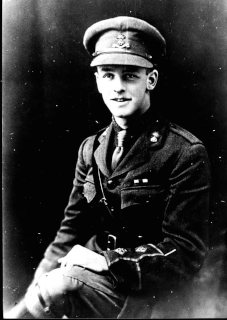
(Pictured: Dalton photographed in lieutenant’s uniform, Royal Dublin Fusiliers, taken circa. 1914-1918)