seamus dubhghaill

Promoting Irish Culture and History from Little Rock, Arkansas, USA


Leave a comment

Death of Séamus Ennis, Musician, Singer & Music Collector

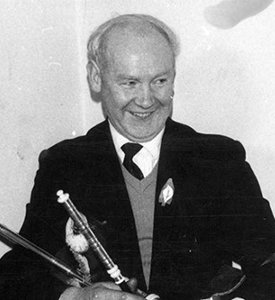
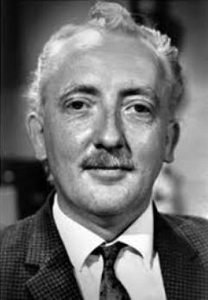
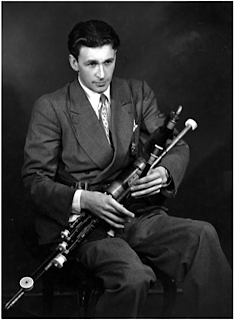
Séamus Ennis (Irish: Séamas Mac Aonghusa), Irish musician, singer and Irish music collector, dies in Naul, County Dublin, on October 5, 1982. He is most noted for his uilleann pipe playing and is partly responsible for the revival of the instrument during the twentieth century, having co-founded Na Píobairí Uilleann, a nonprofit organisation dedicated to the promotion of the uilleann pipes and its music. He is recognised for preserving almost 2,000 Irish songs and dance-tunes as part of the work he does with the Irish Folklore Commission. He is widely regarded as one of the greatest uilleann pipers of all time.

Ennis’s father, James, works for the Irish civil service at Naul, County Dublin. In 1908, James Ennis is in a pawn shop in London and purchases a bag containing the pieces of a set of old uilleann pipes. They were made in the mid nineteenth century by Coyne Pipemakers of Thomas Street in Dublin. In 1912, he comes in first in the Oireachtas competition for warpipes and second in the uilleann pipes. He is also a prize-winning dancer. In 1916, he marries Mary Josephine McCabe, an accomplished fiddle player from County Monaghan. They have six children, Angela, Séamus, Barbara, and twins, Cormac and Ursula (Pixie) and Desmond. Séamus is born on May 5, 1919, in Jamestown in Finglas, Dublin. James Ennis is a member of the Fingal trio, which includes Frank O’Higgins on fiddle and John Cawley on flute, and performs regularly with them on the radio. At the age of thirteen, Séamus starts receiving lessons on the pipes from his father. He attends a Gaelscoil, Cholmcille, and a Gaelcholáiste, Coláiste Mhuire, which gives him a knowledge of the Irish language that serves him well in later life. He sits in an exam to become Employment Exchange clerk but is too far down the list to be offered a job. He is twenty and unemployed.

Colm Ó Lochlainn is editor of Irish Street Ballads and a friend of the Ennis family. In 1938, Ennis confides in Colm that he intends to move to England to join the British Army. Colm immediately offers him a job at The Three Candles Press. There Ennis learns all aspects of the printing trade. This includes writing down slow airs for printed scores – a skill which later proves important. Colm is director of an Irish language choir, An Claisceadal, which Ennis joins. In 1942, during The Emergency, shortages and rationing mean that things become difficult in the printing trade. Professor Seamus Ó Duilearge of the Irish Folklore Commission hires the 23-year-old to collect songs. He is given “pen, paper and pushbike” and a salary of three pounds per week. Off he goes to Connemara.

From 1942 to 1947, working for the Irish Folklore Commission, Ennis collects songs in west Munster; counties GalwayCavanMayoDonegalKerry; the Aran Islands and the Scottish Hebrides. His knowledge of Scottish Gaelic enables him to transcribe much of the John Lorne Campbell collection of songs. Elizabeth Cronin of BallyvourneyCounty Cork, is so keen to chat to Ennis on his visits that she writes down her own songs and hands them over as he arrives, and then gets down to conversation. He has a natural empathy with the musicians and singers he meets. In August 1947, he starts work as an outside broadcast officer with Raidió Éireann. He is a presenter and records Willie ClancySeán Reid and Micho Russell for the first time. There is an air of authority in his voice. In 1951, Alan Lomax and Jean Ritchie arrived from the United States to record Irish songs and tunes. The tables are turned as Ennis becomes the subject of someone else’s collection. There is a photograph from 1952/53 showing Ritchie huddled over the tape recorder while Ennis plays uilleann pipes.

Late in 1951, Ennis joins the BBC. He moves to London to work with producer Brian George. In 1952, he marries Margaret Glynn. They have two children, the organist Catherine Ennis and Christopher. His job is to record the traditional music of England, ScotlandWales and Ireland and to present it on the BBC Home Service. The programme is called As I Roved Out and runs until 1958. Meeting up with Alan Lomax again, he is largely responsible for the album Folk and Primitive Music (volume on Ireland) on the Columbia Records label.

In 1958, after his contract with the BBC is not renewed, Ennis starts doing freelance work, first in England then back in Ireland, with the new TV station Teilifis Éireann. Soon he is relying totally on his musical ability to make a living. About this time, his marriage breaks down and he returns to Ireland. He suffers from tuberculosis and is ill for some time. In 1964, he performs at the Newport Folk Festival. His father gives him the pipes he had bought in 1908. Although most pipers can be classed as playing in a tight style or an open style, Ennis is in between. He is a master of the slow air, knowing how to decorate long notes with taste and discreet variation.

Two events will live in legend among pipers. The first is in Bettystown, County Meath, in 1968, when the society of Irish pipers, Na Píobairí Uilleann, is formed. Breandán Breathnach is playing a tape of his own piping. Ennis asks, “What year?” Breandán replies, “1948.” Ennis says, “So I thought.” For a couple of hours the younger players perform while Ennis sits in silence. Eventually he is asked to play. Slowly he takes off his coat and rolls up his sleeves. He spends 20 minutes tuning up his 130-year-old pipes. He then asks the gathering whether all the tape recorders are ready and proceeds to play for over an hour. To everyone’s astonishment he then offers his precious pipes to Willie Clancy to play a set. Clancy demurs but eventually gives in. Next, Liam O’Flynn is asked to play them, and so on, round the room. The second unforgettable session is in Dowlings’ Pub in Prosperous, County KildareChristy Moore is there, as well as most of the future members of Planxty.

Ennis never runs any school of piping but his enthusiasm infuses everyone he meets. In the early 1970s, he shares a house with Liam O’Flynn for almost three years. Finally, he purchases a piece of land in Naul and lives in a mobile home there. One of his last performances is at the Willie Clancy Summer School in 1982. He dies on October 5, 1982. His pipes are bequeathed to Liam O’Flynn. Radio producer Peter Browne produces a compilation of his performances, called The Return from Fingal, spanning 40 years.

Séamus Ennis Road in his native Finglas is named in his honour. The Séamus Ennis Arts Centre in Naul is opened in his honour, to commemorate his work and to promote the traditional arts. He is also the subject of Christy Moore’s song “The Easter Snow.” This is the title of a slow air Ennis used to play, and one after which he named his final home in Naul.


Leave a comment

Birth of Liam O’Flynn, Uilleann Piper & Traditional Musician

Liam O’Flynn, Irish uilleann piper and Irish traditional musician, is born on September 15, 1945, in Kill, County Kildare. In addition to a solo career and as a member of Planxty, he records with Christy Moore, Dónal Lunny, Andy Irvine, Kate Bush, Mark Knopfler, The Everly Brothers, Emmylou Harris, Mike Oldfield, Mary Black, Enya and Sinéad O’Connor.

O’Flynn is acknowledged as Ireland’s foremost exponent of the uilleann pipes and brings the music of the instrument to a worldwide audience. In 2007, he is named TG4 Musician of the Year at the Gradam Ceoil TG4, considered to be the foremost recognition given to traditional Irish musicians.

O’Flynn is born to musical parents. His father, Liam, is a teacher and fiddle player. His mother, Maisie (née Scanlan), who comes from a family of musicians from County Clare, plays and teaches piano. From an early age, he shows musical talent, and is encouraged to pursue his interest in the uilleann pipes by the piper Tom Armstrong. At the age of 11, he begins taking classes with Leo Rowsome. He is also influenced by Willie Clancy and Séamus Ennis. In the 1960s, he begins to receive recognition of his talent, winning prizes at the Oireachtas na Gaeilge and the Fleadh Cheoil. During his early years, he is sometimes billed as Liam Óg Ó Flynn.

In 1972, O’Flynn co-founds the Irish traditional music group Planxty, alongside Christy Moore, Andy Irvine and Dónal Lunny and remains a member throughout the band’s various incarnations. While Seán Ó Riada and The Chieftains had reinvigorated Irish traditional instrumental music in an ensemble format during the 1960s, Planxty builds on that foundation and takes it one step further. They bring a punch and vitality to acoustic music that draws heavily on O’Flynn’s piping virtuosity.

As O’Flynn grows in his skill as a musician and as he begins to meet pipers like Willie Clancy and Séamus Ennis, he becomes acutely aware of his position in the tradition of piping. His subsequent close friendship with Ennis, which starts as a master/pupil relationship, teaches him that there is much more to being a piper than playing tunes. He notes, “Seamus Ennis gave me much more than a bag of notes.”

“When I’m playing, I’m certainly lost within it. The only way to describe it, is that it’s like looking inwards. I think when a performer engages with the audience, and vice versa, it’s like a spell is cast and a terrific passage of feelings moves from the musician to the audience and back again.”

Following the break-up of Planxty in 1983, O’Flynn finds work as a session musician with such prominent artists as The Everly Brothers, Enya, Kate Bush, Nigel Kennedy, Rita Connolly, and Mark Knopfler. He also works on film scores, including Kidnapped (1979) and A River Runs Through It (1992). He is adventurous enough to work with avant-garde composer John Cage, but his most natural alliance is with neo-romantic composer Shaun Davey.

The Bothy Band are natural successors to the original Planxty, and one of its members, Matt Molloy, who subsequently joins The Chieftains, plays with The Chieftains’ fiddler Seán Keane on O’Flynn’s album, The Piper’s Call, which is performed in the 1999 BBC Proms season at the Royal Albert Hall. He also works on projects with Seamus Heaney, mixing poetry with music.

O’Flynn’s name is mentioned in Christy Moore’s song “Lisdoonvarna.”

O’Flynn dies in a Dublin hospital on March 14, 2018, following a long illness. His cremated remains rest at Newlands Cross Cemetery and Crematorium in Dublin.

The Liam O’Flynn Award is awarded each year by the Arts Council and the National Concert Hall to recognise individual creativity in Traditional Irish music. Awardees include Úna Monaghan, Barry Kerr, Jack Talty, Louise Mulcahy and Strange Boy (aka Jordan Kelly).


Leave a comment

Death of Seán Ó Riada, Composer & Arranger

Seán Ó Riada, Irish composer and arranger of Irish traditional music, dies in London, England on October 3, 1971. Through his incorporation of modern and traditional techniques he becomes the single most influential figure in the revival of Irish traditional music during the 1960s.

Ó Riada is born John Reidy in Cork, County Cork on August 1, 1931. He receives his primary education at St. Finbarr’s College, Farranferris. He moves to St. Munchin’s College in Limerick where he completes his Leaving Certificate in 1948. He plays violin, piano, and organ, and studies Greek and Latin classics at University College Cork, with Aloys Fleischmann and graduates in 1952. While at College, Ó Riada is the auditor of the UCC Philosophical Society.

Ó Riada’s career begins in 1954 as a music director at Radio Éireann, after which he works at the Abbey Theatre from 1955 to 1962. He lectures in music at University College Cork from 1963 until his death in 1971. He leaves a lasting influence as founder and director of the ensemble Ceoltóirí Chualann beginning in 1961. Ó Riada becomes a household name in Ireland through his participation in Ceoltóirí Chualann, compositions, writings, and broadcasts. His best-known pieces in the classical tradition include Nomos No. 1: Hercules Dux Ferrariae (1957), but he becomes particularly famous for his film scores Mise Éire (1959) and Saoirse? (1960).

In 1963 Ó Riada is appointed lecturer in music at University College Cork. He moves to Ballyvourney, and not Cúil Aodha (a common misconception) in West Cork, an Irish-speaking area, where he establishes Cór Chúil Aodha, a male voice choir.

He becomes involved in Irish politics and is a friend of several influential leaders. Ó Riada drinks regularly at a local pub which still advertises itself as being his local. He develops cirrhosis of the liver. He is flown to King’s College Hospital in London for treatment and dies there on October 3, 1971, two months after his 40th birthday. He is buried in St. Gobnait‘s graveyard, Baile Bhuirne, County Cork. Willie Clancy plays at his funeral.

Two schools are named “Scoil Uí Riada” after him – a Gaelscoil in Kilcock, County Kildare, and another in Bishopstown, Cork City. In 2008, a life-sized statue is erected in the grounds of Sépéil Naomh Gobnait, Cúil Aodha.


Leave a comment

Birth of Maura O’Connell, Singer & Actress

maura-oconnell

Maura O’Connell, singer and actress known for her contemporary interpretations of Irish traditional music, strongly influenced by American country music, is born on September 16, 1958, in Ennis, County Clare.

Born into a musical family, O’Connell is the third of four sisters. Her mother’s family owns Costello’s fish shop in Ennis where O’Connell works until music becomes her full-time career. She grows up listening to her mother’s light opera, opera, and parlour music records. Her father’s interest leans towards the rebel ballads. Despite the presence of classical music in the house, O’Connell gets very involved in the local folk club scene and together with Mike Hanrahan, who later fronts folk rock outfit Stockton’s Wing, they perform a country music set, as a duo called “Tumbleweed.”

O’Connell attends St. Joseph’s Secondary School in Spanish Point from 1971 to 1974, where she takes part in the school choir. She is also a member of the “Cúl Aodha Choir”, led by Peader Ó Riada, that sings at the funeral of Willie Clancy in 1973.

O’Connell begins her professional musical journey during a six-week tour of the United States in 1980, as vocalist for the traditionally based Celtic group De Dannan. The following year, she is featured on the band’s landmark album, The Star Spangled Molly, which becomes something of a national phenomenon in her homeland. However, not long after joining the group she becomes very interested in the experimental roots music of America’s New Grass Revival when the bands’ paths cross. She moves to the United States in 1986, settling in Nashville, Tennessee. There she meets progressive bluegrass pioneers Béla Fleck and Jerry Douglas, with whom she works on most of her records.

O’Connell records her first solo album in 1983, however, it does not make any impact in Ireland or in the United States. She receives a Grammy Award nomination for her 1989 album, Helpless Heart, which is her first record released under Warner Bros. Records. Real Life Story (1990) and Blue is the Colour of Hope (1992) register a move toward a pop synthesis. Her versions of “Living in These Troubled Times” and Cheryl Wheeler‘s “Summerfly” become standout tracks on the 1993 album A Woman’s Heart, on four all-female overseas tours and on the 1994 follow-up album in her homeland. A Woman’s Heart Vol. 2 features her heartfelt renditions of Nanci Griffith‘s “Trouble in the Fields” and Gerry O’Beirne’s “Western Highway.” After numerous albums heavily inspired by American newgrass music, she returns to her Irish roots with the 1997 release Wandering Home.

As the new millennium approaches, O’Connell signs with Sugar Hill Records in late 2000 and begins working on her seventh album. Instead of working with her longtime producer Jerry Douglas, she has Ray Kennedy produce Walls and Windows, which is released in 2001, and features an eclectic collection of songs, including work by Kim Richey, Van Morrison, John Prine, Eric Clapton and Patty Griffin. Her 2004 album, Don’t I Know, contains musical textures added by everything from fiddles to clavinets, to lap steel guitar and B-3 organ.

Naked With Friends (2009) is O’Connell’s first a cappella album. Guest vocalists include Mary Black, Paul Brady, Moya Brennan, Jerry Douglas, Alison Krauss, Mairéad Ní Mhaonaigh, Tim O’Brien, Dolly Parton, Sarah Dugas, Kate Rusby and Darrell Scott. The album is nominated for a Grammy Award.

In addition to her solo work, O’Connell has collaborated with a number of Celtic, folk, pop and country artists, including Van Morrison, Brian Kennedy, Moya Brennan, Mary Black, John Prine, Jerry Douglas, Tim O’Brien, John Gorka, Béla Fleck, Robert Earl Keen, Dolly Parton and Shawn Colvin. She has also sung background vocals for a number of artists, including Van Morrison’s 1988 project with The Chieftains, Irish Heartbeat and Stockton’s Wing on Take A Chance.

Aside from the music world, Martin Scorsese casts O’Connell, scruffed up for the role, as an Irish migrant street singer in his 19th-century epic Gangs of New York, released in 2002.

O’Connell announces the end of her solo career in 2013.


2 Comments

Death of Uilleann Piper Willie Clancy

willie-clancy

Willie Clancy, uilleann piper and folklorist, dies in Galway, County Galway on January 24, 1973.

Clancy is born into a musical family in the outskirts of Milltown Malbay, County Clare on December 24, 1918. His parents, Gilbert Clancy and Ellen Killeen, both sing and play concertina, and his father also plays the flute. Clancy’s father has been heavily influenced by local blind piper Garret Barry and passes much of Barry’s music on to Willie.

Clancy starts playing the tin whistle at age five, and later takes up the flute. He first sees a set of pipes in 1936 when he sees Johnny Doran playing locally. He obtains his first set of pipes two years later. His influences include Leo Rowsome, Séamus Ennis, John Potts and Andy Conroy. Clancy wins the Oireachtas competition in 1947. Unable to earn a living from music he emigrates to London where he works as a carpenter.

Returning to Milltown Malbay in 1957 he records some influential 78 rpm recordings for the Gael Linn label, among them the classic reel selection “The Old Bush/The Ravelled Hank of Yarn.” The next decades he stayed in Milltown Malbay. He marries Dóirín Healy in 1962.

Willie Clancy dies suddenly at the early age of 55 on January 24, 1973, leaving a great void. Cór Cúl Aodha sings at his funeral mass, just as Clancy had played at Seán Ó Riada’s funeral only a year earlier. Others who take part include Seán Ach Donnchadha, John Kelly and Séamus Ennis. His funeral cortege to Ballard Cemetery is led by pipers from the Tulla Pipe Band.

The Willie Clancy Summer School is established in his honour in 1973, by Clancy’s friends Junior Crehan, Martin Talty, Seán Reid, Paddy Malone, Paddy McMahon, Frankie McMahon, Jimmy Ward, JC Talty, Harry Hughes, Michael O Friel, Séamus Mac Mathúna and Muiris Ó Rócháin. He is also the subject of a major television documentary “Cérbh É? Willie Clancy” on TG4, first broadcast in November 2009. In this programme, one of a series in which major figures in contemporary traditional music, profile and pay homage to a master of their craft from a bygone age, Peter Browne traces the life and legacy of Clancy.

(Photo courtesy of Mick O’Connor, flute player and friend of Willie Clancy)


Leave a comment

Birth of Uilleann Piper Willie Clancy

willie-clancy

Willie Clancy, an Irish uilleann piper, is born into a musical family at Islandbawn near Milltown Malbay, County Clare, on December 24, 1918.

Clancy’s parents, Gilbert Clancy and Ellen Killeen, both sing and play concertina, and his father also plays the flute. Clancy’s father has been heavily influenced by local blind piper Garret Barry and passes much of Barry’s music on to his son.

Clancy starts playing the whistle at age five, and later takes up the flute. He first lays eyes on a set of pipes in 1936 when he sees Johnny Doran playing locally. He obtains his first set of pipes two years later. His influences include Leo Rowsome, Séamus Ennis, John Potts, and Andy Conroy. Clancy wins the Oireachtas competition in 1947. Unable to earn a living from music he emigrates to London where he works as a carpenter.

Returning to Milltown Malbay shortly after the death of his father in 1957, Clancy records some influential 78 rpm recordings for the Gael Linn label, among them the classic reel selection “The Old Bush/The Ravelled Hank of Yarn.” He develops a highly distinctive and individual style of piping. From 1957 until 1972 the Summer music sessions in the West Clare town become widely renowned, with Clancy as one of the main attractions. Pipe-making, reed-making, and all things connected with the instrument are explored and advanced by the Clancy influence. He gives many performances on both radio and television as well as live sessions in his local area.

He lives out the remainder of his life in Milltown Malbay. Clancy marries Dóirín Healy in 1962. He dies suddenly in a hospital in Galway on January 24, 1973, and is widely mourned among friends and musicians alike. He is buried in Ballard Cemetary just outside Miltown Malbay.

Later that year the Willie Clancy Summer School is established in his honour by his friends Junior Crehan, Martin Talty, Sean Reid, Paddy Malone, Paddy McMahon, Frankie McMahon, Jimmy Ward, JC Talty, Harry Hughes, Michael O Friel, Séamus Mac Mathúna, and Muiris Ó Rócháin. He is also the subject of a major television documentary “Cérbh É? Willie Clancy” on TG4, first broadcast in November 2009. In this programme, one of a series in which major figures in contemporary traditional music, profile and pay homage to a master of their craft from a bygone age, Peter Browne traces the life and legacy of Clancy.

A statue of Clancy is unveiled on November 9, 2013 on the Main Street in Miltown Malbay.


Leave a comment

Birth of Seán Ó Riada, Composer of Irish Traditional Music

seán-o-riada

Seán Ó Riada, Irish composer and arranger of Irish traditional music, is born John Reidy in Cork City on August 1, 1931. Through his incorporation of modern and traditional techniques he becomes the single most influential figure in the revival of Irish traditional music during the 1960s.

Ó Riada receives his primary education at St. Finbarr’s College, Farranferris. He moves to St. Munchin’s College in Limerick where he completes his Leaving Certificate in 1948. He plays violin, piano, and organ, and studies Greek and Latin classics at University College Cork, with Aloys Fleischmann and graduates in 1952. While at College, Ó Riada is the auditor of the UCC Philosophical Society.

Ó Riada’s career begins in 1954 as a music director at Radio Éireann, after which he works at the Abbey Theatre from 1955 to 1962. He lectures in music at University College Cork from 1963 until his death in 1971. He leaves a lasting influence as founder and director of the ensemble Ceoltóirí Chualann beginning in 1961. Ó Riada becomes a household name in Ireland through his participation in Ceoltóirí Chualann, compositions, writings, and broadcasts. His best-known pieces in the classical tradition include Nomos No. 1: Hercules Dux Ferrariae (1957), but he becomes particularly famous for his film scores Mise Éire (1959) and Saoirse? (1960).

In 1963 Ó Riada is appointed lecturer in music at University College Cork. He moves to Cúil Aodha in West Cork, an Irish-speaking area, where he establishes Cór Chúil Aodha, a male voice choir.

He becomes involved in Irish politics and is a friend of several influential leaders. Ó Riada drinks regularly at a local pub which still advertises itself as being his local. He develops cirrhosis of the liver. He is flown to King’s College Hospital in London for treatment and dies there on October 3, 1971, two months after his 40th birthday. He is buried in St. Gobnait‘s graveyard, Baile Bhuirne, County Cork. Willie Clancy played at his funeral.

Two schools are named “Scoil Uí Riada” after him – a Gaelscoil in Kilcock, County Kildare, and another in Bishopstown, Cork City. In 2008, a life-sized statue is erected in the grounds of Sépéil Naomh Gobnait, Cúil Aodha.