The Battle of the Somme, also known as the Somme Offensive, is a battle of the World War I fought by the armies of the British and French empires against the German Empire. It takes place between July 1 and November 18, 1916, on both sides of the upper reaches of the river Somme in France. The battle is intended to hasten a victory for the Allies and is the largest battle of World War I on the Western Front. More than 3 million men fight in this battle and one million men are wounded or killed, making it one of the bloodiest battles in human history.
The French and British commit themselves to an offensive on the Somme during Allied discussions at Chantilly, Oise, in December 1915. The Allies agree upon a strategy of combined offensives against the Central Powers in 1916, by the French, Russian, British and Italian armies, with the Somme offensive as the Franco-British contribution. Initial plans call for the French army to undertake the main part of the Somme offensive, supported on the northern flank by the Fourth Army of the British Expeditionary Force (BEF). When the Imperial German Army begins the Battle of Verdun on the Meuse on February 21, 1916, French commanders divert many of the divisions intended for the Somme and the “supporting” attack by the British becomes the principal effort.
The first day on the Somme, July 1, sees a serious defeat for the German Second Army, which is forced out of its first position by the French Sixth Army, from Foucaucourt-en-Santerre south of the Somme to Maricourt on the north bank and by the Fourth Army from Maricourt to the vicinity of the Albert–Bapaume road. The first day on the Somme is, in terms of casualties, also the worst day in the history of the British army, which suffers 57,470 casualties. These occur mainly on the front between the Albert–Bapaume road and Gommecourt, where the attack is defeated, and few British troops reach the German front line. The British troops on the Somme comprise a mixture of the remains of the pre-war standing army, the Territorial Force, and Kitchener’s Army, a force of volunteer recruits including many Pals Battalions, recruited from the same places and occupations.
The battle is notable for the importance of air power and the first use of the tank. At the end of the battle, British and French forces have penetrated 6 miles into German-occupied territory, taking more ground than in any of their offensives since the First Battle of the Marne in 1914. The Anglo-French armies fail to capture Péronne and halt three miles from Bapaume, where the German armies maintain their positions over the winter. British attacks in the Ancre valley resume in January 1917 and force the Germans into local withdrawals to reserve lines in February, before the scheduled retirement to the Siegfriedstellung (Hindenburg Line) begins in March.
Debate continues over the necessity, significance and effect of the battle. David Frum opines that a century later, “‘the Somme’ remains the most harrowing place-name” in the history of the British Commonwealth.
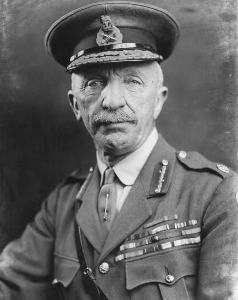
Wilson is born in County Longford and a long-time opponent of the Irish Home Rule movement. He joins the British army in 1884 and sees action during the Boer War. He is assigned to British army headquarters during the infamous Curragh incident and supports the near-mutiny of British officers who refuse to lead troops against Ulster opponents of home rule. He serves in France during the World War I and, when the war ends, continues his staunch support of the Unionist cause while serving as Chief of General Staff. He is a strong supporter of the coercion tactics of the British in Ireland during the Irish War of Independence, even suggesting that the leaders of Sinn Féin be executed. He leaves the army when David Lloyd George decides not to renew his term as chief of staff and is elected Member of Parliament (MP) for North Down as a Conservative in 1922. In Parliament, he urges even stronger coercion methods than those then being carried out by the Black and Tans.
On June 22, 1922, two London-based volunteers of the Irish Republican Army, Reginald Dunne and Joseph O’Sullivan, assassinate Wilson outside his house at 36 Eaton Place at approximately 2:20 PM. He is in full uniform as he is returning from unveiling the Great Eastern Railway War Memorial at Liverpool Street station at 1:00 PM. He has six wounds, two of them fatal wounds to the chest.
Stories later circulate that the first shot misses but rather than taking shelter in the house, he draws his sword and advances on his attackers, who are able to shoot and kill him. These stories often stress that he dies a martyr. His housemaid testifies that she found his drawn sword lying by his side. These details do not feature in the witness accounts by Reginald Dunne, which is smuggled out of prison, the inquest testimony of one of two road menders working nearby, and the taxi driver who had just dropped Wilson off. One of the road mender’s accounts, as published in the Daily Mail, mentions Wilson turning on his attackers with the words “you cowardly swine!” but this is believed to be a possible embellishment by the newspaper.
Two police officers and a chauffeur are also shot as the men attempt to avoid capture. They are then surrounded by a crowd and arrested by other policemen after a struggle. Dunne and O’Sullivan are convicted of murder and hanged on August 10, 1922. On the day Wilson’s killers were hanged, Currygrane, the family homesite in Ballinalee, County Longford is burned to the ground, possibly as a reprisal although possibly as an unrelated part of the unrest in that county.
Wilson’s widow blames the government for his death and is only persuaded to allow government representation at the funeral on the grounds that not to do so would be disrespectful to the King. Wilson’s funeral is a public affair attended by David Lloyd George and the cabinet, Ferdinand Foch, Robert Nivelle and Maxime Weygand from France as well as many of his former army colleagues including John French, Nevil Macready, Douglas Haig and William Robertson. He is buried in the crypt of St. Paul’s Cathedral in London.
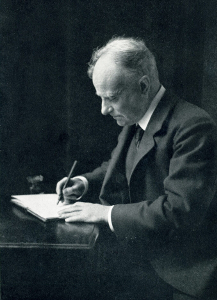
Wood is the fifth child and third son of Charles Wood, Sr. and Jemima Wood. He is a treble chorister in the choir of the nearby St. Patrick’s Cathedral. His father sings tenor as a stipendiary “Gentleman” or “Lay Vicar Choral” in the Cathedral choir and is also the Diocesan Registrar of the church. He is a cousin of Irish composer Ina Boyle.
Wood receives his early education at the Cathedral Choir School and also studies organ with two Organists and Masters of the Boys of Armagh Cathedral, Robert Turle and his successor Dr. Thomas Marks. In 1883 he becomes one of fifty inaugural class members of the Royal College of Music, studying composition with Charles Villiers Stanford and Charles Hubert Hastings Parry primarily, and horn and piano secondarily. Following four years of training, he continues his studies at Selwyn College, Cambridge through 1889, where he begins teaching harmony and counterpoint.
In 1889 he attains a teaching position at Gonville and Caius College, Cambridge, first as organ scholar and then as fellow in 1894, becoming the first Director of Music and Organist. He is instrumental in the reflowering of music at the college, though more as a teacher and organiser of musical events than as composer. After Stanford dies in 1924, Wood assumes his mentor’s vacant role as Professor of Music in the University of Cambridge.
Like his better-known colleague Stanford, Wood is chiefly remembered for his Anglican church music. As well as his Communion Service in the Phrygian mode, his settings of the Magnificat and Nunc dimittis are still popular with cathedral and parish church choirs, particularly the services in F, D, and G, and the two settings in E flat. During Passiontide his St. Mark Passion is sometimes performed, and demonstrates Wood’s interest in modal composition, in contrast to the late romantic harmonic style he more usually employs.
Wood’s anthems with organ, Expectans expectavi, and O Thou, the Central Orb are both frequently performed and recorded, as are his unaccompanied anthems Tis the day of Resurrection, Glory and Honour and, most popular of all, Hail, gladdening light and its lesser-known equivalent for men’s voices, Great Lord of Lords. All of Wood’s a cappella music demonstrates fastidious craftsmanship and a supreme mastery of the genre, and he is no less resourceful in his accompanied choral works which sometimes include unison sections and have stirring organ accompaniments, conveying a satisfying warmth and richness of emotional expression appropriate to his carefully chosen texts.
Wood collaborates with priest and poet George Ratcliffe Woodward in the revival and popularisation of renaissance tunes to new English religious texts, notably co-editing three books of carols. He also writes eight string quartets, and is co-founder of the Irish Folk Song Society in 1904.
He marries Charlotte Georgina Wills-Sandford, daughter of W. R. Wills-Sandford, of Castlerea, County Roscommon on March 17, 1898. Their son is killed in World War I.
Thomson is born to tea merchant John Thomson (1822–1894) and shopkeeper Catherine (née Andrews). He is the eldest of their three surviving children. Although he has no formal artistic training, as a young boy he often fills his schoolbooks with drawings of horses, dogs, and ships. He attends Coleraine Model School, but leaves at the age of fourteen to work as a clerk at E. Gribbon & Sons, Linen Manufacturers. Several years later his artistic talents are discovered, and in 1877 he is hired by printing and publishing company Marcus Ward & Co.
On December 29, 1884 Thomson marries Jessie Naismith Miller in Belfast. Soon afterwards they move back to London for Thomson’s career. They have one son together, John, born in 1886.
In 1911, he and his family move to Sidcup, hoping to improve their “ever delicate health.” Thomson’s correspondence reflects the fact that he misses being close to the National Gallery and the museums where he usually compiles research for his illustrations. During World War I, demand for Thomson’s work decreases to a few propaganda pamphlets and some commissions from friends. By 1917, Thomson has fallen on financial hardship and he has to take a job with the Board of Trade, where he works until 1919.
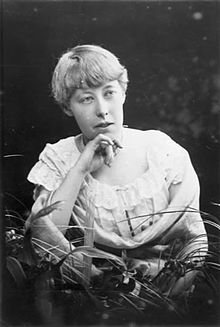
The work of Gore-Booth, alongside that of Esther Roper, the English woman who would become her lifelong companion, is responsible for the close link between the struggle for women’s rights in industry and the struggle for women’s right to vote. As a middle-class suffragist representing Manchester, the work of Gore-Booth is mainly recognized in the Lancashire cotton towns from 1899 to 1913. Her struggle begins when she becomes a member of the executive committee of the National Union of Women’s Suffrage Societies. Carrying out work at the Ancoats settlement, Eva becomes co-secretary of the Manchester and Salford Women’s Trade Union Council.
In 1902 Gore-Booth campaigns at the Clitheroe by-election on behalf of David Shackleton, a Labour candidate who promises her that he would show support for the women’s enfranchisement. Shackleton is elected but does not act upon his promise. This leads to the founding of the Lancashire and Cheshire Women Textile and Other Worker’s Representation Committee by Gore-Booth, Esther Roper and Sarah Reddish. When the Women’s Trade Union Council refuses to make women’s suffrage one of its aims, Gore-Booth resigns from the council.
In 1902 Gore-Booth campaigns at the Clitheroe by-election on behalf of David Shackleton, a Labour candidate who promises her that he would show support for the women’s enfranchisement. Shackleton is elected but does not act upon his promise. This leads to the founding of the Lancashire and Cheshire Women Textile and Other Worker’s Representation Committee by Gore-Booth, Esther Roper and Sarah Reddish. When the Women’s Trade Union Council refuses to make women’s suffrage one of its aims, Gore-Booth resigns from the council.
In 1907 Gore-Booth, reluctant to give up hope, contributes an essay “The Women’s Suffrage Movement Among Trade Unionists” to The Case for Women’s Suffrage. In this essay Eva gives a summary of reasons for the methods of the LCWTOW campaign to gain a vote for working women.
When Gore-Booth embarks on her writing career she is visited by William Butler Yeats who is very much taken with her work. Yeats hopes that she will take up his cause of writing Irish tales to enchant and amuse. Instead, Eva takes Irish folklore and put emphasis on the females in the story. Her widely discussed sexuality in later years is never declared but her poetry reflects it quite overtly. Gore-Booth is also one of a group of editors of the magazine Urania that publishes three issues per year from 1916 to 1940. It is a feminist magazine that reprints stories and poems from all over the world with editorial comment.
After years of playing a lead role in the Women’s Suffrage Movement and fighting for equality of women’s rights in the UK as well as staying true to her literary roots, Gore-Booth and Roper relocate to London from Manchester in 1913 due to Gore-Booth’s deteriorating respiratory health.
Just weeks after the 1916 Easter Rising, Gore-Booth travels to Dublin accompanied by Roper and is pivotal in the efforts to reprieve the death sentence of her sister Constance Markievicz awarded for her instrumental role in the rising, which is successfully converted to a life sentence. She further campaigns to abolish the death sentence overall and to reform prison standards. She attends the trial of Irish nationalist and fellow poet Roger Casement thus showing solidarity and support for the overturning of his death sentence.
During the remaining years of her life, which is claimed by cancer on June 30, 1926, Gore-Booth remains devoted to her poetry, dedicates time to her artistic talents as a painter, studies the Greek language and is known as a supporter of animal rights. She dies in her home in Hampstead, London, which she shares with Roper until her passing. She is buried alongside Roper in St. John’s churchyard, Hampstead.
O’Grady is born on March 22, 1846, at Castletown, County Cork, the son of Reverend Thomas O’Grady, the scholarly Church of Ireland minister of Castletown Berehaven, County Cork, and Susanna Doe. After a rather severe education at Tipperary Grammar School, O’Grady follows his father to Trinity College, Dublin, where he wins several prize medals and distinguishes himself in several sports.
O’Grady proves too unconventional of mind to settle into a career in the church and earns much of his living by writing for the Irish newspapers. Reading Sylvester O’Halloran‘s General history of Ireland sparks an interest in early Irish history. After an initial lukewarm response to his writing on the legendary past in History of Ireland: Heroic Period (1878–81) and Early Bardic Literature of Ireland (1879), he realizes that the public wants romance, and so follows the example of James Macpherson in recasting Irish legends in literary form, producing historical novels including Finn and his Companions (1891), The Coming of Cuculain (1894), The Chain of Gold (1895), Ulrick the Ready (1896) and The Flight of the Eagle (1897), and The Departure of Dermot (1913).
O’Grady also studies Irish history of the Elizabethan period, presenting in his edition of Sir Thomas Stafford‘s Pacata Hibernia (1896) the view that the Irish people have made the Tudors into kings of Ireland in order to overthrow their unpopular landlords, the Irish chieftains. His The Story of Ireland (1894) is not well received, as it sheds too positive a light on the rule of Oliver Cromwell for the taste of many Irish readers. He is also active in social and political campaigns in connection with such issues as unemployment and taxation.
Until 1898, he works as a journalist for the Daily Express of Dublin, but in that year, finding Dublin journalism in decline, he moves to Kilkenny to become editor of the Kilkenny Moderator. It is here he becomes involved with Ellen Cuffe, Countess of Desart and Captain Otway Cuffe. He engages in the revival of the local woolen and woodworking industries. In 1900 he founds the All-Ireland Review and returns to Dublin to manage it until it ceases publication in 1908. O’Grady contributes to James Larkin‘s The Irish Worker paper.
O’Grady’s works are an influence on William Butler Yeats and George Russell and this leads to him being known as the “Father of the Celtic Revival.” Being as much proud of his family’s Unionism and Protestantism as of his Gaelic Irish ancestry, identities that are increasingly seen as antithetical in the late 1800s, he is described by Augusta, Lady Gregory as a “fenian unionist.”
Advised to move away from Ireland for the sake of his health, O’Grady passes his later years living with his eldest son, a clergyman in England, and dies on the Isle of Wight on May 18, 1928.
O’Grady’s eldest son, Hugh Art O’Grady, is for a time editor of the Cork Free Press before he enlists in World War I early in 1915. He becomes better known as Dr. Hugh O’Grady, later Professor of the Transvaal University College, Pretoria, who writes the biography of his father in 1929.
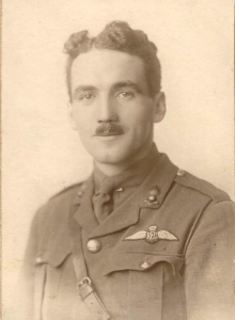
McElroy enlists promptly at the start of World War I in August 1914 and is shipped out to France two months later. He is serving as a corporal in the Motor Cyclist Section of the Royal Engineers when he is first commissioned as a second lieutenant on May 9, 1915. While serving in the Royal Irish Regiment he is severely affected by mustard gas and is sent home to recuperate. He is in Dublin in April 1916, during the Easter Rising, and is ordered to help quell the insurrection. McElroy refuses to fire upon his fellow Irishmen and is transferred to a southerly garrison away from home.
On June 1, 1916, McElroy relinquishes his commission in the Royal Irish Regiment when awarded a cadetship at the Royal Military Academy, Woolwich, from which he graduates on February 28, 1917, and is commissioned as a second lieutenant in the Royal Garrison Artillery.
McElroy is promptly seconded to the Royal Flying Corps, being trained as a pilot at the Central Flying School at Upavon, and is appointed a flying officer on June 28. On July 27 his commission is backdated to February 9, 1916, and he is promoted to lieutenant on August 9. On August 15 he joins No. 40 Squadron RFC, where he benefits from mentoring by Edward “Mick” Mannock. He originally flies a Nieuport 17, but with no success in battle. By the year’s end McElroy is flying Royal Aircraft Factory S.E.5s and claims his first victory on December 28.
An extremely aggressive dogfighter who ignores often overwhelming odds, McElroy’s score soon grows rapidly. He shoots down two German aircraft in January 1918, and by February 18 has run his string up to eleven. At that point, he is appointed a flight commander with the temporary rank of captain and transferred to No. 24 Squadron RFC. He continues to steadily accrue victories by ones and twos. By March 26, when he is awarded the Military Cross, he is up to 18 “kills.” On April 1, the Army’s Royal Flying Corps (RFC) and the Royal Naval Air Service (RNAS) are merged to form the Royal Air Force, and his squadron becomes No. 24 Squadron RAF. McElroy is injured in a landing accident on April 7 when he brushes a treetop while landing. By then he has run his score to 27. While he is sidelined with his injury, on April 22, he is awarded a bar to his Military Cross. Following his convalescence, McElroy returns to No. 40 Squadron in June, scoring three times, on the 26th, 28th, and 30th. The latter two triumphs are observation balloons. That runs his tally to thirty.
In July, he adds to his score almost daily, a third balloon busting on the 1st, followed by one of the most triumphant months in the history of fighter aviation, adding 17 victims during the month. His run of success is threatened on the 20th by a vibrating engine that entails breaking off an attack on a German two-seater and a rough emergency landing that leaves him with scratches and bruises. There is a farewell luncheon that day for his friend Gwilym Hugh “Noisy” Lewis. Their mutual friend Edward “Mick” Mannock pulls McElroy aside to warn him about the hazards of following a German victim down within range of ground fire.
On July 26, Mannock is killed by ground fire. Ironically, on that same day, “McIrish” McElroy receives the second Bar to his Military Cross. He is one of only ten airmen to receive the second Bar.
McElroy’s continues apparent disregard for his own safety when flying and fighting can have only one end. On July 31, 1918, he reports destroying a Hannoversche Waggonfabrik C for his 47th victory. He then sets out again. He fails to return from this flight and is posted missing. Later it is learned that McElroy has been killed by ground fire. He is 25 years old. McElroy is interred in Plot I.C.1 at the Laventie Military Cemetery in La Gorgue, northern France.
McElroy receives the Distinguished Flying Cross posthumously on August 3, citing his shooting down 35 aeroplanes and three observation balloons. The Bar arrives still later, on September 21, and lauds his low-level attacks. In summary, he shoots down four enemy aircraft in flames and destroys 23 others, one of which he shares with other pilots. He drives down 16 enemy aircraft “out of control” and out of the fight. He also destroys three balloons.
On the morning of May 6, RMS Lusitania is 750 miles west of southern Ireland. By 5:00 AM on May 7 she reaches a point 120 miles west southwest of Fastnet Rock off the southern tip of Ireland, where she meets the patrolling boarding vesselPartridge. By 6:00 AM, heavy fog has arrived and extra lookouts are posted. As the ship comes closer to Ireland, Captain William Thomas Turner orders depth soundings to be made and at 8:00 AM for speed to be reduced to eighteen knots, then to 15 knots and for the foghorn to be sounded. Some of the passengers are disturbed that the ship appears to be advertising her presence. By 10:00 AM the fog begins to lift and by noon it has been replaced by bright sunshine over a clear smooth sea. The RMS Lusitania increases speed to 18 knots.
U-20 surfaces at 12:45 PM as visibility is now excellent. At 1:20 PM something is sighted and KapitänleutnantWalther Schwieger is summoned to the conning tower. At first it appears to be several ships because of the number of funnels and masts, but this resolves into one large steamer appearing over the horizon. At 1:25 PM the submarine submerges to periscope depth of 11 metres and sets a course to intercept the liner at her maximum submerged speed of 9 knots. When the ships have closed to 2 miles RMS Lusitania turns away. Schwieger fears he has lost his target, but she turns again, this time onto a near ideal course to bring her into position for an attack. At 2:10 PM with the target at 700m range he orders one gyroscopic torpedo to be fired, set to run at a depth of three metres.
The U-20‘s torpedo officer, Raimund Weisbach, views the destruction through the vessel’s periscope and feels the explosion is unusually severe. Within six minutes, RMS Lusitania‘s forecastle begins to submerge.
On board the RMS Lusitania, Leslie Morton, an eighteen-year-old lookout at the bow, spots thin lines of foam racing toward the ship. He shouts, “Torpedoes coming on the starboard side!” through a megaphone, thinking the bubbles come from two projectiles. The torpedo strikes RMS Lusitania under the bridge, sending a plume of debris, steel plating and water upward and knocking lifeboat number five off its davits. A second, more powerful explosion follows, sending a geyser of water, coal, dust, and debris high above the deck. Schwieger’s log entries attest that he had only launched one torpedo. Some doubt the validity of this claim, contending that the German government subsequently alters the published fair copy of Schwieger’s log, but accounts from other U-20 crew members corroborate it. The entries are also consistent with intercepted radio reports sent to Germany by U-20 once she has returned to the North Sea, before any possibility of an official coverup.
At 2:12 PM Captain Turner orders Quartermaster Johnston stationed at the ship’s wheel to steer “hard-a-starboard” towards the Irish coast, which Johnston confirms, but the ship can not be steadied on the course and rapidly ceases to respond to the wheel. Turner signals for the engines to be reversed to halt the ship, but although the signal is received in the engine room, nothing can be done. Steam pressure collapses from 195 PSI before the explosion, to 50 PSI and falling afterwards. RMS Lusitania‘s wireless operator sends out an immediate SOS, which is acknowledged by a coastal wireless station. Shortly afterward he transmits the ship’s position, 10 miles (16 km) south of the Old Head of Kinsale. At 2:14 PM electrical power fails, plunging the cavernous interior of the ship into darkness. Radio signals continue on emergency batteries, but electric lifts fail, trapping passengers and crew. Bulkhead doors closed as a precaution before the attack can not be reopened to release trapped men.
About one minute after the electrical power fails, Captain Turner gives the order to abandon ship. Water has flooded the ship’s starboard longitudinal compartments, causing a 15-degree list to starboard.
RMS Lusitania‘s severe starboard list complicates the launch of her lifeboats. Ten minutes after the torpedoing, when she has slowed enough to start putting boats in the water, the lifeboats on the starboard side swing out too far to step aboard safely. While it is still possible to board the lifeboats on the port side, lowering them presents a different problem. As is typical for the period, the hull plates of RMS Lusitania are riveted, and as the lifeboats are lowered they drag on the inch high rivets, which threatens to seriously damage the boats before they land in the water.
Many lifeboats overturn while loading or lowering, spilling passengers into the sea. Others are overturned by the ship’s motion when they hit the water. RMS Lusitania has 48 lifeboats, more than enough for all the crew and passengers, but only six are successfully lowered, all from the starboard side. A few of her collapsible lifeboats wash off her decks as she sinks and provides floatation for some survivors.
There is panic and disorder on the decks. Schwieger has been observing this through U-20‘s periscope, and by 2:25 PM, he drops the periscope and heads out to sea.
Captain Turner is on the deck near the bridge clutching the ship’s logbook and charts when a wave sweeps upward towards the bridge and the rest of the ship’s forward superstructure, knocking him overboard into the sea. He manages to swim and find a chair floating in the water which he clings to. He survives, having been pulled unconscious from the water after spending three hours there. RMS Lusitania‘s bow slams into the bottom about 330 feet below at a shallow angle because of her forward momentum as she sinks. Along the way, some boilers explode, including one that causes the third funnel to collapse. The remaining funnels collapse soon after. The ship travels about two miles from the time of the torpedoing to her final resting place, leaving a trail of debris and people behind. After her bow sinks completely, RMS Lusitania‘s stern rises out of the water, enough for her propellers to be visible, and then goes under.
RMS Lusitania sinks in only 18 minutes. It takes several hours for help to arrive from the Irish coast and by that time many in the 52° F water have succumbed to the cold. By the days’ end, 764 passengers and crew from the RMS Lusitania are rescued and land at Queenstown. Eventually, the final death toll for the disaster comes to a catastrophic number. Of the 1,959 passengers and crew aboard RMS Lusitania at the time of her sinking, 1,195 have been lost.
In the days following the disaster, the Cunard line offers local fishermen and sea merchants a cash reward for the bodies floating all throughout the Irish Sea, some floating as far away as the Welsh coast. In all, only 289 bodies are recovered, 65 of which are never identified. The bodies of many of the victims are buried at either Queenstown, where 148 bodies are interred in the Old Church Cemetery, or the Church of St. Multose in Kinsale. The bodies of the remaining 885 victims are never recovered.
Artist William Conor is born on May 6, 1881, in the Old Lodge Road area of north Belfast, the son of a wrought-iron worker.
Celebrated for his warm and sympathetic portrayals of working-class life in Ulster, Conor studies at the Government School of Design in Belfast in the 1890s. His artistic talents are recognized at the early age of ten when a teacher of music, Louis Mantell, notices the merit of his chalk drawings and arranges for him to attend the College of Art.
Conor is one of the first Academicians when the Belfast Art Society becomes the Ulster Academy of Arts in 1930. He becomes an Associate RHA in 1938 and a full member in 1946. Exhibitions at the Victor Waddington Galleries are held in 1944 and 1948. In 1952 he is awarded the Order of the British Empire (OBE) and in 1957 he is elected President of the Royal Ulster Academy, an office he holds until 1964.
More than 50 works of his in crayon and watercolour are in the permanent collections of the Ulster Museum.
(Pictured: Bronze statue of William Conor at Conor’s Corner, Shankill Road, Belfast)
Katharine Tynan, Irish writer, known mainly for her novels and poetry, is born into a large farming family in Clondalkin, County Dublin, on January 23, 1859.
Tynan is educated at St. Catherine’s, a convent school in Drogheda. Her poetry is first published in 1878. She meets and becomes friendly with the poet Gerard Manley Hopkins in 1886. She goes on to play a major part in Dublin literary circles. In 1898 she marries English writer and barrister Henry Albert Hinkson, and they move to England. After her marriage she usually writes under the name Katharine Tynan Hinkson, or variations thereof. Later she lives at Claremorris, County Mayo, when her husband is a magistrate from 1914 until 1919. Of their three children, Pamela Hinkson (1900–1982) was also known as a writer.
For a while, Tynan is a close associate of William Butler Yeats (who may have proposed marriage and been rejected, around 1885), and later a correspondent of Francis Ledwidge. Involved in the Irish Literary Revival, Tynan expresses concern for feminist causes, the poor, and the effects of World War I in her work. She also meditates on her Catholic faith. A prolific writer, she wrote more than one hundred novels, twelve collections of short stories, reminiscences, plays, and more than a dozen books of poetry.
Katharine Tynan Hinkson dies on April 2, 1931, in Wimbledon, London, at the age of 72.







 seamus dubhghaill