seamus dubhghaill

Promoting Irish Culture and History from Little Rock, Arkansas, USA


Leave a comment

Birth of Tenor John McCormack

john-mccormack

John McCormack, an Irish tenor celebrated for his performances of the operatic and popular song repertoires and renowned for his diction and breath control, is born in Athlone, County Westmeath, on June 14, 1884.

McCormack receives his early education from the Marist Brothers in Athlone, and later attends Summerhill College in Sligo. He sings in the choir of the old St. Peters church in Athlone under choirmaster Michael Kilkelly. When the family moves to Dublin, he sings in the choir of St. Mary’s Pro-Cathedral where he is discovered by composer Vincent O’Brien. In 1903 he wins the coveted gold medal of the Dublin Feis Ceoil.

Fundraising activities on his behalf enable McCormack to travel to Italy in 1905 to receive voice training by Vincenzo Sabatini in Milan. In 1906, he makes his operatic début at the Teatro Chiabrera, Savona. The next year he begins his first important operatic performance at Covent Garden in Mascagni‘s Cavalleria rusticana, becoming the theatre’s youngest principal tenor.

In less than three years he is singing opera in the United States, as well as beginning a career on the recital stage that makes him one of the most successful singers of all time. In 1917 he becomes a citizen of the United States, his adopted country, where his concert appeal has proven to be nearly universal and unrelenting.

McCormack originally ends his career in 1938 at the Royal Albert Hall in London. However, one year after that farewell concert he is back singing for the Red Cross and in support of the war effort. He concertizes, tours, broadcasts, and records in this capacity until 1943 when failing health forced him to permanently retire.

Ill with emphysema, he purchases a house near the sea at Booterstown, County Dún Laoghaire–Rathdown, just south of Dublin. After a series of infectious illnesses, including influenza and pneumonia, McCormack dies on September 16, 1945. He is mourned by his countrymen, his English public who had taken him to their hearts as well, a vast number of his fellow citizens in the United States, and music lovers all over the world. He is buried in Deansgrange Cemetery.


Leave a comment

Molly Malone Day

molly-malone-statue

The Dublin Millennium Commission proclaims in 1988 that June 13 is to be designated as “Molly Malone Day.”

Molly Malone is a popular song, set in Dublin, which has become the unofficial anthem of Dublin City. The song tells the fictional tale of a fishmonger who plies her trade on the streets of Dublin, but who dies of a fever at a young age. In the late 20th century a legend grows that there is a historical Molly, who lived in the 17th century. She is typically represented as a hawker by day and part-time prostitute by night. In contrast she has also been portrayed as one of the few chaste female street-hawkers of her day. However, there is no evidence that the song is based on a real woman of the 17th century or any other time for that matter. The name “Molly” originated as a familiar version of the names Mary and Margaret. While many such “Molly” Malones are born in Dublin over the centuries, no evidence connects any of them to the events in the song. Nevertheless, in 1988 the Dublin Millennium Commission endorses claims about a Mary Malone who died on June 13, 1699, and proclaims June 13 to be “Molly Malone Day.”

Artists who have recorded versions of Molly Malone include Heino, U2, The Saturdays, Danny Kaye, Pete Seeger, Frank Harte, Sinéad O’Connor, Johnny Logan, Ian McCulloch, Paul Harrington, and Damien Leith. However, the best-known version is recorded by The Dubliners.

Molly Malone is commemorated in a statue designed by Jeanne Rynhart and unveiled by then Lord Mayor of Dublin, Alderman Ben Briscoe during the 1988 Dublin Millennium celebrations. The statue is presented to the city by Jury’s Hotel Group to mark the Millennium. Originally placed at the bottom of Grafton Street in Dublin, the statue is known colloquially as “The Tart With The Cart,” “The Dish with the Fish,” and “The Trollop With The Scallops.” The statue portrays Molly as a busty young woman in seventeenth-century dress. Her low-cut dress and large breasts were justified on the grounds that as “women breastfed publicly in Molly’s time, breasts were popped out all over the place.”

The statue is later removed and placed in storage to make way for new tracks for Luas, Dublin’s tram/light rail system. On July 18, 2014, it is temporarily placed outside the Dublin Tourist Office on Suffolk Street. The statue is expected to be returned to its original location in late 2017.


Leave a comment

The Armagh Rail Disaster

armagh-rail-disaster

The Armagh rail disaster occurs on June 12, 1889, near Armagh, County Armagh, when a crowded Sunday school excursion train fails to negotiate a steep incline. The steam locomotive is unable to complete the climb and the train stalls. The train crew decides to divide the train and take the front portion forward, leaving the rear portion on the running line. The rear portion has inadequate brakes and rolls back down the gradient, colliding with a following train. Eighty people are killed and 260 are injured, about a third of them children. It is the worst rail disaster in the United Kingdom in the nineteenth century and remains Ireland’s worst railway disaster ever.

Armagh Sunday school organises a day trip to the seaside resort of Warrenpoint, a distance of about 24 miles. A special Great Northern Railway of Ireland train is arranged for the journey, intended to carry about eight hundred passengers. The railway route is steeply graded and curved.

Asked to provide a train to take 800 excursionists, the locomotive department at Dundalk sends fifteen vehicles however instructions provided to the engineer are that the train is to consist of thirteen vehicles. The engineer objects to the use of fifteen vehicles. Witnesses say that the engineer asks for a second engine if the additional carriages are added but his request is refused by the station master as no additional engines are available.

Initially, the train progresses up the steep gradient at about 10 mph but stalls about 200 yards from the top of the gradient. To prevent the train from rolling back, the brakes are applied. The chief clerk directs the train crew to divide the train and proceed with the front portion to Hamilton’s Bawn station about two miles away, leaving it there and returning for the rear portion.

After uncoupling the rear portion, the engineer attempts to proceed on with the front portion. Initially, it rolls back slightly, jolting the rear portion which begins to roll back and gathers speed down the steep gradient back towards Armagh station. The train crew reverses the front portion and tries to catch the rear portion, but this proves to be impossible.

The line is operated on a time interval system so there is no means at Armagh of knowing that the line is not clear. The following scheduled passenger train leaves Armagh after the required 20-minute interval. It is proceeding up the gradient at about 25 mph when the engineer sees the approaching runaway vehicles at a distance of about 500 yards. He brakes his train and has reduced speed to 5 mph at the moment of collision. The two rearmost vehicles of the excursion train are utterly destroyed, and the third rearmost is very badly damaged.


Leave a comment

Formation of the Independent Orange Order

independent-orange-orderThe Independent Orange Order, a Protestant fraternal organisation, is formed in Belfast on June 11, 1903 by Thomas Sloan and others associated with the Belfast Protestant Association, who have been expelled from the Orange Order because they voice opposition to it being used for party political ends by Ulster Unionists. Originally it is associated with the labour movement, but it soon realigns itself with traditional unionist politics.

It takes its name in memory of King William of Orange of the house of Orange who fights at the Battle of the Boyne, brings about the Glorious Revolution and the Bill of Rights giving the Westminster parliament ultimate power of the country rather than the Monarch. The Independent Order is small compared to the main organisation with 1,500 to 2,000 members. It is largely based around north County Antrim in Northern Ireland but has lodges around the world, including England, Scotland, and Australia. Its annual main Twelfth of July demonstration is held in a north Antrim town or village.

The first notable effect after the formation of the Independent Order is a more liberal interpretation of the rules of the “Old Order.” In the early years of the Institution, many suffer the full wrath of the “powers that be,” who are opposed to any splitting of the Orange Order. Jobs are lost, homes are burned, and their headquarters in Belfast is bombed.

Independent Orangeism today maintains that it is essential for the Orange Institution to be kept free from politics and to guard the principles of Reformation Protestantism. They often express alarm when they believe these principles are endangered by conciliatory politicians. They are opposed to ecumenism and, while being opposed to Orangeism being linked to the Ulster Unionist Party, they are not apolitical and tend to work alongside unionist politicians and parties.

The Institution also promotes Ulster Protestant history and proclaims the principle of “Liberty of Conscience.” They declare their right to think and act independently without direction from political or clerical masters, they seek to strengthen the position of Orangeism, and they often warn of the danger of the development of a social and cultural Orangeism devoid of Protestant principle.


Leave a comment

Patrick Magee Found Guilty of Grand Brighton Hotel Bombing

patrick-joseph-magee

Patrick Joseph Magee of Belfast is found guilty on June 10, 1986, of planting a bomb at the Grand Brighton Hotel in 1984 which kills five people but misses its primary target, British Prime Minister Margaret Thatcher. The bombing is testament to the ingenuity of the Irish Republican Army (IRA) and its bomb makers.

The 30-pound bomb is planted behind a bath in a room on the sixth floor more than three weeks prior to the Prime Minister’s visit. Timed to go off on the final day of the conference, it explodes in the early morning hours of October 12, 1984 and nearly wipes out most of Thatcher’s cabinet, killing five prominent Conservatives and injuring thirty-four.

The bomb destroys a bathroom that Mrs. Thatcher had been in just a few minutes earlier.

Magee stays in the hotel four weeks previously under the false name of Roy Walsh, during the weekend of September 14-17, 1984. He plants the bomb, which includes a long-delay timer, in the bathroom wall of his room, number 629. Magee becomes the primary suspect when forensic officers find his palm print on a hotel registration card following the blast.

Magee is arrested in the Queen’s Park area of Glasgow on June 22, 1985 with other members of an active service unit, including Martina Anderson, while planning other bombings.

Sentenced to a minimum 35 years in jail, he is released from prison in 1999 as part of the Good Friday Agreement early release program. Magee is one of many on both sides of the conflict whose release raises differing emotions.

In one of the more compelling twists associated with the Northern Ireland troubles, Magee works diligently since his release to ease tensions in Northern Ireland and develops a strong working relationship with Jo Berry, daughter of Sir Anthony Berry MP who was killed in the Grand Brighton Hotel blast. They first meet publicly in November 2000 in an effort at achieving reconciliation. They have met publicly on more than one hundred occasions since that date.


Leave a comment

The Jeanie Johnston Begins 4-Month Voyage Around Ireland

jeanie-johnston

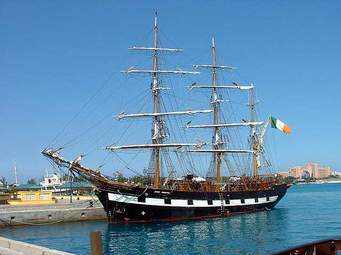
The Jeanie Johnston, a replica of a three-masted barque that was originally built in 1847 in Quebec, Canada, by the Scottish-born shipbuilder John Munn, begins a four-month voyage around Ireland on June 9, 2004.

The original Jeanie Johnston makes her maiden emigrant voyage on April 24, 1848, from Blennerville, County Kerry to Quebec with 193 emigrants on board who are fleeing the effects of the Great Famine that is ravaging Ireland. Between 1848 and 1855, the Jeanie Johnston makes sixteen voyages to North America, sailing to Quebec, Baltimore, and New York. Ships that transport emigrants out of Ireland during this period become known as “famine ships” or “coffin ships.”

The project to build a replica is conceived in the late 1980s, but does not become a reality until November 1993 when a feasibility study is completed. In May 1995, The Jeanie Johnston (Ireland) Company Ltd. is incorporated. The ship is designed by Fred Walker, former Chief Naval Architect with the National Maritime Museum in Greenwich, England.

The original plans are to launch the ship from her shipyard in Blennerville, but a 19th-century shipwreck is discovered by marine archaeologists while a channel is being dredged. To preserve the find, on April 19, 2000 the hull of the Jeanie Johnston is hauled to the shore and loaded onto a shallow-draft barge. There she is fitted with masts and sails, and on May 4 is transported to Fenit, a short distance away. On May 6 the barge is submerged and the Jeanie Johnston takes to the water for the first time. The next day she is officially christened by President Mary McAleese.

In 2003, the replica Jeanie Johnston sails from Tralee to Canada and the United States visiting 32 U.S. and Canadian cities and attracting over 100,000 visitors.

The replica is currently owned by the Dublin Docklands Development Authority who bought it in 2005 for a reported 2.7 million Euro, which were used to clear outstanding loans on the vessel guaranteed by Tralee Town Council and Kerry County Council. It is docked at Custom House Quay in the centre of Dublin.


Leave a comment

Barry McGuigan Wins the World Featherweight Boxing Title

barry-mcguigan

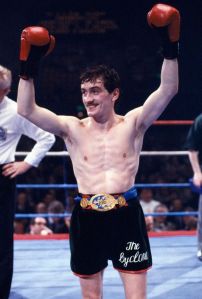
Finbar Patrick McGuigan, known as Barry McGuigan and nicknamed The Clones Cyclone, wins the World Boxing Association featherweight title on June 8, 1985, defeating Eusebio Pedroza in a unanimous 15-round decision at Loftus Road soccer stadium in London.

Barry McGuigan, the son of singer Pat McGuigan, is born in Clones, County Monaghan. He represents Northern Ireland in the Commonwealth Games at Edmonton in 1978 and represents Ireland at the 1980 Summer Olympics in Moscow.

After a successful juvenile boxing career, McGuigan begins his professional boxing career on May 10, 1981, beating Selwyn Bell by knockout in two rounds in Dublin. He wins four out of five additional bouts in 1981. In 1982, McGuigan wins eight fights, seven by knockout, although one of these almost destroys his career and his life. Opposed by Young Ali, on June 14, 1982, McGuigan wins by a knockout in six rounds. Ali falls into a coma and dies five months later.

In 1985, McGuigan meets former world featherweight champion Juan Laporte and wins a 10-round decision. Following one more win, he finally gets his world title attempt when the long reigning WBA featherweight champion, Eusebio Pedroza of Panama, comes to London to put his title on the line at Loftus Road soccer stadium. McGuigan becomes the champion by dropping Pedroza in the seventh round and winning a unanimous fifteen-round decision in a fight refereed by hall of fame referee Stanley Christodoulou. McGuigan and his wife are feted in a public reception through the streets of Belfast that attracts several hundred thousand spectators. Later that year, he is named BBC Sports Personality of the Year, becoming the first person not born in the United Kingdom to win the award.

McGuigan twice successfully defends his title, first against American Bernard Taylor, who is stopped in nine  rounds, and then against Dominican Danilo Cabrera in a controversial knock out in fourteen rounds. The fight is stopped after Cabrera bends over to pick up his mouthpiece after losing it, a practice that is allowed in many countries but not in Ireland. Cabrera is not aware of this, and the fight is stopped.

McGuigan’s next defence takes place in Las Vegas in June 1986, where he faces the relatively unknown Steve Cruz of Texas, in a gruelling 15-round title bout under a blazing sun. McGuigan holds a lead halfway through, but suffers dehydration due to the extreme heat and wilts near the end, being dropped in the tenth and fifteenth rounds. He eventually loses the world title, which he never reclaims, in a close decision. After the fight McGuigan requires hospitalisation because of his dehydrated state.

McGuigan retires after the fight but returns to the ring between 1988 and 1989, beating former world title challengers Nicky Perez and Francisco Tomas da Cruz, as well as contender Julio César Miranda, before losing to former EBU featherweight champ and future WBC and WBA super featherweight challenger Jim McDonnell by a technical knockout. After the McDonnell fight he permanently retires from boxing. His record is 32 wins and 3 losses, with 28 knockouts. In January 2005, McGuigan is elected into the International Boxing Hall of Fame.

McGuigan founds and is the current President of the Professional Boxing Association (PBA). He is also the CEO and founder of Cyclone Promotions.


Leave a comment

John Joseph “Jack” Doyle Becomes First Major League Pinch Hitter

jack-doyle

John Joseph “Jack” Doyle, Irish-American first baseman of the Cleveland Spiders in Major League Baseball, becomes the first to pinch hitter in a baseball game on June 7, 1892. He comes through with a game-winning single against the Brooklyn Dodgers.

Doyle is born in Killorglin, County Kerry, on October 25, 1869, and emigrates with his family to the United States when he is a child, settling in Holyoke, Massachusetts. After attending Fordham University, Doyle embarks on a baseball career that lasts 70 years. He makes his first appearance at the major league level by signing and playing two years for the Columbus Solons of the American Association. Doyle plays for ten clubs between 1889 and 1905, batting .299 in 1,564 games with 516 stolen bases. He begins as a catcher–outfielder and becomes a first baseman in 1894. His best years are in 1894, when he bats .367 for the New York Giants, and in 1897, when he hits .354 with 62 stolen bases for the Baltimore Orioles.

Because of his aggressive playing style, Doyle is known as “Dirty Jack”, often feuding with umpires, fans, opposing players, and even at times, his own teammates. He carries on a lengthy feud with John McGraw that starts when they are teammates in Baltimore. McGraw, of course, has to have the last word. In 1902, McGraw is appointed manager of the Giants and his first act is to release Doyle, even though he is batting .301 and fielding .991 at the time. Even with these seemingly out-of-control traits, Doyle is deemed a natural leader and is selected as team captain in New York, Brooklyn and Chicago, and serves as an interim manager for the Giants in 1895 and Washington Senators in 1898.

In 1905, after playing one game with the New York Highlanders, Doyle becomes manager of Toledo of the Western Association. One year later, he is named the manager of the Des Moines Champions, so named because they won the league championship the previous year, and they win it again under Doyle’s helm. Following his championship season at Des Moines, he manages Milwaukee in 1907.

In 1908–1909, the only years of his adult life spent outside of baseball, Doyle serves as police commissioner of his hometown of Holyoke. He returns to baseball as an umpire and works in the National League for 42 games in 1911. He later joins the Chicago Cubs as a scout in 1920. He remains in that capacity until his death at age 89 on New Year’s Eve 1958. Doyle is buried at St. Jerome Cemetery in Holyoke.


Leave a comment

Assassination of Robert F. Kennedy

robert-f-kennedy

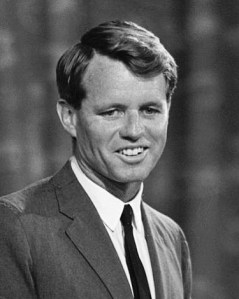
Robert F. Kennedy, Irish-American, United States Senator, Democratic presidential candidate, and brother of assassinated President John F. Kennedy, dies on June 6, 1968 in Los Angeles, California after being shot in the early morning hours of June 5.

After winning the California and South Dakota primary elections for the Democratic nomination for President of the United States and speaking to supporters in a ballroom at the Ambassador Hotel, Kennedy walks through the kitchen area frequently shaking hands with those he encounters. Kennedy starts down a passageway narrowed by an ice machine against the right wall and a steam table to the left. He turns to his left and shakes hands with busboy Juan Romero just as Sirhan Sirhan, a 24-year-old Palestinian/Jordanian immigrant, steps down from a low tray-stacker beside the ice machine and repeatedly fires what is later identified as a .22 caliber Iver-Johnson Cadet revolver.

After Kennedy had falls to the floor, former FBI agent William Barry sees Sirhan holding a gun and hits him twice in the face while others force Sirhan against the steam table and disarmed him as he continues firing his gun in random directions. Five other people are also wounded.

Kennedy is transferred several blocks to Good Samaritan Hospital for surgery. Surgery begins at 3:12 AM PDT and lasts three hours and 40 minutes. Despite extensive neurosurgery to remove bullet and bone fragments from his brain, his condition remains extremely critical until he dies at 1:44 AM PDT on June 6, nearly 26 hours after the shooting.

Sirhan pleads guilty on April 17, 1969, and is sentenced to death. The sentence is commuted to life in prison in 1972 after the California Supreme Court, in its decision in California v. Anderson, invalidates all pending death sentences imposed in California prior to 1972. Since that time, Sirhan has been denied parole fifteen times and is currently confined at the Richard J. Donovan Correctional Facility in southern San Diego County.

Kennedy’s body lay in repose at St. Patrick’s Cathedral in New York City for two days before a funeral Mass is held on June 8. His body is interred near his brother at Arlington National Cemetery in Washington, D.C. His death prompts the protection of presidential candidates by the United States Secret Service. Hubert Humphrey later goes on to win the Democratic nomination for the presidency, but ultimately loses the election to Republican Richard Nixon.

As with his brother’s death, Kennedy’s assassination and the circumstances surrounding it have spawned a variety of conspiracy theories. Kennedy remains one of only two sitting United States Senators to be assassinated, the other being Huey Long.


Leave a comment

Birth of Christy Brown, Author of “My Left Foot”

christy-brown

Christy Brown, writer and painter who has cerebral palsy and is able to write or type only with the toes of one foot, is born into a working-class Irish family at the Rotunda Hospital in Dublin on June 5, 1932. His most recognized work is his autobiography, My Left Foot, which is later made into a 1989 Academy Award-winning film of the same name, starring Daniel-Day Lewis as Brown.

After his birth, doctors discovered that he has severe cerebral palsy, a neurological disorder which leaves him almost entirely spastic in his limbs. Though urged to commit him to a hospital, Brown’s parents are unswayed and subsequently determined to raise him at home with their other children. During Brown’s adolescence, social worker Katriona Delahunt becomes aware of his story and begins to visit the Brown family regularly. She brings Christy books and painting materials as, over the years, he has shown a keen interest in the arts and literature. He has also demonstrated extremely impressive physical dexterity since, soon after discovering several household books, Christy learns to both write and draw himself using his left leg, the only limb over which he had unequivocal control.

Brown quickly matures into a serious artist. Although Brown famously receives almost no formal schooling during his youth, he does attend St. Brendan’s School-Clinic in Sandymount intermittently. At St. Brendan’s he comes in contact with Dr. Robert Collis, a noted author. Collis discovers that Brown is also a natural novelist and later uses his own connections to publish My Left Foot, by then a long-gestating autobiographical account of Brown’s struggle with everyday life amidst the vibrant culture of Dublin.

In 1965, after My Left Foot has become a literary sensation, Brown meets and begins corresponding with Beth Moore, a married American woman, and they begin an affair. She helps push Brown to complete his book Down All the Days, which is published in 1970 and includes a dedication to Moore.

During this time, Brown’s fame continues to spread internationally, and he becomes a prominent celebrity. Upon his return to Ireland, he is able to use proceeds from the sales of his books to design and move into a specially constructed home outside Dublin with his sister’s family. It is around this time that Brown begins an affair with Englishwoman Mary Carr, whom he marries in 1972 at the Registry Office in Dublin. He continues to paint, write novels, poetry, and plays. His 1974 novel, A Shadow on Summer, is based on his relationship with Moore, whom he still considers a friend.

Brown’s health deteriorates after marrying Carr. He becomes a recluse in his final years, which is thought to be a direct result of Carr’s influence and perhaps abusive nature. Brown dies in Parbrook, Somerset, England on September 7, 1981, at the age of 49 after choking during a lamb chop dinner. His body is found to have significant bruising, which leads many to believe that Carr has physically abused him. Further suspicions arise after Georgina Hambleton’s biography, The Life That Inspired My Left Foot, reveals a supposedly more accurate and unhealthier version of their relationship. The book portrays Carr as an abusive alcoholic and habitually unfaithful. Brown is buried in Dublin’s Glasnevin Cemetery.