Cahir Healy, Irish nationalist politician, is born in Mountcharles, County Donegal, on December 2, 1877. He is a leader of northern Nationalists and is a self educated man who makes major contributions to Ireland’s cultural and literary heritage.
Healy is re-elected in 1923, but remains in custody until the following year, in which he does not defend his seat. Instead, he is elected to represent the seat in the House of Commons of Northern Ireland in the 1925 Northern Ireland general election, but does not take his seat until 1927 due to the Nationalist abstentionist policy. In 1928 he becomes a founder of the National League of the North. In 1929, with the break-up of the large Fermanagh and Tyrone constituency, he switches to sit for the new seat of South Fermanagh. In a 1931 Fermanagh and Tyrone by-election he is again elected for Fermanagh and Tyrone to the British Parliament, but stands down again in 1935.
Healy becomes an insurance official but continues to write, his output including journalism, poetry and short stories. He is interned by the United Kingdom government for a year during World War II under Defence Regulation 18B. In 1950 he is elected to the British House of Commons for a third time, on this occasion representing Fermanagh and South Tyrone. He finally sits in the British Parliament in 1952, and holds the seat until he stands down in 1955. He leaves the Northern Ireland House of Commons in 1965, by which point he is the Father of the House.
Healy dies on February 8, 1970, at the age of 92 at Enniskillen, County Fermanagh.
(Pictured: Portrait of Cahir Healy by Lafayette, half-plate nitrate negative, July 7, 1932, given by Pinewood Studios via Victoria and Albert Museum, 1989, National Portrait Gallery, London)
Flood is the son of policeman John Flood and Sarah Murphy. The 1911 census lists the family living at 15 Emmet Street. He is one of ten children consisting of nine brothers and one sister, most of whom are heavily involved in the Independence movement. He attends secondary school at O’Connell School in Dublin and wins a scholarship to study engineering at University College Dublin (UCD) where he is an active member of UCD’s famous debating forum, the Literary and Historical Society. He passes his first- and second-year engineering exams with distinction. At the time of his arrest, he is living with his family at 30 Summerhill Parade, Dublin.
Flood is captured, together with Thomas Bryan, Patrick Doyle, Bernard Ryan and Dermot O’Sullivan, while attacking a lorry-load of Dublin Metropolitan Police at Drumcondra on January 21, 1921. All of the men are found in possession of arms and a grenade is discovered in Flood’s pocket. On February 24, 1921, he is charged by court-martial, with high treason/levying war against the King, and is one of six men executed by hanging on March 14, 1921, in Mountjoy Prison, Dublin. At nineteen years of age, he is the youngest of the six. No members of any of the six families are allowed to attend the execution in the yard at Mountjoy Prison.
Flood is a close personal friend of Kevin Barry and asks that he be buried as close as possible to him. He had taken part in the September 1920 ambush during which Barry had been arrested and had been involved in the planning of several aborted attempts to rescue him. He remains buried at Mountjoy Prison, together with nine other executed members of the Irish Republican Army known as The Forgotten Ten, until he is given a state funeral and reburied at Glasnevin Cemetery on October 14, 2001, after an intense campaign led by the National Graves Association.
Students of University College Dublin establish the Frank Flood Shield, an annual debating competition, in his memory. Flood and the other five men executed on March 14, 1921, are commemorated in Thomas MacGreevy‘s poem “The Six who were Hanged.”
The bridge over the River Tolka in Drumcondra at Millmount Avenue/Botanic Avenue is named Droichead Frank Flood on March 14, 2018.
Cleburne is born on March 17, 1828 at Bride Park Cottage in Ovens, County Cork, just outside Cork city. He is extremely loyal to his adopted country, saying, “if this [Confederacy] that is so dear to my heart is doomed to fail, I pray heaven may let me fall with it, while my face is toward the enemy and my arm battling for that which I know to be right.” Sadly, he ultimately receives his wish.
Cleburne begins his military career in an unlikely manner. When he fails the entrance exam at Trinity College, Dublin, he cannot face his family. He enlists in the 41st Regiment of Foot in the British Army. In 1849 he purchases his discharge and leaves for the United States, eventually settling in Helena, Arkansas in June 1850 and earning his citizenship in 1855. He loves his new country, taking part in many community projects, and even being one of the few volunteers to care for the sick during a yellow fever outbreak.
In January 1861 Cleburne joins the local militia company, the Yell Rifles. He leads the company in the seizure of the U.S. Arsenal in Little Rock in January 1861. When Arkansas secedes from the Union, the Yell Rifles become part of the 1st Arkansas Infantry Regiment. By fall of 1861 he has risen to command the 2nd Brigade, Hardee’s Division, in the Army of Central Kentucky. His first major battle is at the Battle of Shiloh, April 6-7, 1862. At the Battle of Richmond (Kentucky) in August 1862, he is wounded in the mouth and loses several of his teeth. Still, he earns the thanks of the Confederate States Congress for his actions there. During the October 1862 Battle of Perryville he is wounded again – twice, yet stays in command during the battle. In December 1862 he is promoted to Major General.
At the December 1862 Battle of Stones River, Cleburne and his division earn the praise of General Braxton Bragg for their incredible skill and valor. Cleburne’s actions and character play a large role in his men’s determination during battle.
In 1863 Cleburne faces off against Union General George Henry Thomas at the Battle of Chickamauga. His and General John C. Breckinridge’s assaults force General Thomas to call repeatedly for reinforcements. In November 1863 the Confederate army is forced to retreat after the Chattanooga Campaign. However, Cleburne has defeated every assault against his men eventually charging his attackers. After the battle, he and his men are charged with covering the retreat.
On January 2, 1864, Cleburne makes his most controversial decision ever. He gathers the corps and division commanders in the Army of Tennessee to present his proposal. The Confederacy is unable to fill its ranks due to a lack of manpower. He states that slavery is their “most vulnerable point, a continued embarrassment, and in some respects an insidious weakness.” His proposed solution is for the Confederacy to arm slaves to fight in the army. In time, these soldiers would receive their freedom. The proposal is not well received at all. In fact, Jefferson Davis, President of the Confederate States of America, directs that the proposal be suppressed.
General Hood hopes to stop Union General John Schofield and his men before they can reach Nashville to reinforce General Thomas. Due to poor communications and nightfall, Schofield slips past the Army of Tennessee into Franklin.
The November 30, 1864 Battle of Franklin is a tragic loss for the Confederacy. Hood throws his men into well-fortified Union troops. The results are disastrous. About 6,000 men are killed or wounded including six generals who are killed or mortally wounded. Cleburne is one of these six, killed while attacking Union breastworks. He is last seen advancing on foot toward the Union line with his sword raised, after his horse had been shot out from under him. Accounts later say that he is found just inside the Federal line and his body is carried back to an aid station along the Columbia Turnpike. Confederate war records indicate he died of a shot to the abdomen, or possibly a bullet that went through his heart. When Confederates find his body, he has been picked clean of any valuable items, including his sword, boots and pocket watch.
Cleburne’s remains are first laid to rest at Rose Hill Cemetery in Columbia, Tennessee. At the urging of Army Chaplain Bishop Quintard, Judge Mangum, staff officer to Cleburne and his law partner in Helena, his remains are moved to St. John’s Episcopal Church near Mount Pleasant, Tennessee, where they remain for six years. In 1870, he is disinterred and returned to his adopted hometown of Helena, Arkansas, with much fanfare, and buried in the Helena Confederate Cemetery located in the southwest corner of the Maple Hill Cemetery, overlooking the Mississippi River.
After the Irish Rebellion starts, the rebels first attempt to move into Ulster and capture Belfast. When they meet stiff Protestant resistance in Ulster, the rebels turn their focus southward with the goal of taking Dublin. En route to attack Dublin, the rebels come upon the town of Drogheda and begin the siege of the garrison. Approximately one week after the rebels have encircled Drogheda, the English authorities in Dublin put together a relief force and send them to reinforce the Royalist strongpoint. En route to Drogheda, the English force is ambushed and routed by the rebels in Julianstown.
The English relief force is hastily put together and largely untrained. Many of the soldiers in the relief force are emaciated and sick refugees from the northern counties who are pressed into service. The detachment is commanded by Sir Patrick Wemyss and is composed of 600 foot and 50 horse. The rebel forces are led by Philip O’Reilly and Miles O’Reilly, both Irish leaders from County Cavan. Their force of 3,000 men including 300 horse has experienced commanders and appears to have been assigned to the south of Drogheda to complete the encirclement of the garrison.
On the morning of the battle, the rebels become aware of the approach of the Royalists and prepare an ambush. As the rebels spring their trap, the English commander does not immediately order his men to attack and fire upon the enemy. By mistake Wemyss orders his men to “countermarch” which causes them to move backwards as if they are retreating. The rebels take full advantage of the situation and immediately charge the Royalists. The rebel attack causes panic and confusion among the English and prevents them from coordinating an effective counterattack. Many of the Royalists throw down their weapons and attempt to escape. The Royalist horse flee the field. In the end, the rebels kill almost all of the Royalist foot soldiers.
The victory has several short-term benefits for the rebels. From the manner in which they rout the Royalists, the rebel forces gain respect as a military force. It boosts rebel morale and helps to spread the revolt throughout Ireland. For the commander of the Royal Irish Army, James Butler, Earl of Ormond, the battle shows the determination of the rebels and the degree of support for their cause. Ultimately, the Battle of Julianstown as a small part of the Irish Rebellion indirectly leads to the English Civil War and Confederate Ireland.
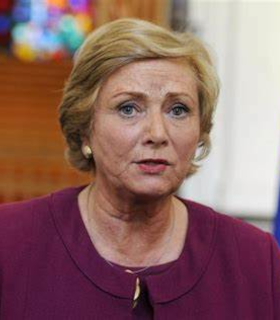
TánaisteFrances Fitzgerald resigns from Government in the “national interest” on November 28, 2017, hours ahead of a no-confidence motion in the Dáil threatens to bring down the Government.
Fitzgerald tells a Cabinet meeting she will be “vindicated” by the Disclosures Tribunal led by Justice Peter Charleton, which is examining allegations of the smear campaign against Garda whistleblower Sgt. Maurice McCabe.
The Tánaiste tells her colleagues she believes she has done nothing wrong but is resigning to avoid “an unwelcome and potentially destabilising general election.” In a statement, she says, “It has been the greatest honour of my life to serve in Government, but I believe it is necessary to take this decision to avoid an unwelcome and potentially destabilising general election at this historically critical time.”
The Tánaiste says she has always sought to act with integrity and responsibility and is now seeking to place “the national interest ahead of my own personal reputation.” She adds, “I decided that my continuation in office risks destabilising that good work, and so I have decided to step down so that this work may continue, and the country can be spared an unnecessary election. It will also allow me to vindicate my good name at the Charleton tribunal, without causing any further distraction to the work of the government. I have always believed in due process, and I believe that in the current situation that is becoming increasingly difficult for me. I acted correctly in difficult circumstances and, in fact, did everything that I could to support the search for truth and protect whistleblowers.”
Earlier in the day, Attorney GeneralSéamus Woulfe gives a presentation to the Cabinet insisting it would be “inappropriate and improper” for Fitzgerald to have intervened when she received the emails in 2015.
TaoiseachLeo Varadkar accepts Fitzgerald’s resignation at the end of the Cabinet meeting and telephones Fianna Fáil leader Micheál Martin to advise him of the development. In a statement in the Dáil, Varadkar says she is leaving office without getting a full and fair hearing, but the work of Government must not be interrupted. It is my strong view that a good woman is leaving office without getting a full and fair hearing. Frances has been an exemplary member of Government and a loyal colleague.”
Varadkar also announces that Minister for JusticeCharles Flanagan is to make a Dáil statement on the controversies surrounding his department. He tells the Dáil that Flanagan will apologise for his department’s failure to answer questions fully in recent weeks and will offer further assurance that questions not answered yet would be answered.
In the evening, Secretary General of the Department of Justice Noel Waters confirms his departure from his position. He is due to resign in February 2018 but confirms he will leave the role immediately. This is a decision he has made on his own, he adds.
Meanwhile, Fine Gael sources say the resignation of Fitzgerald has handed the Fianna Fáil leader a “significant win” and has damaged the Taoiseach. Speaking at his frontbench meeting after the resignation is confirmed, Martin thanks his party for their patience over a difficult few days. He says the focus now needs to be on Brexit and supporting the Government’s stance during the talks scheduled for mid-December.
Fitzgerald had been under intense political pressure in recent days over the handling of the case of Garda whistleblower Sgt McCabe. However, even if the immediate threat of an election has been removed, the crisis has significantly weakened the Government and damaged trust between Fine Gael and Fianna Fáil, which supports the minority Government with a confidence-and-supply arrangement.
Fitzgerald has insisted she was unaware of a legal strategy by former Garda commissioner Nóirín O’Sullivan in 2015 to question the integrity and credibility of Sgt. McCabe at the O’Higgins commission, which was examining allegations of Garda malpractice.
Fianna Fáil and Sinn Féin have been seeking the Tánaiste’s resignation, and both table motions of no confidence in her, the first of which is due to have been heard at 8:00 PM that evening.
During the crisis Varadkar stands by Fitzgerald and offers her his full support. However, Fine Gael Teachtaí Dála (TD) and Ministers question Varadkar’s confidence in Fitzgerald in recent days as more details emerge. Fine Gael Ministers react with fury on November 27 when it emerges that Fitzgerald had received three emails on two separate dates notifying her of the legal strategy pursued by O’Sullivan against Sgt. McCabe.
The Department of Justice emails show Fitzgerald was repeatedly told in 2015 about an “aggressive” approach to undermine Sgt. McCabe at the O’Higgins commission. In two separate emails on July 4, 2015, she is advised of media queries about the “aggressive” approach being adopted by former Garda commissioner O’Sullivan and advises how to respond if the media asks her about the matter. It is a senior Department of Justice official who describes the approach as “aggressive.”
The emails reveal that a senior official suggested to Fitzgerald that she should say that it would be “very unfair to Sgt. McCabe” if she was to respond to queries about the commission. This release of emails about the controversy undermines efforts to defuse the row between Fine Gael and Fianna Fáil over Fitzgerald’s position.
Earlier in the day, Independent Alliance members of Cabinet say they will seek “political accountability” from Fitzgerald. There had been no appetite from within Fine Gael for a general election on the matter, as they fear they will face an intense backlash from voters.
(From: “Frances Fitzgerald resigns in ‘national interest’ to avoid an election” by Sarah Bardon, The Irish Times, http://www.irishtimes.com, November 28, 2017)
Parke joins the British Army Medical Services (AMS) in February 1881 as a surgeon, first serving in Egypt during the final stages of the ʻUrabi revolt in 1882. As a senior medical officer at a field hospital near Cairo, he is responsible for treating battle casualties as well as the deadly cholera epidemic that afflicts 20% of British troops stationed there. In late 1883, he returns to Ireland, where he is stationed at Dundalk with the 16th The Queen’s Lancers. He arrives in Egypt once again in 1884 as a part of the Nile Expedition sent in relief of General Charles Gordon, who is besieged in Khartoum by Mahdists in neighbouring Sudan. The expedition arrives too late, and Gordon is killed. Parke later negatively recounts this experience in an 1892 journal article titled How General Gordon Was Really Lost. Following the expedition, he spends the next few years stationed in Alexandria, where he notably introduces fox hunting to Egypt, becoming master of the Alexandria Hunt Club.
In January 1887, while in Alexandria, Parke is invited by Edmund Musgrave Barttelot to accompany him on the Emin Pasha Relief Expedition. The expedition is led by Henry Morton Stanley, and journeys through the African wilderness in relief of Emin Pasha, an Egyptian administrator who had been cut off by Mahdist forces following the Siege of Khartoum. He is initially rejected by Stanley upon his arrival in Alexandria but is invited by telegram a day later to join the expedition in Cairo. On February 25, 1887, the expedition sets off from Zanzibar for the Congo.
The expedition lasts for three years and faces great difficulty, with the expedition of 812 men suffering from poor logistical planning and leadership. The rainforest is much larger than Stanley expected, leading much of the party to face starvation and disease. The expedition has to resort to looting native villages for food, escalating the conflict between the two groups. Parke, for his part, saves the lives of many in the party, including Stanley, who suffers from acute abdominal pain and a bout of sepsis. Stanley describes Parke’s care as “ever striving, patient, cheerful and gentle…most assiduous in his application to my needs, and gentle as a woman in his ministrations.” Parke also treats Arthur Jephson for fever, and nurses Robert H. Nelson through starvation. Furthermore, after a conflict with the natives, he has to save William Grant Stairs by orally sucking the poison out of an arrow wound.
During the expedition, Parke purchases from an Arab slaver a Mangbetu Pigmy girl, who serves as his nurse and servant for over a year.
After returning to Ireland, Parke receives an Honorary Fellowship of the Royal College of Surgeons in Ireland and is awarded gold medals from the British Medical Association (BMA) and the Royal Geographical Society. He publishes several books, including My Personal Experiences in Equatorial Africa (1891) and A Guide to Health in Africa.
At the outbreak of the First English Civil War, Ireton joins the Parliamentary army, commanding a cavalry force in the indecisive Battle of Edgehill in October 1642, and at the Battle of Gainsborough in July 1643. In 1643 he meets and befriends Oliver Cromwell, then a colonel in the army of eastern England. Cromwell appoints him deputy governor of the Isle of Ely in 1644, and he fights at the Parliamentary victories in the Battle of Marston Moor (July 1644), and the Battle of Naseby (June 1645). In the summer of 1646, he marries Cromwell’s eldest daughter, Bridget. The marriage brings Ireton’s career into parallel with Cromwell’s.
Although Ireton’s military record is distinguished, he earns his fame in politics. Elected to Parliament in 1645, he looks on while a conflict develops between the Independents in the army and the Presbyterians who control the House of Commons. In 1647 he presents his “Heads of the Proposals,” a constitutional scheme calling for division of political power among army, Parliament, and king and advocating religious tolerance for Anglicans and Puritans. These proposals for a constitutional monarchy are rejected by the king. At the same time, they are attacked by the Levellers, a group that calls for manhood suffrage and an unfettered liberty of conscience in matters of religion.
Ireton then turns against the king. When the Independents in the army triumph over Parliament during the second phase of the Civil War, his “Remonstrance of the Army” provides the ideological foundation for the assault on the monarchy. He helps to bring Charles I to trial and is one of the signatories of the king’s death warrant. From 1649 to 1651 he prosecutes the government’s case against Roman Catholic rebels in Ireland, becoming Lord Deputy of Ireland and acting commander in chief in 1650.
In early June 1650, Ireton mounts a counter-guerrilla expedition into the Wicklow Mountains to secure his lines of supply for the Siege of Waterford in southeast Ireland. Thomas Preston surrenders Waterford after a three-month siege. Ireton then advances to Limerick by October but has to call off the siege due to cold and bad weather. He returns to Limerick in June 1651 and besieges the city for five months until it surrenders in October 1651. At the same time, parliamentarian forces conduct the Siege of Galway, and he rides to inspect the command of Charles Coote, who is blockading that city. The physical strain of his command takes hold, and he falls ill.
After the capture of Limerick, Ireton has dignitaries of Limerick hanged for their defence of the city, including Alderman Thomas Stritch, Bishop Terence O’Brien, and an English Royalist officer, Colonel Fennell. He also wants the Irish commander, Hugh Dubh O’Neill hanged, but Edmund Ludlow cancels the order after Ireton’s death.
Ireton falls ill of the plague that is raging through the town and dies on November 26, 1651. His loss reportedly “struck a great sadness into Cromwell” and he is considered a great loss to the administration. At his funeral in Westminster Abbey, John Watson and others wear new tabards that replace the royal arms with the new arms of the commonwealth.
On January 30, 1661, following the Restoration of the English monarchy of 1660, Charles II has Ireton’s corpse exhumed from Westminster and mutilated in a posthumous execution, along with those of Cromwell and John Bradshaw, in retribution for signing his father’s death warrant. The date is symbolic, being the 12th anniversary of the execution of Charles I.
(Pictured: Painting of Henry Ireton, circa 1650, National Portrait Gallery: NPG 3301)
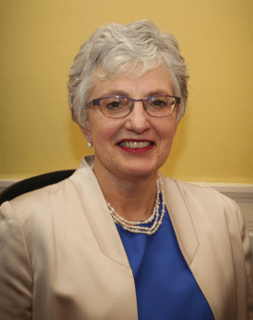
Zappone is nominated by Taoiseach Enda Kenny to the 24th Seanad in 2011, having been recommended by Eamon Gilmore, the then leader of Fine Gael‘s coalition partners, the Labour Party. With her Seanad nomination, she becomes the first openly lesbian member of the Oireachtas and the first member in a recognised same-sex relationship.
Zappone is elected to the Dáil for the Dublin South-West constituency at the 2016 Irish general election, becoming the first openly lesbian TD and, by her own reckoning, the world’s 32nd lesbian to be elected to a national parliament. In May 2016, after a delay in government formation, due to prolonged talks, she becomes Ireland’s first openly lesbian government Minister and the first Minister to have been openly gay at the time of appointment to cabinet, when Taoiseach Enda Kenny appoints her as the Minister for Children and Youth Affairs. She loses her seat at the February 2020 Irish general election and continues to serve as a minister until June 2020 on the election of a new government.
In July 2021, it is announced that Zappone is to be appointed to the newly created position of Special Envoy to the UN for Freedom of Opinion and Expression. It subsequently emerges that the proposed appointment had not been flagged in advance of the Cabinet meeting where it was proposed by Minister Simon Coveney, raising the concerns of the Taoiseach, Micheál Martin. However, he does not block the appointment, attracting criticism from within government, the opposition and the public, with Sinn Féin describing the appointment as “cronyism.”
In the following days it is reported that Zappone had lobbied for the creation of an appointment to the part-time position, which was not openly advertised or subject to a competition. Further controversy arises when it is reported that shortly prior to the announcement of her appointment, she had hosted a party for 50 guests, including politicians such as Leo Varadkar, at the Merrion Hotel, while the COVID-19 pandemic in the Republic of Ireland was ongoing. Comparisons are made between the party and the Oireachtas Golf Society scandal from earlier in the pandemic. On August 4, 2021, she announces that she will not take up the envoy role, saying “While I am honoured to have been appointed by the Government to be the Special Envoy on Freedom of Opinion and Expression, it is clear that criticism of the appointment process has impacted the legitimacy of the role itself. It is my conviction that a Special Envoy role can only be of real value to Ireland and to the global community if the appointment is acceptable to all parties.”
In September 2021, Zappone is invited to appear before the Oireachtas Committee on Foreign Affairs and Defence, but chooses not to attend. As a U.S. citizen and resident, the committee has no power to compel her attendance.
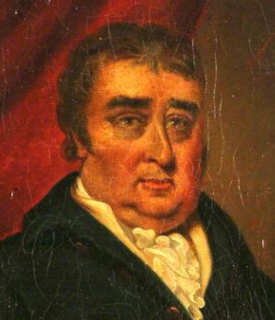
French belongs to the long-established French family of Frenchpark, County Roscommon, who are substantial landowners who also make money in the wine trade. He is the eldest son of Arthur French MP and Alicia Magenis, daughter of Richard Magenis of Dublin and sister of Richard Magenis. He marries Margaret Costello, daughter of Edmond Costello of Edmondstown, County Mayo, and has nine children, including Arthur French, 1st Baron de Freyne, John, 2nd Baron and Charles, 3rd Baron.
In 1783, French is elected a Member of Parliament (MP) for Roscommon County in the Irish House of Commons. After the Act of Union 1800 he represents Roscommon in the Parliament of the United Kingdom. He is alleged to have been offered an Earldom if he would support the union of Ireland with Great Britain but refuses the honour. Later he also refuses a Barony with no strings attached, although in time three of his sons would hold the title of Baron de Freyne. The Crown is frequently irritated by his demands for offices and favours for his brothers and sons, although such behaviour is entirely typical of an Irish politician at the time.
A critic of the policy of collective fines as a deterrent to the illicit distillation of poteen, French incurs the wrath of Chief Secretary for IrelandRobert Peel who calls him “an Abominable fellow,” but his enormous popularity in Roscommon means that he cannot be ignored. He also criticizes the continuation of martial law in Ireland.
By 1817 French is complaining of ill-health. He dies on November 24, 1820. One report at the time states that he had died “from excessive fox hunting.”
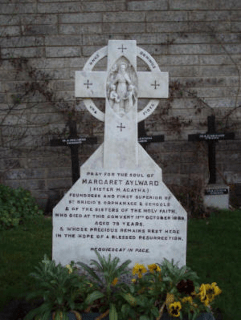
Aylward is educated by the Ursuline nuns in Thurles, County Tipperary. After doing some charitable work in Waterford in her early years, she joins her sister in the Sisters of Charity in 1834 as a novice. She leaves the novitiate in 1836 and returns to Waterford to continue her charity work in a secular role. She again attempts to join a religious order in 1846 when she enters the Ursuline novitiate in Waterford, however she leaves after two months.
By 1851, Aylward has moved to Dublin where she is active in re-energising the Ladies’ Association of the Society of St. Vincent de Paul. The Great Famine leads to a large-scale movement of people from rural areas into cities, including Dublin, which leads to increased pressure on the charitable institutions of these areas. Her efforts are part of this wider charitable effort to help the poor, particularly Catholics who are seen to be at risk of coercive religious conversion (known as Souperism). This association is concerned with the “temporal as well as the spiritual relief of the sick poor in Dublin.”
The Ladies’ Association of St. Vincent de Paul opens St. Brigid’s in 1856, an orphanage which has an anti-proselytising mission and claims to rescue Catholic children from Protestant agencies. The Ladies’ Association often comes into dispute with those involved in the Irish Church Missions (ICM) and the ragged schools in Dublin, with members of the Ladies’ Association distributing crucifixes to children attending the Protestant-run ragged schools and visiting the homes of parents who send their children to them. The women involved in St. Brigid’s Orphanage organise themselves into a society called the Daughters of St. Brigid. However, while the establishment of St. Brigid’s brings Aylward closer to religious orders, historian Maria Luddy notes that in the 1850s, she is not concerned with the establishment of a religious community, rather she wants to “live in a community of women who were united by their religious convictions but did not necessarily desire to take formal religious vows.”
There is a growth in religious orders for women in Ireland from the early nineteenth century due to a relaxing of anti-Catholic Penal Laws. These include the Irish Sisters of Charity who are established in 1815 under Mary Aikenhead, the Sisters of Loreto order (1822) under Frances Ball, and Catherine McAuley‘s Sisters of Mercy (1831). Archbishop Paul Cullen of Dublin is an important figure in persuading leaders of religious communities of women, like Catherine McAuley, to formally organise as religious congregations in order to continue their charitable work and be respectable. While Aylward is resistant to this idea for a while, she eventually agrees. In 1857 the Sisters of the Holy Faith are established, and in 1869 the order are approved by Pope Pius IX.
Aylward is arrested in 1860 for “failing to produce a child named Mary Matthews, who had been taken away and concealed from her parents for the purpose of being brought up in the Roman Catholic faith.” Matthews had been placed with a nurse in Saggart, County Dublin, when her father had died, and her mother had emigrated to The Bahamas. When her mother returns, Aylward is notified by Matthews’ foster mother that she is missing. Aylward is acquitted of the charge of kidnapping but is found to be in contempt of court and serves six months in jail. She continues her work after her release.
Aylward (now Sister Mary Agatha) dies on October 11, 1889. She had continued wearing her own clothes and travelling after taking her religious vows.
Historian Margaret Helen Preston argues that Aylward is unusual for the time that she lives in because she does not believe that poverty results from sin. Aylward refers to the poor as the “Elect of God” and argues that God sees the poor as special because of their difficult circumstances.
The Sisters of the Holy Faith still work around the world.




 seamus dubhghaill