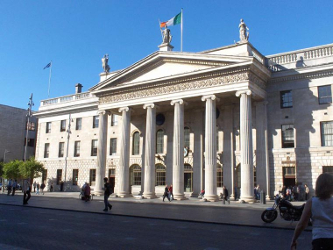
The General Post Office (GPO) is the headquarters of the Irish postal service. The offices are first located at College Green, but in August 1814, construction of a purpose-built headquarters begins. The building on Sackville Street is completed in January 1818 at a cost of £50,000.
According to An Post “The statues on the roof are of Hibernia, a classical representation in female form of the island of Ireland, with Fidelity to one side and Mercury, the messenger of the gods, to the other.”
On Monday afternoon the garrison repulses a cavalry attack while, with the breakdown of law and order, many of the stores in Sackville Street are looted. From Wednesday, the GPO and other buildings in Sackville Street come under artillery fire, mostly from the Helga gunboat at anchor in the River Liffey. Connolly believes the British will not use artillery in city areas. By Friday night the GPO is on fire, at which point it is evacuated.
At a Dublin Corporation meeting in 1884 a motion is called to change the name of Sackville Street to O’Connell Street. After forty years of argument, it is changed to O’Connell Street in May 1924.
Fowke studies at The Royal School Dungannon, County Tyrone, and the Royal Military Academy, Woolwich. He obtains a commission in the Royal Engineers and serves with distinction in Bermuda and Paris. On his return to England, he is appointed architect and engineer in charge of the construction of several government buildings.
Before his sudden death from a burst blood vessel on December 4, 1865, Fowke wins the competition for the design of the Natural History Museum, although he does not live to see it executed. His renaissance designs for the museum are altered and realised in the 1870s by Alfred Waterhouse, on the site of Fowke’s Exhibition building.
A medal is issued by the Royal Engineers in 1865, as a memorial prize for architectural works carried out by members of the corps. With the demise of great architectural works, the prize has transformed into the prize awarded to the top student on the Royal Engineers Clerks of Works course.
Jones is the son of miniature painter Edward Jones. Under the identity of “J. Jones,” architect, 7 Amiens Street, North Strand, Dublin, he exhibits several watercolors at the Royal Hibernian Academy in 1828 and 1829, including his View of the Town of Youghall, showing the proposed Chain Bridge (1828) and Design for a Viaduct (1829). He studies engineering under Alexander Nimmo and works for him on major engineering projects in Ireland including the building of the bridge at Waterford from 1829-1832, which he directs. He is listed as a civil engineer in Wilson’s Dublin Directory for the years 1833-35 with an office address at the Commercial Buildings, Dame Street. In 1839, he is awarded a Telford Medal in silver and 20 guineas for his paper and drawings on the sewage in Westminster.
James Gandon, possibly the most influential architect in Irish history, is born in New Bond Street, London, on February 20, 1743. His better known works include The Custom House, the Four Courts, King’s Inns in Dublin, and Emo Court in County Laois.
Gandon is the only son of Peter Gandon, a gunmaker, and Jane Burchall. He is educated at Shipley’s Drawing Academy where he studies the classics, mathematics, arts, and architecture. Upon leaving the drawing academy he is articled to study architecture in the office of Sir William Chambers. Chambers’s palladian and neoclassical concepts greatly influence the young Gandon.
In 1765, Gandon leaves William Chambers to begin practice on his own. His practice always remains small but is successful. His first commission is on Sir Samuel Hellier’s estate at The Wodehouse, near Wombourne. Around 1769 he enters an architectural competition to design the new Royal Exchange in Dublin. The plan submitted by Thomas Cooley is eventually chosen but Gandon’s design comes in second and brings him to the attention of the politicians who are overseeing the large-scale redevelopment of Dublin.
During the following years in England, Gandon is responsible for the design of the County Hall in Nottingham. Between 1769 and 1771, he collaborates with John Woolfe on two additional volumes of Vitruvius Britannicus, a book of plans and drawings of Palladian revival buildings by such architects as Inigo Jones and Colen Campbell. During his English career he is awarded the Gold medal for architecture by the Royal Academy, London in 1768.
In 1781, at the age of 38, Gandon accepts an invitation to Ireland from Lord Carlow and John Beresford, the Revenue Commissioner for Ireland, to supervise the construction of the new Custom House in Dublin. The original architect on that project, Thomas Cooley, had died and Gandon is chosen to assume complete control. The Irish people are so opposed to the Custom House and its associated taxes that Beresford has to smuggle Gandon into the country and keeps him hidden in his own home for the first three months. The project is eventually completed at a cost of £200,000, an enormous sum at the time.
This commission proves to be the turning point in Gandon’s career and Dublin is to become Gandon’s home for the remainder of his life. The newly formed Wide Streets Commission employs Gandon to design a new aristocratic enclave in the vicinity of Mountjoy Square and Gardiner Street. Gandon also designs Carlisle Bridge, now O’Connell Bridge, over the River Liffey to join the north and south areas of the city. In 1786, he is charged with completing the Four Courts in 1786, which is also originally a Thomas Cooley project.
The success of Gandon’s designs and commissions are not reflected in personal popularity as he attracts huge criticism from his enemies. The taxation symbolised by the Custom House is to taint the appreciation of his work throughout his lifetime. It is even claimed that Gandon designs buildings to boost his self-esteem.
In 1798, revolution breaks out on the streets of Ireland and Gandon, an unpopular figure, hurriedly flees to London. Upon returning to Dublin he finds a much changed city. James Gandon dies in 1823 at his home in Lucan, County Dublin, having spent forty-two years in the city. He is buried in the church-yard of Drumcondra Church.



 seamus dubhghaill