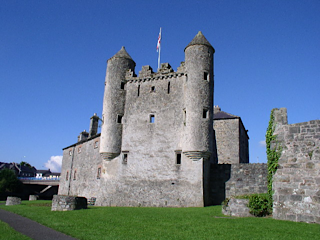
In Enniskillen, armed Williamite civilians drawn from the local Protestant population organise a formidable irregular military force. The armed civilians of Enniskillen ignore an order from Robert Lundy that they should fall back to Derry and instead launch guerrilla attacks against the Jacobites. Operating with Enniskillen as a base, they carry out raids against the Jacobite forces in Connacht and Ulster, plundering Trillick, burning Augher Castle, and raiding Clones.
A Jacobite army of about 3,000 men, led by Justin McCarthy, Viscount Mountcashel (in the Jacobite peerage), advance on them from Dublin. Lord Mountcashel’s men consist of three regiments of infantry and two of dragoons. The regiments include his own regiment, Mountcashel (approx. 650 men in 13 companies), The O’Brien regiment (also 13 companies of 650 men), and the Lord Bophin (Burke) regiment. He also has the dragoon regiments of Cotter and Clare, each with seven companies of about 350 dragoons. On July 28, 1689, Mountcashel’s force encamps near Enniskillen and bombards the Williamite outpost of Crom Castle to the southeast of Enniskillen. Crom Castle is almost 20 miles (32 km) from Enniskillen by road and about 5 miles (8.0 km) from Newtownbutler.
Two days later, they are confronted by about 2,000 Williamite ‘Inniskilliniers’ under Colonel Berry, Colonel William Wolseley and Gustave Hamilton. The Jacobite dragoons under Antoine Hamilton stumble into an ambush laid by Berry’s men near Lisnaskea and are routed, taking 230 casualties. Mountcashel manages to drive off Berry’s cavalry with his main force but is then faced with the bulk of the Williamite strength under Wolseley. There is some debate in the sources over troop numbers, though it is believed that Mountcashel has a large number of poorly armed conscripts. Unwisely, Mountcashel halts and draws up his men for battle about a mile south of Newtownbutler.
Williamite histories claim that many of the Jacobite troops flee as the first shots are fired. Up to 1,500 of them are hacked down or drowned in Upper Lough Erne when pursued by the Williamite cavalry. Of the 500 men who try to swim across the Lough, only one survives. Approximately 400 Jacobite officers, along with Lord Mountcashel, the Jacobite commander, are captured and later exchanged for Williamite prisoners, with the other Jacobites being killed. These claims seem unlikely, for several reasons. Each Irish regiment includes approximately 40 officers. The entire force, therefore, would include only about 200 officers. Many of these officers are accounted for in an October 1689 roll call, which shows approximately a 15–20% change in the officer roll call since July for the infantry regiments and 5% for the dragoons. This totals some 20–30 officers in all. Also, the Mountcashel regiment’s roll call for October shows that companies which would normally have 50–60 men, have around 25, which results in a loss of approximately 300–400 men for this regiment. The Cotter and Clare dragoons who ride away from the battle do not have significant losses, based on the October 1689 roll call. Assuming the other two infantry regiments suffer similar losses, gives a total loss of 1,200–1,300. Given their officers are recorded in the October roll and show fewer losses than the Mountcashel regiment among officers, there may be fewer losses in the ranks as well. The Williamite histories acknowledge that they captured approximately 400, including men who are later sent to Derry, which would indicate a total loss of killed, wounded, and missing of 800–900, and likely less. This number is necessarily an estimate based on the available data but should be contrasted with Williamite claims that they killed and drowned 2,000. It appears likely that a couple of hundred men from Mountcashel’s regiment may have fled into the bogs toward Lough Erne, and some of them who made it to the river tried to swim and were drowned, leading to the story of the hundreds drowned.
The battle is still commemorated by the Orange Order in Ulster and is mentioned in the traditional unionist song, “The Sash.”
The battle is significant in another way: the regiments on both sides go on to have long and famous histories. On the Williamite side, the Innsikilling Regiment (27th Foot), and on the Jacobite side, the Clare and Mountcashel/Lee/Bulkeley regiments of the Irish Brigade. The two Irish regiments face off again at the Battle of Fontenoy in 1745, where the Irish Brigade famously drives the British army from the battlefield with a charge in the final stage of the battle.
On July 28, 1689, two armed merchant ships, Mountjoy and Phoenix, sail toward the heavily defended defensive boom (floating barrier) across the River Foyle at Culmore, protected by the frigate HMS Dartmouth under Captain John Leake. Mountjoy rams and breaches the boom at Culmore fort and the ships move in, unloading many tons of food to relieve the Siege of Derry.
The Siege of Derry in 1689 is the first major event in the Williamite War in Ireland. The siege is preceded by an attempt against the town by Jacobite forces on December 7, 1688, that is foiled when thirteen apprentices shut the gates. This is an act of rebellion against James II.
The second attempt begins on April 18, 1689, when James himself appears before the Derry city walls with an Irish army led by Jacobite and French officers. The town is summoned to surrender but refuses. The siege begins. The besiegers try to storm the walls, but fail. They then resort to starving Derry. They raise the siege and do not leave until supply ships break through to the town.
Frederick Schomberg, having been appointed commander-in-chief by William III, orders Major-GeneralPercy Kirke to attack the boom. Thereupon, on July 28, Kirke sends four ships to the mouth of the River Foyle to try to bring food into Derry. These are HMS Dartmouth and three merchant ships: Mountjoy from Derry, Phoenix from Coleraine, and Jerusalem. Dartmouth, under Captain John Leake, engages the shore batteries, while Mountjoy, commanded by her Master Michael Browning, rams and breaches the boom, whereupon Mountjoy and Phoenix sail up to Derry, unloading many tons of food. Seeing that he can no longer starve out Derry and not having enough troops to storm the town, Conrad von Rosen, the commander of the Jacobite troops, decides to raise the siege. On August 1, the besieged discover that the enemy is gone. On August 3, Kirke reports the raising of the siege to London. On July 31, another Jacobite army is defeated at Newtownbutler by the armed citizens of Enniskillen.
The city endures 105 days of siege, from April 18 to August 1, 1689. Some 4,000 of its garrison of 8,000 are said to have died during this siege. The siege is commemorated annually by the Protestant community.
(Pictured: HMS Dartmouth fires at shore batteries while Mountjoy rams through the boom, from the 1873 book British Battles on Land and Sea, Volume 1)
Godert de Ginkel, the commanding general of William III‘s army, begins a ten-day siege of Athlone on June 20, 1691. Athlone is besieged twice during the Williamite War in Ireland (1689–91). The town is situated in the centre of Ireland on the River Shannon and commands the bridge crossing the river into the Jacobite-held province of Connacht. For this reason, it is of key strategic importance.
The army of William III first besieges Athlone in 1690, shortly after their defeat of the main Jacobite army at the Battle of the Boyne. James Douglas and about 7,500 troops attempt to take the town, but the Jacobite garrison’s commander, Colonel Richard Grace, refuses to surrender. Lacking siege artillery, Douglas is forced to withdraw after a week.
In the summer of the following year, the Williamite army, having regrouped at Mullingar under the command of Dutch general Godert de Ginkel, marches via Ballymore to make a second attempt on Athlone.
The Jacobite commander, Charles Chalmot de Saint-Ruhe, marches his main field army from its winter quarters in Limerick to meet the threat. He draws up his force to the west of the town. Other Jacobite troops man fortifications in the ruins of the “English Town,” the eastern half of Athlone, along with a garrison in the “Irish Town” on the western bank. This arrangement is intended to allow the Jacobites to fight a staggered, drawn-out defence, though the advantage is reduced by high ground on the Leinster bank of the Shannon and the fact that the river is running exceptionally low at the time.
Jacobite defences are also hampered by disagreements between James’s Viceroy, Richard Talbot, 1st Earl of Tyrconnell, Saint-Ruhe, and Jacobite general Patrick Sarsfield. When Talbot asserts his seniority and offers advice on the defences to Saint-Ruhe, the latter refuses to recognise Talbot’s command, while Sarsfield sends him a message that his pavilion ropes will be cut if he does not leave immediately. Though Talbot surmises that a large number of the best Jacobite troops will side with him, he chooses to depart for Limerick rather than split the army.
Ginkel opens an assault on the eastern part of Athlone on June 20, which causes the Jacobites to retreat to the west bank of the river, dismantling the bridge in the process. Colonel Grace, who had been superseded as garrison commander by the French officer d’Usson, is killed in a bombardment at the western end of the bridge on the same day.
The Jacobite forces in the western half of Athlone, led by Major-General Thomas Maxwell, a Scottish Catholic, initially hold off the Williamite assault. There is fierce fighting centred on the bridge over the Shannon. The Williamites try to lay planks over the partially wrecked structure, which the Irish Jacobite troops manage to destroy despite coming under intense fire. One such Jacobite sortie, by a small group of volunteers from Maxwell’s dragoon regiment led by a Sergeant Custume or Costy, all of whom are killed, later passes into Irish folklore as an example of bravery. Several attempts by the Williamites to storm the bridge are repulsed with heavy losses.
The Williamite bombardment of the western, Connacht, side of the town is intense, with over 12,000 cannonballs and 600 bombs or mortars fired into the town. John Stevens, serving in the Grand Prior’s Regiment, records that “with the balls and bombs flying so thick, that spot was hell on earth.” During the ten-day bombardment, 32 heavy cannon and mortars fire one shot every minute. Athlone suffers the heaviest bombardment of any city in Britain and Ireland up to this point.
While developing a plan to storm the bridge, Ginkel identifies another potential crossing point at a ford to the south. To test the crossing, on the morning of June 29 he orders a Danish quartermaster and two privates, under sentence of death for cowardice, to ford the river while troops fire over their heads to give the impression they are deserting. All three ford to the western bank and return safely, whereupon Ginkel sends a force of grenadiers, 2,000 strong, to cross there and attack the Jacobite positions from the rear.
Following an argument between Saint-Ruhe and the garrison commander d’Usson, the fortifications on the western side of the city have not been levelled, as Talbot had suggested some days earlier. Saint-Ruhe does not issue an order to demolish them until June 29, apparently believing it impossible that a city could be taken with a relieving army so close by. They remain standing a day later, and a party of Ginkel’s grenadiers hurry to occupy them and raise the drawbridge there, holding off counterattacks from Saint-Ruhe’s army until the main Williamite force can be brought up. Saint-Ruhe detaches two brigades under Major-General John Hamilton to dislodge the Williamites, but after approximately an hour and a half of intense fighting, the Jacobites retreat.
The breakthrough of the Williamites forces the remains of the Jacobite garrison, who have been awaiting reinforcement from the main Jacobite force under Saint-Ruhe, to hastily abandon their positions in Athlone. Maxwell is captured. Accusations of treachery are later levelled at him, partly as he had been a supporter of Talbot’s faction. Saint-Ruhe withdraws into County Galway, passing through Ballinasloe. The Jacobites lose around 1,000 men at Athlone, though the highest estimates suggest losses of over 2,000, including colonels McGuinness, McMahon and O’Gara, in addition to Grace.
Ginkel continues to march toward Limerick, unaware of the position of Saint-Ruhe. On the morning of July 12, the Williamites are confronted by the main Jacobite army drawn up in a strong defensive position at Aughrim. In the ensuing Battle of Aughrim, Ginkel inflicts a crushing defeat on them, effectively ending Jacobite resistance in Ireland.
(Pictured: The powerful Williamites army attack, illustration by Victor Ambrus)
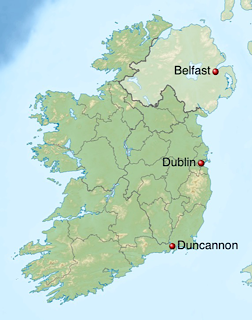
The siege of Enniskillen takes place at Enniskillen in Fermanagh, present day Northern Ireland, in 1594 and 1595, during the Nine Years’ War. In February 1594, the English had captured Enniskillen Castle from the Irish after a waterborne assault and massacred the defenders after they surrendered. From May 1594, an Irish army under Hugh Maguire and Cormac MacBaron O’Neill besiege the English garrison in the castle, and in August they defeat an English relief force. A second relief force is allowed to resupply the garrison, but the castle remains cut off. Eventually, in May 1595, the English garrison surrenders to the Irish and are then massacred.
In 1593, Hugh Maguire, Chief of the Name and Lord of Fermanagh, had objected to the behaviour of the newly-appointed English Crown sheriff Humphrey Willis. As he had done before being expelled by Hugh Roe O’Donnell from Tyrconnell in 1592, Willis is cattle raiding and plundering throughout Clan Maguire territory. Maguire is not strong enough to resist the sheriff, but after receiving reinforcements from Hugh O’Neill, Earl of Tyrone, Maguire expels Willis. In May and June 1593, Maguire and Brian Oge O’Rourke of West Breifne raid lands held by the English Lord President of Connaught, Richard Bingham. They destroy the town around Ballymote Castle. This is part of a proxy war waged to distract the Crown while Tyrone strengthens his position in Ulster. As hoped for, the Crown responds by sending an army under Sir Henry Bagenal and Gaelic leader Hugh O’Neill, Earl of Tyrone (outwardly still loyal to the Crown), who defeat Maguire’s force at the Battle of Belleek in October 1593. However, Maguire’s main force remains unscathed.
On May 17, 1594, now acting with the covert support of Tyrone, Hugh Maguire and Cormac MacBaron O’Neill lay siege to Enniskillen which is now isolated in hostile country. Their army consists of 1,400 foot soldiers and 600 horsemen. It quickly grows with support arriving from HughRoeO’Donnell. The English commander, James Eccarsall, has only 50 foot soldiers and 24 horsemen to defend the castle, along with some light artillery. Eccarsall launches a sortie by boat but has to retreat under heavy fire. Irish fortifications cut off access by river and the castle is attacked nightly. Many of the garrison fall sick due to food shortages and exhaustion brought on by incessant skirmishing with the Irish.
On August 7, Maguire and his allies defeat an English relief force for Enniskillen at the Battle of the Ford of the Biscuits. A second relief force commanded by the Lord DeputyWilliam Russell is sent by another route. Although it is not attacked by the Irish, none of Russell’s scouts or messengers reach the castle nor return. Russell relieves the beleaguered garrison by August 30 with six months supplies, then withdraws. Following this, there is a truce, but “subterfuge and deception were the hallmarks of this stage of the war.”
The Battle of Glentaisie is fought in the north of Ulster on May 2, 1565. The result is a victory for Shane O’Neill over the Clan MacDonald of Dunnyveg. The conflict is a part of the political and military struggle for control of the north of Ireland, involving the English and occasionally the Scots. Although the MacDonalds are a Scottish family, based principally on the island of Islay in the Hebrides, they have long been associated with the Gaelic polity rather than the Kingdom of Scotland.
O’Neill assembles his army for the attack on the MacDonnells at the tower house of Feadan, at Fathom Mountain, near Newry. Traditionally, he “kept Easter” at Feadan, and an assembly of his clan would be unremarked until its size draws notice.
The MacDonnells expect O’Neill’s sizeable army to take some weeks to reach their territory on the Antrim coast. They start gathering as many warriors in the Highlands and Islands as they can muster. However, O’Neill advances with unprecedented speed. Within a week his army arrives at Edenduffcarrick.
Sorley Boy MacDonnell gathers a small holding force at a forward base at Cloughdonaghy. He attempts to stop O’Neill’s advancing army at Knockboy, a wooded pass in the hills above Broughshane. O’Neill sweeps Sorley’s ambush away, takes Cloughdonaghy and sends a force of cavalry to seize James MacDonald of Dunnyveg’s recently constructed Red Bay Castle. With the landing beaches at Waterfoot and Cushendall now controlled by O’Neill’s army, the first several hundred of MacDonnell’s men are compelled to land farther north. They land at Ballycastle beach to await the locally raised MacDonnnell army. Their plan is to await the arrival of their brother Alexander, the MacDonnell seneschal of Cantyre, who is assembling a second army composed from late comers to James of Dunnyveg’s army.
O’Neill does not permit the MacDonnells any time for their reinforcement to arrive. His advance guard continues to press the retreating MacDonnell army, who fall back from the beach through Ballycastle. They are driven past the area of the modern Diamond and well away from the river Tow, denying them the necessary water supply for a sizeable army.
Both armies set up camp for the night. O’Neill’s army occupies land at the centre of modern Ballycastle, between the modern Diamond and the river Tow, giving them full access to water. The combined MacDonnell army of around five hundred men occupy the exposed higher ground at Ramon, the ridge at the head of modern Castle Street, Ballycastle, where the Presbyterian Church now stands, with only a small well for their needs.
At very first light, O’Neill attacks uphill with a sudden onslaught led by his heavy Gallowglassinfantry. By forgoing the customary exchange of spears, darts, and arrows by the light infantry kernagh and Scots archers that customarily precede the usually decisive deployment of the Gallowglass corrughadh, or battalions, O’Neill surprises the MacDonnell army. The MacDonnell leaders try to rally their men, but after a violent interlude of some confusion, they break and flee over Knocklayd mountain in the direction of Glenshesk, heading back toward the beach at Cushendun. James of Dunnyveg is seriously wounded in the early fighting and his brother Angus MacDonnell is killed.
The attempt to flee by the old mountain road between Greenan and Ballypatrick Forest in an attempt to reach a possible landing place for their birlinns at Cushendun beach is finally stopped at a hollow at Legacapple. Sorley Boy and James are both taken prisoner. James dies of his wounds two months later at Castle Crocke, near Strabane. Their brother Alistair Og MacDonnell had landed at Rathlin, with the final levies raised in the Highlands and Islands, reputed to be nine hundred men. However, in the immediate aftermath of O’Neill’s decisive victory, Alistair can achieve nothing without a base on the mainland. O’Neill marches on along the north coast to mop up the MacDonnell garrisons and deny Alistair any foothold from which to launch a MacDonnell recovery. Dunseverick and Dunluce fall within a few days, and Alistair returns to Scotland.
In January and February 1689, Butler votes against the motion to put William of Orange and Mary on the throne and against the motion to declare that James II has abdicated it. Nevertheless, he subsequently joins the forces of William of Orange, by whom he is made colonel of the 2nd Troop of Horse Guards on April 20, 1689. He accompanies William in his Irish campaign, debarking with him in Carrickfergus on June 14, 1690, and commands this troop at the Battle of the Boyne in July 1690. In February 1691 he becomes Lord Lieutenant of Somerset.
Butler serves on the continent under William of Orange during the Nine Years’ War and, having been promoted to major general, he fights at the Battle of Steenkerque in August 1692 and the Battle of Landen in July 1693, where he is taken prisoner by the French and then exchanged for the Duke of Berwick, James II’s illegitimate son. He is promoted to lieutenant general in 1694.
Butler plays a dramatic role at the notorious meeting of the Privy Council on March 8, 1711, when Antoine de Guiscard, a French double agent who is being questioned about his treasonable activities, attempts to assassinate Robert Harley, 1st Earl of Oxford, against whom he has a personal grudge for drastically cutting his allowance, by stabbing him with a penknife. Harley is wounded, but not seriously, due largely to the fact that he is wearing a heavy gold brocade waistcoat in which the knife gets stuck. Several Councillors, including Butler, stab Guiscard in return. Guiscard implores Butler to finish the deed, but he replies that it is not for him to play the hangman. In any case, he has the sense to see that Guiscard must be kept alive at least long enough to be questioned, although as it turns out Guiscard’s wounds are fatal, and he dies a week later.
On April 23, 1712, Butler leaves Harwich for Rotterdam to lead the British troops taking part in the war. Once there he allows himself to be made the tool of the Tory ministry, whose policy is to carry on the war in the Netherlands while giving secret orders to him to take no active part in supporting their allies under Prince Eugene. In July 1712, he advises Prince Eugene that he can no longer support the siege of Le Quesnoy and that he is withdrawing the British troops from the action and instead intends to take possession of Dunkirk. The Dutch are so exasperated at the withdrawal of the British troops that they close the towns of Bouchain on Douai to British access, despite the fact that they have plenty of stores and medical facilities available. Butler takes possession of Ghent and Bruges as well as Dunkirk, in order to ensure his troops are adequately provided for. On April 15, 1713, he becomes Lord Lieutenant of Norfolk.
Ormonde’s position as Captain-General makes him a personage of much importance in the crisis brought about by the death of Queen Anne and, during the last years of Queen Anne, he almost certainly has Jacobite leanings and corresponds with the Jacobite Court including his cousin, Piers Butler, 3rd Viscount Galmoye, who keeps barrels of gunpowder at Kilkenny Castle. King George I, on his accession to the throne in August 1714, institutes extensive changes and excludes the Tories from royal favour. Butler is stripped of his posts as Captain-General, as colonel of the 1st Regiment of Foot Guards and as Commander in Chief of the Forces with the first two posts going to the Duke of Marlborough and the role of Commander-in-Chief going to John Dalrymple, 2nd Earl of Stair. On November 19, 1714, Butler is instead made a member of the reconstituted Privy Council of Ireland.
Accused of supporting the Jacobite rising of 1715, Butler is impeached for high treason by Lord Stanhope on June 21, 1715. He might avoid the impending storm of Parliamentary prosecution, if he remains in England and stands trial but instead, he chooses to flee to France in August 1715 and initially stays in Paris with Henry St. John, 1st Viscount Bolingbroke. On August 20, 1715, he is attainted, his estate forfeited, and honours extinguished. The Earl Marshal is instructed to remove the names and armorial bearings of Butler and Bolingbroke from the list of peers and his banner as Knight of the Garter is taken down in St. George’s Chapel.
On June 20, 1716, the Parliament of Ireland passes an act extinguishing the regalities and liberties of the county palatine of Tipperary; for vesting Butler’s estate in the crown and for giving a reward of £10,000 for his apprehension, should he attempt to land in Ireland. But the same parliament passes an act on June 24, 1721, to enable his brother, Charles Butler, 1st Earl of Arran, to purchase his estate, which he does accordingly.
Butler subsequently moves to Spain where he holds discussions with Cardinal Giulio Alberoni. He later takes part in a Spanish and Jacobite plan to invade England and puts James Francis Edward Stuart on the British throne in 1719, but his fleet is disbanded by a storm in the Bay of Biscay. In 1732, he moves to Avignon, where he is seen in 1733 by the writer Lady Mary Wortley Montagu. He dies at Avignon in exile on November 16, 1745, but his body is returned to London and buried in Westminster Abbey on May 22, 1746.
On July 20, 1682, Butler, then called Lord Ossory, marries Lady Anne Hyde, daughter of Laurence Hyde, who is then Viscount Hyde of Kenilworth but becomes Earl of Rochester in November. The couple has a daughter, Mary, who dies young in 1688.
Following the death of his first wife in 1685, Butler plans to marry again in order to secure a male heir. He gains permission from the House of Lords for the arranging of a jointure for another marriage in May 1685, and in August of that year, he marries Lady Mary Somerset, daughter of the Duke of Beaufort and Mary Capel. The couple has a son, Thomas (1686–1689), and two daughters, Elizabeth (1689–1750) and Mary (1690–1713). His second wife is a Lady of the Bedchamber to Queen Anne. Their younger daughter, Mary, marries John Ashburnham, 1st Earl of Ashburnham.
(Pictured: Portrait of James Butler, 2nd Duke of Ormonde, by Michael Dahl, National Portrait Gallery)
Butler succeeds to the title at the age of fifteen and was educated at the University of Oxford, taking the degree of LL.D. in 1677. In 1678, he is commissioned as a captain in Colonel Thomas Dongan‘s regiment, which is disbanded before he takes up his post.
In 1692, Butler is created Earl of Newcastle in County Limerick in the Jacobite peerage of Ireland. In France he is named Colonel of the 2nd Queen’s Regiment of Irish Horse in the service of that country and serves with distinction in various battles of the War of the Spanish Succession, also becoming a Lieutenant-General in the Spanish army. He is at the Siege of Roses in 1693, and in 1694 is a Brigadier attached to the army of Germany. He serves in Italy and other parts of Continental Europe from 1701 to 1703, sharing all the fortunes of the Irish Brigade. He later serves in the French army as a Lieutenant-General. He is created Brigadier of Cavalry in 1694.
Butler dies at the age of eighty-eight in Paris on June 18, 1740, and is buried at St. Paul’s there. John C. O’Callaghan writes in Irish Brigades in the Service of France (Glasgow, 1870): “The successive claimants of the title of Galmoy were officers in France down to the Revolution; in whose armies, as well as in others, various gentlemen have honourably represented a name, of which the illustrious General Lafayette is related to have said, in the war for the independence of the United States of America, that ‘whenever he wanted anything well done, he got a Butler to do it.'”
Notwithstanding the attainder, the viscountcy is assumed by his nephew, James Butler of the Irish Brigade in France, the son of the Viscount’s brother, Richard Butler of Galmoye.
The Protestant forces are taken by surprise and there is little fighting, reflected in the term “Break,” a Scottish word for rout. Victory secures eastern Ulster for the Jacobites but they fail to fully exploit their success.
While much of the Protestant population of east Ulster supports the claim of William III to thrones of Ireland, England and Scotland, the rest of Ireland, including the Lord Deputy of Ireland, Richard Talbot, 1st Earl of Tyrconnell, and the army, support James II. As a result, war breaks out in Ireland after James is deposed in the Glorious Revolution. At the start of the conflict, the Jacobites are left in control of two fortified positions at Carrickfergus and Charlemont in territory which is predominantly Williamite in sympathy. The local Williamites raise a militia and meet in a council at Hillsborough. They make an ineffective assault on Carrickfergus. However, this is easily beaten off and a local Catholic cleric named O’Hegarty reports that the Williamite are badly armed and trained.
The Jacobite commander in the north is Richard Hamilton, an experienced soldier who serves with the French military from 1671 to 1685, when he is appointed a colonel in the Irish Army. In September 1688, he and his regiment are transferred to England. When James flees into exile, he is held in the Tower of London. Released on parole by William in February, he is sent to negotiate with Talbot but drops this mission once back in Ireland. Alexander Osbourne, a Presbyterian clergyman, is sent to offer the Hillsborough council a pardon in return for surrender but they refuse, reportedly encouraged by Osbourne. On March 8, Hamilton marches north from Drogheda with 2,500 men to subdue the Williamites by force.
On March 14 Hamilton crosses the River Lagan and attacks a 3,000 strong Williamite force under Lord Mount Alexander at Dromore. Alexander’s cavalry falls back in disorder following a charge by the Jacobite dragoons. Seeing this, Hamilton orders a general advance of his infantry and the Williamite foot flee toward Dromore itself. They are overtaken in the village by the Jacobite cavalry and slaughtered, roughly 400 being killed and the rest fleeing for their lives.
Lord Mount Alexander rides to Donaghadee and takes a ship to England, while many other Protestants leave for Northern England or Scotland. Hamilton’s men capture Hillsborough, along with £1,000 and large stocks of food but fail to pursue their opponents. This allows the bulk of the militia under Rawdon and Henry Baker to reach Coleraine, then make their way to Derry, where they take part in the successful defence of the city.
The Capture of Bandon begins on February 23, 1689, when the town of Bandon, County Cork, is forcibly seized from its rebellious Protestant inhabitants by force of Irish Army troops under Justin McCarthy. The skirmishing at the town takes place during the early stages of the Williamite War in Ireland. The Jacobite success at Bandon helps suppress any chance of a general Munster uprising against the rule of James II similar to that which occurs in Ulster the same year. The slogan “No Surrender!” is believed to have been first used at Bandon and subsequently taken up, more famously, by the defenders at the Siege of Derry later in the year.
In 1685, the Catholic James II comes to the throne. This leads to a sharp reversal of government policy in Ireland, which had previously favoured the Protestant inhabitants. This is quickly changed by James’ representative Richard Talbot, 1st Earl of Tyrconnell. Under Talbot’s administration, the army and civil government are mostly purged of Protestants, who are replaced by Catholics. In Bandon, the previous town burgesses are replaced by Catholic nominees.
Talbot’s actions lead to a growing hostility amongst the Protestant inhabitants across the island toward the King and his Irish government. Bandon is a historic centre of Protestants, dating back to the Plantation of Munster in the Elizabethan era and is a natural focus of dissent against James’s rule. In 1688, a similar opposition in England leads to the Glorious Revolution, in which William III successfully invades with a Dutch Army. Many Protestants now believe William to be their rightful King while Catholics, and some Protestants, remain loyal to James. During the growing turmoil, many rural County Cork Protestants come to shelter in Bandon.
Fearing a potential outbreak of rebellion in Bandon will occur, the government sends a detachment of the Irish Army under Captain Daniel O’Neill to take the town. They reportedly enter on a Sunday morning while the inhabitants are attending church services. The following day, February 24, sometimes referred to as “Black Monday,” the townspeople rise and attack the soldiers. Various sources say between three and eight of the redcoats are killed and the remainder are driven out of the town. Using their captured weapons, the Protestants then make an effort to prepare Bandon to withstand an assault.
Having received word about the growing rebellion in the county, Talbot in Dublin has already dispatched six companies of infantry under Justin McCarthy, an experienced Irish Catholic soldier. Instead of immediately assaulting Bandon, McCarthy first seizes nearby Cork, another major centre of Protestants in the south of the country and clamps down on other potential dissidents. He then proceeds to Bandon with his troops, plus some cavalry and artillery. Although they had previously hung out a banner proclaiming “No Surrender,” the defenders negotiate a surrender in exchange for generous conditions. Despite the usual punishment for rebellion being death, the town corporation is fined £1,000 and the walls are ordered to be demolished.
The comparatively light terms imposed on the town are part of a wider attempt by King James to convince Protestants of his goodwill toward them. It angers more hardline Catholics, including McCarthy’s nephew, Donough MacCarthy, 4th Earl of Clancarty, who wants a harsher punishment for the rebels.
The fighting at Bandon is part of a succession of defeats of locally raised Protestant troops both across Munster (at Castlemartyr) and Ireland as a whole, with the Ulster-raised Army of the North suffering heavy defeats at the Break of Dromore and the Battle of Cladyford. The advance of the mainly Catholic Jacobite Army is halted by the successful Protestant defence of Enniskillen and Derry. The arrival of large-scale reinforcements under Frederick Schomberg and King William reverse the tide, and Dublin is captured following the Battle of the Boyne in 1690. The same year, Bandon is re-taken by Protestant forces following John Churchill, 1st Duke of Marlborough‘s successful Siege of Cork. The walls are not rebuilt, as they are becoming increasingly militarily obsolete.
The assault focuses on the English fort which sits at a bridge on the River Blackwater, marking the border between Counties Tyrone and Armagh. It is built by Walter Devereux, 1st Earl of Essex, in 1575 as an outpost of English military strength in the heart of Gaelic Ulster, but also to secure the power of the main Irish ally in the region, Hugh O’Neill, Baron of Dungannon. The fort is composed of a square earthwork bawn “twelve score yards in circuit” reinforced by two bulwarks and punctuated with gun loops in its ramparts. In one corner stands a wooden tower, four stories tall, topped with a wooden walkway and a slate-covered building. It is accessed by two doors, one leading out onto the ramparts, another leading to a cellar. Each story has defensive firing loops, also known as spike holes. This tower overlooks a road and bridge across the river. At the other side of the river, on the Tyrone side, is a stone tower. The stone tower controls access to the bridge, as the road runs through it via large wooden doors.
Hugh O’Neill, Lord of Tyrone, is thought an ally of the English Crown and he is supported by the English authorities in Dublin as a counterweight to the power of other native lords in Ulster such as Turlough Lynagh O’Neill. However, encroachment by English authorities on the liberties of the native Irish lords in Ulster during the 1580s and early 1590s causes O’Neill to create an alliance of Irish lords, which look to throw off English rule with the help of Philip II of Spain. From April 1593, O’Neill orchestrates a proxy war against the English using Hugh Maguire, Lord of Fermanagh, and Hugh Roe O’Donnell, Lord of Tyrconnell. They engage the English in the west of Ulster while O’Neill, outwardly still loyal to the Crown, strengthens his power base in Ulster and subdues the Crown’s Irish allies in the north. The Irish lay siege to Enniskillen Castle and defeat an English force sent to relieve it.
O’Neill’s alliance is not limited to Ulster as he is allied to Fiach McHugh O’Byrne in Leinster. He has come under increasing pressure from Lord DeputyWilliam Russell‘s military expeditions into the Wicklow Mountains. In desperation, Fiach McHugh asks that Tyrone offer help or at least raid the northern Pale to draw Russell out of Wicklow. O’Neill requests a meeting with Russell to discuss how to proceed but this is dismissed by the Lord Deputy as a ploy to draw him out of O’Byrne’s lands. Therefore, to help O’Byrne, O’Neill makes his first open move against the Crown.
On the morning of Sunday, February 16, 1595, Art MacBaron O’Neill approaches the fort from the direction of Armagh with 40 men, escorting what appears to be two prisoners. As they cross the bridge one of the English warders notices the match cords of the Irishmen’s matchlock calivers are lit, a sign that they are ready to fire. The English open fire and MacBaron’s men force their way into the stone tower, but the English withdraw to the upper stories and prevent the Irish from taking the tower. Meanwhile, on the other side of the river, 200 Irish soldiers sweep over the earth ramparts and take the bawn. The English soldiers and their families retreat to the wooden tower. Defensive fire from within keeps the Irish back and twice the warders thwart MacBaron’s attempts to burn the position. Fifteen of MacBaron’s men are killed attempting to storm the towers, and eight more later die of their wounds. The stalemate lasts until five o’clock in the evening when MacBaron calls for a ceasefire. He offers the garrison terms for their surrender. The English, led by Edward Cornwall, are critically low on ammunition but still prevaricate until MacBaron threatens to burn the fort to the ground with all in it. The ward’s surrender is agreed and MacBaron guarantees their safe passage to Newry.
The loss of the fort is doubtless a military setback for the Crown, but of more significance is the presence of the Earl of Tyrone in person. According to the English commander, O’Neill arrives after the surrender and is outraged at the losses suffered in taking the fort and is angry that the defenders had not been executed. After the English soldiers and their families leave, O’Neill looks on as the bridge is demolished and the fort’s defence slighted. Up until this point there is no concrete proof that O’Neill was active in the attacks by Maguire and O’Donnell in the west of Ireland. Now there is indisputable proof that the Crown was at war with O’Neill.
(Pictured: The Blackwater Fort at present-day Blackwatertown in County Armagh, built by the Earl of Essex during a foray into Ulster in 1575 and captured and destroyed by the Irish in 1595. This pen and ink sketch measures 22½ by 16½ inches and is dated March 27, 1587.)