seamus dubhghaill

Promoting Irish Culture and History from Little Rock, Arkansas, USA


2 Comments

The Hanging of Irish Republican Charlie Kerins

Charlie Kerins, a physical force Irish Republican and Chief of Staff of the Irish Republican Army (IRA), is hanged on December 1, 1944 at Mountjoy Prison in Dublin by the English hangman Albert Pierrepoint.

Kerins is born in Caherina, Tralee, County Kerry and attends Balloonagh Mercy Convent School and then the CBS, Edward Street. At the age of 13, he wins a Kerry County Council scholarship and completes his secondary education at the Green Christian Brothers and the Jeffers Institute. In 1930, he passes the Intermediate Certificate with honours and the matriculation examination to the National University of Ireland (NUI). He later does a commercial course and takes up employment in a radio business in Tralee.

In 1940, Kerins is sworn into the IRA and is appointed to the GHQ staff in May 1942. At the time, the Fianna Fáil government of Éamon de Valera is determined to preserve Irish neutrality during World War II. Therefore, the IRA’s bombing campaign in England, its attacks against targets in Northern Ireland, and its ties to the intelligence services of Nazi Germany are regarded as severe threats to Ireland’s national security. IRA men who are captured by the Gardaí are interned for the duration of the war by the Irish Army in the Curragh Camp in County Kildare.

On the morning of September 9, 1942, Garda Detective Sergeant Denis O’Brien is leaving his home in Ballyboden, Dublin. He is between his front gate and his car when he is cut down with Thompson submachine guns. O’Brien, an Anti-Treaty veteran of the Irish Civil War, had enlisted in the Garda Síochána in 1933. He is one of the most effective Detectives of the Special Branch division, which has its headquarters at Dublin Castle. The shooting greatly increases public feeling against the IRA, particularly as the murder is carried out in full view of his wife.

Following the arrest of Hugh McAteer in October 1942, Kerins is named Chief of Staff of the IRA. Despite a massive manhunt by Gardaí, he remains at large for two years. He stays at a County Waterford home for two weeks while he is on the run, having given his name as Pat Carney. He is captured several months after he leaves the home.

Kerins had previously left papers and guns hidden at Kathleen Farrell’s house in the Dublin suburb of Rathmines. He telephones the house, as he intends to retrieve them. However, Farrell’s telephone had been tapped by the Gardaí. On June 15, 1944, he is arrested in an early morning raid. He is sleeping when the Gardaí enter his bedroom and does not have an opportunity to reach the Thompson submachine gun which is hidden under his bed.

At a trial before the Special Criminal Court in Collins Barracks, Dublin, Kerins is formally charged on October 2, 1944 for the “shooting at Rathfarnham of Detective Dinny O’Brien.” At the end of his trial, the president of the Military Court delays sentence until later in the day to allow Kerins, if he wishes, to make an application whereby he might avoid a capital sentence. When the court resumes, he says, “You could have adjourned it for six years as far as I am concerned, as my attitude towards this Court will always be the same.” He thus deprives himself of the right to give evidence, to face cross-examination, or to call witnesses.

Despite legal moves initiated by Seán MacBride, public protests, and parliamentary intervention by TDs from Clann na Talmhan, Labour, and Independent Oliver J. Flanagan in Leinster House, the Fianna Fáil government of Éamon de Valera refuses to issue a reprieve. On December 1, 1944 in Mountjoy Prison, Kerins is hanged by British chief executioner Albert Pierrepoint, who is employed by the Irish Government for such occasions.

Kerins is the last IRA member to be executed in the Republic of Ireland. He is buried in the prison yard. In September 1948, his remains are exhumed and released to his family. He is buried in the Republican plot at Rath Cemetery, Tralee, County Kerry.

Leave a comment

Republican Prisoner Denny Barry Dies on Hunger Strike

Irish Republican prisoner Denis “Denny” Barry dies on hunger strike in Newbridge internment camp on November 20, 1923, shortly after the Irish Civil War.

Barry is born into a farming family in Riverstick, ten miles south of Cork city, on July 15, 1883. He enjoys Gaelic culture and sport and is a prominent member of the Ballymartle hurling club. He later joins the famous Blackrock National Hurling Club where he wins four senior county championships in a row during the years of 1910 to 1913.

In 1913, Barry joins the newly formed Irish Volunteers. He is a member of the first Cork brigade and has been politically active in Sinn Féin. In 1915, he moves to Kilkenny to take up employment there, where he continues his volunteer activities. Shortly after the Easter Rising in 1916, he is arrested in Kilkenny in a British Government crackdown and sent to Frongoch internment camp in North Wales. In 1917 he becomes election agent for W. T. Cosgrave in the Kilkenny by-election, one in which Cosgrave is successfully elected. However, just six years later he finds himself imprisoned by Cosgrave’s own government.

In 1922 Barry is imprisoned in Newbridge camp in Kildare and takes part in the hunger strike of 1923. On November 20, 1923, after 34 days protesting against the harsh regime and undignified conditions, he dies but even in death he is still refused dignity.

Barry’s body is not released to his family and is instead, on the orders of Minister of Defence, Richard Mulcahy, buried in the grounds of Newbridge internment camp. The Barry family takes legal action against this and eventually receives the body, but this is not the last of their troubles.

Upon their arrival in Cork with Barry’s body, the Bishop of Cork, Daniel Cohalan, instructs his priests not to allow Barry’s funeral in any church. Ironically just a few short years before, Bishop Cohalan had been a strong vocal supporter of Terence MacSwiney, Sinn Féin Lord Mayor of Cork, who died on hunger strike in Brixton Prison.

Shortly after MacSwiney’s death, Bishop Cohalan’s attitude towards the Irish Republican Army (IRA) changes and he issues a decree condemning the IRA in which he states, “Anyone who shall within the diocese of Cork organise or take part in an ambush or in kidnapping or otherwise, shall be guilty of murder or attempted murder and shall incur by the very fact the censure of excommunication.”

On December 10, 1922, Bishop Cohalan preaches publicly his support for the Anglo-Irish Treaty which establishes the Irish Free State, and he urges his flock to do the same. This leads to an even greater wedge between the Catholic Church and many IRA members, yet it is the incident with Barry that seriously taints the Bishop of Cork and the Catholic Church in republican eyes.

Because of Bishop Cohalan’s stern objection to Barry’s body being permitted into a Catholic church, his body has to lay in state in the Cork Sinn Féin headquarters on the Grand Parade in Cork city. He is then taken in a funeral procession to St. Finbarr’s Cemetery where he is buried in the Republican plot next to Terence MacSwiney, whose funeral Bishop Cohalan had presided over three years previously. In place of a priest is David Kent, Sinn Féin Teachta Dála for Cork and brother of Thomas Kent, who was executed for his part in the 1916 Rising. Kent gives an oration, recites the Rosary and sprinkles holy water on the grave.

On November 28, 1923, the day Barry is buried, Bishop Cohalan sends an open letter to The Cork Examiner publicly denying a Christian burial for Barry and urging all men of the cloth to stay away from any such attempts for such a funeral. He goes so far as to write to the Bishop of Kildare and Leighlin, Dr. Patrick Foley, to enquire about Barry getting the last sacraments. Barry did indeed receive the last rites from a Fr. Doyle who was serving as prison chaplain, and this does not impress the Bishop of Cork.

Barry’s funeral precession through Cork City draws massive crowds with people from all walks of Cork’s political, social and sporting life attending to pay their respects to this man who had been at the heart of the revolution in Cork during the last decade of his life. The IRA, Cumann na mBan and Na Fíanna Éireann march in military formations with the funeral party.

Two days after Barry’s death another IRA prisoner, Andrew O’Sullivan, from Cork dies and the strike is called off the following day. Women prisoners are then released while men remain in prison until the following year.

A memorial to Barry is unveiled in Riverstick in 1966.


Leave a comment

The Niemba Ambush

The Niemba ambush takes place on November 8, 1960, when an Irish Army platoon in Congo-Léopoldville is ambushed, the first time the Irish Army is embroiled in battle since the founding of the Irish state in 1922. The Republic of Ireland had deployed troops as United Nations Operation in the Congo (ONUC) peacekeepers.

After the Belgian Congo becomes independent (as Republic of the Congo) in 1960, a civil war breaks out in Katanga, the southern, mineral-rich province of Congo. A local political leader, Moïse Tshombe, declares Katanga an independent state. United Nations peacekeeping troops are invited to help restore order and to end the Katanga secession.

The Luba people or “Baluba” ethnic group do not support the Katangese secession. As a result, they come under attack from pro-Katangese and allied forces. On October 4, several villages are attacked by Katangese gendarmes and European mercenaries and many Baluba are massacred. This leaves them suspicious of and hostile to any white European troops. Irish troops are sent to the area to secure it and encourage local people to return.

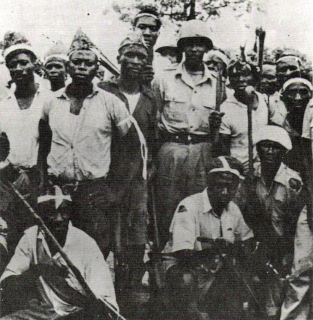
On November 8, 1960, an eleven-man section from the Irish Army’s 33rd Battalion arrives at the bridge over the Luweyeye River. They are forced to leave their vehicles when they encounter a blockade on the road. While clearing it, they encounter about 100 Luba militiamen armed with bows, poison-tipped arrows, spears and clubs, as well as some guns. While the Irish troops had arrived to protect the Baluba, the militia undoubtedly mistakes them for Katangese mercenaries. Lieutenant Kevin Gleeson, advancing unarmed with his platoon sergeant, Hugh Gaynor, attempt to greet them peacefully, but is hit with a barrage of poison-tipped arrows.

Gleeson and Gaynor are overtaken, beaten and hacked to death. The surprised Irish soldiers, who had not been deployed in a defensive formation after dismounting from their vehicles, retreat behind trees on either side of the road and open fire on the tribesmen with their Gustav submachine guns, Lee–Enfield rifles and Bren light machine guns. The Baluba however advance on them, and the Irish are cut off from their vehicles. Despite taking heavy losses, the Baluba overrun the Irish soldiers, and fierce hand-to-hand fighting breaks out, during which most of the Irish troops are killed.

The surviving Irish troops regroup by a ridge but are surrounded by the Baluba. They fight to hold them off, but their position is rapidly overrun and all but three of them are killed. The three survivors manage to escape. One of them, Anthony Browne, reaches a nearby village and gives all the money he has to the village women, hoping they will get him help, but is instead mobbed and beaten to death by the village men. His body is recovered two years later. The two surviving soldiers manage to hide and are found by other UN troops the following day.

A total of nine Irish soldiers die: Lt. Kevin Gleeson of Carlow, Sgt. Hugh Gaynor of Blanchardstown, Cpl. Peter Kelly of Templeogue, Cpl. Liam Dougan of Cabra, Pt. Matthew Farrell of Jamestown, Dublin, Tpr. Thomas Fennell of Donnycarney, Tpr. Anthony Browne of Rialto, Pte. Michael McGuinn of Carlow, and Pte. Gerard Killeen of Rathmines. Some 25 Baluba are also killed.

The bodies of the Irish dead are flown to Casement Aerodrome in Baldonnel, where they lay in state. Lt. Kevin Gleeson’s coffin is placed on a gun carriage, while those of the rest are placed on army trucks. Following a funeral procession through Dublin, they are buried at Glasnevin Cemetery.

A stone commemorating Lt. Gleeson can be found in his hometown of Carlow while a plaque commemorating Sgt. Hugh Gaynor can be found in his hometown of Blanchardstown.

The notoriety of the attack, and the allegations of mutilation and cannibalism that circulate in the Irish popular press in its aftermath, lead to the word “baluba” (sometimes spelled “balooba”) becoming a synonym for any “untrustworthy and barbaric” individual in certain parts of Ireland.

(Pictured: Baluba militiamen in 1962)


Leave a comment

Death of Risteárd Ó Glaisne, Irish Language Writer & Teacher

Risteárd Ó Glaisne, teacher and writer with a lifelong commitment to the Irish language, dies in Dublin on November 6, 2003. He is the author of biographies of two former Presidents, Douglas Hyde (pictured) and Cearbhall Ó Dálaigh.

Risteárd Earnán Ó Glaisne is born on September 2, 1927, near Bandon, County Cork, the third of four children of George William Giles and his wife, Sara Jane (née Vickery). Educated at Bandon Grammar School and Trinity College Dublin, he graduates with a BA in 1949 and obtains a master’s degree in 1959. At TCD he is greatly influenced by Daithí Ó hUaithne.

Ó Glaisne first becomes interested in the Irish language at school in Bandon. His headmaster gives him a copy of Liam Ó Rinn‘s Peann agus Pár, along with a book of poems by Ivan Turgenev translated into Irish by Ó Rinn. “I suddenly found myself breaking into a world vastly larger than my own world in Irish,” he recalls. “The quality of mind I encountered made me realise I could never again connect Irish only with poteen and potatoes.”

Ó Glaisne further explores the language by making contact with the few native Irish speakers left in the Bandon area. He gradually comes to the conclusion that he is a member of a nation that has an extremely old and in many ways distinguished culture, of which Irish has been historically an integral part. Deciding that Irish best reflects the society in which he grew up and reflects him as an individual, he adopts it as his first language.

On graduating from TCD Ó Glaisne teaches Irish at Avoca School, Blackrock. He later teaches in St. Andrew’s College, Dublin, and at St. Patrick’s Cathedral Grammar School, where he ends his teaching career in 1989. He took a career break in the mid-1960s to study the French educational system and to travel on the Continent.

To perfect his Irish Ó Glaisne holidays on the Great Blasket Island, where he immerses himself in the rich oral culture. He makes many friends among the islanders, and the friendships continue after they are resettled on the mainland in Dún Chaoin. He regularly visits Corca Dhuibhne to meet friends like Muiris Mhaidhc Léan Ó Guithín, one of the last surviving islanders, and to enjoy the annual Ceiliúradh an Bhlascaoid.

Ó Glaisne holds that Protestants have enjoyed a long association with Irish, pointing to 18th-century followers of John Wesley such as Charles Graham, Gideon Ousley and Tomás Breathnach, who evangelised in Irish. He firmly believes that Protestants can be “every whit as Irish” as Roman Catholics. He urges his co-religionists to identify fully with Ireland.

Ó Glaisne is the founder and editor of Focus (1958-66), a monthly magazine that aims to help Protestants “come to an understanding of their cultural heritage.” He is a regular contributor to programmes on RTÉ and RTÉ Raidió na Gaeltachta, and writes for Comhar, Inniú, An tUltach and The Irish Times.

Ó Glaisne is the author of over 20 books and pamphlets in Irish. These include biographies of Conor Cruise O’Brien, Ian Paisley, Tomás Ó Fiaich and Dúbhglas de hÍde. Other works include a history of Methodism in Ireland, a book of essays on early revivalist writers and a manual for beginners in journalism. He also writes Saoirse na mBan (1973), Gaeilge i gColáiste na Trionóide 1592-1992 (1992) and Coláiste Moibhí (2002), a history of the preparatory college for Protestant teachers.

Generous with his time and knowledge, Ó Glaisne makes a point of encouraging young writers.

(From: “Worked to make Protestants aware of Irish culture heritage,” The Irish Times, Saturday, November 15, 2003)


Leave a comment

Gerry Ryan Model Unveiled at Madame Tussaud’s Dublin Museum

Gerard “Gerry” Ryan, presenter of radio and television employed by Raidió Teilifís Éireann (RTÉ), becomes the latest homegrown celebrity to feature in the Irish version of Madame Tussauds collection when he unveils a life-size model of himself at the Dublin museum on October 29, 2002.

Ryan is born in Clontarf, County Dublin on June 4, 1956. He describes his father, Vinnie, as a “slightly eccentric” dentist from a Presbyterian background and his mother, Maureen, as “a flamboyant woman” who comes from a theatrical background and works in the theatre. His godfather is broadcaster Eamonn Andrews. He is educated at St. Paul’s College, Raheny.

Ryan hosts several series of television shows, including Secrets, Gerry Ryan Tonight, Ryantown, Gerry Ryan’s Hitlist, Ryan Confidential and the first three series of Operation Transformation. In 1987, he earns notoriety and the moniker “Lambo” after an unpleasant incident in Connemara. He is also noted for co-presenting, with Cynthia Ní Mhurchú, Eurovision Song Contest 1994 and, in 2008, presenting an edition of The Late Late Show, television’s longest-running chat show, in place of the then regular host Pat Kenny.

Ryan presents The Gerry Ryan Show on radio station RTÉ 2fm each weekday morning from 1988 until hours before his sudden death. He is presented with a Jacob’s Award for the show in 1990.

Ryan marries Morah Brennan in 1988 and they have five children: Lottie, Rex, Bonnie, Elliott and Babette. In 1997, Morah famously telephones her husband’s show and, under the name Norah, tells half a million listeners intimate details concerning his personal household habits. Gerry and Morah announce their separation in March 2008, which Ryan calls “a very painful experience.” He soon begins a relationship with the former South African Ambassador to Ireland and the then UNICEF Ireland executive director, Melanie Verwoerd.

Ryan is noted for his love of fine food and wine. He battles a weight problem for several years and takes Reductil (Sibutramine), a “slimming pill,” which he says is effective and safe. Ryan concedes in his autobiography Would the Real Gerry Ryan Please Stand Up, released in October 2008, that he drinks too much for his own good.

Ryan is found dead in the bedroom of his home on Leeson Street, Dublin on April 30, 2010.

Among the dignitaries to send tributes following Ryan’s death are Bono, Bill and Hillary Clinton, Taoiseach Brian Cowen, and President Mary McAleese. His funeral takes place on May 6, 2010, and is broadcast on 2fm, the home of Ryan’s radio show and a first for the predominantly youthpop-oriented station. His death also comes sixteen years to the day after he hosted Eurovision 1994.

An inquest shows that the cause of Ryan’s death is cardiac arrhythmia and that traces of cocaine found in Ryan’s system are the “likely trigger” of Ryan’s death. A considerable public controversy erupts when Ryan’s long-term use of cocaine comes to light. RTÉ eventually admits to having given insufficient coverage of Ryan’s cocaine habit in the aftermath of the inquest.


Leave a comment

Irish Nurse’s Organization Votes to Reactivate Industrial Action

Two hundred delegates of the 24,000-strong Irish Nurses Organisation (INO) nurse’s union vote unanimously on October 27, 1998, to reactivate industrial action if their claims are not met. The delegates gather at the Burlington Hotel in Dublin.

The more difficult task is to modify the pay demands made by the State’s 2,500 ward sisters. The INO executive calls for senior ward sisters to receive salaries of £31,000 a year, or £6,400 more than the current maximum. However, one of the INO branch amendments calls for a new maximum of £35,000, the same salary as directors of nursing in major hospitals.

The conference is called to report on progress to date in talks, spell out objectives and obtain a mandate for strike action if negotiations break down. There is little progress to report. Talks at the Labour Relations Commission the previous week failed to resolve claims on extra-long-service increments for staff nurses, or better rates of pay for ward sisters. Both issues are now referred to the Labour Court, which is already dealing with allowances for extra professional qualifications held by nurses.

The Labour Court is due to hear submissions from the INO, other nursing unions and health service managers on the qualifications issue the following day. About half of the State’s staff nurses have such qualifications, worth £347 a year. The union wants them re-rated at 10% of basic salary, worth up to £2,200 a year for staff nurses at the top of the scale. Despite the negotiating gap, this issue is less difficult to resolve than the others, because it is less likely to lead to follow-on claims from other public service unions.

The union is looking for new long-service increments at the top of the current 15-year scale, which will add 18% to basic salary. As 80% of nurses never graduate to ward sister level, the INO argues that a nurse with 22 years’ service should be earning £25,000.

It is also seeking a minimum 10% pay differential between the maximum amount staff nurses can earn and the pay for the new Clinical Nurse Managers I, recommended by the Nursing Commission. The differential for Clinical Nurse Managers II should be 15% and that for Clinical Nurse Managers III should be 25%.

The union argues that any smaller differentials will make it unattractive for staff nurses to accept promotion and forgo the opportunity for unsocial hours premiums. Recent offers from the management on overtime pay could make promotion even less attractive.

A week earlier the nursing unions defer a nationwide overtime ban only after management agrees to introduce a national framework for overtime payments. Ominously, the concession comes after an overtime ban was introduced in Cork. For the first time nurses nationwide will be paid time-and-a-half, or double time for overtime.

But the unions also demand permanent part-time nursing posts be introduced, as a means of combating the increasing nursing shortage. That there is a shortage of staff nurses is the one issue unions, health service managers and the Department of Health are agreed on. It is severest in Dublin hospitals, where over 300 beds have closed.


Leave a comment

Irish Government Announces New Zealand Embassy

The Irish Government confirms on October 24, 2017, that it plans to open an embassy in New Zealand. The announcement comes as President Michael D. Higgins meets Governor-General Patsy Reddy on the first day of his State visit to New Zealand.

The new Embassy in New Zealand brings to six the number of new Embassies or Consulates announced by the Government in the recent weeks. The new Missions announced on Budget Day are an Embassy in Santiago, Chile; an Embassy in Bogotá, Colombia; an Embassy in Amman, Jordan; a Consulate General in Vancouver, Canada; and a Consulate General in Mumbai, India.

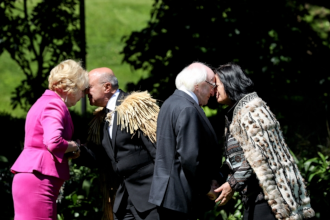
The President along with his wife Sabina Higgins meet with Governor-General Reddy and Sir David Gascoigne on the first day of their State visit to New Zealand.

According to a statement released by the President’s office, “the decision to establish an embassy reflects an exceptionally close partnership between Ireland and New Zealand in international affairs, including at the United Nations.” New Zealand also announces plans to open an embassy in Ireland.

Diplomatic relations between Ireland and New Zealand are established in 1965. Ireland’s Ambassador to Australia is also accredited to New Zealand. Niamh McMahon serves as Ireland’s Honorary Consul in Auckland, New Zealand.

The President visits Wellington, Christchurch, Auckland and Waitangi while in New Zealand, a country in which there are almost 14,000 Irish born people and one in six people claim Irish heritage.

President Higgins also meets with the prime minister-elect of New Zealand, Jacinda Ardern, who becomes the third woman to lead a government in her country.

(Pictured: President Michael D. Higgins and Sabina Higgins receive a traditional Maori welcome from Governor-General of New Zealand Dame Patsy Reddy and Sir David Gascoigne, Government House, Wellington)


Leave a comment

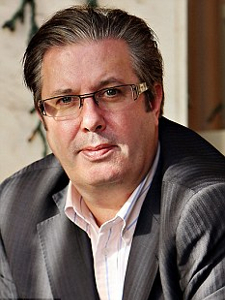
Birth of Gerry Robinson, Businessman & Television Presenter

Sir Gerrard Jude “Gerry” Robinson, Irish-born British business executive and television presenter, is born in Dunfanaghy, County Donegal on October 23, 1948. He is the former non-executive Chairman of Allied Domecq and the ex-Chairman/chief executive of Granada.

The ninth of ten children born to Anthony and Elizabeth Robinson, Robinson moves with his family to England in his early teens. He briefly trains to become a Catholic priest at St. Mary’s Missionary College of the Holy Ghost Fathers at Castlehead, Grange-over-Sands, Lancashire. He begins a career in accounting in 1965 as a clerk with the Matchbox toy company. While with the firm, he progresses through various accounting roles to become Chief Management Accountant in 1974. During that time he also qualifies as an Associate Chartered Management Accountant.

In 1974, Robinson leaves Matchbox to work for Lex Vehicle Leasing as a management accountant. He rises through the company and is ultimately appointed finance director. In 1980, he joins the UK franchise of Coca-Cola, owned at the time by Grand Metropolitan. In 1983 he is appointed managing director of Grand Metropolitan’s international services division. In 1987 he leads the successful £163m management buyout of the loss-making contract services and catering division of Compass Group, known as Compass Caterers. He joins Granada as CEO in 1991 and ousts Granada’s chairman, David Plowright, in 1992, which leads John Cleese to call Robinson “an upstart caterer.”

Robinson steers the company through various mergers, and hostile takeovers including London Weekend Television (1993) and Forte Group (1996). In 1999 he is the subject of a biography, Lord of the Dance, written by business journalist William Kay, and published by Orion Business Books. In 2005 he makes an unsuccessful attempt to oust Doug Flynn as CEO of Rentokil Initial and install himself as Executive chairman for a 5% stake in the company, then valued at £56M.

Robinson’s first foray into broadcasting is a revival of the BBC‘s Troubleshooter series, originally fronted by Sir John Harvey-Jones in the early 1990s. Titled I’ll Show Them Who’s Boss and co-produced by the Open University, in 2004 he goes into struggling businesses to try to turn them round by advice and mentoring.

In January 2007 following a similar format, he presents a three-part series, Can Gerry Robinson Fix the NHS? as he attempts to reduce waiting lists at Rotherham General Hospital. He returns a year later for a sequel, Can Gerry Robinson Fix the NHS? One Year On. In December 2009, he presents a programme in a similar format entitled Can Gerry Robinson Fix Dementia Care Homes?.

In June 2009 Robinson presents a special edition of The Money Programme entitled Gerry Robinson’s Car Crash investigating the history and future of the British motor industry. He regularly appears on British TV as a celebrity businessman. In July 2009 he starts a TV series called Gerry’s Big Decision, in which he reviews struggling companies and decides whether it is worth investing his own money to save them. From January 14 through February 18, 2011 he presents BBC Two show Can’t Take It with You, which helps people to write their wills.

Robinson also serves as chairman of the Arts Council England for six years from 1998, in which capacity he is one of the many victims of a spoof by British comedian Ali G. He has divorced and remarried and has four children. He lives in Raphoe, County Donegal and has established a botanical garden with a narrow-gauge railway – the Difflin Lake Railway – which is open to the public. He was knighted in the 2004 New Year Honours list.


Leave a comment

Body of Jack Lynch Moved to Church of St. Paul of the Cross

On October 21, 1999, President Mary McAleese leads mourners at the removal of the body of former Taoiseach and Fianna Fáil leader, Jack Lynch, from Dublin’s Royal Hospital, where he had died the previous day, to the Church of St. Paul of the Cross, Mount Argus.

Jack Lynch, in full John Mary Lynch, is born on August 15, 1917, in Cork, County Cork. He serves as Taoiseach of Ireland from 1966 to 1973 and from 1977 to 1979.

Lynch studies law and enters the civil service with the Department of Justice in 1936. He eventually decides on a legal career, is called to the bar in 1945, resigns from the civil service, and practices on the Cork circuit. He already enjoys a national reputation as a sports hero as he had won five All-Ireland medals as a Cork hurler and another as a footballer.

Lynch joins Fianna Fáil and wins a seat in Dáil Éireann, the lower house of the Oireachtas, in 1948. He works closely with Éamon de Valera in opposition (1948–51), and de Valera appoints him a Parliamentary Secretary in 1951–1954, Minister for the Gaeltacht in 1957, and Minister for Education in 1957–1959. When Seán Lemass succeeds de Valera as Taoiseach in 1959, he makes Lynch Minister for Industry and Commerce and in 1965–1966 Minister for Finance.

Lemass’s retirement in 1966 causes an internal party conflict over the succession that leads to Lynch’s selection as a compromise candidate, a position he reluctantly accepts. In November 1966 he becomes leader of Fianna Fáil and Taoiseach. In June 1969 he becomes the only Fianna Fáil leader other than de Valera to win an overall majority in a general election.

In 1969–1973 Lynch plays an important role when civil unrest leads to the collapse of the government of Northern Ireland and poses a threat to the stability of the Irish state. He fires two cabinet ministers who are suspected of involvement in smuggling arms to the Provisional Irish Republican Army (IRA). He also creates a consensus in Irish party politics on a policy of conciliation and cooperation with the British government in seeking a solution to the Northern Ireland problem based on establishing power-sharing between the unionist majority and the Roman Catholic minority.

In 1972 Lynch wins an 83% majority in a referendum on Ireland’s entry into the European Economic Community and, on January 1, 1973, Ireland becomes a member. Although he is defeated in the 1973 Irish general election, he again demonstrates his remarkable popularity at the polls in 1977 when Fianna Fáil wins their largest and their last overall majority. In December 1979, however, discouraged by challenges to his authority from party colleagues, he resigns his leadership and soon after retires from politics. He serves on a number of corporate boards after his retirement.

Lynch dies in the Royal Hospital, Donnybrook, Dublin on October 20, 1999, at the age of 82. He is honoured with a state funeral which is attended by the President Mary McAleese, Taoiseach Bertie Ahern, former Taoisigh John Bruton, Albert Reynolds and Charles Haughey, and various political persons from all parties. The coffin is then flown from Dublin to Cork where a procession through the streets of the city draws some of the biggest crowds in the city’s history. Following the Requiem Mass celebrated in his home parish of the Cathedral of St. Mary and St. Anne, his friend and political ally, Desmond O’Malley, delivers the graveside oration, paying tribute to Lynch’s sense of decency. He is buried in St. Finbarr’s Cemetery, Cork.


Leave a comment

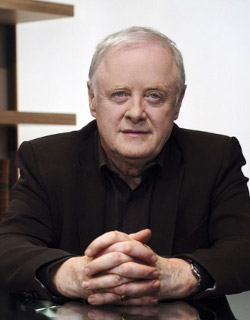
Kerrygold Butter Launched on the World Market

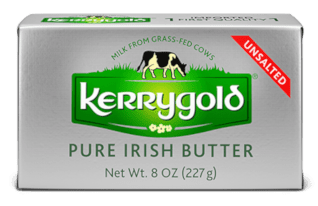
Kerrygold Pure Irish Butter, created by Sir Anthony O’Reilly, is launched on the world market on October 8, 1962.

O’Reilly is the CEO of what is then called An Bord Bainne (Irish for “The Irish Dairy Board”). His aim is to create a premium brand worthy of the rich quality of Irish milk. The name for the brand is chosen in 1962 from a total of 60 suggestions. Some of the names proposed include Shannon Gold, Tub-o-gold, Golden Farm, Butter-cup, and even Leprechaun.

Surprisingly, Kerrygold is first launched in the UK, not in Ireland. The butter is launched in October 1962 in Manchester. It is available in London three years later.

In 1964, the butter begins exporting to overseas markets. It is not until 1973 that the brand is even made available for sale in Ireland. Kerrygold eventually expands its offerings to include other dairy products, such as its Dubliner Cheese (named after the city of Dublin, although it is made in Cork).

Kerrygold advertising campaigns become legendary. The most well-known is the “Who’s taking the horse to France?” commercial, which first airs in 1994.

Today, the golden foil packaging of Kerrygold butter is recognized around the world in 60 countries. Kerrygold is the number one branded butter in Germany, and in the United States, it is the number one imported butter brand and the number three overall butter brand.

In 2017, Kerrygold is banned in Wisconsin for not complying with a 1970 state law making it unlawful to sell any butter in the state unless it has been tested by industry experts and issued a grade. Some critics suggest that the law is only proposed to protect the state’s own dairy industry. Fans of Kerrygold butter in Wisconsin are forced to travel across state lines to stock up due to the ban.

Two lawsuits are filed challenging the constitutionality of the state’s butter grading law.

Ornua, the rebranded An Bord Bainne, confirms in November 2017 its Kerrygold butter is back on store shelves in Wisconsin as the company now complies with the state’s law requiring butter sold in Wisconsin to pass a government-mandated grading test.