seamus dubhghaill

Promoting Irish Culture and History from Little Rock, Arkansas, USA


Leave a comment

The Bayardo Bar Attack

bayardo-bar-attack

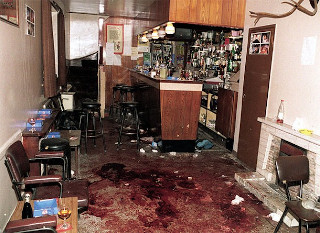
The Bayardo Bar attack takes place on August 13, 1975, in Belfast as a unit of the Provisional Irish Republican Army (IRA), led by Brendan McFarlane, launch a bombing and shooting attack on a pub on Aberdeen Street, in the loyalist Shankill Road area of the city.

By 1975, the conflict in Northern Ireland known as “the Troubles” is more than six years old. On February 10, 1975, the Provisional IRA and the British government enter into a truce and restart negotiations. There is a rise in sectarian killings during the truce, which ‘officially’ lasts until early 1976. The truce, however, is interrupted in the early hours of July 31, 1975, by the Miami Showband killings at Buskhill outside Newry, County Down.

Two weeks later, on August 13, 1975, the Bayardo Bar is crowded with people of all ages. Shortly before closing time a stolen green Audi automobile, containing a three-man unit of the IRA’s Belfast Brigade, pulls up outside. It is driven by the unit’s leader Brendan “Bik” McFarlane, a 24-year-old volunteer from Ardoyne. Volunteers Seamus Clarke and Peter “Skeet” Hamilton get out and approach the pub’s side entrance on Aberdeen Street. One of them immediately opens fire with an ArmaLite, instantly killing doorman William Gracey and his brother-in-law Samuel Gunning, with whom he had been chatting outside. The other volunteer then enters the pub, where patrons are drinking and singing, and drops a duffel bag containing a ten-pound bomb at the entrance. Both men make their getaway back to the waiting car. As panicked customers run to the toilets for safety, the bomb explodes and brings down a section of the old brick-and-plaster building upon them. The bodies of civilian Joanne McDowell and UVF member Hugh Harris are later found beneath the rubble of fallen masonry. Seventeen-year-old civilian Linda Boyle is pulled out alive but dies of her injuries at the hospital on August 21. Over 50 people are injured in the attack.

A Belfast Telegraph article later claims that, as the IRA unit drives away down Agnes Street, they fire into a crowd of women and children queuing at a taxi rank although there are no fatalities. Within 20 minutes of the blast, the IRA unit is arrested after their car is stopped at a roadblock. The ArmaLite that had been used to kill Gracey and Gunning is found inside the car along with spent bullet casings and fingerprints belonging to the three IRA men.

The IRA does not initially claim responsibility, however, IRA members later state that the Bayardo was attacked because it was a pub where Ulster Volunteer Force (UVF) members met and planned terrorist assaults against nationalists. The pub is in the UVF-dominated middle Shankill Road area, and the Ulster Banner is displayed from its upper windows. A former IRA prisoner claims that fellow inmate Lenny Murphy told him he had left the Bayardo ten minutes before the attack and that the Brigade Staff had just finished holding a meeting there.

Loyalists, especially the UVF, respond with another wave of sectarian attacks against Catholics. Two days after the pub attack, a loyalist car bomb explodes without warning on the Falls Road, injuring 35 people. On 22 August, the UVF launches a gun and bomb attack on McGleenan’s Bar in Armagh. The attack is strikingly similar to that at Bayardo. One gunman opens fire while another plants the bomb, the explosion causing the building to collapse. Three Catholic civilians are killed and several more are wounded. That same night, another bomb wrecks a Catholic-owned pub in nearby Blackwatertown, although there are no injuries.

In May 1976, Brendan McFarlane, Seamus Clarke, and Peter Hamilton are convicted in a non-jury Diplock court and sentenced to life imprisonment inside the HM Prison Maze for carrying out the Bayardo murders. In 1983 McFarlane leads the Maze Prison escape, a mass break-out of 38 republican prisoners, including Clarke and Hamilton.


Leave a comment

Death of Hunger Striker Joe McDonnell


joe-mcdonnell

Joseph (Joe) McDonnell, a volunteer in the Provisional Irish Republican Army (IRA), dies on July 8, 1981, after 61 days on hunger strike during the 1981 Irish hunger strike.

McDonnell is born on Slate Street in the lower Falls Road of Belfast, Northern Ireland on September 14, 1951, as one of ten children. He attends a nearby Roman Catholic school. He marries Goretti in 1970 and moves into her sister’s house in Lenadoon. There are only two Catholic houses in this predominantly Ulster Protestant housing estate, and their house is attacked on numerous occasions.

McDonnell is arrested in Operation Demetrius and, along with Gerry Adams and others, is interned on the prison ship HMS Maidstone. He is later moved to HM Prison Maze in County Down for several months. Upon release, he joins the Provisional IRA Belfast Brigade. He meets Bobby Sands during the preparation for a firebomb attack on the Balmoral Furnishing Company’s premises in Dunmurry. During the ensuing shoot-out between the IRA and the Royal Ulster Constabulary (RUC) and British Army, both men, along with Séamus Finucane and Seán Lavery, are arrested. McDonnell and the others are sentenced to 14 years in prison for possession of a firearm. None of the men accept the jurisdiction of the court.

McDonnell agrees with the goals of the Irish hunger strike, namely: the right not to wear a prison uniform; the right not to do prison work; the right of free association with other prisoners; the right to organise their own educational and recreational facilities and the right to one visit, one letter and one parcel per week.

Although McDonnell is not involved in the first hunger strike in 1980, he joins Bobby Sands and the others in the second hunger strike the following year. During the strike he fights the general election in the Republic of Ireland, and only narrowly misses election in the Sligo–Leitrim constituency. He goes 61 days without food before dying on July 8, 1981. He has two children. His wife takes an active part in the campaign in support of the hunger strikers.

McDonnell is buried in the grave next to Bobby Sands at Milltown Cemetery in west Belfast. John Joe McGirl, McDonnell’s election agent in Sligo–Leitrim, gives the oration at his funeral. Quoting Patrick Pearse, he states, “He may seem the fool who has given his all, by the wise men of the world; but it was the apparent fools who changed the course of Irish history.”

McDonnell is commemorated on the Irish Martyrs Memorial at Waverley Cemetery in Sydney, Australia and is also commemorated in The Wolfe Tones song, “Joe McDonnell.”


Leave a comment

The Crumlin Road Gaol Escape

crumlin-road-jail-escape

Eight Provisional Irish Republican Army prisoners escape from Crumlin Road Gaol in Belfast, one of the most heavily guarded prisons in Europe, on June 10, 1980. Using handguns that had been smuggled into the prison, they take prison officers hostage and shoot their way out of the building and exit through the front gate.

The regime inside Crumlin Road Gaol on that day is just like any other. The prison had been the scene of several protests regarding strip-searching shortly beforehand, but the rules had been somewhat relaxed. On A and C Wings the remand prisoners are outside in the yard for exercise. As usual, several men from each wing are called for visits. Some of these visits are from solicitors and an area of the prison is set aside to allow legal teams and the accused a place to discuss their business in private.

When warders come to return one set of prisoners to their wing, the operation begins. One of the Volunteers produces a gun, forces the warders to release the other prisoners and then locks about ten warders in the cell. They then make their way to B wing’s visiting area and arrest all the warders, visitors and solicitors who are there, before locking about thirty up in a room. One warder named Killen reaches for his baton, is disarmed and hit over the head.

Two warders and a solicitor are ordered to strip and three of the IRA Volunteers, dress in two uniforms and a suit respectively, calmly walk to the main gate which is opened for them. They then pull guns on the real warders in this key security area and make them lie on the ground until their five comrades run across a small courtyard to join them.

Once outside however, the alarm is set off and British Army sentries pour a hail of automatic fire at the prisoners from a watch tower before they are able to reach the front gate. Undeterred, the prisoners dash through the bullets, weaving from side to side to throw off their attackers.

As the men make their escape, clearly visible to republican prisoners in cells on the top landing of A wing, loud cheers go up and makeshift flags are flown from the windows.

Outside the prison, cars have been parked by the IRA’s Belfast Brigade in the car park of the health clinic beside the courthouse, their ignition keys hidden under the floor mats. The prisoners run across the road towards the health centre, dodging bullets as they run. The escapees head towards the loyalist Shankill area where they commandeer cars to help their getaway.

Stunned by the daring escapees, the crown forces erect checkpoints across Belfast and along all border routes.

Seven of the escapees, known as the “M60 gang,” are brothers Tony and Gerry Sloan, Gerard McKee, Joe Doherty, Angelo Fusco, Paul ‘Dingus’ Magee and Tony Campbell. All are from Belfast and charged in connection with either an M60 machine gun attack in 1980 on a Royal Ulster Constabulary (RUC) patrol in Andersonstown, or with the siege on the Antrim Road in May 1980, when a Special Air Service (SAS) captain is killed. The eighth escapee is Pete Ryan from Ardboe, County Tyrone who had been charged with killing an RUC Reservist and an Ulster Defence Regiment (UDR) soldier.

All eight men reach safe houses within an hour and, after a lying low for a short while, are spirited over the border to begin new lives “on the run.”

One week later, at the annual pilgrimage to the graveside of Wolfe Tone, the father of republicanism, which is always a source of renewed strength for its participants, the crowd is given an added morale boost when at the closing ceremony, one of the escapees, Paul ‘Dingus’ Magee, makes a dramatic appearance on the platform.

There are many more attempts to break free from Crumlin Road Gaol before it finally closes its doors in April 1995, having been used as a weapon in the attempted suppression of the Irish freedom struggle for 151 years.

(From: An Phoblacht Magazine, http://www.anphoblacht.com, June 15, 2006 edition)


Leave a comment

The Widgery Report Is Released

john-passmore-widgery

John Passmore Widgery, Baron Widgery, English judge who serves as Lord Chief Justice of England and Wales from 1971 to 1980, issues his report exonerating “Bloody Sunday” troops on April 19, 1972.

Widgery receives promotion to the Court of Appeal in 1968. He has barely gotten used to his new position when Lord Parker of Waddington, who had been Lord Chief Justice of England and Wales since 1958, announces his retirement. There is no obvious successor and Widgery is the most junior of the possible appointees. The Lord Chancellor, Quintin Hogg, Baron Hailsham of St. Marylebone, chooses Widgery largely on the basis of his administrative abilities. On April 20, 1971, he is created a life peer taking the title Baron Widgery, of South Molton in the County of Devon.

Shortly after taking over, Widgery is handed the politically sensitive job of conducting an inquiry into the events of January 30, 1972, in Derry, where troops from 1st Battalion, Parachute Regiment had murdered 13 civil rights marchers, commonly referred to as Bloody Sunday. A 14th person dies shortly after Widgery’s appointment. He hears testimony from the paratroopers, who claim they had been shot at, while the marchers insist that no one from the march was armed. Widgery produces a report that takes the British Army‘s side. He placed the main blame for the deaths on the march organisers for creating a dangerous situation where a confrontation was inevitable. His strongest criticism of the Army is that the “firing bordered on the reckless.”

The Widgery Report is accepted by the British government and Northern Ireland‘s unionists but is immediately denounced by Irish nationalist politicians, and people in the Bogside and Creggan areas are disgusted by his findings. The British Government had acquired some goodwill because of its suspension of the Stormont Parliament, but that disappears when Widgery’s conclusions are published. The grievance with Widgery’s findings lingers and the issue remains live as the Northern Ireland peace process advances in the 1990s.

In January 1998, on the eve of the 26th anniversary of Bloody Sunday, Prime Minister Tony Blair announces a new inquiry, criticising the rushed process in which Widgery failed to take evidence from those wounded and did not personally read eyewitness accounts. The resulting Bloody Sunday Inquiry lasts 12 years before the Saville Report is published on June 15, 2010. It demolishes the Widgery Report, finding that soldiers lied about their actions and falsely claimed to have been attacked.

Prime Minister David Cameron, on behalf of the United Kingdom, formally apologises for the “unjustified and unjustifiable” events of Bloody Sunday. As a result of the Saville Report, even observers who are natural supporters of the British Army now regard Widgery as discredited. The conservative historian and commentator Max Hastings describes the Widgery report as “a shameless cover-up.”


Leave a comment

The 1979 Bessbrook Bombing

File source: http://commons.wikimedia.org/wiki/File:Coalisland.jpg

The Bessbrook bombing takes place on the April 17, 1979, when four Royal Ulster Constabulary (RUC) officers are killed when the Provisional Irish Republican Army (IRA) explodes an estimated 1,000-pound roadside van bomb at Bessbrook, County Armagh.

The bombing occurs during a period of heightened IRA activity. The previous two years are some of the less active and less violent years during the Troubles. The British policy of criminalization seems to be working but the IRA is gearing up for a new offensive. In 1976, 295 people are killed compared with 111 in 1977 and 80 in 1978 but in 1979 the number increases to 120 with 76 being British security force members compared to just 34 in 1978. The entire IRA “battalion structure” has been reconstructed using more smaller, tight knit cells making the IRA more secretive, harder to infiltrate and makes them much more effective at carrying out larger operations. The only brigade area which does not go under this reconstruction is the South Armagh Brigade which is viewed by the IRA Army Council as an independent Republic. In fact, by the mid-1970s South Armagh has become so dangerous for the British security forces, who are snipped at and have bombs thrown at them whenever they enter the area on foot, they have to be airlifted into the area and ground patrols are stopped altogether effectively giving up the ground to the South Armagh PIRA.

While the four Protestant members of the Royal Ulster Constabulary are on an evening patrol, they are all killed when a Provisional IRA unit detonates a remote-controlled bomb hidden in a parked van. The IRA unit detonates the well-hidden bomb at the exact second the RUC mobile patrol is passing giving the officers no chance of survival. The dead RUC men are, Paul Gray (25), Robert Lockhart (44), Richard Baird (28) and Noel Webb (30). The bomb is estimated at 1,000 lbs. and is believed to be the largest bomb used by the IRA up to that date.

In January 1981, Patrick Joseph Traynor (27) from Crossmaglen is found guilty of the four murders and a range of other charges. He is jailed for life on each of the four murder charges and is sentenced to 12 years for the related crimes.

The IRA continues to intensify their campaign. On August 29, 1979, the IRA carries out two separate attacks in Northern Ireland and the Republic of Ireland that shock the world and give huge media coverage to their campaign. The first is the killing of Lord Mountbatten and his grandson when the boat they are on off the County Sligo coast is blown up by a remote-controlled bomb. The second is the Warrenpoint Ambush where the IRA kills 18 British soldiers in a double bomb attack, the highest loss of life for the British Army during the Troubles. The IRA carries out several of these type of large attacks against the British forces throughout the 1980s like the 1983 Ballygawley land mine attack which kills four soldiers, the 1988 Lisburn van bombing which kills six soldiers and the Ballygawley bus bombing also carried out in 1988 which kills eight soldiers and injures 28.


Leave a comment

The Milltown Cemetery Attack

milltown-cemetery-attack

The Milltown Cemetery attack, also known as the Milltown Cemetery killings or the Milltown Massacre, takes place on March 16, 1988 at Milltown Cemetery in Belfast, Northern Ireland.

On March 6, 1988, Provisional Irish Republican Army members Daniel McCann, Seán Savage and Mairéad Farrell are shot dead by the Special Air Service (SAS) in Gibraltar, in Operation Flavius. The three were allegedly preparing a bomb attack on British military personnel there, but their deaths outrage republicans as the three are unarmed and shot without warning. Their bodies arrive in Belfast on March 14 and are taken to their family homes.

The “Gilbraltar Three” are scheduled to be buried in the republican plot at Milltown Cemetery on March 16. For years, republicans had complained about heavy-handed policing of IRA funerals, which had led to violence. In a change from normal procedure, the security forces agree to stay away from the funeral in exchange for guarantees that there will be no three-volley salute by IRA gunmen. The British Army and Royal Ulster Constabulary (RUC) would instead keep watch from the sidelines. This decision is not made public.

Present at the funeral are thousands of mourners and top members of the IRA and Sinn Féin, including Sinn Féin leader Gerry Adams and Martin McGuinness. Two RUC helicopters hover overhead.

Michael Stone, a loyalist and member of the Ulster Defence Association (UDA), learns there are to be no police or armed IRA members at the cemetery. As the third coffin is about to be lowered into the ground, Stone throws two grenades, which have a seven-second delay, toward the republican plot and begins shooting. The first grenade explodes near the crowd and about 20 yards from the grave. There is panic and confusion, and people dive for cover behind gravestones.

As Stone runs towards the nearby motorway, a large crowd begins chasing him and he continues shooting and throwing grenades. Some of the crowd catches Stone and begin beating him, but he is rescued by the police and arrested. Three people are killed and more than 60 wounded in the attack. The “unprecedented, one-man attack” is filmed by television news crews and causes shock around the world.

Three days later, two British Army corporals drive into the funeral procession of one of the Milltown victims. The non-uniformed soldiers are dragged from their car by an angry crowd, beaten and then shot dead by the IRA, in what becomes known as the corporals killings.

In March 1989, Stone is convicted for the three murders at Milltown, for three paramilitary murders before, and for other offences, receiving sentences totaling 682 years. He is released after serving 13 years as a result of the Good Friday Agreement.

(Pictured: The funeral at Milltown Cemetery in Belfast moments before the attack by Michael Stone)


Leave a comment

The Glasdrumman Ambush

glasdrumman-ambush-ni-map

The Glasdrumman ambush, an attack by the South Armagh Brigade of the Provisional Irish Republican Army (IRA) against a British Army observation post, takes place on July 17, 1981, at a scrapyard in Glasdrumman, County Armagh, southwest of Crossmaglen.

The crisis, triggered by the 1981 Irish hunger strike of Provisional IRA and Irish National Liberation Army (INLA) prisoners, leads to an increase in militant Irish republican activity in Northern Ireland. British intelligence reports unveil IRA intentions of mounting illegal checkpoints and hijacking vehicles on the IRA-controlled roads in South County Armagh, near the Irish border. To counter it, the British Army deploy the so-called COPs (close observation platoons), small infantry sections acting as undercover units, a tactic introduced by Major General Richard Trant in 1977.

On May 6, 1981, a day after the death of hunger-striker Bobby Sands, one IRA member from a three-man unit is arrested while trying to set up a roadblock east of the main Belfast-Dublin road by twelve members of the Royal Green Jackets, divided in three teams. A second volunteer crosses the border, only to be arrested by the Irish Army. The third IRA man escapes apparently injured. A total of 689 rounds are fired by the soldiers.

After this initial success, the British Army continues these tactics. On July 16, another operation is carried out by eighteen Royal Green Jackets soldiers. That night, four concealed positions – Alpha, Bravo, Charlie and Delta – are inserted into the Glassdrumman area, around a scrapyard along the border. The plan is that another unit, called the triggering team, would ambush any IRA unit on sight, while the other four would block the expected escape routes. On July 17, the commanders in charge of Alpha and Delta teams, suspecting that the operation has been compromised by the presence of local civilians, orders the withdrawal of their men. Shortly thereafter, Bravo team is suddenly engaged by automatic fire from an M60 machine gun and AR-15 rifles fired by six or seven IRA members. The concealed position, emplaced inside a derelict van, is riddled by more than 250 bullets. The team’s leader, Lance Corporal Gavin Dean, is killed instantly and one of his men, Rifleman John Moore, is seriously wounded. Moore is later awarded the Military Medal. The IRA members fire their weapons from across the border, 160 yards away.

British army commanders conclude that “it was not worth risking the lives of soldiers to prevent an IRA roadblock being set up.” The incident also exposes the difficulties of concealing operations from local civilians in South Armagh, whose sympathy with the IRA is manifest. Several years later, the IRA would repeat its success against undercover observation posts in the course of Operation Conservation in 1990.


Leave a comment

Assassination of Activist Miriam Daly

miriam-daly

Miriam Daly, Irish republican activist and university lecturer, is assassinated by the loyalist Ulster Defence Association (UDA) on June 26, 1980.

Daly is born in the Curragh Irish Army camp, County Kildare in 1928. She grows up in Hatch Street, Dublin and attends Loreto College on St. Stephen’s Green and University College, Dublin, graduating in history. She goes on to teach economic history in UCD for some years before moving to Southampton University with her husband, Joseph Lee. Two years after her first husband dies, she marries James Daly and returns to Ireland with him in 1968. They both are appointed lecturers in Queen’s University Belfast.

Daly soon becomes an activist in the civil rights movement, particularly following the introduction of internment without trial by the Government of Northern Ireland. She is active in the Northern Ireland Civil Rights Association and the Northern Resistance Movement.

Daly is a militant member of the Prisoners’ Relatives Action Committee and the national Hunger Strike Committee. In that campaign, she works with Seamus Costello and soon joins him in the Irish Republican Socialist Party (IRSP) and the Irish National Liberation Army (INLA). After Costello is assassinated, she becomes chairperson, leading the party for two years. During this time, she and her husband are instrumental in opposing Sinn Féin‘s drift towards federalism.

On June 26, 1980, Daly is shot dead at her home in the Andersonstown area of west Belfast. At the time of her assassination, she is in charge of the IRSP prisoners’ welfare.

According to reports in The Irish Times, members of the Ulster Defence Association gain entry to her home with the intention of killing her husband, who is also a republican activist. Daly is captured and tied up while they wait for him to return home. However, he is in Dublin at the time and so does not arrive. After a considerable time, the UDA men decide to kill Daly instead. Muffling the sound of the gun with a cushion, they shoot her in the head and cut the phone lines before fleeing. Her body is discovered when her ten-year-old daughter arrives home from school.

Daly is buried in Swords, County Dublin. Mourners at her funeral, which features the firing of a volley of shots over her coffin, includes Seán Mac Stíofáin and Ruairí Ó Brádaigh. She is included as a volunteer on the INLA monument in Milltown Cemetery and is one of several commemorated by an IRSP mural on the Springfield Road, Belfast.


Leave a comment

The 1994 Shankill Road Killings

trevor-king-mural

The 1994 Shankill Road killings take place on June 16, 1994. The Irish National Liberation Army (INLA) shoot dead Ulster Volunteer Force (UVF) members Trevor King, Colin Craig and David Hamilton on the Shankill Road in Belfast, close to the UVF headquarters.

On June 16, 1994, high-ranking UVF Commander volunteer Trevor King is standing on the Shankill Road about one hundred yards from “The Eagle,” the UVF’s Belfast GHQ, talking to fellow UVF members David Hamilton and Colin Craig. A car drives past them and as it does so Irish National Liberation Army (INLA) gunmen inside the vehicle open fire on the three men. The car is later found burning close to Divis Tower.

David Lister and Hugh Jordan claim that Gino Gallagher, who is himself shot dead in 1996 during an internal dispute, is the main gunman in the attack. However, Henry McDonald and Jack Holland say that Gallagher is inside the car, which is scouting the area for UVF members, and not one of the gunmen.

Colin Craig is killed on the spot. King and David Hamilton lay in the street, seriously wounded as panic and chaos erupt on the Shankill in the wake of the shooting. Presbyterian minister Roy Magee is in “The Eagle” discussing an upcoming Combined Loyalist Military Command (CLMC) meeting and the possibility of a loyalist ceasefire with the UVF Brigade Staff when the attack takes place. He and the others race out of the building after hearing the gunfire.

King is rushed to the hospital where he is put on a life-support machine. The shooting has left him paralysed from the neck down. He dies on July 9 with Reverend Magee at his bedside. According to Magee, King himself makes the decision to turn off the machine.

The killings are a blow for the Northern Ireland peace process and a morale boost for the INLA. The attack is the INLA’s most notorious since the Droppin Well bombing in 1982 which killed seventeen people, eleven British soldiers and 6 civilians.

The following day, the UVF launches two retaliatory attacks. In the first, UVF members shoot dead a Catholic civilian taxi driver in Carrickfergus. In the second, they shoot dead two Protestant civilians in Newtownabbey, whom they believe to be Catholics. Two days after the killings the UVF decide to launch another revenge attack when they kill six Catholic civilians in a bar while they are watching the Ireland vs. Italy 1994 FIFA World Cup game opener in what becomes known as the Loughinisland massacre. The tit-for-tat attacks continue during the spring and summer of 1994 until the Provisional Irish Republican Army ceasefire of August 31, 1994, and the Combined Loyalist Military Command ceasefire in October. The attacks on the Shankill are the INLA’s deadliest attacks of the 1990s.

When interviewed for Boston College for research on the conflict, Progressive Unionist Party leader David Ervine suggests the INLA might have been working in cahoots with the Provisional IRA in targeting prominent Loyalists, as the month after the Provisional IRA kill three leading Ulster Defence Association (UDA) men.

(Pictured: Trevor King mural, Disraeli Street, May 2012)


Leave a comment

Murder of IRA Paramilitary Eamon Collins

eamon-collins

Eamon Collins, a Provisional Irish Republican Army paramilitary in the late 1970s and early 1980s, is beaten and stabbed to death near his home in Newry, County Down on January 27, 1999.

Collins grows up in a middle-class Irish family in Camlough, a small, staunchly Irish republican town in County Armagh. After completing his schooling, he works for a time in the Ministry of Defence in a clerical capacity in London before studying law at Queen’s University Belfast, where he becomes influenced by Marxist political ideology. He eventually drops out of university and, after working in a pub for a period, joins Her Majesty’s Customs & Excise Service, serving in Newry, and goes on to use this internal position within the administrative machinery of the British Government to support IRA operations against Crown Forces personnel.

Collins joins the Provisional IRA during the blanket protest by Long Kesh inmates in the late 1970s and he becomes involved in street demonstrations. He joins the South Down Brigade of the IRA, based around Newry, and is appointed its intelligence officer.

Collins becomes noted within IRA circles for his hard-line views on the continuance of armed campaign and later joins its Internal Security Unit. Around this time, he has a confrontation with Gerry Adams at the funeral of an IRA man killed in a failed bombing over how to deal with the funeral’s policing, where he accuses Adams a being a “Stick.”

Despite his militarist convictions at this time Collins finds the psychological strain caused by his involvement in the terrorist war increasingly difficult to address. His belief in the martial discipline of the IRA’s campaign is seriously undermined by the March 11, 1982, assassination of Norman Hanna, a 28-year-old Newry man, in front of his wife and young daughter. His uneasy state is further augmented by being arrested on two occasions under anti-terrorism laws, the second including a week of detention and intense interrogation.

Collins subsequently states that the strain of the interrogation merely exacerbates increasing doubts that he has already possessed about the moral justification of the IRA’s terrorist paramilitary campaign and his actions within it. These doubts are made worse by the organization’s senior leadership quietly deciding in the early 1980s that the war has failed and now slowly manoeuvering the movement away from a military campaign to allow its political wing, Sinn Féin, to pursue its purposes by another means in what would become the Northern Ireland peace process.

In 1987, after being charged with several counts of murder and attempted murder, Collins is acquitted as the statement in which he admits to involvement in these acts is ruled legally inadmissible by the court. On release from prison, he spends several weeks being counter-interrogated by the IRA’s Internal Security Unit, after which he is exiled by the organization from Ulster, being warned that if he is found north of Drogheda after a certain date he will be executed.

After his exile Collins moves to Dublin and squats for a while in a deserted flat in the impoverished Ballymun area of the city. After several years in Dublin, he subsequently moves to Edinburgh, Scotland for a period, where he runs a youth centre.

In 1995 Collins returns to Newry, a district known for the militancy of its communal support of the IRA, with numerous IRA members in its midst. The IRA order exiling him from Ulster has not been lifted, but with a formal ceasefire from the organization and renunciations of violence by all the paramilitary organizations in the province, he deems it safe to move back in with his wife and children who had never left the town.

Rather than maintaining a low-profile Collins decides to take a prominent role in the ongoing transition of Ulster’s post-war society, using his personal history as a platform in the media to analyze the adverse effects of terrorism. In May 1998 he gives evidence against leading republican Thomas “Slab” Murphy in a libel case Murphy has brought against The Sunday Times, over a 1985 article naming him as the IRA’s Northern Commander. Murphy denies IRA membership, but Collins takes the witness stand against him and testifies that from personal experience he knew that Murphy had been a key military leader in the organization. Murphy subsequently loses the libel case and sustains substantial financial losses in consequence. Collins and his family receive numerous threats after the trial.

Collins is beaten and stabbed to death by one or more unidentified assailants early in the morning of January 27, 1999, while walking his dogs near the Barcroft Park Estate in Newry along a quiet stretch of country lane at Doran’s Hill. His body also bears marks of having been struck by a car moving at speed. The subsequent police investigation and Coroner’s Inquest comment upon the extremity of weaponed violence to Collins’ head and face used during the attack.

Rumoured reasons behind the murder are that he had returned to Ulster in breach of the IRA’s banning order, and further he had detailed IRA activities and publicly criticized in the media a multiplicity of Irish terrorist paramilitary splinter groups that had appeared after the IRA’s 1994 ceasefire, and that he had testified in court against Murphy.

After a traditional Irish wake, with a closed coffin necessitated by the condition of his face, and a funeral service at St. Catherine’s Church in Newry, Collins’ body is buried at the town’s Monkshill Cemetery, not far from the grave of Albert White, a Catholic former Royal Ulster Constabulary Inspector, whose assassination he had helped to organize in 1982.