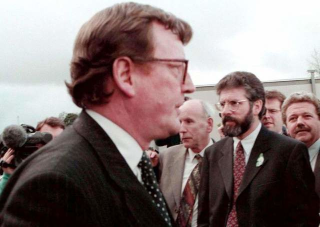
Sinn Féin says the meeting is a hugely significant move. “This is the first time in Irish history that a republican leader and a leader of unionism have sat down together in a room on their own,” says a spokesman. “This is about normalising relations between Sinn Féin and the First Minister.”
But the two men are not expected to shake hands after Trimble says Adams is still holding arms. They are likely to discuss decommissioning terrorist weapons.
The men meet briefly on Monday, September 7, in a round-table discussion of party leaders on procedural matters of the future government of the province, the Northern Ireland Assembly.
News of Trimble’s invitation to Adams breaks the previous week after the Sinn Féin President issues a firm denunciation of violence. But Trimble is adamant that the Irish Republican Army (IRA) must hand over arms before Sinn Féin can take seats in the new government. Sinn Féin has made moves in this direction by appointing strategist Martin McGuinness as an intermediary between the international arms decommissioning body and the IRA.
The 1998 Good Friday Agreement includes a power sharing administration under British rule and an all-Ireland ministerial council to promote island-wide co-operation. London is due to hand over a large measure of home rule powers by February 1999. In the meantime a “shadow” ruling executive must up be set up and mechanisms put in place to ensure smooth implementation of all aspects of the Agreement.
Meanwhile, two rebel Ulster Unionists who ran against official candidates in the 1998 Northern Ireland Assembly election are waiting to learn if they have been expelled from the party. Party officials say it will take several days to decide the future of the two members of the new parliament, Denis Watson and Boyd Douglas, who contested the June poll on an anti-Agreement ticket.
(From: “Trimble and Adams make history,” BBC News, news.bbc.co.uk, September 10, 1998)
The road and castle are on the northern bank of the Newry River, which marks the border between Northern Ireland and the Republic of Ireland. The Republic’s side of the river, the Cooley Peninsula in County Louth, is an ideal spot from which to launch an ambush. It is thickly wooded, which gives cover to the ambushers, and the river border prevents British forces from giving chase.
On the afternoon of August 27, a British Army convoy of one Land Rover and two four-ton lorries carrying soldiers of the 2nd Battalion, Parachute Regiment is driving from Ballykinlar Barracks to Newry. The British Army is aware of the dangers of using the stretch of road along the Newry River and often declares it out of bounds. However, they sometimes use it to avoid setting a pattern. At 4:40 p.m., as the convoy is driving past Narrow Water Castle, an 800-pound fertiliser bomb, hidden among bales of straw on a parked flatbed trailer, is detonated by remote control by IRA members watching from across the border in County Louth. The explosion catches the last lorry in the convoy, hurling it onto its side and instantly killing six paratroopers, whose bodies are scattered across the road. There are only two survivors amongst the soldiers traveling in the lorry, both of whom receive serious injuries. The lorry’s driver, Anthony Wood (19), is one of those killed. All that remains of his body is his pelvis, welded to the seat by the fierce heat of the blast.
According to the soldiers, immediately after the blast they are targeted by rifle fire from the woods on the Cooley Peninsula on the other side of the border, with this view supported by two part-time firefighters assisting the wounded. Shortly afterwards, the two IRA members arrested by the Garda Síochána and suspected of being behind the ambush, are found to have traces of gunsmoke residue on their hands and on the motorbike they are riding. The IRA’s first statement on the incident, however, denies that any shots had been fired at the troops, and according to Royal Ulster Constabulary (RUC) researchers, the soldiers might have mistaken the sound of ammunition cooking off for enemy gunfire. Nevertheless, at the official inquiry the soldiers declare on oath that they had been fired on.
The surviving paratroopers radio for urgent assistance, and reinforcements are dispatched to the scene by road. A rapid reaction unit is sent by Gazelle helicopter, consisting of Lieutenant Colonel David Blair, commanding officer of the Queen’s Own Highlanders, his signaler Lance Corporal Victor MacLeod, and army medics. Another helicopter, a Wessex, lands to pick up the wounded. Colonel Blair assumes command once at the site.
William Hudson, a 29-year-old from London, is killed by the British Army and his cousin Barry Hudson, a 25-year-old native of Dingle, is wounded when shots are fired across the Newry River into the Republic of Ireland about 3 km from the village of Omeath, County Louth.
The pair are partners in ‘Hudson Amusements’ and had been operating their amusements in Omeath for the duration of the Omeath Gala. When the first explosion is heard across the Lough, the pair go down to the shore to see what is unfolding. The pair makes their way to Narrow Water on the southern side of the border to get a better view of what is happening on the northern side. Barry Hudson is shot in the arm and as he falls to the ground he sees his cousin, who is the son of a coachman at Buckingham Palace, fall to the ground, shot in the head. He dies almost immediately.
The IRA had been studying how the British Army behaves after a bombing and correctly predicts that they would set up an incident command point (ICP) at the stone gateway on the other side of the road. At 5:12 p.m., thirty-two minutes after the first explosion, another 800-pound bomb hidden in milk pails explodes at the gateway, destroying it and hurling lumps of granite through the air. It detonates as the Wessex helicopter is taking off carrying wounded soldiers. The helicopter is damaged by the blast but does not crash.
The second explosion kills twelve soldiers, ten from the Parachute Regiment and the two from the Queen’s Own Highlanders. Lieutenant Colonel Blair is the second Lieutenant Colonel to be killed in the Troubles up until then, following Lieutenant Colonel Corden-Lloyd of the 2nd Battalion Royal Green Jackets in 1978. Only one of Colonel Blair’s epaulettes remains to identify him as his body had been vaporised in the blast. The epaulette is taken from the scene by BrigadierDavid Thorne to a security briefing with Prime MinisterMargaret Thatcher to “illustrate the human factor” of the attack. Mike Jackson, then a major in the Parachute Regiment, is at the scene soon after the second explosion and later describes seeing human remains scattered over the road, in the water and hanging from the trees. He is asked to identify the face of his friend, Major Peter Fursman, still recognisable after it had been ripped from his head by the explosion and recovered from the water by divers from the Royal Engineers.
Press photographer Peter Molloy, who arrives at the scene after the first explosion, comes close to being shot by an angry paratrooper who sees him taking photographs of the dead and dying instead of offering to help the wounded. The soldier is tackled by his comrades. Molloy says, “I was shouted at and called all sorts of things, but I understood why. I had trespassed on the worst day of these fellas’ lives and taken pictures of it.”
The Warrenpoint ambush is a victory for the IRA. It is the deadliest attack on the British Army during the Troubles and the Parachute Regiment’s biggest loss since World War II, with sixteen paratroopers killed. General Sir James Glover, Commander of British forces in Northern Ireland, later says it was “arguably the most successful and certainly one of the best planned IRA attacks of the whole campaign.” The ambush happens on the same day that Lord Mountbatten, a prominent member of the British royal family, is killed by an IRA bomb aboard his boat at Mullaghmore, County Sligo, along with three others.
Republicans portray the attack as retaliation for Bloody Sunday in 1972 when the Parachute Regiment shot dead 13 unarmed civilians during a protest march in Derry. Graffiti appears in republican areas declaring “13 gone and not forgotten, we got 18 and Mountbatten.” The day after the Mountbatten and Warrenpoint attacks, the Ulster Volunteer Force (UVF) retaliates by shooting dead a Catholic man, John Patrick Hardy (43), at his home in Belfast‘s New Lodge estate. Hardy is targeted in the mistaken belief that he is an IRA member.
Very shortly after the ambush, IRA volunteers Brendan Burns and Joe Brennan are arrested by the Gardaí. They are stopped while riding a motorbike on a road opposite Narrow Water Castle. They are later released on bail due to lack of evidence. Burns dies in 1988 when a bomb he is handling explodes prematurely. In 1998, former IRA member Eamon Collins claims that Burns had been one of those who carried out the Warrenpoint ambush. No one has ever been criminally charged.
According to Toby Harnden, the attack “drove a wedge” between the Army and the RUC. Lieutenant General Sir Timothy Creasey, General Officer Commanding Northern Ireland, suggests to Margaret Thatcher that internment should be brought back and that liaison with the Gardaí should be left in the hands of the military. Sir Kenneth Newman, the RUC Chief Constable, claims instead that the British Army practice since 1975 of supplying their garrisons in south County Armagh by helicopter gives too much freedom of movement to the IRA. One result is the appointment of Sir Maurice Oldfield to a new position of Co-ordinator of Security Intelligence in Northern Ireland. His role is to co-ordinate intelligence between the military, MI5 and the RUC. Another is the expansion of the RUC by 1,000 members. Tim Pat Coogan asserts that the deaths of the 18 soldiers hastens the move to Ulsterisation.
Edward Montgomery O’Rorke Dickey is born in Belfast on July 1, 1894, the son of Edward O’Rorke Dickey. He later marries Eunice Emmeline Howard and they have one son, Daniel. He is educated at Wellington College and Trinity College, Cambridge. He studies painting under Harold Gilman at the Westminster School of Art.
Dickey becomes the first curator of The Minories in Colchester, Essex, a post he holds for five years from 1957 to 1962.
Dickey is a founder member of the Society of Wood Engravers in 1920, and exhibits with them from 1920 to 1924. He is at his most active in the early 1920s and virtually all his engravings date from this period.
In 1922 Dickey contributes a wood engraving to Contemporary English Woodcuts, an anthology of wood engravings produced by Thomas Balston, a director at Gerald Duckworth and Company and an enthusiast for the new style of wood engravings. Campbell Dodgson, Keeper of Prints and Drawings at the British Museum, writes about him in his introduction to the book Mr. Hagreen and Mr. Dickey are among the engravers who rely very much upon the effective use of white lines and spaces. This is a limited edition of 550 copies, as is the only book that he illustrates with wood engravings, Workers by the Irish writer Richard Rowley, published by Balston at Duckworth in 1923.
McElwee, the sixth of twelve children, is born on November 30, 1957, into the small, whitewashed home built by his father, along the Tamlaghtduff Road in Bellaghy, County Derry, Northern Ireland. He attended St. Mary’s primary in Bellaghy, and then Clady intermediate. After leaving school he goes to Magherafelt technical college for a while but later changes his mind and goes to Ballymena training centre to begin an apprenticeship as a motor mechanic. Harassment from loyalist workers there forces him to leave and he then goes to work with a local mechanic.
McElwee and his cousin Francis Hughes form an independent Republican unit, which for several years carries out ambushes on British Army patrols as well as bomb attacks in neighbouring towns such as Magherafelt, Castledawson, and Maghera.
In October 1976, McElwee takes part in a planned bombing blitz on the town of Ballymena. Along with several colleagues, he is transporting one of the bombs, which explodes prematurely and blinds him in his right eye. He is transferred from the Ballymena hospital to the Royal Victoria Hospital in Belfast for emergency surgery to save his remaining eye. It is three weeks before he is able to see at all.
After six weeks McElwee is transferred again, this time to the military wing of the Musgrave Park Hospital. One week before Christmas, he is charged and sent to Crumlin Road Gaol.
At McElwee’s subsequent trial in September 1977, having spent over eight months on remand in Crumlin Road, he is charged and sentenced to 20 years’ imprisonment for possession of explosives and the murder of Yvonne Dunlop, who is killed when one of the firebombs destroys the shop where she is employed. His murder charge is reduced to manslaughter on appeal, although the original jail term stands. He returns to the blanket protest he had joined immediately after his trial, in the H-Blocks of Long Kesh.
Imprisonment is particularly harsh for McElwee and his brother Benedict who are frequently singled out for brutality by prison warders, outraged at the stubborn refusal of the two to accept any form of criminal status. On one occasion he is put on the boards for fourteen days for refusing to call a prison warder ‘sir.’ In a letter smuggled out to his sister Mary, Benedict writes of the imprint of a warder’s boot on his back and arms after a typical assault. However, throughout the brutality and degradation they have to endure serves only to deepen yet further, and harder, their resistance to criminalisation.
McElwee joins the 1981 Irish hunger strike on June 7, 1981, and died on August 8, 1981, after 62 days on the strike. Indicative of the callousness of the British government towards prisoners and their families alike, he is denied the comfort of his brother’s presence at that tragic moment. He dies after 62 days of slow agonising hunger strike with no company other than prison warders – colleagues of those who had brutalised, degraded and tortured him for three-and-a-half years.
In 2009, Republican Sinn Féin (RSF) name their Waterfordcumann after McElwee, replacing that of George Lennon, OC of the Waterford Flying Column who led the IRA anti-Treaty Republicans into Waterford City in March 1922. The Waterford RSF had adopted the Lennon name without the permission of his son who noted that his father had, in later years, become a committed pacifist and opponent of the Vietnam War.
McElwee is the main subject of the song Farewell to Bellaghy, which also mentions his cousin Francis Hughes, other members of the independent Republican unit and deceased volunteers of the South Derry Brigade of the Provisional IRA. He is also the subject of The Crucifucks‘ song The Story of Thomas McElwee.
Seven people are killed in the explosion, including two members of the Royal Ulster Constabulary (RUC), who say they had evacuated people to what was considered to have been a safe area following misleading telephone calls, which had originally placed the device in a nearby street. The Provisional IRA Belfast Brigade admits responsibility for the bomb, which also injures 148 people, but claims that the security forces had deliberately misrepresented the warnings in order to maximise the casualties. This is one of the first car bombs the IRA uses in their armed campaign.
On Monday, March 20, 1972, at 11.45 a.m., a local carpet dealer receives a telephone call warning that a bomb will explode in Belfast city centre’s Church Street which is crowded with shoppers, office workers on lunch breaks, and schoolchildren. British Army troops and the RUC are alerted and immediately begin to evacuate the people into nearby Lower Donegall Street. The second call to The Irish News newspaper seven minutes later also gives Church Street as the location for the device. A final call comes at 11:55 a.m. advising theNews Letter newspaper that the bomb is instead placed outside its offices in Lower Donegall Street where the crowds have been sent. Thus, the warning arrives too late for the security forces to clear the street. Staff working inside the News Letter building are told by the caller that they have 15 minutes in which to leave the building, but they never have a chance to evacuate.
At 11:58 a.m. a 100-pound gelignite bomb explodes inside a green Ford Cortina parked in the street outside the offices of the News Letter, shaking the city centre with the force of its blast, and instantly killing the two RUC constables, Ernest McAllister (31) and Bernard O’Neill (36), who had been examining the vehicle. The remains of the two policemen are allegedly found inside a nearby building. Minutes earlier they had been helping to escort people away from Church Street.
The explosion sends a ball of flame rolling down the street and a pall of black smoke rising upward. The blast wave rips into the crowds of people who had run into Donegall Street for safety, tossing them in all directions and killing another four men outright: Ernest Dougan (39), James Macklin (30), Samuel Trainor (39) and Sydney Bell (65). Trainor is also an off-duty Ulster Defence Regiment (UDR) soldier and a member of the Orange Order. A seriously wounded pensioner, Henry Miller (79) dies in hospital on April 5. Most of the dead are mutilated beyond recognition. With the exception of Constable O’Neill, who is a Catholic, the other six victims are Protestants.
The explosion blows out all the windows in the vicinity, sending shards of glass into people’s bodies as they are hit by falling masonry and timber. The ground floor of the News Letter offices and all buildings in the area suffer heavy damage. The News Letter library in particular sustains considerable damage with many priceless photographs and old documents destroyed. Around the blast’s epicentre, the street resembles a battlefield. About one hundred schoolgirls lay wounded on the rubble-strewn, bloody pavement covered in glass and debris, and screaming in pain and fright. A total of 148 people are injured in the explosion, 19 of them seriously. Among the injured are many of the News Letter staff.
One of the wounded is a child whose injuries are so severe a rescue worker at the scene assumes the child has been killed. A young Czech art student, Blanka Sochor (22), receives severe injuries to her legs. She is photographed by Derek Brind of the Associated Press as a British Paratrooper holds her in his arms. Passerby Frank Heagan witnesses the explosion and comes upon what is left of two binmen who had been “blown to pieces.” He adds that “there was blood everywhere and people moaning and screaming. The street was full of girls and women all wandering around.” The injured can be heard screaming as the ambulances transport them to hospital. Emergency amputations are performed at the scene.
While the security forces and firemen pull victims from the debris in Donegall Street, two more bombs go off elsewhere in the city centre, however, nobody is hurt in either attack. On the same day in Derry, a British soldier, John Taylor, is shot dead by an IRA sniper. In Dublin, Chief of Staff of the Irish Republican Army, Seán Mac Stíofáin, suffers burns to his face and hands after he opens a letter bomb sent to him through the post. Cathal Goulding, head of the Official Irish Republican Army, also receives a letter bomb but escapes injury by having dismantled the device before it exploded.
This is amongst the first car bombs used by the Provisional IRA during The Troubles in its militant campaign to force a British military withdrawal and reunite the six counties of Northern Ireland with the rest of the island of Ireland. It is part of the IRA’s escalation of violence to avenge the Bloody Sunday killings in which 13 unarmed Catholic civilian men were killed by the British Army’s Parachute Regiment when the latter opened fire during an anti-internment demonstration held in Derry on January 30, 1972.
The bombing is carried out by the North Belfast unit of the Provisional IRA’s Third Battalion Belfast Brigade. The OC of the Brigade at that time is the volatile Seamus Twomey, who orders and directs the attack.
On March 23, the IRA admits responsibility for the bomb with one Belfast Brigade officer later telling a journalist, “I feel very bad when the innocent die.” The IRA, however, tempers the admission by claiming that the caller had given Donegall Street as the correct location for the bomb in all the telephone calls and that the security forces had deliberately evacuated the crowds from Church Street to maximise the casualties. The IRA’s official statement claiming responsibility for the blast is released through the Irish Republican Publicity Bureau.
The IRA follows the Donegall Street attack two days later with a car bomb at a carpark adjacent to the Belfast Great Victoria Street railway station and close to the Europa Hotel. Seventy people are treated in hospital for injuries received mainly by flying glass, but there are no deaths. The blast causes considerable damage to two trains, parked vehicles, the hotel, and other buildings in the area.
Although many members of the Provisional IRA are rounded up by police in the wake of the Donegal Street attack, none of the bombers are ever caught nor is anyone ever charged in connection with the bombing.
On March 6, 1988, Provisional IRA members Daniel McCann, Seán Savage and Mairéad Farrell are shot dead by the Special Air Service (SAS) in Gibraltar, in Operation Flavius. The three had allegedly been preparing a bomb attack on British military personnel there, but the deaths outrage republicans as the three were unarmed and shot without warning. Their bodies arrive in Belfast on March 14 and are taken to their family homes. Tensions are high as the security forces flood the neighbourhoods where they had lived, to try to prevent public displays honouring the dead. For years, republicans have complained about heavy-handed policing of IRA funerals, which have led to violence. In a change from normal procedure, the security forces agree to stay away from the funeral in exchange for guarantees that there will be no three-volley salute by IRA gunmen. The British Army and Royal Ulster Constabulary (RUC) will instead keep watch from the sidelines. This decision is not made public.
Michael Stone is a loyalist, a member of the Ulster Defence Association (UDA) who had been involved in several killings and other attacks, and who describes himself as a “freelance loyalist paramilitary.” He learns that there will be little security force presence at the funerals, and plans “to take out the Sinn Féin and IRA leadership at the graveside.” He says his attack is retaliation for the Remembrance Day bombing four months earlier, when eleven Protestants had been killed by an IRA bomb at a Remembrance Sunday ceremony. He claims that he and other UDA members considered planting bombs in the graveyard but abandon the plan because the bombs might miss the republican leaders.
The funeral service and Requiem Mass go ahead as planned, and the cortege makes its way to Milltown Cemetery, off the Falls Road. Present are thousands of mourners and top members of the IRA and Sinn Féin, including Sinn Féin leader Gerry Adams and Martin McGuinness. Two RUC helicopters hover overhead. Stone claims that he entered the graveyard through the front gate with the mourners and mingled with the large crowd, although one witness claims to have seen him enter from the M1 motorway with three other people.
As the third coffin is about to be lowered into the ground, Stone throws two grenades, which have a seven-second delay, toward the republican plot and begins shooting. The first grenade explodes near the crowd and about 20 yards from the grave. There is panic and confusion, and people dive for cover behind gravestones. Stone begins jogging toward the motorway, several hundred yards away, chased by dozens of men and youths. He periodically stops to shoot and throw grenades at his pursuers.
Three people are killed while pursuing Stone – Catholic civilians Thomas McErlean (20) and John Murray (26), and IRA member Caoimhín Mac Brádaigh (30), also known as Kevin Brady. During the attack, about 60 people are wounded by bullets, grenade shrapnel and fragments of marble and stone from gravestones. Among those wounded is a pregnant mother of four, a 72-year-old grandmother and a ten-year-old boy. Some fellow loyalists say that Stone made the mistake of throwing his grenades too soon. The death toll would likely have been much higher had the grenades exploded in mid-air, “raining lethal shrapnel over a wide area.”
A white van that had been parked on the hard shoulder of the motorway suddenly drives off as Stone flees from the angry crowd. There is speculation that the van is part of the attack, but the RUC says it was part of a police patrol, and that the officers sped off because they feared for their lives. Stone says he had arranged for a getaway car, driven by a UDA member, to pick him up on the hard shoulder of the motorway, but the driver allegedly “panicked and left.” By the time he reaches the motorway, he has seemingly run out of ammunition. He runs out onto the road and tries to stop cars, but is caught by the crowd, beaten, and bundled into a hijacked vehicle. Armed RUC officers in Land Rovers quickly arrive, “almost certainly saving his life.” They arrest him and take him to Musgrave Park Hospital for treatment of his injuries. The whole event is recorded by television news cameras.
That evening, angry youths in republican districts burn hijacked vehicles and attack the RUC. Immediately after the attack, the two main loyalist paramilitary groups—the UDA and the Ulster Volunteer Force (UVF)—deny responsibility. Sinn Féin and others “claimed that there must have been collusion with the security forces, because only a small number of people knew in advance of the reduced police presence at the funerals.”
Three days later, during the funeral of one of Stone’s victims, Caoimhín Mac Brádaigh, two British Army corporals, Derek Wood and David Howes, in civilian clothes and in a civilian car drive into the path of the funeral cortège, apparently by mistake. Many of those present believe the soldiers are loyalists intent on repeating Stone’s attack. An angry crowd surrounds and attacks their car. Corporal Wood draws his service pistol and fires a shot into the air. The two men are then dragged from the car before being taken away, beaten and shot dead by the IRA. The incident is often referred to as the corporals killings and, like the attack at Milltown, much of it is filmed by television news cameras.
In March 1989, Stone is convicted for the three murders at Milltown, for three paramilitary murders before, and for other offences, receiving sentences totaling 682 years. Many hardline loyalists see him as a hero, and he becomes a loyalist icon. After his conviction, an issue of the UDA magazine Ulster is devoted to Stone, stating that he “stood bravely in the middle of rebel scum and let them have it.” Apart from time on remand spent in Crumlin Road Gaol, he spends all of his sentence in HM Prison Maze. He is released after serving 13 years as a result of the Good Friday Agreement.
In November 2006, Stone is charged with attempted murder of Martin McGuinness and Gerry Adams, having been arrested attempting to enter the Parliament Buildings at Stormont while armed. He is subsequently convicted and sentenced to a further 16 years imprisonment. He is released on parole in 2021.
In the early 1970s, after the onset of the Troubles, the Provisional IRA launches a campaign aimed at forcing the British to withdraw from Northern Ireland.
The IRA, particularly its South Armagh Brigade, has repeatedly attacked the British Army and RUC with home-made mortars, but with limited success. Between 1973 and early 1978 a total of 71 mortar attacks are recorded, but none cause direct British Army or RUC deaths. There are only two deadly mortar attacks before 1985. The first is on March 19, 1979, when Private Peter Woolmore of the Queen’s Regiment is killed in a mortar attack on Newtownhamilton British Army base. The second is on November 12, 1983, when a RUC officer is killed and several hurt in a mortar attack on Carrickmore RUC base.
The attack is jointly planned by members of the South Armagh Brigade and an IRA unit in Newry. The homemade mortar launcher, dubbed the ‘Mark 10,’ is bolted onto the back of a Fordlorry that had been hijacked in Crossmaglen.
Shortly after 6:30 PM on February 28, nine shells are launched from the lorry, which had been parked on Monaghan Street, about 250 yards from the base. At least one 50-lb. shell lands on a portacabin containing a canteen, where many officers are having their evening tea break. Nine police officers are killed and 37 people are hurt, including 25 civilian police employees, the highest death toll inflicted on the RUC in its history. The nine dead officers range in age from 19 to 41, seven male and two female, seven Protestants and two Catholics. Another shell hits the observation tower, while the rest land inside and outside the perimeter of the base.
The day is dubbed “Bloody Thursday” by the British press. British prime ministerMargaret Thatcher calls the attack “barbaric,” while Ireland’s Taoiseach, Garret FitzGerald, says it is “cruel and cynical,” and pledges the help of the Irish security forces to catch those responsible. Although not involved in the attack, Newry IRA member Eamon Collins is arrested shortly afterwards and interrogated. After five days of questioning, Collins breaks under interrogation and turns supergrass, leading to more than a dozen arrests of other IRA members. The attack prompts calls from unionist politicians to “increase security,” and the British government launches a multi-million pound programme of construction to protect bases from similar attacks. This involves installing reinforced roofs and building blast-deflecting walls around the base of buildings.
After the successful attack in Newry, the IRA carries out a further nine mortar attacks in 1985. On September 4, an RUC training centre in Enniskillen is attacked. Thirty cadets narrowly escape death due to poor intelligence-gathering by the IRA unit responsible. The cadets are expected to be in bed sleeping, but are instead eating breakfast when the bombs land. In November 1986, the IRA launches another attack on the RUC base in Newry, but the bombs fall short of their target and land on houses. A four-year-old Catholic girl is badly wounded and another 38 people are hurt, prompting the IRA to admit that “this incident left us open to justified criticism.”
Beginning in the 1990s, operations at the Corry Square base are progressively shifted to a new facility on the outskirts of Newry. The base is closed in 2002, and a park occupies the site today.
(Pictured: Destroyed cars and remains of the Newry RUC Corry Square police Station in Catherine Street taken the day after the attack by the Provisional IRA using homemade mortar bombs)
Eleven people are injured when a car bomb rocks the centre of Moira, County Down, on the evening of February 20, 1998. The injured include seven Royal Ulster Constabulary (RUC) officers, one a policewoman, and four civilians. The RUC Chief Constable, Ronnie Flanagan, who visits the scene the following morning, says that a warning was issued by a man with a “southern” accent in calls to the Maze and Maghaberry prisons. He adds that a vehicle, possibly the getaway car, was discovered on the southern route of the M1 motorway, suggesting that the attack may have come from south of the Border.
The car bomb, estimated at 500 lbs., is planted outside the local RUC station and explodes at approximately 11:40 PM, about ten minutes after the warnings are issued. Houses and pubs in the vicinity of the RUC station are evacuated. Local people described the explosion as “huge” and “massive.”
The attack comes just hours after Sinn Féin is expelled from the talks about the future of the province by the British Government because of recent IRA killings. By the following morning, no organisation has admitted responsibility for the bombing.
There are reports of the explosion being heard 20 miles away from Moira, which is a picturesque village about 20 miles west of Belfast.
The injured are rushed to Craigavon Area Hospital. None of the injuries are believed to be critical. Flanagan says the damage caused to the local RUC station is significant. A number of nearby houses are also extensively damaged. “One house was virtually demolished in the explosion,” says a police source.
The Democratic Unionist Party (DUP) justice spokesman, Ian Paisley, Jr., who lives nearby, believes that the bomb is initially intended for a specific target in the nearby town of Lisburn, but because of heavy policing the bombers set off the device instead in Moira. “I lay the blame completely at the door of the Provisional IRA,” he says.
In December 2013, a 43-year-old man is arrested in Moy, County Tyrone, and questioned about the attack, but is later released unconditionally. A 47-year-old man is arrested in Dungannon, County Tyrone, on May 7, 2014. He is taken to Antrim police station for questioning but is also released unconditionally.
(From: “11 injured in bomb blast in Co Down,” by Gerry Moriarty, The Irish Times, http://www.irishtimes.com, February 21, 1998)
According to journalistEd Moloney, the IRA Army Council, suspecting a great deal of infiltration by double agents at the grassroots level of the IRA, decide to form an experimental flying column (rather than the usual active service unit) to mount a large-scale operation against a permanent vehicle checkpoint along the border. It hopes that this will prevent any information leak that might result in another fiasco like the Loughgall Ambush of 1987.
Moloney maintains that the planning is in the charge of Thomas Murphy, alleged leader of the South Armagh Brigade, and that the raid is to be led by East Tyrone Brigade member Michael “Pete” Ryan. Journalist Ian Bruce instead claims that the IRA unit is led by an Irish citizen who had served in the Parachute Regiment, citing intelligence sources. The column is made up of about 20 experienced IRA volunteers from throughout Northern Ireland, eleven of whom are to carry out the attack itself. Bruce reports that IRA members from County Monaghan, supported by local Fermanagh militants, carry out the raid.
The target is a permanent vehicle checkpoint at Derryard. Described as a “mini base,” it includes an accommodation block and defensive sangars. It is manned by eight soldiers of the 1st Battalion, King’s Own Scottish Borderers and a Royal Ulster Constabulary (RUC) officer. The eleven IRA members are driven to the checkpoint in the back of a makeshift Bedford armoured dumper truck. They are armed with 7.62mm AK-47s, 5.56mm ArmaLite AR-18s, two 12.7mm DShK heavy machine-guns, RPG-7s, different kinds of grenades, and a LPO-50 flamethrower. The heavy machine guns and the flamethrower are mounted on a tripod on the lorry bed. To assure widespread destruction, the column plan to detonate a van bomb after the initial assault.
The attack takes place shortly after 4:00 PM. IRA members seal off roads leading to the checkpoint in an attempt to prevent civilians from getting caught up in the attack. The truck is driven from the border and halted at the checkpoint. As Private James Houston begins to check the back of the truck, the IRA open fire with assault rifles and throw grenades into the compound. Two RPG-7s are fired at the observation sangar while the flamethrower stream is directed at the command sangar. Heavy shooting continues as the truck reverses and smashes through the gates of the compound. At least three IRA volunteers dismount inside the checkpoint and spray the portacabins with gunfire and the flamethrower’s fire stream, while throwing grenades and nail bombs. The defenders are forced to seek shelter in sangars, from where they fire into their own base. A farmer some distance away sees an orange ball of flames and hears gunfire ‘raking the fields.’ As the truck drives out of the now wrecked compound, a red transit van loaded with a 400-lb. (182 kg) bomb is driven inside and set to detonate once the IRA unit has made its escape. However, only the booster charge explodes.
The attack is finally repulsed by a four-men Borderers section from the checkpoint that is patrolling nearby, with the support of a Westland Wessex helicopter. The patrol fires more than 100 rounds at the IRA unit. The Wessex receives gunfire and is forced to take evasive action. The IRA column, at risk of being surrounded, flee toward the border in the armoured truck. It is found abandoned at the border with a 460-lb. (210 kg) bomb on board.
Two soldiers are killed in the attack: Private James Houston (22) from England and Lance-Corporal Michael Patterson (21) from Scotland. Corporal Whitelaw is badly wounded by shrapnel and later airlifted for treatment. Another soldier suffers minor injuries.
There is outrage in Westminster and among unionists, as a supposedly well-defended border post has been overrun by the IRA and two soldiers killed. On the other hand, according to Moloney, there is also some disappointment among republicans. Despite the positive propaganda effect, the quick and strong reaction from the outpost’s defenders convince some high-ranking IRA members that the Army Council has been infiltrated by a mole.
KOSB officers and security sources believe that the IRA unit involved was not locally recruited, putting the blame instead on IRA members from Clogher, County Tyrone and South Monaghan in the Republic. The same sources say that the attack was executed “in true backside-or-bust Para style.”
After the action of Derryard, the British Army in Northern ireland are issued the French designed Luchaire 40mm rifle grenade, fitted on the muzzle of the SA80 rifle. This gives the troops a lightweight armour piercing capability to deal with the threat imposed by improvised armoured vehicles. Permanent checkpoints along the border are also fitted with general-purpose machine guns. From 1990 until the end of the IRA campaign in 1997, there are a number of further bloodless, small-scale attacks against permanent vehicle checkpoints along this part of the border using automatic weapons, particularly in County Fermanagh and against a military outpost at Aughnacloy, County Tyrone.
Two soldiers, Corporal Robert Duncan and Lance Corporal Ian Harvey, are bestowed the Distinguished Conduct Medal (DCM), while Lance-Corporal Patterson receives a posthumous mention in dispatches for his actions during the attack. The checkpoint is dismantled in March 1991, as part of a major border security re-arrangement codenamed Operation Mutilate.
(Pictured: Republican memorial at Carragunt bridge, on the border between Northern Ireland and the Republic, often crossed by Provisional IRA forces during the Troubles to attack British targets inside County Fermanagh)
The Ballygawley attack involves two IRA active service units from the East Tyrone Brigade: an armed assault unit and a bomb unit. There are also several teams of IRA observers in the area. The assault team is armed with AK-47 and AR-15 rifles, while the bombing unit is responsible for planting and detonating a 100-pound (45 kg) bomb. Both units are commanded by Patrick Kelly.
The assault is launched on Saturday, December 7, at 6:55 PM, when the handful of RUC officers manning the base are getting ready to hand over to the next shift. In the first burst of automatic fire, the two guards at the entrance are killed, Constable George Gilliland and Reserve Constable William Clements. Constable Clements’s Ruger Security-Sixrevolver is taken by the attackers. The base is then raked with gunfire. Another three RUC officers who are inside run out to the back of the base, where they hope the walls might offer some cover. IRA members go into the building and take documents and weapons. The bomb is placed inside and, upon detonation, destroys the entire base, injuring three officers.
The republican IRIS Magazine (#11, October 1987) describes the attack as follows:
“One volunteer took up a position close to the front gate. Two RUC men opened the gate and the volunteer calmly stepped forward, shooting them both dead at point blank range. Volunteers firing AK-47 and Armalite rifles moved into the barracks, raking it with gunfire. Having secured the building, they planted a 100-lb. bomb inside. The bomb exploded, totally destroying the building after the volunteers had withdrawn to safety.”
The first British Army unit to arrive at the base in the wake of the attack is X Company, 1st Battalion, Royal Regiment of Fusiliers.
The attack is one of the Provisional IRA’s biggest during this period. Twelve days later the same IRA brigade mortar the RUC station at Castlederg badly damaging the base and injuring four people. The Ballygawley base is rebuilt by the Royal Engineers in 1986.
The East Tyrone IRA launches two similar attacks in the following years: the successful attack on the Birches base in 1986, and the ill-fated attack on the Loughgall base in 1987, in which eight IRA members are killed. Ballygawley itself had seen conflict before with the Ballygawley land mine attack in 1983 and would see more violence in 1988 with the Ballygawley bus bombing, that cost the lives of eight British soldiers. The gun taken from Constable Clements is found by security forces after the SAS ambush at Loughgall.
The RUC base at Ballygawley is once again targeted by the East Tyrone Brigade on December 7, 1992, in what becomes the debut of the IRA’s brand-new Mark-15 improvised mortar, better known as “Barrack Buster.” Another attack with a horizontal mortar occurs on April 30, 1993, when a RUC mobile patrol leaving Ballygawley compound is targeted. According to an IRA statement, the projectile misses one of the vehicles, hits a wall and explodes.
(Pictured: A Provisional Irish Republican Army badge, with the phoenix symbolising the origins of the Provisional IRA)