seamus dubhghaill

Promoting Irish Culture and History from Little Rock, Arkansas, USA


Leave a comment

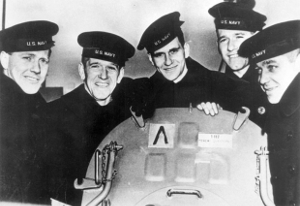
Sullivan Brothers Perish in the Sinking of the USS Juneau

sullivan-brothers

Five Sullivan brothers from Waterloo, Iowa, die when their ship, the light cruiser USS Juneau, is torpedoed and sunk by a Japanese submarine on November 13, 1942. Raised in an Irish Catholic family, the brothers’ great grandfather had emigrated from Ireland.

The five brothers, the sons of Thomas and Alleta Sullivan, are George Thomas Sullivan (27), Francis “Frank” Henry Sullivan (26), Joseph “Joe” Eugene Sullivan (24), Madison “Matt” Abel Sullivan (23), and Albert “Al” Leo Sullivan (20).

The Sullivans enlist in the U.S. Navy on January 3, 1942, with the stipulation that they serve together. The Navy has a policy of separating siblings, but it is not strictly enforced. George and Frank have served in the Navy before, but their brothers have not. All five are assigned to the light cruiser USS Juneau.

The Juneau participates in a number of naval engagements during the months-long Guadalcanal Campaign beginning in August 1942. Early on the morning of November 13, 1942, during the Naval Battle of Guadalcanal, the Juneau is struck by a Japanese torpedo and forced to withdraw. Later that day, as it is leaving the Solomon Islands area for the Allied rear-area base at Espiritu Santo with other surviving U.S. warships from battle, the Juneau is struck again, this time by a torpedo from Japanese submarine I-26. The torpedo apparently hits the thinly armored light cruiser at or near the ammunition magazines and the ship explodes and quickly sinks.

Captain Gilbert C. Hoover, commanding officer of the USS Helena and senior officer present in the battle-damaged U.S. task force, is skeptical that anyone has survived the sinking of the Juneau and believes it would be reckless to look for survivors, thereby exposing his wounded ships to a still-lurking Japanese submarine. Therefore, he orders his ships to continue on towards Espiritu Santo. Helena signals a nearby U.S. B-17 bomber on patrol to notify Allied headquarters to send aircraft or ships to search for survivors.

However, approximately 100 of Juneau‘s crew survive the torpedo attack and the sinking of their ship and are left in the water. The B-17 bomber crew, under orders not to break radio silence, does not pass the message about searching for survivors to their headquarters until they land several hours later. The crew’s report of the location of possible survivors is mixed in with other pending paperwork actions and goes unnoticed for several days. It was not until days later that headquarters staff realize that a search has never been mounted and belatedly orders aircraft to begin searching the area. In the meantime, Juneau‘s survivors, many of whom are seriously wounded, are exposed to the elements, hunger, thirst, and repeated shark attacks.

Eight days after the sinking, ten survivors are found by a PBY Catalina search aircraft and retrieved from the water. The survivors report that Frank, Joe, and Matt died instantly, Al drowned the next day, and George survived for four or five days before, suffering from delirium as a result of hypernatremia, he goes over the side of the raft he occupies and is never seen or heard from again.

Security requires that the Navy not reveal the loss of Juneau or the other ships so as not to provide information to the enemy. Letters from the Sullivan sons stop arriving at the home and the parents grow worried, which prompts Alleta Sullivan to write to the Bureau of Naval Personnel in January 1943, citing rumors that survivors of the task force claim that all five brothers were killed in action.

The letter is answered by President Franklin D. Roosevelt on January 13th, who acknowledges that the Sullivans are missing in action. By then, however, the parents have already been informed of their fate, having learned of their deaths on January 12, 1943. That morning, the boys’ father, Thomas, is preparing for work when three men in uniform approach his door. “I have some news for you about your boys,” one naval officer says. “Which one?” asks Thomas. “I’m sorry,” the officer replies. “All five.”

As a direct result of the Sullivans’ deaths, and the deaths of four of the Borgstrom brothers within a few months of each other two years later, the United States War Department adopts the Sole Survivor Policy.
Leave a comment

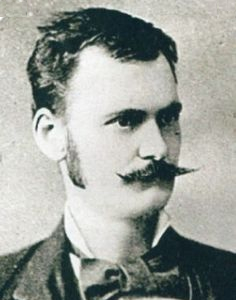
Death of Irish American Painter William Harnett

william-harnett

William Michael Harnett, Irish American painter known for his trompe-l’œil still lifes of ordinary objects, dies at New York Hospital on October 29, 1892.

Harnett is born in Clonakilty, County Cork, on August 10, 1848, during the time of the Great Famine. Shortly after his birth his family emigrates to America, settling in Philadelphia. Becoming a United States citizen in 1868, he makes a living as a young man by engraving designs on table silver, while also taking night classes at the Pennsylvania Academy of the Fine Arts and later, in New York City, at Cooper Union and at the National Academy of Design. His first known oil painting, a still life, dates from 1874.

The style of trompe-l’œil painting that Harnett develops is distinctive and inspired many imitators, but it is not without precedent. A number of 17th century Dutch painters, Pieter Claesz for instance, specialize in tabletop still life of astonishing verisimilitude. Raphaelle Peale, working in Philadelphia in the early 19th century, pioneers the form in America. What sets Harnett’s work apart, besides his enormous skill, is his interest in depicting objects not usually made the subject of a painting.

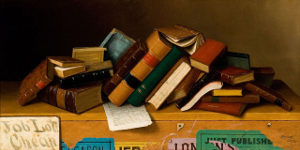
Harnett paints musical instruments, hanging game, and tankards, but also painted the unconventional Golden Horseshoe (1886), a single rusted horseshoe shown nailed to a board. He paints a casual jumble of second-hand books set on top of a crate, Job Lot, Cheap (1878), as well as firearms and even paper currency. His works sell well, but they are more likely to be found hanging in a tavern or a business office than in a museum, as they did not conform to contemporary notions of high art.

Harnett spent the years 1880–1886 in Europe, staying in Munich from 1881 until early 1885. Harnett’s best-known paintings, the four versions of After the Hunt, are painted between 1883 and 1885. Each is an imposing composition of hunting equipment and dead game, hanging on a door with ornate hinges at the right and keyhole plate at the left. These paintings, like the horseshoe or currency depictions mentioned earlier, are especially effective as trompe-l’œil because the objects occupy a shallow space, meaning that the illusion is not spoiled by parallax shift if the viewer moves.

job-lot-cheap

Overall, Harnett’s work is most comparable to that of the slightly younger John F. Peto. The two artists know each other, and a comparison can be made between two paintings featuring violins. Harnett’s Music and Good Luck from 1888 shows the violin hanging upright on a door with ornate hinges and with a slightly torn piece of sheet music behind it. The elements are arranged in a stable, deliberate manner. Peto’s 1890 painting shows the violin hanging askew, as well as chipped and worn, with one string broken. The sheet music is dog-eared and torn around the edges and placed haphazardly behind the instrument. The hinges are less ornate, and one is broken. Harnett’s objects show signs of use but are well preserved, while Peto’s more humble objects are nearly used up.

Crippling rheumatism plagues Harnett in his last years, reducing the number but not the quality of his paintings. He seeks relief in the waters at Karlsbad and Wiesbaden, Germany and later at Hot Springs, Arkansas. But he continues to worsen and is hospitalized several times. He dies in New York City in 1892.


Leave a comment

1947 All-Ireland Senior Football Championship Final

1947-all-ireland-final

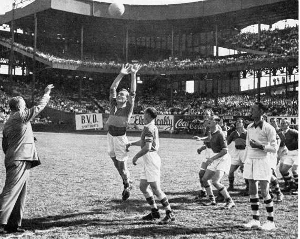
For the first and only time, the All-Ireland Senior Football Championship Final is played outside Ireland on September 14, 1947, at the Polo Grounds in Upper Manhattan, New York City, to cater for the large Irish American community there.

The New York final matching Cavan against Kerry is also intended to observe the centenary of the Great Famine that triggered mass Irish emigration to the United States and other countries. Around 30,000 people are in attendance for the final. Cavan travels to the U.S. by air and Kerry by sea. The Ulster team credits their victory partially to their shorter time spent travelling. The Cavan team flight, via the Azores, takes 30 hours. Kerry’s trip by Ocean Liner takes far longer.

Mick Higgins, a key member of the Cavan team that day, recalls later in life, “There was no huge send-off for us in Cavan, but both teams got a good reception in New York when we arrived. I remember the team stayed in the Commodore Hotel, but I stayed with my relatives.” He also remembers the “oppressive heat” during the game itself.

After a slow start, Cavan fights back to lead 2-5 to 2-4 at the break and goes on to win by four points. Peter Donohoe scores eight points from frees and is called “the Babe Ruth of Gaelic football” in the New York press. The match commentary was broadcast by radio across the Atlantic Ocean by Michael O’Hehir.

The Cavan team returns to Ireland aboard the RMS Queen Mary. Higgins recalls, “It was only after we arrived in Southampton that we realised the joy of it all. Large numbers of Cavan people turned up to see us in London and Birmingham. We were treated like kings in Cavan.”


Leave a comment

Ireland Reacts to Terrorist Attacks in U.S.

tricolour-at-ground-zero

President Mary McAleese goes on RTÉ Radio on September 11, 2001, to express her shock and horror at the terrorist attacks in the United States.

The President says that these atrocities are “crimes against the very foundations of our humanity.” She comments that “it is unbearable and almost unbelievable for the rest of the world to be witnessing such wanton destruction of human life in front of our eyes.”

President McAleese speaks by telephone with the United States Ambassador to Ireland, Richard Egan, and asks him to convey to President George W. Bush the heartfelt sympathies of the Irish people in this hour of great tragedy for the people of America, a nation which Ireland holds so dear.

The Irish government names more than a dozen of its natives among the dead in New York City, Washington, D.C., and Pennsylvania. Based on family names and individual stories, there are many hundreds of American dead with Irish heritage, including Americans who through parents or grandparents have become Irish citizens.

The website www.IrishTribute.com, set up in reaction to the September 11 attacks, estimates that perhaps one-sixth of the dead are in some way “Irish.” The website claims that “September 11, 2001 may well go down as the bloodiest day in the history of the Irish people. An estimated 1,000 people who were of Irish descent or of Irish birth were lost in the violent events on that day.”

A National Day of Mourning is held in Ireland on September 14 and a remembrance mass is held on September 12, 2001. Ireland is one of the few countries to hold a service day. Taoiseach Bertie Ahern and President McAleese are both in attendance.

Families in Limerick take in American tourists grounded at Shannon Airport after all flights into and out of the United States are cancelled.

The only flag, other than the U.S. flag, to fly at the Ground Zero site is the Irish tricolour, which is put in place by the Carpenters Union #608 and FDNY Command Post.

In the wake of the attacks, the Irish government immediately begins reviewing security arrangements.


Leave a comment

Death of General Philip Henry Sheridan

philip-sheridan

Irish American General Philip Henry Sheridan, career United States Army officer and a Union general in the American Civil War, dies of heart disease in Dartmouth, Massachusetts, on August 5, 1888.

Sheridan is born in Albany, New York, the third child of six by John and Mary Meenagh Sheridan, immigrants from the parish of Killinkere, County Cavan. Fully grown, he reaches only 5 feet 5 inches in height, a stature that leads to the nickname “Little Phil.” Abraham Lincoln describes his appearance in a famous anecdote, “A brown, chunky little chap, with a long body, short legs, not enough neck to hang him, and such long arms that if his ankles itch, he can scratch them without stooping.”

Sheridan’s career is noted for his rapid rise to major general and his close association with General-in-chief Ulysses S. Grant, who transfers Sheridan from command of an infantry division in the Western Theater to lead the Cavalry Corps of the Army of the Potomac in the East. In 1864, he defeats Confederate forces in the Shenandoah Valley and his destruction of the economic infrastructure of the Valley, called “The Burning” by residents, is one of the first uses of scorched earth tactics in the war. In 1865, his cavalry pursues General Robert E. Lee and is instrumental in forcing his surrender at Appomattox Court House.

In later years, Sheridan fights in the Indian Wars of the Great Plains. Comanche Chief Tosahwi reputedly tells Sheridan in 1869, “Me, Tosahwi; me good Injun,” to which Sheridan supposedly replies, “The only good Indians I ever saw were dead.” Sheridan denies he had ever made the statement. Biographer Roy Morris Jr. states that, nevertheless, popular history credits Sheridan with saying “The only good Indian is a dead Indian.” This variation “has been used by friends and enemies ever since to characterize and castigate his Indian-fighting career.” In Bury My Heart at Wounded Knee, Dee Brown attributes the quote to Sheridan but does not provide documentation to support his contention, so the quote may be more apocryphal than real.

Both as a soldier and private citizen, Sheridan is instrumental in the development and protection of Yellowstone National Park. The protection of the Yellowstone area is Sheridan’s personal crusade. He authorizes Lieutenant Gustavus Doane to escort the Washburn Expedition in 1870 and for Captain John W. Barlow to escort the Hayden Expedition in 1871. Barlow names Mount Sheridan, a peak overlooking Heart Lake in Yellowstone, for the general in 1871. As early as 1875, Sheridan promotes military control of the area to prevent the destruction of natural formations and wildlife.

In 1883, Sheridan is appointed general-in-chief of the U.S. Army, and in 1888 he is promoted to the rank of General of the Army during the term of President Grover Cleveland. Sheridan serves as the ninth president of the National Rifle Association.

Sheridan suffers a series of massive heart attacks two months after sending his memoirs to the publisher. After his first heart attack, the U.S. Congress quickly passes legislation to promote him to general and he receives the news from a congressional delegation with joy, despite his pain. His family moves him from the heat of Washington, D.C. and he dies of heart failure in his summer cottage in the Nonquitt section of Dartmouth, Massachusetts.

His body is returned to Washington, and he is buried on a hillside facing the capital city near Arlington House in Arlington National Cemetery. The burial helps elevate Arlington to national prominence.


Leave a comment

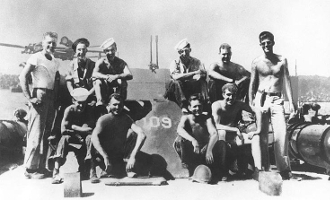
The Sinking of John F. Kennedy’s PT-109

pt-109-crew

In the early morning hours of August 2, 1943, three small American torpedo boats are moving just west of New Georgia in the Solomon Islands. In command of PT-109 is a young Irish American destined to one day be the first Catholic president of the United States, Lieutenant John Fitzgerald Kennedy.

On a moonless night, Kennedy’s boat is idling on one engine to avoid detection of her wake by Japanese aircraft when the crew realizes they are in the path of the Japanese destroyer Amagiri, which is returning to Rabaul from Vila, Kolombangara, after offloading supplies and 900 soldiers. Amagiri is traveling at a relatively high speed of between 23 and 40 knots in order to reach harbor by dawn, when Allied air patrols are likely to appear.

The crew of PT-109 has less than ten seconds to get the engines up to speed. The commander of the Amagiri, Kohai Hanami, spots the tiny ship but it is too close to fire upon. Instead, Hanami decides to ram it. PT-109 is cut in half and bursts into flames. Seamen Andrew Jackson Kirksey and Harold W. Marney are killed, and two other members of the crew are badly injured. PT-109 is gravely damaged, with watertight compartments keeping only the forward hull afloat in a sea of flames.

PT-169 launches two torpedoes that miss the destroyer and PT-162‘s torpedoes fail to fire at all. Both boats then turn away from the scene of the action and return to base without checking for survivors.

The eleven survivors cling to PT-109’s bow section as it drifts slowly south. By about 2:00 PM, it is apparent that the hull is taking on water and will soon sink, so the men decide to abandon it and swim for land. Since there are Japanese camps on all the nearby large islands, they choose the tiny deserted Plum Pudding Island, southwest of Kolombangara. They place their lantern, shoes, and non-swimmers on one of the timbers used as a gun mount and begin kicking together to propel it. Kennedy, who had been on the Harvard University swim team, uses a life jacket strap clenched between his teeth to tow his badly burned senior enlisted machinist mate, MM1 Patrick McMahon. It takes four hours to cover the 3.5 miles to their destination, which they reach without confrontation by sharks or crocodiles.

The island is only 100 yards in diameter and has no food or water. The crew has to hide from passing Japanese barges. Kennedy swims to Naru and Olasana islands, a round trip of about 2.5 miles, in search of help and food. He then leads his men to Olasana Island, which has coconut trees and drinkable water.

The explosion of PT-109 is spotted by an Australian coastwatcher, Sub-lieutenant Arthur Reginald Evans, who mans a secret observation post at the top of the Mount Veve volcano on Kolombangara, where more than 10,000 Japanese troops are garrisoned below on the southeast portion. Evans dispatches islanders Biuku Gasa and Eroni Kumana in a dugout canoe to look for possible survivors after decoding news that the explosion he had witnessed was likely from the lost PT-109.

Kennedy and his men survive for six days on coconuts before they are found by the scouts. The small canoe is not big enough for passengers. Kennedy quickly carves a note on a coconut for Gasa and Kumana to deliver to Evans. Evans gets word back to the U.S. Navy and, on the night of August 8, all eleven survivors of PT-109 are rescued by PT-157.

John F. Kennedy keeps that carved coconut on his desk in the Oval Office at the White House until the day he is assassinated.


Leave a comment

Death of Frank McCourt, Author of “Angela’s Ashes”

frank-mccourt

Francis “Frank” McCourt, Irish American teacher and writer, dies of cancer in Manhattan, New York City, on July 19, 2009.

A New York city schoolteacher for more than thirty years, McCourt achieves literary fame later in life with his best-selling childhood memoir of the misery and squalor of his childhood, Angela’s Ashes. With a first printing of just 25,000 copies, the book becomes an instant favourite with critics and readers and is perhaps the ultimate case of the non-celebrity memoir, the extraordinary life of an ordinary man.

McCourt wins the annual Pulitzer Prize for Biography or Autobiography in 1997 and one of the annual National Book Critics Circle Awards for the book, which is eventually published in 25 languages and 30 countries. It is a bestseller and makes him a millionaire. Three years later, a movie version of Angela’s Ashes opens to mixed reviews with Northern Irish actor Michael Legge playing McCourt as a teenager.

McCourt is also the author of ‘Tis (1999), which continues the narrative of his life, picking up from the end of Angela’s Ashes and focusing on his life after returning to New York. He subsequently writes Teacher Man (2005) which details his teaching experiences and the challenges of being a teacher.

McCourt writes the book for a 1997 musical entitled The Irish…and How They Got That Way, which features an eclectic mix of Irish music – everything from the traditional Danny Boy to U2‘s I Still Haven’t Found What I’m Looking For.

It is announced in May 2009 that McCourt has been treated for melanoma and that he is in remission, undergoing home chemotherapy. On July 19, 2009, he died from the cancer, with meningeal complications, at a hospice in Manhattan.


Leave a comment

Birth of Irish Dancer & Choreographer Michael Ryan Flatley

michael-flatley

Michael Ryan Flatley, Irish American dancer, choreographer, and musician, is born to Irish parents in Chicago, Illinois on July 16, 1958. He becomes internationally known for Irish dance shows Riverdance, Lord of the Dance, Feet of Flames, and Celtic Tiger.

Flatley begins dancing lessons at age 11 and, at age 17, is the first American to secure a World Irish Dance title at the World Irish Dance Championships, the Oireachtas Rince na Cruinne. He is also an accomplished flautist, having won twice in the All-Ireland Fleadh Cheoil Concert Flute competitions from 1975-1976.

Flatley is taught dance by Dennis Dennehy at the Dennehy School of Irish Dance in Chicago. After graduating from Brother Rice High School, on Chicago’s Southwest Side, he opens a dance school but later closes it to focus on performing.

In 1978 and 1979 Flatley tours with Green Fields of America and then with The Chieftains in the 1980s. In May 1989, Flatley sets a Guinness Book world record for tapping speed at 28 taps per second, and subsequently breaks his own record in 1998 with 35 taps per second.

Flatley creates and choreographs the original Riverdance and leads the show to great success as the intermission act in the Eurovision Song Contest staged in Ireland on April 30, 1994. Flatley abruptly leaves the show over creative control disputes in October 1995.

Shortly after the Riverdance split, Flatley creates Lord of the Dance, which plays mostly in arenas and stadiums instead of stage theaters. He also puts together a dance production called Feet of Flames in 1998. Flately’s Irish dance show Celtic Tiger opens in July 2005. The show explores the history of the Irish people and Irish emigration to the United States, fusing a wide range of dance styles, including jazz.

Flatley returns to the stage in 2009 for a limited run of the “Hyde Park” version of Feet of Flames in Taiwan. His return is met with multiple standing ovations and the run of shows has to be extended to meet the demand for tickets.

Flatley premiers Lord of the Dance: Dangerous Games at the celebrated Palladium Theatre on London’s West End in 2014 and moves to the Dominion Theatre in 2015 where he makes his final appearance on the West End stage before revisiting another sold out Wembley Arena for his final performance in the United Kingdom.

Flatley embarks on his final tour on February 19, 2016 and performs on stage for the last time at The Colosseum at Caesar’s Palace in Las Vegas, NV, on March 17, 2016. He continues as the show’s creator, producer, and choreographer.


Leave a comment

The Last Official Bare-Knuckle Title Fight

sullivan-kilrain-fight

Heavyweight boxer John L. Sullivan defeats fellow Irish American Jake Kilrain in a world championship bout which lasts 75 rounds on July 8, 1889, the last official bare-knuckle title fight ever held.

Bare-knuckle boxing is the original form of boxing, closely related to ancient combat sports. It involves two individuals fighting without boxing gloves or other padding on their hands. The difference between a street fight and a bare-knuckle boxing match is an accepted set of rules, such as not striking a downed opponent.

The Sullivan-Kilrain fight is considered to be a turning point in boxing history because it is the last world title bout fought under the London Prize Ring Rules, and therefore the last bare-knuckle heavyweight title bout. It is one of the first sporting events in the United States to receive national press coverage.

For the first time, newspapers carry extensive pre-fight coverage, reporting on the fighters’ training and speculating on where the bout will take place. The traditional center of bare-knuckle fighting is New Orleans, but the governor of Louisiana has forbidden the fight in that state. Sullivan has trained for months in Belfast, New York under trainer William Muldoon, whose biggest problem has been keeping Sullivan from liquor. A report on Sullivan’s training regimen in Belfast is written by famed reporter Nellie Bly and published in the New York World.

Rochester reporter Arch Merrill comments that occasionally Sullivan would “escape” from his guard. In Belfast village, the cry is heard, “John L. is loose again. Send for Muldoon!” Muldoon would snatch the champ away from the bar and take him back to their training camp.

On July 8, 1889, an estimated 3,000 spectators board special trains for the secret location, which turns out to be Richburg, a town just south of Hattiesburg, Mississippi. The fight begins at 10:30, and it looks as if Sullivan is going to lose, especially after he vomits during the 44th round. But the champion gets his second wind after that, and Kilrain’s manager, Mike Donovan, finally throws in the towel after the 75th round. Kilrain does not want to give up thinking he can outlast Sullivan, but Donovan defends his actions insisting that Kilrain would die if the fight continued. In any case, the Kilrain-Sullivan fight can rightly be listed among the greatest fights of the pre-modern era.


Leave a comment

State Visit of U.S. President John F. Kennedy

jfk-state-visit

John F. Kennedy, an Irish American and the first Catholic to become president of the United States, arrives in Ireland on a state visit on June 26, 1963. After Air Force One touches down at Dublin airport, Kennedy’s motorcade weaves through the streets of Dublin city, the thrilled crowd, lacking ticker tape, improvises by throwing rolls of bus tickets.

Kennedy is proud of his Irish roots and makes a special visit to his ancestral home in Dunganstown, County Wexford, while in the country. There, he is greeted by a crowd waving both American and Irish flags and is serenaded by a boys’ choir that sings The Boys of Wexford. Kennedy breaks away from his bodyguards and joins the choir for the second chorus, prompting misty-eyed reactions from both observers and the press.

Kennedy meets with 15 members of his extended Irish family at the Kennedy homestead in Dunganstown. There he enjoys a cup of tea and some cake and makes a toast to “all those Kennedys who went and all those Kennedys who stayed.” His great-grandfather, Thomas Fitzgerald, had left Ireland for the United States in the middle of the Great Famine of 1848 and settled in Boston, becoming a cooper. Generations of his descendants go on to make their mark on American politics.

At the time of JFK’s visit to Ireland, the predominantly Catholic Irish Republic has been an independent nation for 41 years. The northern counties of the island, however, remain part of the largely Protestant British Empire and still suffer from long-standing sectarian violence. On the day after his arrival in Dublin, Kennedy speaks before the Irish parliament, where he openly condemns Britain’s history of persecuting Irish Catholics. Two days later, he travels to England, America’s oldest ally, to meet with British Prime Minister Harold Macmillan and his cabinet to discuss setting up a pro-democratic regime in British Guiana.

Kennedy later tells his aides that his favourite part of the trip was the wreath laying and silent funeral drill done by the Irish Army cadets at Arbour Hill military cemetery in Dublin.

Five months later, his widow, Jacqueline Kennedy, makes a special request to the Irish government. She asks that those same Irish army cadets, who so impressed the President on his visit, perform the drill again at his state funeral. Within days, those awe-stuck, trembling young men stand just inches away from foreign dignitaries from over 90 countries and perform their silent funeral drill in memory of a president that had inspired their country just a few short months earlier.