seamus dubhghaill

Promoting Irish Culture and History from Little Rock, Arkansas, USA


Leave a comment

Bridget Cleary Burned to Death by Husband

bridget-cleary

Bridget Cleary is burned to death on March 15, 1895, by her husband who believes her spirit has been taken by bad faeries and replaced with a changeling.

Cleary is born Bridget Boland around 1869 in Ballyvadlea, County Tipperary. Bridget meets Michael Cleary in Clonmel in August 1887, where he works as a cooper and she serves as a dressmaker’s apprentice, and they marry a short time later.

After the marriage, she returns to her townland of Ballyvadlea to live with her parents while Michael continues to work as a cooper in Clonmel. During this period of living apart, Bridget’s independence grows and she begins keeping her own flock of chickens and selling the eggs to neighbours. She is also a professional woman which is somewhat unusual for the era and area. She obtains a Singer sewing machine, which is state-of-the-art at the time, and is variously described as a dressmaker and a milliner.

Despite their eight years of marriage, the couple has no children by the time of Bridget’s death. Following the death of Bridget’s mother, the Clearys find themselves responsible for Bridget’s elderly father, Patrick Boland. His residence with the couple enables them to secure a house reserved for labourers. Neither Bridget nor Michael is entitled to this cottage, but as Patrick had been a labourer in his youth, they are able to acquire the best house in the village. However, there is no widespread interest in the house as it is built on the site of a supposed fairy ringfort.

In early March 1895, Bridget becomes ill although her specific diagnosis is unknown. On March 13, more than a week into her illness, a physician visits her home. Her condition is considered sufficiently grave that a priest soon follows to administer last rites. Several friends and family members attend her over the next two days and a number of home remedies are administered including one ritual that anticipates her later demise. Her father and her husband accuse her of being a fairy sent to take Bridget’s place. Urine is thrown on her and she is carried before the fireplace to cast the fairy out. By March 16, rumours begin to circulate that Bridget is missing and the local police begin searching for her. Michael is quoted as claiming that his wife has been taken by fairies. Witness statements are gathered over the ensuing week and, by the time Bridget’s burned corpse is found in a shallow grave on March 22, nine people have been charged in her disappearance, including her husband. A coroner‘s inquest the next day returns a verdict of death by burning.

Legal hearings take place from April 1 to April 6, 1895. The court session begins on July 3. Evidence indicates that Michael attempted to force-feed his wife, throwing her down on the ground before the kitchen fireplace. Bridget’s chemise catches fire and Michael then throws lamp oil on Bridget. Witnesses are unclear as to whether she is already dead by this point. Michael keeps the others away from her body as it burns, insisting that she is a changeling and has been for a week. Michael believes that this will allow him to get his wife back from the fairies.

Michael Cleary is found guilty of manslaughter and spends 15 years in prison.


Leave a comment

Gerry Adams Assassination Attempt

adams-assassination-attempt

Sinn Féin president Gerry Adams is seriously wounded in an assassination attempt in central Belfast on March 14, 1984. As the car containing Adams and four other leading Sinn Féin members leaves Belfast Magistrate’s Court, a vehicle pulls alongside and three Ulster Defence Association (UDA) gunmen fire approximately 20 shots into the car. Adams is shot in the neck and shoulder, Seán Keenan in the face, Joe Keenan in the body and hands, and Kevin Rooney in the body. Bob Murray is the only person in the car to escape without injury.

The republicans are in Belfast facing charges of obstruction after the Royal Ulster Constabulary (RUC) attempt to remove an Irish tricolour from a Sinn Féin election cavalcade. After the shooting, Adams is rushed to the Royal Victoria Hospital, where he undergoes surgery to remove the three bullets.

The three loyalist death squad members who carry out the assassination attempt are arrested shortly after the attack by off-duty RUC and British soldiers who open fire on them before ramming their car. One of the UDA gunmen accidentally shoots himself in the foot during the escape attempt.

Following his release from the hospital later in the month, Gerry Adams says it is “quite obvious that British Intelligence were aware” of the operation and that “they wanted myself and my comrades out of the way.” Democratic Unionist Party (DUP) Stormont Assembly member George Seawright expresses regret that Adams has not been killed. The Ulster Unionist Party (UUP) and the British Government remain tight-lipped while Will Glendinning of the Alliance Party of Northern Ireland uses the attack to remind voters he was “totally opposed to the politics of Gerry Adams.”

A Sinn Féin statement released just hours after the attack says, “If the shooting was an attempt to drive us off the streets or underground, it has already failed.” The party says that such attacks are a constant danger, and that it is a testament to Sinn Féin that they continue their work despite such threats.


6 Comments

The Ballinglass Incident

ballinglass-evictionsDuring the Great Famine (An Gorta Mór) in Ireland, the Ballinglass incident occurs in Ballinglass, County Galway, on March 13, 1846, when 300 tenants are evicted by their landlord, a Mrs. Gerrard who wants to use the land for grazing purposes.

During this period, Ireland is part of the United Kingdom of Great Britain and Ireland, governed directly by its parliament in London. Many working class Irish farmers are tenants under landlords, producing cereals, potatoes, and livestock. But only the potatoes remain as food for the farmers themselves. A portion of the other products are used for paying the rent while the remainder is exported from Ireland to Great Britain. These exports continue even after the potato crop fails in 1845.

Farmers who are not able to pay the rent during this period are evicted from their homes and land. It is estimated that tens of thousands are evicted during the famine.

The 300 inhabitants of the townland of Ballinglass in Galway County, in the Barony of Killian, northeast of Mountbellew, are relatively “wealthy” and able to pay their rent. But despite this fact, they are evicted because their landlord intends to establish a grazing farm where the village is situated.

The houses of Ballinglass are demolished by army and police. The evicted tenants sleep in the ruins that night. The next day, police and army return to evict them permanently and their neighbours are not allowed to take them in.

The eviction of the entire village receives wide publicity. Even the London Times, never a supporter of Irish rights, rails against this particular injustice. Lord Londonderry “personally investigates” the evictions and issues a statement on March 30, 1846 saying, “I am deeply grieved, but there is no doubt concerning the truth of the evictions at Ballinglass. Seventy-six families, comprising 300 individuals had not only been turned out of their houses, but had even – the unfortunate wretches – been mercilessly driven from the ditches to which they had been taken themselves for shelter…these unfortunate people had their rents actually ready…” Despite widespread condemnation, the eviction order is not rescinded.


Leave a comment

The Beginning of the Williamite War

battle-of-the-boyne

The Williamite War in Ireland begins on March 12, 1688. It is a conflict between Jacobites, who support the English Catholic King James II, and Williamites, who support the Dutch Protestant Prince William of Orange, over who would be King of England, Scotland, and Ireland.

The cause of the war is the deposition of James II as King of the Three Kingdoms in the “Glorious Revolution” of 1688. James is supported by the mostly Catholic Jacobites in Ireland and hopes to use the country as a base to regain his Three Kingdoms. He is given military support by France. For this reason, the war becomes part of a wider European conflict known as the Nine Years’ War, or War of the Grand Alliance. Some Protestants of the established Church in Ireland also fight on the side of King James.

James is opposed in Ireland by the mostly Protestant Williamites, who are concentrated in the north of the country. William lands a multi-national force in Ireland, composed of English, Scottish, Dutch, Danish, and other troops, to put down Jacobite resistance. James leaves Ireland after a reverse at the Battle of the Boyne in 1690 and the Irish Jacobites are finally defeated after the Battle of Aughrim in 1691.

The Treaty of Limerick, signed on October 3, 1691, offers favourable terms to Jacobites willing to stay in Ireland and give an oath of loyalty to William III. Peace is concluded on these terms between Patrick Sarsfield and Godert de Ginkell, giving toleration to Catholicism and full legal rights to Catholics that swear an oath of loyalty to William and Mary. Part of the treaty agreed to Sarsfield’s demand that the Jacobite army be allowed to leave Ireland as a body and go to France. This event is popularly known in Ireland as the “Flight of the Wild Geese.” Around 14,000 men with around 10,000 women and children leave Ireland with Patrick Sarsfield in 1691.

The Williamite victory in the war in Ireland has two main long-term results. The first is that it ensures James II will not regain his thrones in England, Ireland, and Scotland by military means. The second is that it ensures closer British and Protestant dominance over Ireland. Until the 19th century, Ireland is ruled by what becomes known as the “Protestant Ascendancy,” the mostly Protestant ruling class. The majority of the Irish Catholic community and the Ulster-Scots Presbyterian community are systematically excluded from power, which is based on land ownership.

For over a century after the war, Irish Catholics maintain a sentimental attachment to the Jacobite cause, portraying James and the Stuarts as the rightful monarchs who would have given a just settlement to Ireland, including self-government, restoration of confiscated lands and tolerance for Catholicism. Thousands of Irish soldiers leave the country to serve the Stuart monarchs in the Irish Brigade (Spanish) and Irish Brigade of the French Army. Until 1766, France and the Papacy remain committed to restoring the Stuarts to their British Kingdoms. At least one composite Irish battalion drawn from Irish soldiers in the French service fight on the Jacobite side in the Scottish Jacobite uprisings leading up to the Battle of Culloden in 1746.

Protestants, on the other hand, portray the Williamite victory as a triumph for religious and civil liberty where triumphant murals of King William still controversially adorn the gable walls in Ulster. The defeat of the Catholics in the Williamite war is still commemorated by Protestant Unionists in Ulster on the Twelfth of July by the Orange Order.


Leave a comment

Birth of Thomas James Clarke, Irish Revolutionary Leader

thomas-james-clarke

Thomas James “Tom” Clarke, Irish republican revolutionary leader and arguably the person most responsible for the 1916 Easter Rising, is born to Irish parents on March 11, 1858, at Hurst Castle, Milford-on-Sea, Hampshire, England opposite the Isle of Wight. Clarke’s father, a sergeant in the British Army, is transferred to Dungannon, County Tyrone, in 1865 and it is there that Tom grows up.

In 1878, following the visit to Dungannon of John Daly, Clarke joins the Irish Republican Brotherhood (IRB) and soon becomes head of the local IRB circle. In August, in retaliation to the killing of a man by a member of the Royal Irish Constabulary (RIC), Clarke and other IRB members attack some RIC men in Irish Street but are driven back. Fearing arrest, Clarke flees to the United States.

In 1883, Clarke is sent to London to blow up London Bridge as part of the Fenian dynamite campaign advocated by Jeremiah O’Donovan Rossa. He is arrested along with three others and tried and sentenced to penal servitude for life on May 28, 1883, at London’s Old Bailey. He subsequently serves 15 years in Pentonville and other British prisons. In 1896, a series of public meetings in Ireland call for the release of Clarke and the other four remaining Fenian prisoners.

Following his release in 1898, Clarke moves to Brooklyn, New York where he marries Kathleen Daly, 21 years his junior and niece of John Daly. Clarke works for the Clan na Gael under John Devoy. In 1906, the couple moves to a 30-acre farm in Manorville, New York and purchases another 30 acres in 1907 shortly before returning to Ireland.

In Ireland, Clarke opens a tobacconist shop in Dublin and immerses himself in the IRB which is undergoing a substantial rejuvenation under the guidance of younger men such as Bulmer Hobson and Denis McCullough.

Clarke takes a keen interest when the Irish Volunteers are formed in 1913 but takes no part in the organisation feeling that his criminal record would lend discredit to the Volunteers. With several IRB members taking important roles in the Volunteers, it becomes clear that the IRB will have substantial to total control of the Volunteers. This proves largely to be the case until John Redmond, leader of the Irish Parliamentary Party, demands the Provisional Committee accept 25 additional members of the Party’s choosing, giving IPP loyalists a majority stake. Though most of the hard-liners stand against this, Redmond’s decree is accepted, partially due to the support given by Bulmer Hobson. Clarke never forgives him for what he considers a treasonous act.

Following Clarke’s falling out with Hobson, Sean MacDermott and Clarke become almost inseparable. In 1915, Clarke and MacDermott establish the Military Committee of the IRB to plan what later becomes the Easter Rising. The members are Patrick PearseÉamonn Ceannt, and Joseph Plunkett, with Clarke and MacDermott adding themselves shortly thereafter. When Jeremiah O’Donovan Rossa dies in 1915, Clarke uses his funeral to mobilise the Volunteers and heighten expectation of imminent action. When an agreement was reached with James Connolly and the Irish Citizen Army in January 1916, Connolly is added to the committee. Thomas MacDonagh is added at the last minute in April. These seven men are the signatories of the Proclamation of the Irish Republic, with Clarke as the first signatory.

Clarke is stationed at headquarters in the General Post Office during the events of Easter Week of 1916, where rebel forces are largely composed of Irish Citizen Army members under the command of Connolly. Though he holds no formal military rank, Clarke is recognised by the garrison as one of the commanders and is active throughout the week in the direction of the fight. Following their surrender on April 29, Clarke is held in Kilmainham Gaol until his execution by firing squad on May 3 at the age of 59. He is the second person to be executed following Patrick Pearse.

Before his execution, Clarke asks his wife to give this message to the Irish People:

“I and my fellow signatories believe we have struck the first successful blow for Irish freedom. The next blow, which we have no doubt Ireland will strike, will win through. In this belief, we die happy.”


Leave a comment

Birth of Sir Samuel Ferguson, Irish Poet & Barrister

sir-samuel-ferguson

Sir Samuel Ferguson, Irish poet, barrister, antiquarian, artist, and public servant, is born at 23 High Street in Belfast on March 10, 1810. Ferguson is perhaps the most important Irish poet of the 19th century. Due to his interest in Irish mythology and early Irish history he is seen as a forerunner of William Butler Yeats and the other poets of the Irish Literary Revival.

Ferguson lives at a number of addresses, including Glenwhirry, where he acquires the love of nature that informs his later work. He is educated at the Belfast Academy and the Belfast Academical Institution and then moves to Dublin to study law at Trinity College, obtaining his bachelor’s degree in 1826 and his master’s degree in 1832.

Because his father has exhausted the family property, Ferguson is forced to support himself through his student years. He turns to writing and is a regular contributor to Blackwood’s Magazine by the age of 22. He is called to the bar in 1838, but continues to write and publish, both in Blackwood’s and in the newly established Dublin University Magazine.

Ferguson settles in Dublin, where he practises law. In 1848, he marries Mary Guinness, a great-great-niece of Arthur Guinness and the eldest daughter of Robert Rundell Guinness, founder of Guinness Mahon bank. At the time he is defending the Young Irelander poet Richard Dalton Williams.

In addition to his poetry, Ferguson contributes a number of articles on topics of Irish interest to antiquarian journals. In 1863, he travels in Brittany, Ireland, Wales, England, and Scotland to study megaliths and other archaeological sites. These studies are important to his major antiquarian work, Ogham Inscriptions in Ireland, Wales and Scotland, which is edited after his death by his widow and published in 1887.

His collected poems, Lays of the Western Gael is published in 1865, resulting in the award of a degree LL.D. honoris causa from Trinity College. He writes many of his poems in both Irish and English translations. In 1867, Ferguson retires from the bar to take up the newly created post of Deputy Keeper of the Public Records in Ireland. As reward for his services, he receives a knighthood in 1878.

Ferguson’s major work, the long poem Congal is published in 1872 and a third volume, Poems, in 1880. In 1882, he is elected President of the Royal Irish Academy, an organisation dedicated to the advancement of science, literature, and antiquarian studies. His house in North Great George’s St., Dublin, is open to everyone interested in art, literature or music.

Ferguson dies on August 9, 1886, in Howth, just outside Dublin city, and is buried in Donegore near Templepatrick, County Antrim.


Leave a comment

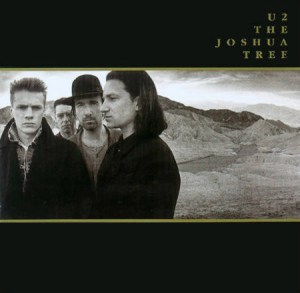
U2 Album “The Joshua Tree” is Released

the-joshua-treeThe Joshua Tree, the fifth studio album by Irish rock band U2, is released on March 9, 1987. The album is produced by Daniel Lanois and Brian Eno on Island Records. Formed in 1976, the band consists of Bono (vocals and rhythm guitar), The Edge (lead guitar, keyboards, and vocals), Adam Clayton (bass guitar), and Larry Mullen, Jr. (drums and percussion).

In contrast to the ambient experimentation of their 1984 release The Unforgettable Fire, the band aims for a harder-hitting sound within the limitation of conventional song structures on The Joshua Tree. The album is influenced by American and Irish roots music, and depicts the band’s love–hate relationship with the United States, using socially and politically conscious lyrics embellished with spiritual imagery.

Inspired by American tour experiences, literature, and politics, U2 chooses America as a theme for the album. Recording begins in Ireland in January 1986. Several events during the recording sessions help shape the conscious tone of the album, including the band’s participation in A Conspiracy of Hope tour, the death of roadie Greg Carroll, and lead vocalist Bono’s travels to Central America. Recording is completed in November 1986 and additional production continues into January 1987. Throughout the sessions, U2 seeks a “cinematic” quality for the record, one that will evoke a sense of location, in particular, the open spaces of America. They represent this in the sleeve photography depicting them in American desert landscapes.

The Joshua Tree receives critical acclaim, topping the charts in over 20 countries, and selling in record-breaking numbers. According to Rolling Stone, the album increases the band’s stature “from heroes to superstars.” It produces the hit singles With or Without You, I Still Haven’t Found What I’m Looking For, and Where the Streets Have No Name. The album wins Grammy Awards for Album of the Year and Best Rock Performance by a Duo or Group with Vocal in 1988. The group supports the record with the Joshua Tree Tour throughout 1987.

Frequently featured on critics’ lists of music’s greatest records, The Joshua Tree is one of the world’s best-selling albums, with over 25 million copies sold. U2 releases a remastered edition of the record in 2007 to commemorate its 20th anniversary. In 2014, it is deemed “culturally, historically, or aesthetically significant” by the U.S. Library of Congress and selected for preservation in the National Recording Registry.


Leave a comment

Birth of Paddy Devlin, Founder of the SDLP

paddy-devlin

Paddy Devlin, Irish social democrat and Labour activist, former Stormont Member of Parliament (MP), founder of the Social Democratic and Labour Party (SDLP), and member of the 1974 Power Sharing Executive, is born in West Belfast on March 8, 1925.

Devlin lives almost all his life in Belfast and grows up in a highly political household. His early activism is confined to Fianna Éireann and later the Irish Republican Army (IRA). As a result, he is interned in Crumlin Road Gaol during World War II. He leaves the republican movement upon his release.

After the war he spends some time in Portsmouth and Coventry, where he becomes interested in Labour and trade union politics and briefly joins the British Labour Party. Devlin returns to Belfast in 1948 and helps establish the Irish Labour Party after the split of the Northern Ireland Labour Party (NILP). He later defeats Gerry Fitt to win a seat on the city council. Later Catholic Action claims the Irish Labour Party is infested with communists which effectively wipes out the party and Devlin loses his seat.

In the mid 1960s, Devlin joins the revived NILP and beats Harry Diamond for the Falls seat in Stormont. Devlin then joins Fitt, John Hume, Austin Currie, and others to found the SDLP in 1970. At the request of Secretary of State for Northern Ireland William Whitelaw in 1973, he becomes involved in ensuring safe passage for Gerry Adams to talks with the British government.

Devlin is a member of the Northern Ireland Assembly in 1973 and Minister of Health and Social Services in the power-sharing Executive from January 1, 1974, to May 28, 1974.

In 1978, Devlin establishes the United Labour Party, which aims to be a broad-based Labour formation in Northern Ireland. He stands under its label for the European Parliament in 1979 but polls just 6,122 first preferences and thereby loses his deposit.

In 1987, Devlin and remnants of the NILP and others, establish Labour ’87 as another attempt at building a Labour Party in Northern Ireland by uniting the disparate groups supporting labour and socialist policies but it is met with little or no success. In 1985 he loses his seat on the Belfast City council.

Devlin suffers from severe diabetes and throughout the 1990s suffers a series of ailments as his health and sight collapse. Devlin dies at the age of 74 on August 15, 1999.


Leave a comment

First Public Unveiling of the Irish Tricolour

irish-flag

At a meeting in his native Waterford on March 7, 1848, the Young Ireland leader Thomas Francis Meagher first publicly unveils the flag from a second-floor window of the Wolfe Tone Club.

Following the Irish Rebellion of 1798, which pits the “green” United Irishmen against the Orange Order who are traditionally loyal to the British Crown, the ideal of making peace between both traditions in a self-governed Ireland is first mooted.

The oldest known reference to the use of green, white, and orange as a nationalist emblem date from September 1830 when the colours are used for rosettes and badges. Since that historical period the use of the tricolour becomes the preferred mark of a republic in national flags. However, widespread recognition is not accorded to the flag until 1848.

Presented to Meagher as a gift in 1848 by a small group of French women symathetic to the Irish cause, the flag flies proudly as Meagher addresses the Waterford crowd gathered on the street below who are celebrating news of the French Revolution. Speeches made at that time by Meagher suggest that it is regarded as an innovation and not as the revival of an older flag.

From March 1848 Irish tricolours appear side-by-side with French “tricolores” at meetings held all over the country. John Mitchel, referring to the provisional Irish banner which Meagher had presented at a meeting in Dublin on April 15, 1848, says, “I hope to see that flag one day waving as our national banner.”

Although the tricolour is not forgotten as a symbol of a free Ireland, it is rarely used between 1848 and 1916. Even up to the eve of the 1916 Easter Rising, the green flag featuring a harp holds undisputed sway. Neither the colours nor the arrangement of the early tricolours are standardised. All of the 1848 tricolours show green, white, and orange, but orange is sometimes put next to the staff, and, in at least one flag, the order is orange, green and white.

In 1850, a flag of green for the Roman Catholics, orange for the Protestants of the Established Church, and blue for the Presbyterians is proposed.

In 1883, a Parnellite tricolour of yellow, white, and green, arranged horizontally, is proposed. Down to modern times, yellow has occasionally been used instead of orange but such substitution tarnish’s the tricolour’s fundamental symbolism.

The flag is adopted by the rebels in the 1916 Easter Rising rebels and raised above the General Post Office in Dublin. This marks the first time that the tricolour is regarded as the national flag. It is subsequently adopted by the Irish Republic during the Irish War of Independence (1919–1921). Its use is continued by the Irish Free State (1922–1937) and is later given constitutional status under the 1937 Constitution of Ireland. The tricolour is used by nationalists on both sides of the border as the national flag of the whole island of Ireland since 1916.


Leave a comment

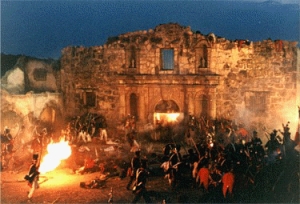
The Battle of the Alamo Ends

battle-of-the-alamoThe Battle of the Alamo, a pivotal event in the Texas Revolution, ends on March 6, 1836, near San Antonio de Béxar. Of the 189 men that die in the battle, twelve of the defenders are actually Irish-born, while twenty others including  Davy Crockett, William B. Travis, and Jim Bowie, are of Irish descent.

Several months before the battle, Texians drive all of the Mexican troops out of Mexican Texas. About 100 Texians, including a number of Irish, are garrisoned at the Alamo. The Texian force grows slightly with the arrival of reinforcements led by eventual Alamo co-commanders Jim Bowie and William B. Travis. On February 23, approximately 1,500 Mexicans under the leadership of President General Antonio López de Santa Anna march into San Antonio de Béxar as the first step in a campaign to retake Texas. For the following ten days the two armies engage in several skirmishes with minimal casualties. Aware that his garrison cannot withstand an attack by such a large force, Travis writes multiple letters pleading for more men and supplies, but fewer than 100 reinforcements arrive.

In the early morning hours of March 6, following a 13-day siege, the Mexican Army advances on the Alamo. After repulsing two attacks, the Texians are unable to fend off a third attack. As Mexican soldiers scale the walls, most of the Texian soldiers withdraw into interior buildings. Defenders who are unable to reach these points are slain by the Mexican cavalry as they attempt to escape. All but two of the defenders are killed. Most historians agree that around 600 Mexicans are killed or wounded.

Several noncombatants are sent to Gonzales to spread word of the Texian defeat. The news of Santa Anna’s cruelty during the battle sparks a strong rush of men to join the Texian army. Buoyed by a desire for revenge, the Texians defeat the Mexican Army at the Battle of San Jacinto on April 21, 1836, ending the revolution.

The Irish-born defenders who die at the Alamo are Samuel Burns, Stephen Denison, Andrew Duvalt, Robert Evans, Joseph Mark Hawkins, William Daniel Jackson, James McGee, Robert McKinney, James Nowlin, Jackson J. Rusk, Burke Trammel, and William B. Ward.