seamus dubhghaill

Promoting Irish Culture and History from Little Rock, Arkansas, USA


Leave a comment

The Acts of Union 1800

On January 1, 1801, the Acts of Union 1800 goes into effect uniting the Kingdom of Great Britain and the Kingdom of Ireland to create the United Kingdom of Great Britain and Ireland. The Acts of Union 1800 consists of two acts with the same long title, An Act for the Union of Great Britain and Ireland. Both are passed in 1800.

Before these Acts, Ireland had been in personal union with England since 1541, when the Parliament of Ireland had passed the Crown of Ireland Act 1542 proclaiming King Henry VIII of England to be King of Ireland. Both Ireland and England had come in personal union with Scotland with the Union of the Crowns in 1603.

In 1707, the Kingdom of England and the Kingdom of Scotland were united into a single kingdom named the Kingdom of Great Britain. The Irish parliament at that time was subject to a number of restrictions that placed it subservient to the Parliament of England and, following the union of England and Scotland, the Parliament of Great Britain.

In the century that followed the union of England and Scotland, Ireland gained effective legislative independence from Great Britain through the Constitution of 1782. However, access to institutional power in Ireland was restricted to a small minority, the so-called Anglo-Irish of the Protestant Ascendancy. Frustration at the lack of reform eventually led to a rebellion in 1798, involving a French invasion of Ireland and seeking complete independence from Great Britain. The rebellion was crushed with much bloodshed and the subsequent drive for union between Great Britain and Ireland that passed in 1800 was motivated at least in part by the belief that the rebellion was caused as much by loyalist brutality as by the United Irishmen.

Each Act had to be passed in the Parliament of Great Britain and the Parliament of Ireland. The final passage of the Act in the Irish Parliament was achieved with substantial majorities, achieved in part according to contemporary documents through bribery, namely the awarding of peerages and honours to critics to get their votes.

Both Acts, though since amended, still remain in force in the United Kingdom but have been repealed in the Republic of Ireland.
Leave a comment

Guinness Leases St. James Gate

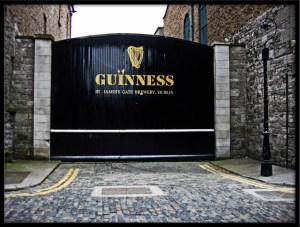
st-james-gate

On December 31, 1759, after leaving his younger brother in charge of a Leixlip brewery in County Kildare that he had leased in 1755, Arthur Guinness signs a 9,000-year lease for a brewery at St. James Gate at £45 per annum and starts brewing Guinness. It becomes the largest brewery in Ireland in 1838 and the largest in the world by 1886. Although no longer the largest brewery in the world, it is still the largest brewer of stout on the planet.

After ceasing to brew ale, on May 19, 1769 Guinness exported his beer for the first time, shipping six and one half barrels to England. Arthur Guinness started selling dark beer porter in 1778.

Arthur Guinness died in 1803 at the age of 78 and it was at this time that his son, Arthur Guinness II, took over the company. Arthur Guinness II passed away on June 9, 1855, and his third son, Sir Benjamin Lee Guinness, succeeded him. The trademark Guinness label was created and introduced in 1862. In 1868, Edward Cecil took over after his father’s death and under his leadership Guinness doubled in size.

Guinness trademarked their iconic harp in 1876. In 1923, the Irish government wanted to use a harp as their official logo and asked Guinness for permission. He denied their request so the harp of Ireland must always face in the opposite direction.

In October 1886, Guinness became the first brewery to be publicly traded on the London Stock Exchange and was averaging sales of 1,138,000 barrels a year.

In 1929, the first ever advertisement for Guinness was published in the British national press. By this year, Guinness was selling about 2 million pints per day, a large number considering the United States was in the throes of Prohibition.

Today, the Guinness family no longer owns or runs the company, but they remain a shareholder. The legacy and traditions of Arthur Guinness remain present in the company, married with modern technologies to account for the massive growth the company has seen over the past 250 years.

Guinness has expanded well beyond the original 4-acre lot and has consequently bought out the property, rendering the 9,000-year lease from 1759 redundant.


Leave a comment

The Easter Rising Centennial

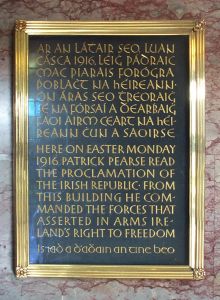
GPO_Easter_Rising_Plaque

I publish this site as we prepare to enter the year 2016, which will be an important year to Ireland and those of Irish heritage around the world. During the upcoming year, we mark the centennial of the Easter Rising of 1916 which began on Easter Monday, April 24, 1916, and lasted for six days.

Approximately 1,200 Volunteers and Citizen Army members, led by Patrick Pearse and James Connolly, took over strongpoints in Dublin with the General Post Office being their headquarters. The British army, which had vastly superior numbers and artillery, quickly suppressed the Rising. Pearse agreed to an unconditional surrender on Saturday, April 29, 1916.

Ninety people were sentenced to death in a series of courts martial, which began on May 2. Fifteen of those, including all seven signatories of the Proclamation, had their sentences confirmed by British General John Maxwell and were executed by firing squad at Kilmainham Gaol in Kilmainham, Dublin between May 3 and 12.

Although lasting but six days, the Rising succeeded in bringing physical force republicanism back to the forefront of Irish politics.

Annual commemorations, rather than taking place on April 24–29, are typically based on the date of Easter, which is a moveable feast. The official programme of centenary events in 2016 climaxes from March 26 (Good Friday) to April 3 (Easter Saturday) with other events earlier and later in the year taking place on the calendrical anniversaries.