seamus dubhghaill

Promoting Irish Culture and History from Little Rock, Arkansas, USA


13 Comments

Death of Robert Curtis, First Fatality of The Troubles

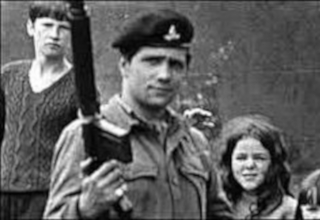
robert-curtisRobert George Curtis, officially the first military fatality during the Troubles in Northern Ireland, is killed by the Provisional Irish Republican Army (IRA) on February 6, 1971, becoming the first British soldier to die in the line of duty in Ireland since 1921. The gunman responsible is believed to be Provisional IRA member Billy Reid, who is killed later that year in a gunfight. A total of 705 British soldiers are killed during the Troubles.

156 (Inkerman) Battery, 94 Locating Regiment, Royal Artillery is deployed to Northern Ireland on January 5, 1971 under the command of the 32nd Regiment Royal Artillery. During the first week of February 1971, there is major violence in many Irish republican areas of Belfast when the British Army launches a series of searches for IRA arms. Rioting in the republican area of the New Lodge escalates and reinforcements are summoned. 156 Battery is ordered into the area. Because mobs of rioters are threatening the bordering unionist Tiger’s Bay area, the Battery is deployed along the interface to block them.

A large crowd gathers at the junction of New Lodge Road and Lepper Street. A troop of soldiers from 156 Battery, including Gunner Rob Curtis, are deployed to disperse the crowd. As the troops move to the junction they are attacked with a barrage of stones and bottles by the mob and deploy in “riot-formation” with shields as protection. Subsequently, a nail bomb is thrown at the troops. In the aftermath of the blast the crowd splits allowing a gunman to fire a long burst of automatic fire from a Sterling submachine gun, probably from the base of Templar House. The crowd then reforms, allowing the gunman to escape. Gunner Curtis is hit by a ricochet which passes through the shoulder opening of his flak jacket, penetrating his heart. He dies almost instantly. Four other troop members are wounded, one seriously.

Curtis is, at the time of his death, 20 years old and married for just over a year. His wife is expecting their first child and had just informed him in a letter that he was to become a father. He is laid to rest in West Road Cemetery, Newcastle upon Tyne, England. He is the first officially recognised fatality that the army suffers as a direct result of IRA actions. Unofficially 21 other military personnel died or were killed before his death. On the morning after his death Sir James Chichester-Clark, then Prime Minister of Northern Ireland, announces that “Northern Ireland is at war with the Irish Republican Army Provisionals.”

Some sources claim the shots were fired from a Thompson submachine gun, but some eyewitnesses are sure that it was a Sterling submachine gun that was fired. Curtis’s wife is later compensated to the sum of £6500 together with £1500 for her daughter. His daughter is married wearing her father’s wedding ring and later names her son Robert in honour of his grandfather.


Leave a comment

Sean Graham Bookmaker’s Shop Shooting

sean-graham-bookmakers-shop

A mass shooting takes place at the Sean Graham bookmaker‘s shop on the Lower Ormeau Road in Belfast, Northern Ireland on February 5, 1992. Members of the Ulster Defence Association (UDA), a loyalist paramilitary group, open fire on the customers, killing five civilians and wounding another nine. The shop is in an Irish nationalist area, and all of the victims are local Catholic civilians. The UDA claims responsibility using the cover name “Ulster Freedom Fighters”, and says the shooting is retaliation for the Teebane bombing, which had been carried out by the Provisional Irish Republican Army (IRA) less than three weeks earlier.

The start of 1992 witnesses an intensification in the campaign of violence being carried out by the Ulster Defence Association (UDA) under their UFF covername. However, the Inner Council of the UDA, which contains the six brigadiers that control the organisation, feel that one-off killings are not sending a strong enough message to republicans and so it sanctions a higher-profile attack in which a number of people will be killed at once. On this basis the go-ahead is given to attack Sean Graham bookmaker’s shop on the Irish nationalist Lower Ormeau Road, which is near the UDA stronghold of Annadale Flats. The bookmaker’s shop is chosen by West Belfast Brigadier and Inner Council member Johnny Adair because he has strong personal ties with the commanders of the Annadale UDA. A 1993 report commissioned by the Royal Ulster Constabulary (RUC) Special Branch also claims that Adair is the driving force behind the attack.

The attack occurs at 2:20 in the afternoon. A car parks on University Avenue facing the bookmakers and two men, wearing boilersuits and balaclavas, leave the car and cross the Ormeau Road to the shop. One is armed with a vz.58 Czechoslovak assault rifle and the other with a 9mm pistol. They enter the shop and unleash a total of 44 shots on the fifteen customers. Five Catholic men and boys are killed and nine others are wounded, one critically.

In a separate incident, a unit of the Ulster Volunteer Force (UVF) travels to the area at the time of the attack with the intention of killing a local Sinn Féin activist based on intelligence they had received that he returns home about that time every day. The attack is abandoned, however, when the car carrying the UVF members is passed by speeding RUC vehicles and ambulances. The UVF members, who had already retrieved their weapons for the attack, are said to be livid with the UDA for not coordinating with them beforehand and effectively spoiling their chance to kill a leading local republican.

A UDA statement in the aftermath of the attack claims that the killings are justified as the Lower Ormeau is “one of the IRA’s most active areas.” The statement also includes the phrase “remember Teebane”, suggesting that the killings are in retaliation for the Teebane bombing in County Tyrone less than three weeks earlier. In that attack, the IRA had killed eight Protestant men who were repairing a British Army base. The same statement had also been yelled by the gunmen as they ran from the betting shop.

On February 5, 2002 a plaque is erected on the side of the bookmaker’s shop in Hatfield Street carrying the names of the five victims and the Irish language inscription Go ndéana Dia trócaire ar a n-anamacha (“May God have mercy on their souls”). A small memorial garden is later added. The unveiling ceremony, which takes place on the tenth anniversary of the attack, is accompanied by a two-minute silence and is attended by relatives of the dead and survivors of the attack. A new memorial stone is laid on February 5, 2012 to coincide with the publication of a booklet calling for justice for the killings.


Leave a comment

Founding of the Irish National Army

irish-national-army-cap-badge

The first regiment of the Irish National Army, sometimes unofficially referred to as the Free State army or the Regulars, is set up in Dublin on January 31, 1922.

The National Army is the army of the Irish Free State from January 1922 until October 1924. Its role in this period is defined by its service in the Irish Civil War, in defence of the institutions established by the Anglo-Irish Treaty. Michael Collins is the army’s first chief of staff from its establishment until his death in an ambush at Béal na mBláth on August 22, 1922.

The National Army is constituted from the revolutionary Irish Republican Army (IRA), which emerges from the successful Irish War of Independence fought as a guerrilla campaign against the British Army and Royal Irish Constabulary. Its first troops are those IRA volunteers who support the Anglo-Irish Treaty and the Provisional Government of Ireland formed there under. The army makes its first public appearance on January 31, 1922, when command of Beggars Bush Barracks is handed over from the British Army.

Conflict arises between the National Army and the anti-Treaty components of the IRA, which does not support the government of the Irish Free State. On June 28, 1922, the National Army commences an artillery bombardment of anti-Treaty IRA forces who are occupying the Four Courts in Dublin, thus beginning the Irish Civil War.

The National Army is greatly expanded in size to fight the civil war against the anti-Treaty IRA, in a mostly counter-insurgency campaign that is brought to a successful conclusion in May 1923. From October 1, 1924, the Army is reorganised into a smaller, better regulated force. The term “National Army” is superseded by the legal establishment of the Defence Forces as the Irish Free State’s military force.


Leave a comment

Birth of Provisional IRA Member Seán Savage

sean-savage

Seán Savage, Provisional Irish Republican Army member who is shot dead by the British Army while attempting to plant a car bomb in Gibraltar, is born in Belfast on January 26, 1965.

Born into an Irish Republican family in the Kashmir area of Belfast, Savage is educated at St. Gall’s Primary School, and at St. Paul’s Secondary School in the Falls Road area of West Belfast.

In 1987 Savage and Daniel McCann shoot and kill two Royal Ulster Constabulary officers at Belfast docks. He is also the leader of an IRA attack that places a car bomb beneath the car of John McMichael, an Ulster loyalist paramilitary, in Lisburn in December 1987. McMichael dies of his injuries two hours after the blast.

In March 1988, Savage and McCann, along with another Provisional IRA member, Mairéad Farrell, are sent to the British overseas territory of Gibraltar to plant a bomb in the town area targeting a British Army band which parades weekly in front of The Convent, the official Governors’ residence. However, the British Government acquires information about the intended attack and specially dispatches a British Army detachment there to intercept it, in an operation that it code-names Operation Flavius.

On March 6, 1988 Savage, McCann and Farrell enter Gibraltar from across the Spanish border to carry out a reconnaissance of the target. Having conducted it, they are leaving Gibraltar on foot approaching the Spanish border in two separate parties, when Savage sees McCann and Farrell up ahead being confronted and shot dead by soldiers from the Special Air Service regiment. He turns around and flees, running back into Gibraltar town, closely pursued on foot by another SAS soldier. After a 300-yard chase the soldier catches up with Savage and shoots him dead beneath a beech tree in Smith Dorrien Avenue. Civilian witnesses to the incident state afterwards that Savage is repeatedly fired upon by the soldier that had run him down while he is lying on the ground seemingly incapacitated.

The IRA team is subsequently found to be unarmed at the time of their deaths. A hire car rented by them, converted into a car bomb containing 140 lbs. of Semtex, with a device timed to go off during the changing of the guard ceremony in Gibraltar, is found two days later by the Spanish Police, who had assisted the British Government in tracking the IRA team’s movements in its territory before it had entered Gibraltar.

The bodies of Savage, Farrell and McCann are repatriated to Northern Ireland, where a collective IRA-sponsored funeral is held for them on March 16, 1988 at the IRA plot in Milltown Cemetery in West Belfast. As the coffins are being lowered into the ground Michael Stone, an Ulster loyalist paramilitary, stages a single-handed attack upon the ceremony, throwing grenades and firing a handgun at mourners. The funeral immediately descends into chaos. One group of mourners pursues the retreating attacker, who continues to throw grenades and fire bullets, through the cemetery grounds. Three of the unarmed mourners are killed and scores are injured. Stone retreats onto the adjoining M1 motorway, where he is arrested.

A Gibraltar inquest into the deaths of Savage, McCann and Farrell concludes the three had been lawfully killed. In 1995, the European Court of Human Rights rules that the human rights of the three were infringed, and criticizes the British authorities for lack of control in the arrest operation. They also rule that the three had been engaged in an act of terrorism, and consequently dismissed unanimously the applicants’ claims for damages, for costs and expenses incurred in the Gibraltar Inquest and the remainder of the claims for just satisfaction.

A British television documentary, Death on the Rock (1988), is produced and broadcast about the failed IRA operation in Gibraltar, examining the details of the events, and raising doubts about aspects of the British Government’s statements about the circumstances of the shootings of the IRA team, and questioning whether excessive force had been used in the confrontation in line with persistent rumours in the British media at that time of a “Shoot to Kill” strategy being used against the Provisional IRA by the British Government.


Leave a comment

Birth of Tomás Mac Giolla, Irish Workers’ Party Politician

tomas-mac-giolla

Tomás Mac Giolla, Workers’ Party of Ireland politician who serves as Lord Mayor of Dublin from 1993 to 1994, leader of the Workers’ Party from 1962 to 1988 and leader of Sinn Féin from 1962 to 1970, is born Thomas Gill in Nenagh, County Tipperary on January 25, 1924. He serves as a Teachta Dála (TD) for the Dublin West constituency from 1982 to 1992.

Mac Giolla’s uncle T. P. Gill is a Member of Parliament (MP) and member of the Irish Parliamentary Party (IPP) of Charles Stewart Parnell. His father, Robert Paul Gill, an engineer and architect, also stands unsuccessfully for election on a number of occasions. His mother is Mary Hourigan.

Mac Giolla is educated at the local national school in Nenagh before completing his secondary education at St. Flannan’s College in Ennis, County Clare. It is while at St. Flannan’s that he changes to using the Irish language version of his name. He wins a scholarship to University College Dublin where he qualifies with a Bachelor of Arts degree, followed by a degree in Commerce.

A qualified accountant, Mac Giolla is employed by the Irish Electricity Supply Board (ESB) from 1947 until he goes into full-time politics in 1977.

In his early life Mac Giolla is an active republican. He joins Sinn Féin and the Irish Republican Army (IRA) around 1950. He is interned by the Government of Ireland during the 1956–1962 IRA border campaign. He also serves a number of prison sentences in Mountjoy Prison in Dublin.

At the 1961 Irish general election, Mac Giolla unsuccessfully contests the Tipperary North constituency for Sinn Féin. In 1962, he becomes President of Sinn Féin and is one of the people who moves the party to the left during the 1960s. In 1969, Sinn Féin splits, and he remains leader of Official Sinn Féin. It is also in 1962 that he marries May McLoughlin who is also an active member of Sinn Féin as well as Cumann na mBan, the women’s section of the IRA. In 1977, the party changes its name to Sinn Féin the Workers Party and in 1982 it becomes simply the Workers’ Party.

Mac Giolla is elected to Dublin City Council representing the Ballyfermot local electoral area in 1979 and at every subsequent local election until he retires from the council in 1997. In the November 1982 Irish general election, he is elected to Dáil Éireann for his party. In 1988, he steps down as party leader and is succeeded by Proinsias De Rossa. He serves as Lord Mayor of Dublin from 1993 to 1994 and remains a member of Dublin Corporation until 1998.

While president Mac Giolla is regarded as a mediator between the Marxist-Leninist wing headed by Sean Garland and the social democratic wing of Prionsias De Rossa. At the 1992 special Ardfheis he votes for the motion to abandon democratic centralism and to re-constitute the party much as the Italian Communist Party became the Democratic Party of the Left. However, the motion fails to reach the required two-thirds majority. Following the departure of six Workers’ Party TDs led by De Rossa to form the new Democratic Left party in 1992, Mac Giolla is the sole member of the Workers’ Party in the Dáil. He loses his Dáil seat at the 1992 Irish general election by a margin of just 59 votes to Liam Lawlor of Fianna Fáil.

In 1999, Mac Giolla writes to the chairman of the Flood Tribunal calling for an investigation into revelations that former Dublin Assistant City and County Manager George Redmond had been the official supervisor at the election count in Dublin West and was a close associate of Liam Lawlor. In 2003, Redmond is convicted of corruption by a Dublin court but subsequently has his conviction quashed due to conflicting evidence.

In his eighties Mac Giolla continues to be active and is a member of the group which campaigns to prevent the demolition of No. 16 Moore Street in Dublin city centre, where the surrender after the Easter Rising was completed. He also serves on the Dublin ’98 committee to commemorate the 200th anniversary of the Irish Rebellion of 1798.

Tomás Mac Giolla dies in Beaumont Hospital in Beaumont, Dublin on February 4, 2010, after a long illness.


Leave a comment

The Irish Republican Army S-Plan

s-plan-coventry-attack

The S-Plan or Sabotage Campaign or England Campaign, an Irish Republican Army (IRA) campaign of bombing and sabotage against the civil, economic, and military infrastructure of the United Kingdom, begins on January 16, 1939, and lasts until March 1940. The campaign is conceived by Seamus O’Donovan in 1938 at the request of then IRA Chief of Staff Seán Russell. It is believed that Russell and Joseph McGarrity devised the strategy in 1936.

The S-Plan contains many precise instructions for acts of destruction which have as their object the paralysis of all official activity in England and the greatest possible destruction of British defence installations. It divides the IRA campaign into two main lines: propaganda and offensive (military) action.

Operations are strictly concentrated on the island of Britain, in and around centres of population where IRA volunteers can operate freely without drawing attention. No attacks on targets in Northern Ireland or other areas under British control are planned as part of the S-Plan.

Sources of funding for the campaign are not known, but once the campaign is operational, the weekly expenses for operations in the field amount to approximately £700. Operational units are expected to raise any money needed themselves, and the men who act within IRA teams are unpaid and expected to support themselves while on missions.

On January 12, 1939, the IRA Army Council sends an ultimatum, signed by Patrick Fleming, to British Foreign Secretary Lord Halifax. The communiqué duly informs the British government of “The Government of the Irish Republic’s” intention to go to “war.”

On Sunday, January 15, with no reply from the British Government, a proclamation is posted in public places throughout Ireland announcing the IRA’s declaration of war on Britain. This proclamation is written by Joseph McGarrity, leader of Clan na Gael in the United States, and is signed by six members of the Army Council – Stephen Hayes, Patrick Fleming, Peadar O’Flaherty, George Oliver Plunkett, Larry Grogan and Seán Russell.

The five deaths during the Coventry bombing on August 25, 1939, effectively ends the campaign. By late 1940 the introduction of the Treason Act 1939 and the Offences Against the State Act 1939 in Ireland, and the Prevention of Violence (Temporary Provisions) Act in Britain lead to many IRA members interned in Ireland, arrested in Britain, or deported from Britain. The granting of extra powers to the Irish Justice Minister under the Emergency Powers Act in January 1940 leads to 600 IRA volunteers being imprisoned and 500 interned during the course of World War II alone.

The final figures resulting from the S-Plan are cited as 300 explosions, ten deaths and 96 injuries.

(Pictured: The aftermath of an IRA bike bomb in Coventry on August 25, 1939)


Leave a comment

Birth of Liam Quinn, Former PIRA Volunteer

liam-quinn-sf-examiner

William Joseph Quinn, known as Liam Quinn, is born in San Francisco, California on January 9, 1949. He is a former volunteer in the Provisional Irish Republican Army who killed off-duty London Metropolitan Police Constable Stephen Tibble at Charleville Road, Barons Court, London on February 26, 1975.

Tibble sees Quinn fleeing from the police after he has been noticed acting suspiciously near a house in which Quinn and fellow members of the Balcombe Street Gang are later found to have been preparing bombs. Tibble chases Quinn on his motorbike and, while attempting to stop him, is fatally shot twice in the chest.

Quinn escapes to Dublin in the aftermath of the shooting and serves a short prison sentence after his arrest for assaulting a police officer there. After his release in 1978 he returns to his hometown of San Francisco but is arrested in 1981 and later extradited to England in February 1988 where he is convicted of murder and jailed for life with a recommended minimum term of 35 years.

Quinn serves eleven years before he is released in April 1999, aged 51, along with the rest of the Balcombe Street Gang, under the terms of the Good Friday Agreement. While with the IRA, Quinn adopts an Irish accent and is tagged with the nickname “Yankee Joe” because of his American origins.


2 Comments

Annie’s Bar Massacre

annies-bar-memorial

The Annie’s Bar massacre, a mass shooting incident in Derry‘s Top of the Hill, takes place on December 20, 1972, during the height of the Northern Ireland Troubles. The bar is located in a small Catholic enclave of the majority Protestant Waterside area of Derry. Five civilians are shot dead by Loyalist paramilitaries from a unit of the Ulster Freedom Fighters (UFF) which is a part of the Ulster Defence Association (UDA). The shooting is also known as the “Top of the Hill bar shooting.”

The UDA is formed in September 1971 during one of the most violent phases of The Troubles right after internment without trial is introduced when a number of Loyalist Defense groups combine together. They form a paramilitary wing, the UFF, in 1972 so the organisation can use the UFF name to carry out violent acts and kill people while keeping the UDA name legal by not involving the UDA name with attacks.

The UDA/UFF claim to be combating the Provisional Irish Republican Army (IRA) but approximately 85% of its victims are innocent Catholic civilians. The UDA carries out its first killing on April 20, 1972, when they shoot dead taxi driver Gerard Donnelly in Ardoyne, Belfast. In October, the group is responsible for the deaths of two small girls when they detonate a car bomb outside an Irish nationalist pub in Sailortown, Belfast. The girls killed are Clare Hughes, age 4, and Paula Strong, age 6.

On December 20, 1972, along the Strabane Old Road, Annie’s Bar is packed with customers watching a football match. At about 10:30 PM two men from the UDA burst into the bar, one of them carrying a Sterling submachine gun and the other holding a pistol. Both are wearing hoods to disguise their identities. The men instantly and indiscriminately spray the main room in the bar with bullets. The attack is reported to have lasted less than a minute, but it still manages to leave five people dead, and four others wounded. Those killed in the attack are all males and include, Charlie McCafferty (31), Frank McCarron (58), Charles Moore (31), Barney Kelly (26) and Michael McGinley (37). At the time this is the largest and most deadly attack carried out by the UDA. They do not carry out another attack of this size until February 1992, when they shoot dead five civilians and injure nine in the Sean Graham bookmakers’ shooting on the Ormeau Road in Belfast.

The year 1972 in Derry begins with the Bloody Sunday shooting which occurs in the Bogside area and ends with the Annie’s Bar shooting. Nobody is ever charged in connection with the Annie’s Bar murders, although in recent years relatives of those murdered have been calling for a fresh investigation to take place.

The attack is carried out by members from the UDA’s “North Antrim & Londonderry Brigade.” Although this is one of the UDA’s smaller brigades it also carries out the October 1993 Greysteel massacre which is the UDA’s worst ever attack, in which eight people are killed and 19 others are injured. The Greysteel shooting happens about 9-10 miles away from Annie’s Bar.

(Pictured: Annie’s Bar Memorial stone located at Strabane Old Road, Top of the Hill, Waterside, Derry, County Derry, Northern Ireland. Annie’s Bar is in the background. Photo taken by Martin Melaugh, November 20, 2008.)


Leave a comment

The Curragh Camp Executions

1922-curragh-executions-monument

Seven Republican fighters, all from County Kildare, are executed in the Glasshouse in the Curragh Camp on December 19, 1922. The Glasshouse is a small stone and brick military prison where the military usually houses their own prisoners. It consists of two floors enclosed within a twelve foot high walled enclosure with cells for 64 prisoners. During the Irish Civil War, and afterwards, it is used as a punishment block for Republican prisoners.

The seven, Patrick Bagnall, Patrick Mangan, Joseph Johnston, Bryan Moore, Patrick Nolan, Stephen White and James O’ Connor, are all veteran Irish Republican Army (IRA) men and belong to a column of ten which operates against railways, goods trains and some shops in the vicinity of Kildare. Five of them are involved in the derailment of engines at Cherryville on December 11 when they make a serious attempt to dislocate the whole railway service on the Great Southern and Western Railway. Two engines are taken out of a shed at Kildare and sent down the line by Cherryville. One engine runs out of steam and does no harm, while the other overturns and blocks the line for a considerable time.

The column is also responsible for an ambush on National troops at the Curragh Siding on November 23 when a large party of troops are returning to Dublin after escorting prisoners to the Curragh Camp. On their return journey the troops are fired on at the Curragh Siding and two are wounded. In the confusion a policeman is accidentally shot by a National soldier.

The seven, along with Commandant Thomas Behan, are found in a dug-out at Mooresbridge, on the edge of the Curragh, on the night of December 13. They are under the command of Commandant Bryan Moore, a veteran IRA officer, and comprise a section of the 6th Battalion Column. They are armed with rifles bought from a soldier stationed in Naas Barracks.

When they surrender, Behan is struck with a rifle butt, breaking his arm. When the captives are ordered into the back of a truck he cannot climb aboard because of his arm. He is struck again on the head with a rifle butt and dies at the scene.

The remaining seven men are charged before a Military Committee with being in possession, without proper authority, of ten rifles, 200 rounds of ammunition, four bomb detonators and one exploder. They are found guilty and sentenced to death. Father Donnelly, chaplain to the troops, administers to the seven volunteers before their executions. They are executed one by one by firing squad on the morning of December 19 and are buried in the yard adjacent to the Glasshouse.


Leave a comment

The Balcombe Street Siege Ends

balcombe-street-siege

The six-day Balcombe Street siege in London ends peacefully on December 12, 1975, after four Provisional Irish Republican Army (IRA) gunmen free their two hostages and give themselves up to the Metropolitan Police Service (MPS).

In 1974 and 1975, London is subjected to a 14-month campaign of gun and bomb attacks by the Provisional IRA. Some 40 bombs explode in London, killing 35 people and injuring many more. The four members of what becomes known as the “Balcombe Street gang,” Joe O’Connell, Edward Butler, Harry Duggan and Hugh Doherty, are part of a six-man IRA Active Service Unit (ASU) that also includes Brendan Dowd and Liam Quinn.

The Balcombe Street siege starts after a chase through London, as the MPS pursues Doherty, O’Connell, Butler and Duggan through the streets after they had fired gunshots through the window of Scott’s restaurant in Mount Street, Mayfair. The four IRA men ultimately run into a block of council flats in Balcombe Street, adjacent to Marylebone station, triggering the six-day standoff.

The four men go to 22b Balcombe Street in Marylebone, taking its two residents, middle-aged married couple John and Sheila Matthews, hostage in their front room. The men declare that they are members of the IRA and demand a plane to fly both them and their hostages to Ireland. Scotland Yard refuses, creating a six-day standoff between the men and the police. Peter Imbert, later Commissioner of the Metropolitan Police Service, is the chief police negotiator.

The men surrender after several days of intense negotiations between Metropolitan Police Bomb squad officers, Detective Superintendent Peter Imbert and Detective Chief Superintendent Jim Nevill, and the unit’s leader Joe O’Connell, who goes by the name of “Tom.” The other members of the gang are named “Mick” and “Paddy,” thereby avoiding revealing to the negotiators precisely how many of them are in the living room of the flat. The resolution of the siege is a result of the combined psychological pressure exerted on the gang by Imbert and the deprivation tactics used on the four men. The officers also use carefully crafted misinformation, through the BBC Radio news to further destabilise the gang into surrender. A news broadcast states that the British Special Air Service are going to be sent in to storm the building and release the hostages. This seems to deter the gang and they eventually give themselves up to the police.

The four are found guilty at their Old Bailey trial in 1977 of seven murders, conspiring to cause explosions, and falsely imprisoning John and Sheila Matthews during the siege. O’Connell, Butler and Duggan each receive 12 life sentences, and Doherty receives 11. Each of the men is later given a whole life tariff, the only IRA prisoners to receive this tariff. During the trial they instruct their lawyers to “draw attention to the fact that four totally innocent people were serving massive sentences” for three bombings in Woolwich and Guildford. Despite telling the police that they are responsible, they are never charged with these offences and the Guildford Four and Maguire Seven remain in prison for 15 more years, until it is ruled that their convictions are unsafe.

After serving 23 years in English prisons, the four men are transferred to the high security wing of Portlaoise Prison, County Laois, in early 1998. They are presented by Gerry Adams to the 1998 Sinn Féin Ardfheis as “our Nelson Mandelas,” and are released together with Brendan Dowd and Liam Quinn in 1999 as part of the Good Friday Agreement.