seamus dubhghaill

Promoting Irish Culture and History from Little Rock, Arkansas, USA


Leave a comment

Death of Charles Stewart Parnell

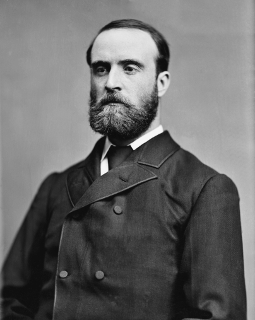
charles-stewart-parnell

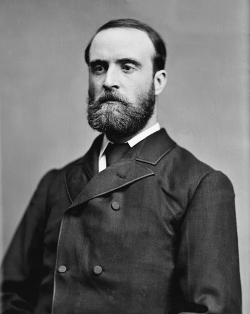
Charles Stewart Parnell, Irish nationalist politician and one of the most powerful figures in the British House of Commons in the 1880s, dies of pneumonia at age 45 in Hove, East Sussex, England on October 6, 1891.

Born into a wealthy and powerful Anglo-Irish Protestant landowning family in County Wicklow on June 27, 1846, Parnell enters the House of Commons in 1875. He is a land reform agitator and becomes leader of the Home Rule League in 1880, insisting on operating independently of the Liberals, and winning great influence by his balancing of constitutional, radical, and economic issues, and by his skillful use of parliamentary procedure. He is imprisoned in Kilmainham Gaol in 1882 but, being a very capable negotiator, is released when he renounces violent extra-Parliamentary action in an informal agreement, the Kilmainham Treaty, with British Prime Minister William Ewart Gladstone. That same year he reforms the Home Rule League as the Irish Parliamentary Party, which he controls minutely as Britain’s first disciplined democratic party.

The hung Parliament of 1885 sees him hold the balance of power between Gladstone’s Liberals and Robert Gascoyne-Cecil, 3rd Marquess of Salisbury‘s Conservatives. His power is one factor in Gladstone’s adoption of Home Rule as the central tenet of the Liberal Party. His reputation peaks in 1889-1890 when letters published in The Times linking him to the Phoenix Park murders of 1882 are shown to have been forged by Richard Pigott. However, the Irish Parliamentary Party splits in 1890 after the revelation of Parnell’s long adulterous love affair, causing many English Liberals, many of them nonconformists, to refuse to work with him, and strong opposition from Catholic bishops. He heads a small minority faction until his death in 1891.

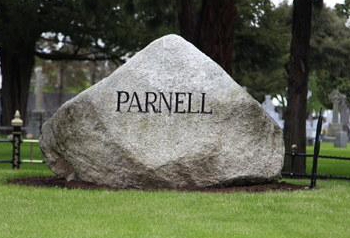
parnell-marker

In describing Parnell, Gladstone says, “I do not say the ablest man; I say the most remarkable and the most interesting. He was an intellectual phenomenon.” Liberal leader H. H. Asquith calls him as one of the three or four greatest men of the 19th century, while Richard Haldane, 1st Viscount Haldane describes him as the strongest man the House of Commons has seen in 150 years. Historian A.J.P. Taylor says, “More than any other man he gave Ireland the sense of being an independent nation.”

Charles Stewart Parnell dies of pneumonia at age 45 in his home at 10 Walsingham Terrace, Hove, England on October 6, 1891, in the arms of his wife Katharine. Though an Anglican, his funeral on October 11 is at the Irish National nondenominational Glasnevin Cemetery in Dublin and is attended by more than 200,000 people. His notability is such that his gravestone of unhewn Wicklow granite, erected in 1940, reads only “Parnell.”


Leave a comment

Death of Kathleen Clarke, Founder of Cumann na mBan

kathleen-clarke

Kathleen Clarke (née Daly), a founder member of Cumann na mBan, and one of very few privy to the plans of the Easter Rising in 1916, dies in Dublin on September 29, 1972. She is the wife of Tom Clarke and sister of Edward “Ned” Daly, both of whom are executed for their part in the Rising. She is subsequently a Teachta Dála (TD) and senator with both Sinn Féin and Fianna Fáil, and the first female Lord Mayor of Dublin (1939–41).

Kathleen Daly is born into a prominent Fenian family in Limerick on April 11, 1878, the third daughter of Edward and Catherine Daly. Her paternal uncle, John Daly, is at the time imprisoned for his political activities in Chatham and Portland Prisons in England. He is released in 1896 and returns home to Limerick. When Tom Clarke, who had been imprisoned with her uncle, is released in 1898 he travels to Limerick to receive the Freedom of the City and stays with the Daly family.

In 1901 Daly decides to emigrate to the United States to join Tom, who had been there since 1900, having secured work through his Fenian contacts. They marry on July 16, 1901, in New York City. Through his contacts in the Clan na Gael and the Irish Republican Brotherhood (IRB), Tom Clarke continues to be involved in nationalist activity. Kathleen joins the Gaelic League while in the United States and they return to Ireland in November 1907.

In 1914 Clarke becomes a founder member of Cumann na mBan. Her husband forbids her permission to take an active part in the 1916 Easter Rising as she has orders regardless of how the events pan out. As Tom Clarke is the first signatory of the Proclamation of the Irish Republic, he is chosen to be executed for his part in the Easter Rising. Her younger brother, Ned Daly, is also executed for taking part in the rising. She visits both of them before they are executed. After the Rising, Michael Collins establishes contact with her while in prison in his attempts to re-build the IRB network. She also sets up the Irish National Aid Fund to aid those who had family members killed or imprisoned as a result of the Easter Rising, closely aided by Sorcha MacMahon.

Clarke becomes a member of Sinn Féin and in 1917 is elected a member of the party’s Executive. During the German Plot she is arrested and imprisoned in Holloway Prison for eleven months. During the Irish War of Independence, she serves as a District Judge on the Republican Courts in Dublin. In 1919 she is elected as an Alderman for the Wood Quay and Mountjoy Wards of Dublin Corporation and serves until the Corporation is abolished in 1925.

Clarke is elected unopposed as a Sinn Féin TD to the Second Dáil at the 1921 elections for the Dublin Mid constituency. She is not re-elected at the 1922 Irish general election, however, and supports the Anti-Treaty forces during the Irish Civil War. In 1926 she becomes a founder member of Fianna Fáil and has to resign from Cumann na mBan. She is re-elected to the short-lived 5th Dáil at the June 1927 Irish general election as a Fianna Fáil member for the Dublin Mid constituency but loses her seat at the September 1927 Irish general election and does not regain it. She is elected as one of six Fianna Fáil Senators to the Free State Seanad for nine years at the 1928 Seanad election under the leadership of Joseph Connolly. She remains a member of the Seanad until it is abolished in 1936.

In 1930 Clarke is elected to the re-constituted Dublin Corporation for Fianna Fáil along with Robert Briscoe, Seán T. O’Kelly, Thomas Kelly and Oscar Traynor. She serves as the first Fianna Fáil Lord Mayor of Dublin as well as the first female Lord Mayor, from 1939 to 1941. She opposes the Constitution of Ireland as she feels that several of its sections would place women in a lower position that they had been afforded in the Proclamation of the Irish Republic. She is criticised by many in the Fianna Fáil organisation as a result and, while she resigns from the Thomas Clarke Cumann, she remains a member of the Fianna Fáil Ard Chomhairle.

While Clarke does not support the Irish Republican Army (IRA) bombing in England during World War II, she appeals for those sentenced to death by the Irish Government to be given clemency. Ultimately this leads to her breaking with the party completely after her term as Lord Mayor finishes in 1941. She declines to stand as a Fianna Fáil candidate at the 1943 Irish general election.

In 1966, as part of the celebrations of the Easter Rising, Clarke and other surviving relatives are awarded honorary Doctor of Law by the National University of Ireland. Following her death on September 29, 1972, she receives the rare honour of a state funeral. She is buried at Deans Grange Cemetery, Dublin.


Leave a comment

Charles Stewart Parnell’s Last Public Appearance

charles-stewart-parnell

Charles Stewart Parnell makes his last public appearance at Creggs, County Galway on September 27, 1891.

After the split caused by the controversy over his relationship with Katharine O’Shea, Parnell tours the country seeking support. Already ill, his last public meeting is in Creggs, where he attacks his critics at length during heavy rain. He returns to his home in England and dies just over a week later, on October 6, at the age of 45.

Parnell, who is accompanied by J. P. Quinn, travels overnight from Dublin by the night mail train, is seen off by a considerable crowd at the Broadstone terminus and to them he makes a brief speech, expressing the hope that those who listen will give all support in their power to the new Nationalist paper it is intended to produce within a month. Parnell, who did not look at all well the previous night, wears his arm in a sling in consequence of his suffering from a severe attack of rheumatism.

When Parnell reaches Roscommon, he is met by a large crowd of people, who cheer him most enthusiastically. When he arrives at Mitchell’s Hotel, where he remains for the night, he is greeted with much enthusiasm, and, in response to repeated calls for a speech, he says a few words, explaining that on his arrival in Dublin he had been ordered by his doctor to go to bed and to remain there. But he disobeys those orders because of his desire to again meet with the men of Roscommon and Galway.

Parnell starts from Roscommon shortly after noon on September 27 and, in the company of Quinn and Luke Hayden, MP, travels to the meeting place in Creggs where he is met by a very large concourse of people. In fact, considering all the conditions of the district, its desolate character, and the smallness of the village, it is really surprising to find a gathering of between three and four thousand persons assembled.

As Parnell takes to the platform which is erected outside a pub in the village, sprinklings of rain begin to fall. Halfway through his speech the Heavens open and pour down upon the rally. Parnell, who is wearing light clothes and no hat, swats away an umbrella someone on the platform puts over him.

The crowd dwindles as the rain proves too hard to stand under, but Parnell perseveres and does not leave the platform until he has finished his entire speech. When he eventually finishes, he changes into dry clothes but finds such a mundane task difficult as his joints are so stiff and sore. He then joins twelve members of the organising committee for supper. Afterwards, on the train back to Dublin, he states how he regretted sitting at a table for thirteen as it is an extremely unlucky number.


Leave a comment

Death of U.S. President William McKinley

william-mckinley

William McKinley, the 25th President of the United States, dies on September 14, 1901, eight days after being shot by anarchist Leon Czolgozc and six months into his second term. McKinley leads the nation to victory in the Spanish American War, raises protective tariffs to promote American industry, and maintains the nation on the gold standard in a rejection of free silver.

McKinley is born on January 29, 1843, in Niles, Ohio, the seventh child of William McKinley Sr. and Nancy (née Allison) McKinley. The McKinleys are of English and Scots Irish descent and settled in western Pennsylvania in the 18th century, tracing back to a David McKinley who is born in Dervock, County Antrim, in present-day Northern Ireland.

McKinley is the last president to serve in the American Civil War and the only one to start the war as an enlisted soldier, beginning as a private in the Union Army and ending as a brevet major. After the war, he settles in Canton, Ohio, where he practices law and marries Ida Saxton. In 1876, he is elected to the United States Congress, where he becomes the Republican Party‘s expert on the protective tariff, which he promises will bring prosperity. His 1890 McKinley Tariff is highly controversial which, together with a Democratic redistricting aimed at gerrymandering him out of office, leads to his defeat in the Democratic landslide of 1890.

McKinley is elected Ohio’s governor in 1891 and 1893, steering a moderate course between capital and labor interests. With the aid of his close adviser Mark Hanna, he secures the Republican nomination for president in 1896, amid a deep economic depression. He defeats his Democratic rival, William Jennings Bryan, after a front porch campaign in which he advocates “sound money” and promises that high tariffs will restore prosperity.

Rapid economic growth marks McKinley’s presidency. He promotes the 1897 Dingley Act to protect manufacturers and factory workers from foreign competition, and in 1900, he secures the passage of the Gold Standard Act. He hopes to persuade Spain to grant independence to rebellious Cuba without conflict, but when negotiation fails, he leads the nation into the Spanish American War of 1898. The U.S. victory is quick and decisive. As part of the Treaty of Paris (1898), Spain turns over to the United States its main overseas colonies of Puerto Rico, Guam, and the Philippines. Cuba is promised independence, but at that time remains under the control of the U.S. Army. The United States annexes the independent Republic of Hawaii in 1898, and it became a U.S. territory.

Historians regard McKinley’s 1896 victory as a realigning election, in which the political stalemate of the post–Civil War era gives way to the Republican-dominated Fourth Party System, which begins with the Progressive Era.

McKinley defeats Bryan again in the 1900 presidential election, in a campaign focused on imperialism, protectionism, and free silver. However, his legacy is suddenly cut short when he is shot on September 6, 1901, by Leon Czolgosz, a second-generation Polish American with anarchist leanings. McKinley dies eight days later on September 14, 1901, and is succeeded by his Vice President, Theodore Roosevelt. He is buried at the McKinley National Memorial in Canton, Ohio.

As an innovator of American interventionism and pro-business sentiment, McKinley’s presidency is generally considered above average, though his highly positive public perception is soon overshadowed by Roosevelt.


2 Comments

Birth of Sir Lucius O’Brien, 3rd Baronet

lucius-obrien-3rd-baronet

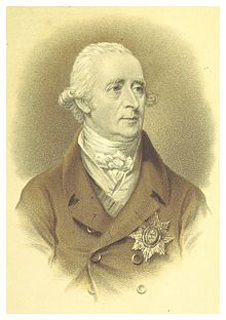
Sir Lucius Henry O’Brien, 3rd Baronet PC (Ire), Irish baronet and politician for 34 years, is born on September 2, 1731.

O’Brien is the son of Sir Edward O’Brien, 2nd Baronet and his wife Mary Hickman, inheriting the baronetcy upon the death of his father in 1765. He is educated at Trinity College, Dublin and enters the Middle Temple in 1753, later becoming a barrister.

In 1761, O’Brien enters the Irish House of Commons as the member for Ennis, sitting until 1768. Subsequently he successfully runs for Clare, a seat previously held by his father, holding it until 1776. He is then again elected for Ennis, but following the unseating of Hugh Dillon Massy as Member of Parliament for Clare, he returns to represent that constituency in 1778. In the election of 1783, he becomes the representative for Tuam. He is sworn of the Privy Council of Ireland in 1786. He serves for the latter constituency until 1790, when he is re-elected for Ennis. He holds this seat finally until his death on January 15, 1795.

O’Brien is elected a Fellow of the Royal Society in 1773.

O’Brien marries Anne French, the daughter of Robert French, in 1768 and has by her seven children, three sons and four daughters. He is succeeded in the baronetcy as well as in the constituency of Ennis by his oldest son Edward.

O’Brien’s grandson James FitzGerald (1818–1896) is a prominent politician in New Zealand.


Leave a comment

Birth of James Caulfeild, 1st Earl of Charlemont

james-caulfeild

James Caulfeild, 1st Earl of Charlemont, Irish statesman, soldier and nationalist, is born in Dublin on August 18, 1728.

Caulfeild, the son of the 3rd Viscount Charlemont, succeeds his father as 4th Viscount in 1734. The title of Charlemont descends from Sir Toby Caulfeild, 1st Baron Caulfeild (1565–1627) of Oxfordshire, England, who is given lands in Ireland, and creates Baron Charlemont (the name of a fort on the Blackwater), for his services to King James I in 1620. The 1st Viscount is the 5th Baron (d. 1671), who is advanced by Charles II.

Lord Charlemont is well known for his love of Classical art and culture and spends nine years on the Grand Tour in Italy, Greece, Turkey and Egypt. He returns to Dublin and employs the Scottish architect Sir William Chambers to remodel his main residence Marino House, to design his town house Charlemont House and the unique Neoclassical Garden pavilion building, the Casino at Marino.

Lord Charlemont is historically interesting for his political connection with Henry Flood and Henry Grattan. He is a cultivated man with literary and artistic tastes, and both in Dublin and in London he has considerable social influence. He is the first President of the Royal Irish Academy and is a member of the Royal Dublin Society. He is appointed Custos Rotulorum of County Armagh for life in 1760. For various early services in Ireland, he is made an earl in 1763, but he disregards court favours and cordially joins Grattan in 1780 in the assertion of Irish independence. In 1783 he is made a founding Knight of the Order of St. Patrick.

Lord Charlemont is president of the volunteer convention in Dublin in November 1783, having taken a leading part in the formation of the Irish Volunteers, and he is a strong opponent of the proposals for the Acts of Union 1800. His eldest son, who succeeds him, is subsequently created an English Baron in 1837.

Lord Charlemont dies on August 4, 1799.

(Pictured: Charlemont as painted by Pompeo Batoni, c. 1753-56)


2 Comments

Birth of Geoffrey Henry Cecil Bing, Barrister & Politician

geoffrey-henry-cecil-bing

Geoffrey Henry Cecil Bing, British barrister and politician who serves as the Labour Party Member of Parliament for Hornchurch from 1945 to 1955, is born on July 24, 1909, at Craigavad near Belfast in what is now Northern Ireland.

Bing is educated at Rockport School and Tonbridge School before going on to Lincoln College, Oxford, where he reads history. He graduates with a second-class degree in 1931, before attending Princeton University, where he is a Jane Eliza Procter Visiting Fellow between 1932 and 1933. He is called to the bar from the Inner Temple in 1934.

Always a radical and a member of the socialist left, Bing is active in the Haldane Society of Socialist Lawyers and the National Council for Civil Liberties. During the Spanish Civil War, he joins the International Brigades as a journalist, barely avoiding capture at Bilbao. He is also an early anti-Nazi.

During World War II, Bing serves in the Royal Corps of Signals, attaining the rank of major. A 1943 experiment with parachutes at the GSO2 Airborne Forces Development Centre leaves him disfigured and he bears the scars for many years.

At the 1945 general election, Bing stands for Labour in Hornchurch, winning the seat. He is re-elected in 1950 and 1951, serving until 1955. He serves briefly as a junior whip in 1945-1946 but this is widely thought to have been the unintended result of confusion on the part of Clement Attlee, who confuses him for another Labour MP of a similar name.

On the backbenches, Bing is, according to his Times obituary, “the unrestrained leader of a small group of radicals, never fully trusted by their colleagues and known as ‘Bing Boys.'” He takes a particular interest in the cases of Timothy Evans and John Christie, and he supports the campaign to overturn the conviction of Evans, which is ultimately successful. He supports Communist China and takes a keen interest in Northern Ireland, the brewers’ monopoly and parliamentary procedure.

Bing also builds a practice in West Africa. He becomes close to Kwame Nkrumah, the first post-colonial president of Ghana and is appointed Ghana’s attorney-general, a post he holds until 1961. When Nkrumah is ousted in 1966, Bing is arrested and ill-treated, before being sent home some months later. His memoir of Nkrumah’s Ghana, Reap the Whirlwind, is published in 1968.

Geoffrey Henry Cecil Bing dies in London on April 24, 1977, at the age of 67.


Leave a comment

Birth of Former Politician John Cushnahan

Portrait of MEP John Walls CUSHNAHAN

John Walls Cushnahan, former politician in both Northern Ireland and the Republic of Ireland, is born in Belfast, Northern Ireland on July 23, 1948. He serves as leader of the Alliance Party of Northern Ireland and then as a Member of the European Parliament for Fine Gael.

Cushnahan is educated at St. Mary’s Christian Brothers Grammar School and Queen’s University, Belfast and works as a teacher before going into politics. He works as General Secretary of the Alliance Party from 1974 until 1982 and is a member of Belfast City Council between 1977 and 1985.

In 1982 Cushnahan is elected to the Prior Assembly for North Down and two years later he becomes the new leader of Alliance, succeeding Oliver Napier. During his tenure as leader, he seeks to strengthen the party’s links with the British Liberal Party. The Anglo-Irish Agreement is signed during this period and Cushnahan faces the difficult position of giving Alliance support to it and facing the united opposition of the Unionist parties. However, when the Assembly is dissolved in 1986, Cushnahan finds it financially difficult to remain in politics and so stands down as leader in 1987 to be succeeded by John Alderdice.

Two years later Cushnahan makes a surprise political comeback when he moves to the Republic of Ireland and stands as a Fine Gael candidate in the 1989 election to the European Parliament, winning a seat in the Munster constituency. He is an MEP for fifteen years before retiring at the 2004 elections.

Cushnahan now serves as a board member of the peace and reconciliation charity Co-operation Ireland.


Leave a comment

Birth of Thomas Talbot, Canadian Soldier & Politician

thomas-talbot

Thomas Talbot, Irish-born Canadian soldier and politician, is born at Malahide Castle near Dublin on July 19, 1771. He is the fourth son of Richard Talbot and his wife Margaret Talbot, 1st Baroness Talbot of Malahide. Richard Talbot, 2nd Baron Talbot of Malahide and Sir John Talbot are his elder brothers.

Talbot receives a commission in the army as ensign before he is twelve years old, and is appointed at sixteen to aid his relative, the Lord Lieutenant of Ireland. He sees active service in Holland and at Gibraltar.

Talbot immigrates to Canada in 1791, where he becomes personal secretary to John Graves Simcoe, Lieutenant Governor of Upper Canada. After returning to England, Talbot convinces the government to allow him to implement a land settlement scheme along the shore of Lake Erie. His petition for 5,000 acres is granted in 1803. On May 21, 1803 he lands at a spot which has since been called Port Talbot and builds a log cabin. Nearby, he adds a sawmill, a cooper shop, a blacksmith shop, and a poultry house along with a barn. When settlers begin to arrive in 1809, Talbot adds a gristmill as well.

Here Talbot rules as an absolute, if erratic, potentate, doling out strips of land to people of his choosing, a group that emphatically does not include supporters of the American Revolution, liberals or anyone insufficiently respectful. For every settler he places on 50 acres of land, he receives an additional 200 acres for himself. One of the conditions attached to the free grant of 50 acres is the right to purchase an additional 150 acres at $3 each, and the promise of a road in front of each farm within three and a half years. The other condition is the building of a small house and the clearing and sowing of 10 acres of land.

The result of the road-making provision is that the settlement becomes noted for its good roads, especially for that named Talbot Road. By the late 1820s Talbot has organized the construction of a 300 mile long road linking the Detroit River and Lake Ontario as part of grand settlement enterprise in the south western peninsula. By 1820, all of the land originally allotted to Talbot has been taken up. From 1814 to 1837 he settles 50,000 people on 650,000 acres of land in the Thames River area. Many, if not most of the settlers, are American. He places about 20,000 immigrants on the Talbot settlement by 1826.

Because Talbot has done his work so well, the government places the southwestern part of the province under his charge. This affords him the opportunity of extending the Talbot road from the Long Point region to the Detroit River. In 1823, he decides to name the port after his friend Baron Edward Smith-Stanley, 14th Earl of Derby, whose son, Frederick Arthur Stanley eventually becomes Governor General of Canada and donates to the hockey world the elusive trophy, which still bears his name.

Talbot’s administration is regarded as despotic. He is infamous for registering settlers’ names on the local settlement map in pencil and if displeased is alleged to erase their entry. However, his insistence on provision of good roads, maintenance of the roads by the settlers, and the removal of Crown and clergy reserves from main roads quickly results in the Talbot Settlement becoming the most prosperous part of the province. Eventually, however, he begins to make political demands on the settlers, after which his power is reduced by the provincial government. His abuse of power is a contributing factor in the Upper Canada Rebellion of 1837.

Talbot dies in the home of George Macbeth at London, Ontario on February 5, 1853 and is interred in the cemetery of St. Peters Anglican Church near Tyrconnell, Ontario in Elgin County. Talbot’s home in Port Talbot, called Malahide, is demolished in 1997 generating much public outcry from heritage preservationists. Talbotville, a community in Southwold, Ontario, and the city of St. Thomas, Ontario are named after him, as well as Colonel Talbot Road and Talbot Street in both London and St. Thomas.


Leave a comment

Birth of William O’Dwyer, 100th Mayor of New York City

william-o-dwyer

William O’Dwyer, Irish American politician and diplomat who serves as the 100th Mayor of New York City, holding that office from 1946 to 1950, is born in Bohola, County Mayo on July 11, 1890.

O’Dwyer studies at St. Nathy’s College, Ballaghaderreen, County Roscommon. He emigrates to the United States in 1910, after abandoning studies for the priesthood. He sails to New York City as a steerage passenger on board the liner Philadelphia and is inspected at Ellis Island on June 27, 1910. He first works as a laborer, then as a New York City police officer, while studying law at night at Fordham University Law School. He receives his degree in 1923 and then builds a successful practice before serving as a Kings County (Brooklyn) Court judge. He wins election as the Kings County District Attorney in November 1939 and his prosecution of the organized crime syndicate known as Murder, Inc. makes him a national celebrity.

After losing the mayoral election to Fiorello La Guardia in 1941, O’Dwyer joins the United States Army for World War II, achieving the rank of brigadier general as a member of the Allied Commission for Italy and executive director of the War Refugee Board, for which he receives the Legion of Merit. During that time, he is on leave from his elected position as district attorney and replaced by his chief assistant, Thomas Cradock Hughes, and is re-elected in November 1943.

In 1945, O’Dwyer receives the support of Tammany Hall leader Edward V. Loughlin, wins the Democratic nomination, and then easily wins the mayoral election. He establishes the Office of City Construction Coordinator, appointing Park Commissioner Robert Moses to the post, works to have the permanent home of the United Nations located in Manhattan, presides over the first billion-dollar New York City budget, creates a traffic department and raises the subway fare from five cents to ten cents. In 1948, he receives The Hundred Year Association of New York‘s Gold Medal Award “in recognition of outstanding contributions to the City of New York.” In 1948, he receives the epithets “Whirling Willie” and “Flip-Flop Willie” from U.S. Representative Vito Marcantonio of the opposition American Labor Party while the latter is campaigning for Henry A. Wallace.

Shortly after his re-election to the mayoralty in 1949, O’Dwyer is confronted with a police corruption scandal uncovered by the Kings County District Attorney, Miles McDonald. O’Dwyer resigns from office on August 31, 1950. Upon his resignation, he is given a ticker tape parade up Broadway‘s Canyon of Heroes in the borough of Manhattan. President Harry Truman appoints him U.S. Ambassador to Mexico. He returns to New York City in 1951 to answer questions concerning his association with organized crime figures and the accusations follow him for the rest of his life. He resigns as ambassador on December 6, 1952, but remains in Mexico until 1960.

O’Dwyer visits Israel for 34 days in 1951 on behalf of his Jewish constituents. Along with New York’s Jewish community, he helps organize the first Israel Day Parade.

William O’Dwyer dies in New York City on November 24, 1964, in Beth Israel Hospital, aged 74, from heart failure. He is interred at Arlington National Cemetery, Section 2, Grave 889-A-RH.